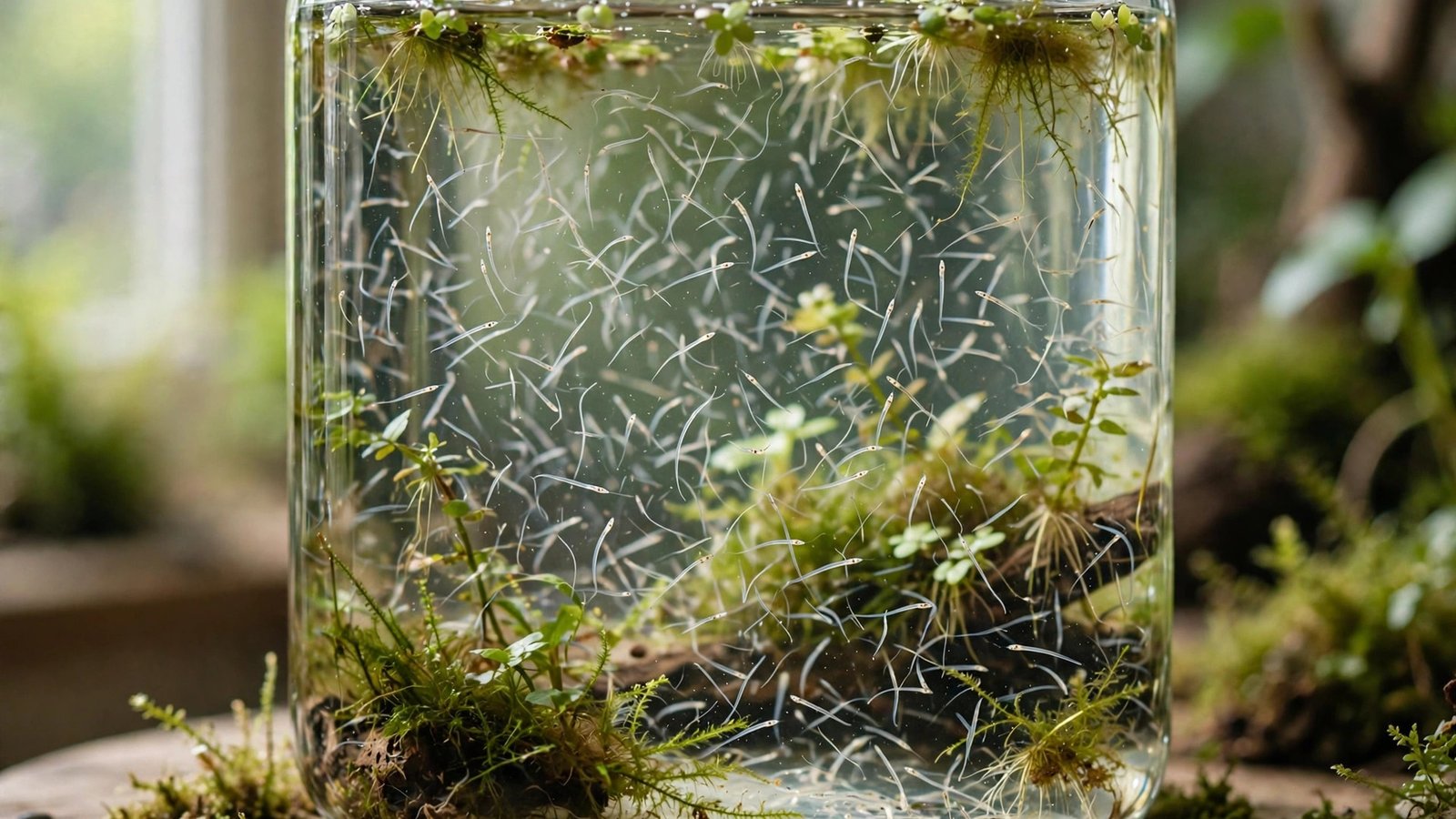
Most live fry foods demand daily babysitting: brine shrimp hatcheries need saltwater mixes and 24-hour schedules, and microworm cultures crash if you skip feeding them for a week. Vinegar eels ask for none of that. A vinegar eels culture is a jar of apple cider vinegar on a shelf that quietly breeds thousands of tiny worms for months, almost unattended. By the end of this guide you'll start a culture in under ten minutes, harvest clean eels with a simple filter-floss wick, and give newly hatched egg-layer fry an ideal first food for fry in a planted tank nursery.
Why vinegar eels punch above their weight
A fry's first week is the killer: newly free-swimming fry need food that fits a mouth barely wider than a pinhead, and it has to move — most egg-layer fry ignore still food for days. Vinegar eels solve this neatly: tiny, constantly wriggling nematodes that live for up to a week in the aquarium once added, drifting where fry hunt.
The practical advantage is maintenance. A brine shrimp hatchery is a daily operation; microworms demand feeding every few days or they sour. A vinegar eel bottle can be ignored for weeks and still be productive when a surprise spawn appears. Compare them with microworm cultures for aquarium fry and this DIY baby brine shrimp hatchery to weigh your options.
Starting your vinegar eels culture
You need exactly four things: a bottle or jar (a glass wine bottle or 500 ml mason jar is ideal), raw apple cider vinegar, a starter portion of live vinegar eels, and a few slices of apple. Get a vinegar eel starter culture from a fellow hobbyist, a fish club auction, or an online live-food seller — one small portion is enough.
- Rinse the bottle well — no soap residue.
- Fill it about half full with a 50/50 mix of apple cider vinegar and dechlorinated water.
- Drop in 3–4 thin apple slices to feed the bacteria and yeast the eels graze on.
- Pour in your starter culture.
- Cover the opening with a coffee filter or cloth secured by a rubber band — breathable, so gases exchange but fruit flies stay out.
- Set the bottle somewhere dark at room temperature, 20–27 °C (68–80 °F). Avoid direct sun and cold windowsills.
Then do nothing. Leave it alone for 2–4 weeks while the population builds. You'll know it's ready when you hold the bottle to a light and see a shimmering, slightly cloudy band of tiny threads wriggling near the surface. For a big spawn, start two or three bottles a week apart for rotation harvesting.
Feeding and maintaining the culture
Ongoing care is as close to zero as aquarium chores get. Top up the liquid if it evaporates, and replace the apple slices every 4–6 weeks when they go mushy. Around the six-month mark the medium turns noticeably cloudier and production tapers — that's your signal to restart: pour a few tablespoons of the old culture into a fresh bottle with new vinegar mix and apple slices, and it'll be harvestable again within 2–4 weeks. Skip soap entirely — rinse with hot water only. You never "feed" the eels: they graze continuously on the bacteria and yeast the vinegar and apple host.
Harvesting with a filter-floss wick
You want the worms without the vinegar. The filter-floss wick does this elegantly — the eels climb toward oxygen on their own:
- Let the bottle sit undisturbed for a couple of weeks so the population is dense.
- Stuff a loose wad of filter floss into the neck so its bottom sits in the vinegar.
- Gently pour dechlorinated fresh water into the neck above the floss.
- Wait 8–24 hours. Seeking oxygen, the eels migrate up through the floss into the clean water; the vinegar stays below.
- Draw up some of that fresh water with a fine-tipped pipette (a plastic pipette makes this effortless) and squirt it into the fry tank.
Harvest one bottle for several days, then rest it 4–5 days so the population rebounds; two or three bottles in rotation keep one always ready.
Vinegar eels vs. other first foods
| Food | Size | Daily effort | Position in tank | Culture lifespan |
|---|---|---|---|---|
| Vinegar eels | ~1–2 mm | Near zero | Water column, near surface | ~6 months, neglect-tolerant |
| Microworms | ~1–2 mm | Feed culture every few days | Sink to bottom within hours | Crashes if neglected |
| Baby brine shrimp | ~0.5 mm | Hatch a new batch daily | Swim freely | Each batch lasts ~24 h |
| Grindal worms | ~10 mm | Feed oatmeal daily | Bottom | Ongoing soil-box care |
A note on grindal worm culture for fry food: it's a different system entirely — worms raised in a moist soil or coconut-fiber box on oatmeal, better for larger fry. The two complement each other across a fry's growth stages.
The classic breeder's trio is vinegar eels for the first two weeks, then microworms or newly hatched brine shrimp as fry grow, and finally daphnia cultures for live fish food for free-swimming juveniles.
Which fry benefit most?
Vinegar eels shine with egg-layer fry that feed in mid-water during their first one to two weeks: killifish, most tetras, corydoras, angelfish, and bettas all take them eagerly. Because the eels hang near the surface, they're also handy for top-feeding species. Offer a small pipette squirt two to three times a day, only what the fry can finish in about 30 minutes, and siphon out uneaten food daily to keep the nursery water pristine.
After two weeks, graduate fry to bigger prey. When you're planning the tank they'll grow up in, start with easy aquarium plants for a beginner community tank so the nursery is planted and sheltered before the fry arrive.
Frequently Asked Questions
How long does a vinegar eel culture take to get going?
Expect 2–4 weeks from adding a starter before the population is dense enough to harvest. Keep the bottle at 20–27 °C in the dark, leave it undisturbed, and check by holding it against a light — a shimmering, slightly cloudy layer of wriggling threads near the surface means it's ready.
Are vinegar eels safe for aquarium fish?
Yes. Vinegar eels (Turbatrix aceti) are free-living, non-parasitic nematodes that feed on bacteria and yeast, not animals — the Encyclopedia of Life notes they are harmless and non-parasitic. Just harvest them cleanly with the wick method so no vinegar enters the tank.
Why does my culture smell bad or the eels are dying?
A healthy culture smells faintly of vinegar, nothing worse. A foul smell usually means soap contamination, apple left to rot too long, or temperatures above 30 °C. Restart with a clean bottle rather than trying to rescue it, and confirm you're using apple cider vinegar — distilled white vinegar supports much poorer reproduction.
Can I feed vinegar eels to adult fish too?
You can, but it's a snack, not a meal — guppies, endlers, and small tetras snap them up eagerly as enrichment. Their real value is as a first food for fry too small for anything else. As fry grow, move on to larger live foods like microworms, grindal worms, or baby brine shrimp.
How do vinegar eels compare to microworms?
Both are ~1–2 mm, but vinegar eels stay suspended in the water column for hours while microworms sink within hours — and eels tolerate neglect far better. An Aquarium Co-Op culturing guide recommends them as the lowest-maintenance fry food. Use eels for mid-water fry, microworms for bottom feeders, or run both.
A bottle that waits for your fry
The best fry food is the one that's ready when the fry are. A vinegar eels culture gives you exactly that: ten minutes of setup, months of near-zero maintenance, and a harvest method that keeps vinegar out of the nursery tank. Start a bottle today, and the next spawn won't catch you scrambling.