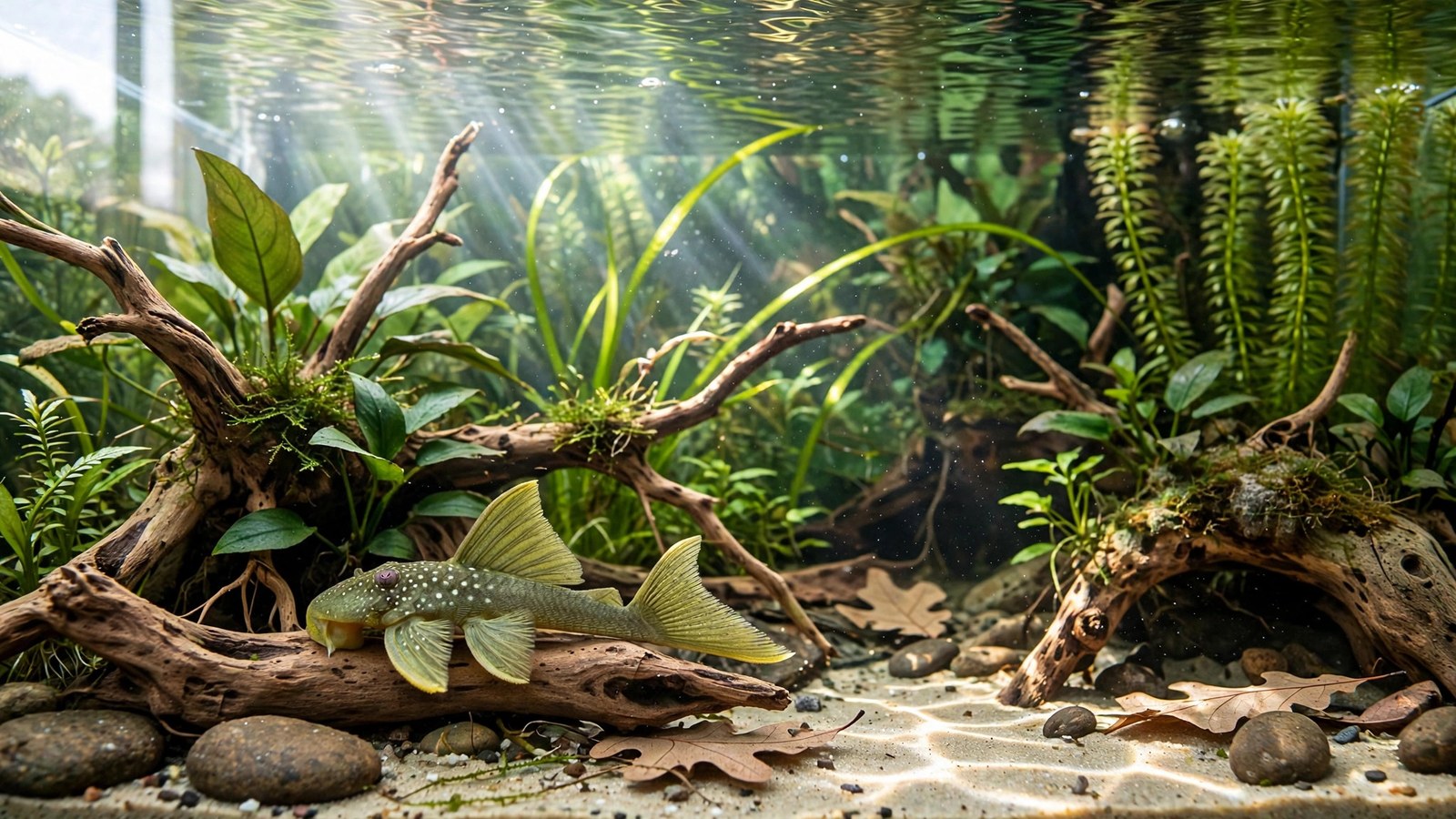
You paid for a green phantom pleco — but which fish actually arrived in the bag? Two different species share the L200 number, and it matters. Get the ID right and a green phantom pleco planted tank is straightforward: a rocky, high-flow river channel with tough plants. Get it wrong and you're following care advice for the wrong fish.
Straight answer: A green phantom pleco planted tank should replicate the rocky, fast-flowing Orinoco and Ventuari riverbed — granite hardscape, strong current, dissolved oxygen above 7 mg/L, and rhizome plants anchored to rock. Uniquely, "L200" covers two species: Hemiancistrus subviridis (true L200) and Baryancistrus demantoides ("L200a," the hifin green phantom). The instant field test: only B. demantoides has an enlarged dorsal-fin membrane connecting to the adipose fin — a diagnostic published in Neotropical Ichthyology in 2005.
Which L200 do you actually own? The green phantom disambiguation
This is the piece most guides skip, and it's the most useful thing you can learn about this fish. The L-number L200 was assigned before taxonomists sorted the green phantom out, and the 2005 species description by Werneke, Sabaj Pérez, Lujan, and Armbruster confirmed two distinct species:
- Hemiancistrus subviridis — the "true" L200, from the Orinoco and Ventuari drainages of Venezuela and Colombia. Olive body with yellow spots running from the midsection toward the head; no connection between dorsal and adipose fins.
- Baryancistrus demantoides — the "L200a" or "hifin green phantom," from the upper Orinoco and the Ventuari confluence. Taller dorsal fin, and a visibly expanded membrane linking the dorsal fin to the adipose fin. Golden-yellow spots concentrate on the front half of the body.
Both occur together at the Orinoco–Ventuari confluence in Amazonas state, Venezuela, so mixed shipments are genuinely common — not mislabeling, just geography. To ID yours, check the gap between the dorsal and adipose fins: a membrane bridge means B. demantoides; a clean gap means H. subviridis.
Why it matters: B. demantoides stays slightly smaller (~15 cm), is rarer, usually costs more, and leans harder toward meaty foods. H. subviridis is the hardier, more widely traded one. Seriously Fish's species profile for Baryancistrus demantoides documents the fin-membrane diagnostic in detail.
Setting up a green phantom pleco planted tank: the Orinoco recipe
The green phantom lives between granite bedrock and boulders in fast, highly oxygenated water. Your tank should behave like that channel:
- Hardscape first. Stack granite or slate into caves and crevices — the fish spends most of its day pressed against rock in the strongest current. Smooth rounded river stones beat sharp gravel for a bottom-dwelling armored catfish.
- Flow and oxygen. Keep one end of the tank visibly moving with a powerhead or spray-bar return, aiming for dissolved oxygen above 7 mg/L. Warm water holds less oxygen, so don't combine 28 °C with still corners.
- Keep the plants back. Plant the rear two-thirds densely and leave a foreground "rapids lane" of bare rock where the pleco holds station in the current. Flow also keeps waste suspended for the filter.
Lighting and planting density
Medium light is the sweet spot: enough for Anubias and Cryptocoryne, dim enough that the pleco ventures out in daylight. Green phantoms are unusually gregarious for plecos — keep them well fed and they'll graze openly rather than hiding until lights-out.
Orinoco recipe is a rocky, cave-filled river channel; caves are essential shelter for this grazer and this ceramic cave stays inert: a ceramic pleco cave ★4.6.
Plants that survive the scraping mouth
Green phantoms graze every surface, and their scraping mouth tests soft leaves. These hold up:
| Plant | Placement | Why it works |
|---|---|---|
| Anubias barteri / nana | Tied to rock or wood | Thick, unpalatable leaves the pleco ignores |
| Java fern (Microsorum) | Anchored to crevices | Tough rhizome foliage, near-indestructible |
| Cryptocoryne wendtii | Midground substrate | Broad but resilient once established |
| Bolbitis heudelotii | High-flow rock faces | Thrives in the current the pleco prefers |
| Amazon sword (Echinodorus) | Background | Big enough to absorb occasional rasping |
Skip delicate stems like Cabomba or pearlweed in the pleco's grazing lanes — they'll be shredded. Avoid dosing heavy liquid fertilizers right after water changes; plecos are sensitive to sudden chemistry swings.
Water parameters: an honest note on the temperature mess
Sources disagree, so here's the range as reported rather than a made-up consensus: The Aquarium Wiki's Green Phantom Pleco entry lists 22–25 °C (72–77 °F); retailers report 78–82 °F, some hobby references up to 88 °F. The split partly reflects the two-species problem — and seasonal Orinoco fluctuation.
Practical approach: 25–27 °C (77–81 °F) sits inside every source's range, matches the river habitat, and keeps oxygen manageable. Hold pH between 6.0 and 7.5, keep nitrates under 30 ppm through weekly 30% water changes, and drip-acclimate new fish for 45 minutes.
Feeding: the meat-eating grazer
Green phantoms are omnivores whose adults skew carnivorous — wafers alone aren't enough:
- Daily: sinking pleco wafers or algae pellets after lights-out (they're most active then).
- 3–4× weekly: blanched zucchini, cucumber, or sweet potato — anchor them under a rock so they don't drift.
- Weekly: frozen bloodworm, brine shrimp, or mysis — this is what keeps adults in top condition and brings out the brightest fin coloration.
Skip raw potato and iceberg lettuce. A sunken belly means it's being outcompeted at feeding time — add a second wafer site at the opposite end of the tank.
Tankmates and stocking
Same river playbook in other builds: the zebra pleco planted tank setup, the cooler-water bristlenose pleco planted tank alternative, and the gold nugget pleco planted tank.
Stock last: a pleco with claimed crevices ignores new tankmates; one arriving into caves already owned by other fish gets stressed.
Frequently Asked Questions
Is the green phantom pleco safe with aquarium plants?
Mostly, yes. Green phantoms are grazers, not plant eaters, and hobbyists widely report them leaving tough plants alone. The risk is mechanical: their rasping mouth works over every surface, so soft, delicate leaves get chewed up over time. Stick to rhizome plants like Anubias and Java fern anchored to rock, and avoid thin-stemmed carpet plants in their grazing lanes.
How do I tell the true L200 from the hifin L200a?
Look at the gap between the dorsal fin and the adipose fin (the small fin near the tail). If an enlarged membrane visibly bridges the two fins, you have Baryancistrus demantoides (L200a, hifin green phantom). If there's a clean gap, you have Hemiancistrus subviridis (true L200). The hifin also has a taller dorsal fin and golden spots concentrated on the front half of the body.
What temperature should a green phantom pleco be kept at?
Sources disagree: The Aquarium Wiki lists 22–25 °C, while aquarium retailers report up to 78–88 °F for the warmer end. The safest target is 25–27 °C (77–81 °F), which sits inside every published range, suits both species, and keeps dissolved oxygen at healthy levels in flowing water.
How big a tank does a green phantom pleco need?
A minimum of 75 gallons (280 L) for one adult. At 15–18 cm long, with a fondness for strong current and rock territories, smaller tanks can't provide the swimming lane, grazing area, and oxygen levels it needs. Go larger if you want tankmates or any other bottom dwellers sharing the hardscape.
Can green phantom plecos live with discus?
It's workable but demanding. Green phantoms tolerate the warm end of their range, which suits discus, and they're peaceful toward mid-water fish. The catch: discus tanks are often still and soft, while green phantoms want current and oxygen. You'd need careful aeration and flow design that doesn't stress the discus — a big tank with distinct zones.
Set up right, a green phantom pleco planted tank gives you something few pleco tanks offer: the fish on display, holding station in the current against granite, grazing in daylight. Nail the L200 ID, build the rapids, plant tough. For broader foundations, see our aquarium plants for fish tank guide and the freshwater aquarium plants complete guide.