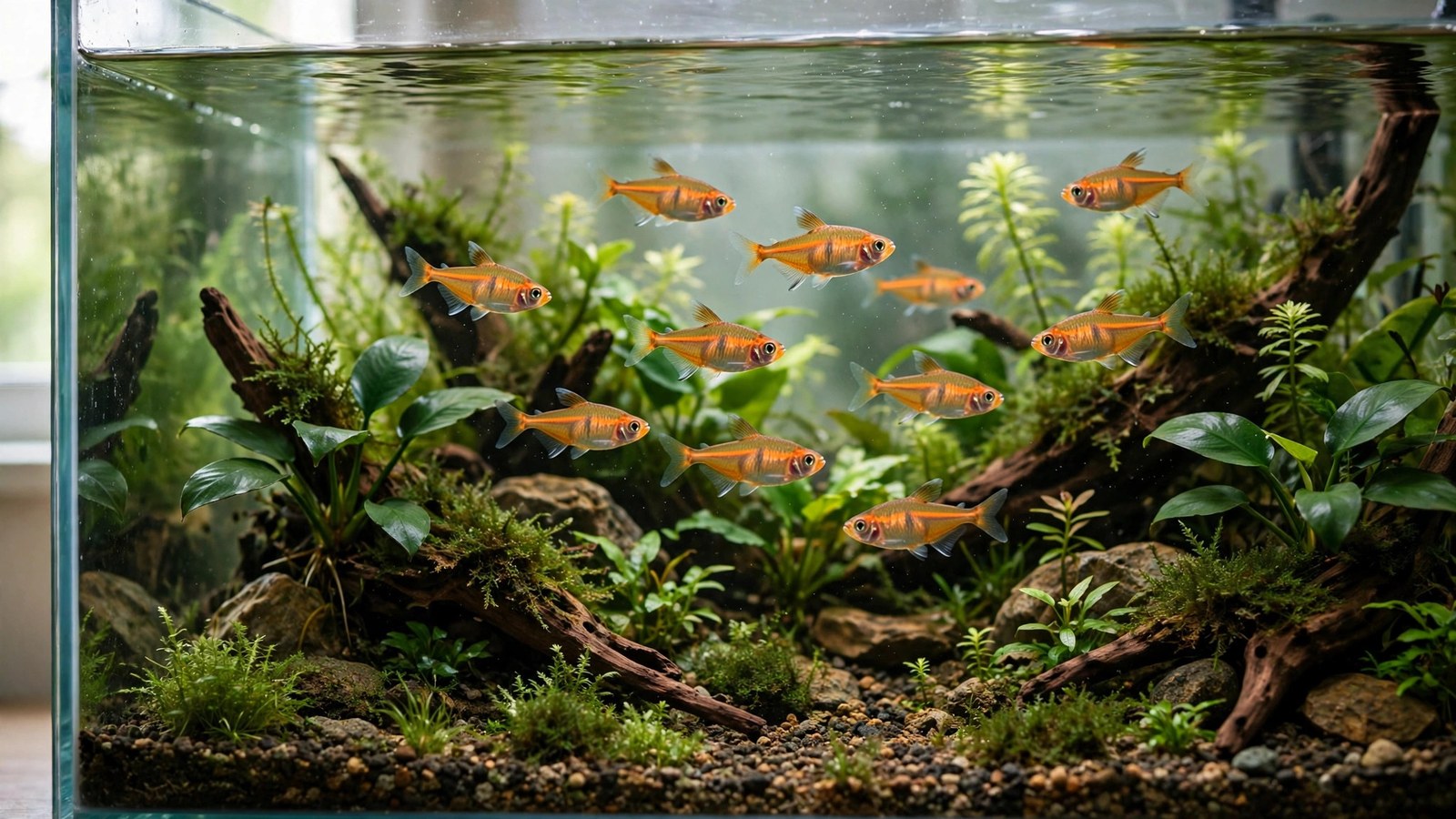
The orange-red stripe on a glowlight tetra is reflective tissue, not glow-in-the-dark magic — it only does its party trick when the tank around it cooperates. In a bright, bare tank the fish look washed out; in a dim, plant-crowded glowlight tetra planted tank, the stripe burns like a fuse against the green. This guide builds the second kind: a 10-gallon planted setup tuned to make Hemigrammus erythrozonus look like living embers.
A glowlight tetra planted tank works best as a 10-gallon nano with 10–12 fish over dark substrate under dim, dappled light — the setup that maximizes the reflective red-orange stripe. The stripe is iridescent, not bioluminescent: it needs incoming light to reflect and darkness to contrast against, so a bright tank over white sand erases the fish's best feature. Hold 75–82°F and pH 6.0–7.2, plant the background densely, feed small foods twice daily.
Why Glowlights Were Made for Planted Tanks
In the wild, glowlight tetras come from the dim, slow forest streams of Guyana's Essequibo basin, where tannin-stained water filters sunlight to a soft amber glow. That is the stage their stripe evolved for: a signal flashing brightest in subdued light against darkness. A planted nano tank recreates that stage better than any showpiece — which is why the fish looks so disappointing in brightly lit store tanks.
Do not confuse them with their famous cousins. Neon and cardinal tetras carry a blue-over-red scheme; the glowlight's single unbroken band of gold-to-orange-red sits on a translucent silver body and reads brightest when the tank is dark. Compare neon tetra planted setups if you like — the glowlight build runs darker and warmer. Either way, pick plants with the fish's needs first: dim-tolerant, dense, and forgiving of soft acidic water. Seriously Fish's glowlight tetra profile confirms the wild parameters worth copying — soft water, gentle flow, plenty of cover.
Your glowlight tetra planted tank: the 10-gallon setup blueprint
Ten gallons is the sweet spot: room for a real school to form its weaving ribbon formation, small enough to maintain in twenty minutes a week. Cycle fully before the fish arrive — four to six weeks with plants in place — then add the whole school at once so no fish starts out as a nervous loner.
Substrate is the single most consequential choice in this build. A dark bed — black sand or a nutrient-rich dark aquasoil — feeds root feeders and turns the stripe up like a dimmer switch. Compare the dark substrate options side by side before buying: aquasoil for heavy root feeding, or cheaper inert sand plus root tabs. Avoid bright white gravel — it reflects light upward and bleaches the school out from below.
| Parameter | Target | Notes |
|---|---|---|
| Temperature | 75–82°F (24–28°C) | 78°F is the comfortable middle |
| pH | 6.0–7.2 | Soft, slightly acidic suits them best |
| Hardness | 2–12 dGH | Adaptable, but soft water deepens color |
| Filtration | Gentle sponge or baffled hang-on-back | Glowlights dislike strong current |
| Water changes | 25–30% weekly | Non-negotiable in a stocked nano |
| Hardscape | Driftwood + leaf litter | Tints the water a natural amber |
Plants That Frame the Stripe
Think of the planting as a stage set in three depths. The background gets tall, dark-green stems — rotala, ludwigia, or vallisneria — dense enough to form a living wall the silver bodies cruise in front of. The midground gets anubias and Java fern tied to the driftwood, which tolerate dim light and give shy fish cover. The foreground stays low and open — dwarf sagittaria or bare dark sand — so the school has an uncluttered runway to display across.
Keep the palette restrained: green on green, with the fish as the only warm color in the tank. One or two red-tinged stems work as accents, but a rainbow plant collection competes with the school instead of framing it. Browse Tropica's layout inspiration gallery for the dark-background, single-school compositions this build borrows from.
 ★3.9
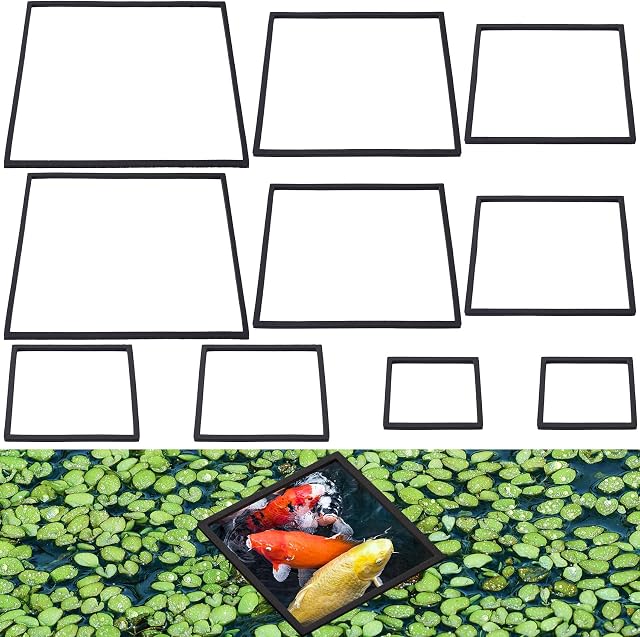
PAGOW Floating Plant Corral Rings
Check Price on Amazon ★3.9Tankmates, Feeding, and the Daily Rhythm
Glowlights are peaceful to a fault, so every tankmate must be equally gentle. A second small tetra school works beautifully — ember tetra setups pair especially well, their smaller red bodies echoing the glowlight stripe. Pygmy corydoras fit the footprint, and rummy-nose tetra schools add a second tight schooling display in a slightly larger tank. Skip anything boisterous, nippy, or large-mouthed: tiger barbs, most gouramis, and angelfish will harass the school or eventually eat it.
Feeding is simple: tiny mouths, big appetites. Offer a quality micro pellet or finely crushed flake twice a day, only what vanishes in two minutes. Twice a week, swap one meal for frozen daphnia or baby brine shrimp — the carotenoids in crustacean foods deepen the orange in the stripe over a few weeks. Shrimp colonies can coexist, but expect shrimplets to become expensive snacks.
Sexing and Breeding Glowlights
Males stay slimmer with a brighter, straighter stripe and slightly longer dorsal and anal fins; females grow deeper-bodied and rounder when carrying eggs. In a well-fed school you will spot both sexes without trying.
Breeding follows the classic tetra script. Set up a separate 5-gallon spawning tank with very soft, acidic water (pH 6.0–6.5), dim light, and a spawning mop or dense Java moss. Condition a pair or trio on frozen foods for ten to fourteen days, add them in the evening, and spawning usually happens at first light. Remove the parents immediately afterward — they will eat their own eggs. Eggs hatch in 24–36 hours; feed the fry infusoria for the first week, then newly hatched baby brine shrimp.
Frequently Asked Questions
How many glowlight tetras should I keep in a 10-gallon planted tank?
Ten to twelve is ideal for a 10-gallon. That number lets the fish form their natural weaving formation, spreads pecking-order tension harmlessly thin, and keeps the bioload manageable with weekly 25–30% water changes. Fewer than eight and the school breaks apart, colors fade, and nipping starts.
Do glowlight tetras need CO2 or high light?
Neither. Glowlights evolved under a dim forest canopy and look best in low to medium light — bright lighting washes out their stripe. Choose easy low-light plants like anubias, Java fern, and crypts, skip the CO2 system, and spend the savings on a larger school and quality frozen foods.
What is the best substrate to make the glowlight stripe glow?
Any dark substrate: black sand or dark aquasoil both work. The dark bed absorbs light instead of reflecting it up at the fish, deepening the contrast that makes the iridescent stripe pop. Avoid white or pale gravel — it acts like a reflector and bleaches the school's color from below.
Are glowlight tetras the same as neon tetras?
No — entirely different species. The glowlight tetra is Hemigrammus erythrozonus, from Guyana's Essequibo basin, with a single gold-to-orange-red stripe on a silver body. Neon tetras (Paracheirodon innesi) carry a blue-over-red pattern from different Amazonian waters. Glowlights are hardier and better for beginners.
Can glowlight tetras breed in a planted community tank?
They will scatter eggs, but almost none survive — parents and tankmates eat them within hours, and fry need infusoria-sized food. For real results, move a conditioned pair to a separate dim 5-gallon with a spawning mop, remove the parents after spawning, and raise fry on infusoria then baby brine shrimp.
What tankmates are safe with glowlight tetras in a nano tank?
Stick to small, peaceful species: ember tetras, pygmy corydoras, otocinclus, and small rasboras all work well. Avoid fin-nippers like tiger barbs, boisterous fish like large danios, and anything big enough to eat a 1.5-inch tetra. Shrimp colonies can coexist, but shrimplets will be hunted.
A glowlight tetra planted tank asks for little — dark sand, dim light, a real school, patience through the cycle — and pays it back every evening when the stripe catches fire.