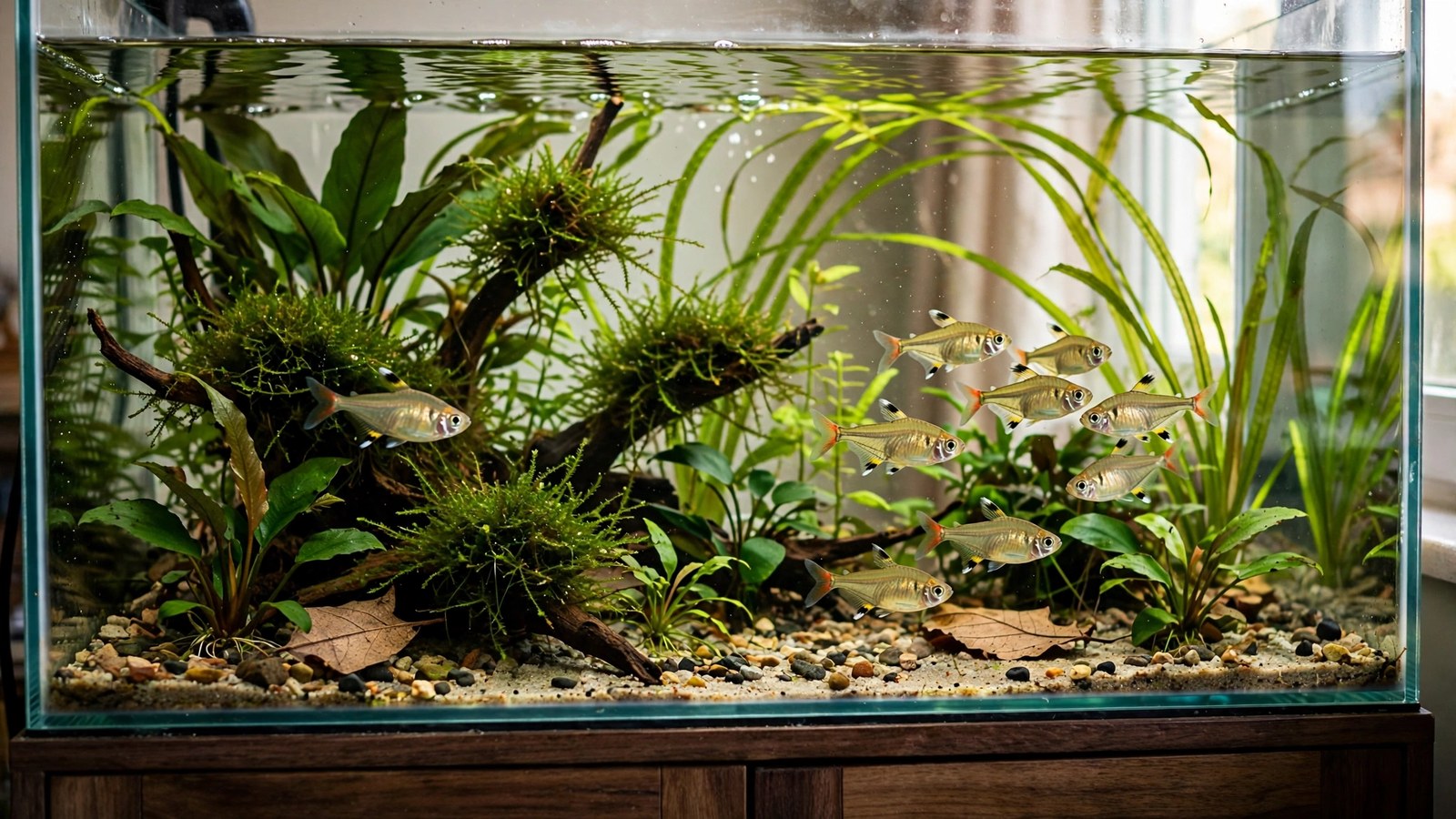
If you want a schooling fish that forgives beginner mistakes and looks striking against green plants, the pristella tetra planted tank is one of the most reliable setups you can build. Pristella maxillaris — the x-ray tetra — is a translucent, gold-flashed little schooling fish from South American rivers that handles new-tank wobbles better than most tetras. With dense plant cover, a school of at least eight, and gentle flow, it settles in fast.
A 20-gallon pristella tetra planted tank holds a school of 8–12 x-ray tetras at 24–28 °C and pH 6.5–7.8, with at least 60% of the footprint planted in low-light species such as anubias and water sprite. Cycle first: zero ammonia and nitrite with nitrates under 20 ppm keeps translucent bodies clear and stress-free. Stock eight or more: small groups pale and hide, while schools of ten spend the day out in open water.
Building a pristella tetra planted tank step by step
Start with the tank itself. A 20-gallon long is the sweet spot: room for a school of ten plus planted lanes. Fifteen gallons works nearly as well; a 10-gallon is the honest minimum for eight fish. See this 20-gallon planted setup guide for dimensions and equipment that suit schooling tetras best.
Substrate is simple: dark fine gravel or aquasoil shows off translucent bodies and makes waste easy to spot, with root tabs under root feeders in inert gravel. Filtration should be gentle — a sponge filter or a hang-on-back at its lowest setting suits slow-water fish that fight strong currents.
Light low-to-medium on a 6–8 hour timer grows everything this tank needs while keeping algae in check. Choose plants that put the fish first: shelter and broken sightlines matter more than a sculpted look. Cycle fully before stocking — this cycling a planted tank guide covers the fishless method.
Water parameters: hardy does not mean careless
Pristellas are among the toughest tetras in the trade — they ride out small parameter swings that knock over fussier species. That tolerance is a safety net, not a strategy: keep conditions stable, and you get clear bodies, confident schooling, and the golden wash that gives the fish its charm.
| Parameter | Target range | Why it matters |
|---|---|---|
| Temperature | 24–28 °C (75–82 °F) | Keeps immunity and appetite steady. |
| pH | 6.5–7.8 | Stability beats a perfect number. |
| Ammonia / nitrite | 0 ppm | Non-negotiable — test weekly with a liquid kit. |
| Nitrate | Under 20 ppm | Weekly 25% water changes plus dense plants keep it low. |
| GH / KH | Soft to moderately hard (4–12 dGH) | Most tap water suits them. |
| Flow | Gentle | Strong current pins them to corners and dulls their color. |
Pristellas tolerate blackwater-style tannins but do not require them — they color up just as well in clean, neutral water. This is what makes them the beginner's tetra: they accept tap water as long as it is stable and dechlorinated.
Plants that make x-ray tetras comfortable
Cover is the single biggest factor in whether pristellas show themselves. In a bare tank they clump in a corner, pale and nervous. In a well-planted tank the same fish scatter through the water column, flashing silver and gold as they turn. Build layered cover: background stems for retreat, midground clumps for sightlines, and open lanes where the school moves as a group.
The easiest plants for a beginner community tank all thrive here: anubias and java fern tied to driftwood, water sprite floating or rooted, hornwort in the back. Cryptocoryne wendtii or vallisneria along the rear glass adds depth. None needs CO2 or high light — steady low-medium light and the odd root tab is the whole plant program.
One or two pieces of spider wood or a low rock group give the school reference points and anubias something to grip. Keep the center-front open: a school of ten moving through an open lane flanked by plants is the entire show — clutter the middle and the display collapses.
Feeding and everyday care
Pristellas are uncomplicated omnivores: micro pellets or crushed flake as the staple, plus frozen daphnia or baby brine shrimp two or three times a week. Feed twice daily, only what vanishes in two minutes — translucent bellies make overfeeding obvious, a secret advantage for beginners.
Routine is the usual rhythm: weekly 25% water changes, a monthly filter rinse in old tank water, and trimming stems before they mat the surface — pristellas prefer dappled light to a dark canopy. A tight, hiding school means test your water that evening.
Tank mates that share the water calmly
Pristellas mix well with any peaceful community fish in their water range. Dwarf corydoras are the classic bottom partners — an Adolfo's cory planted tank build shows how a cory school complements tetras without competing for space. Small rasboras, cherry shrimp (expect shrimplets to be eaten), and one honey gourami all work in a 20-gallon.
Skip anything nippy, large, or territorially aggressive. If you are weighing options across schooling species, this roundup of the best schooling fish for planted tanks compares temperament and requirements side by side. When in doubt, stock fewer species in bigger groups — one confident school always looks better than four stressed pairs.
Pristella tanks fail in a few predictable ways — rushed cycling, too few plants, too-small schools — and every one is avoidable on day one.
Frequently Asked Questions
How many pristella tetras should I keep in a planted tank?
Keep at least eight, and aim for ten to twelve in a 20-gallon. Pristellas are true schooling fish: small groups hide, pale out, and stress, while larger schools display natural swimming and feeding behavior. In a 10-gallon, eight is the workable minimum; in a 15–20 gallon, twelve makes the school the centerpiece of the tank.
Do pristella tetras need blackwater or tannin-stained water?
No. Pristellas come from waters that vary seasonally, so they tolerate tannins from driftwood or leaf litter but do not require them. They color up just as well in clean, neutral water, which makes them far more forgiving than strict blackwater species. If you like the look, tannins will not hurt them — but do not chase blackwater chemistry to keep them.
Can pristella tetras live in a 10-gallon planted tank?
Yes, a school of eight fits a well-planted 10-gallon, and pristellas are small enough (around 4 cm) to swim comfortably there. It is the minimum, though: water parameters swing faster in small volumes, and there is little room for tank mates beyond shrimp or snails. For a school of ten-plus with companions, step up to 15–20 gallons.
Why are my pristella tetras pale and hiding in the plants?
Three usual causes, in order: too few fish (under eight), too little cover (under half the tank planted), or unstable water from a rushed cycle. Pristellas pale when stressed and regain color within days once the cause is fixed. Check ammonia and nitrite first, then add cover and consider raising the school to ten or more.
Will pristella tetras eat my aquarium plants?
No — pristellas are fully plant-safe. They pick at microfauna on leaves and may nibble soft algae films, but they do not damage healthy plant tissue. They are also generally shrimp-safe with adults; only newborn shrimplets are at risk. If delicate carpet plants are struggling, the cause is almost certainly light or CO2, not the tetras.
A pristella tetra planted tank rewards the simple things done well: a real cycle, real cover, a school big enough to behave like one. See the Seriously Fish profile of Pristella maxillaris and FishLore's x-ray tetra guide for more on the species. Build it calmly, stock it generously, and the tetras will do the rest.