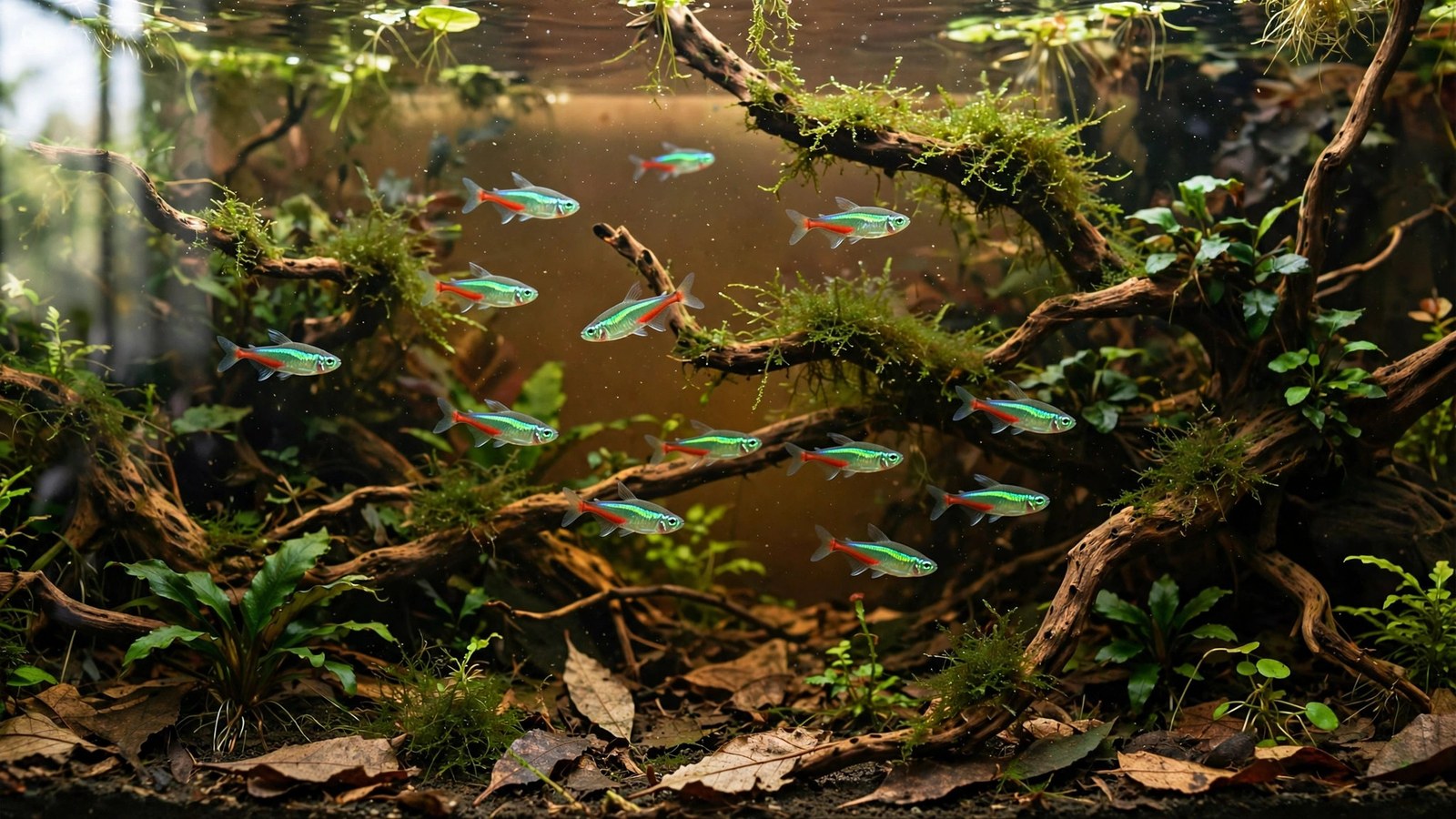
Most green neon tetras die within their first month in a home aquarium — not from disease, but from being treated like the common neon they are constantly mistaken for. Paracheirodon simulans is smaller, more delicate, and far pickier about water than P. innesi, yet most care sheets copy neon parameters straight onto it. This guide builds a green neon tetra planted tank around what this fish actually needs: a soft, acidic blackwater nano setup with tannin-tinted water like its Rio Negro home.
Green Neon Tetra vs. Classic Neon: Know the Difference
Before anything goes into the tank, get the species straight. If you keep the classic neon tetra instead, that fish tolerates a wide range of water and forgives beginner mistakes. Paracheirodon simulans does not. Green neons come from the upper Rio Negro basin, where water is tea-colored, extremely soft, and acidic — sometimes below pH 5.0 in the wild. They are also smaller, topping out around 0.8–1 inch versus the classic neon's 1.5 inches.
Advice written for P. innesi routinely kills P. simulans: harder alkaline water stresses them, bright light makes them wash out and hide, and busy communities with larger fish pick them off. Every choice below assumes a Rio Negro blackwater specialist, not a generic tetra.
| Trait | Green neon (P. simulans) | Classic neon (P. innesi) |
|---|---|---|
| Adult size | 0.8–1 in (2–2.5 cm) | 1.2–1.5 in (3–4 cm) |
| Wild habitat | Rio Negro blackwater tributaries | Clear and blackwater streams |
| Preferred pH | 4.0–6.5 | 6.0–7.0 |
| Hardness | Very low (dGH 1–6) | Moderate (dGH 1–10) |
| Light preference | Dim, tannin-shaded | Adaptable to medium light |
| Hardiness | Delicate, acclimation-sensitive | Forgiving, beginner-friendly |
Building the Blackwater Green Neon Tetra Planted Tank
Blackwater is the heart of this setup. Tannins from driftwood, catappa leaves, or alder cones tint the water amber, soften it slightly, and dim the light — the combination that makes green neons comfortable and brilliantly colored. A 10-gallon is the minimum; a 15–20 gallon long is better, giving a school of 8–12 room to move horizontally.
Substrate and Hardscape
Use a dark, fine substrate — nutrient-rich aquasoil or dark fine sand. Aquasoil softens the water, fine sand keeps bottom-dwellers safe, and a dark bed makes the green stripe pop. Add one or two pieces of driftwood as the tannin source and centerpiece; mopani and Malaysian driftwood release the most color. Scatter a handful of catappa leaves or alder cones across the substrate — they keep leaching tannins for weeks. Replace leaves monthly as they break down.
Plants for a Dim, Tannin-Tinted Tank
High-light carpeting plants will struggle here — and that is fine, because green neons want shade, not a lawn. Choose low-light, fine-textured plants that shelter tiny fish and filter nitrates at the same time. Float water sprite or frogbit on the surface for a dappled forest-stream canopy, and add a dense java moss corner as a refuge for new fish. Skip CO2 — it is unnecessary at these light levels and risks pH swings in already-soft water. The easiest aquarium plants for a beginner community tank are all compatible with this dim setup too.
| Plant | Role | Light |
|---|---|---|
| Java moss | Fine cover for shy schools | Low |
| Water sprite | Floating or planted; diffuses light | Low–medium |
| Anubias nana | Attach to driftwood; shade | Low |
| Java fern | Background height, zero fuss | Low |
| Salvinia / frogbit | Floating cover; blackwater light levels | Low |
 ★3.9
PAGOW Floating Plant Corral Rings
Check Price on Amazon ★3.9Water Parameters and Cycling
Cycle the tank fully before adding a single fish — in soft acidic water, bacteria colonize slowly, so expect 4–6 weeks with an ammonia source or bacteria starter. Target: 72–80°F (22–27°C), pH 4.0–6.5, dGH 1–6, zero ammonia and nitrite, nitrates under 20 ppm. If your tap water is hard, use RO or rain water remineralized lightly; hard alkaline tap water is the classic reason green neons fade and die within weeks. For plant–water chemistry background, the aquarium plants for fish tank guide covers the fundamentals.
Acclimation: The Step Most People Skip
Drip acclimation is non-negotiable for P. simulans. Float the bag 15 minutes, then drip tank water in at 2–4 drops per second for 45–60 minutes until the bag volume has roughly tripled. The pH and hardness gap between store water and your blackwater tank is the shock that kills most new green neons.
Stocking, Schooling, and Feeding
Keep a single school of 8–12 green neons; below 6 they hide constantly and never color up. A 20-gallon long can hold 12–15 plus a small cleanup crew. Their tiny mouths need tiny food: crushed micro-pellets, baby brine shrimp, daphnia, and flake crumbled to powder. Feed once or twice daily, only what they eat in 90 seconds — in dim blackwater tanks, uneaten food rots invisibly and crashes parameters.
Best Tankmates for Green Neons
Choose small, calm companions that share soft acidic water: chili or strawberry rasboras, pygmy corydoras, otocinclus, and cherry shrimp. Adult shrimp are safe and share the water green neons need, though green neons may hunt newborn shrimplets — give the shrimp dense moss cover. Avoid anything boisterous, nippy, or large enough to swallow a 1-inch fish — angelfish, larger barbs, and most cichlids are out. The rummy-nose tetra planted tank guide follows the same school-first philosophy at a larger size.
Weekly Maintenance Routine
Every week: change 20–25% with temperature-matched, pre-conditioned soft water; siphon detritus from the substrate surface; test pH and nitrates. Water changes keep pH stable as organics accumulate. Clean the filter (gentle sponge filter or low-flow hang-on-back — green neons hate strong current) in old tank water, never tap water. Trim plants monthly. Watch the school daily: tight schooling means the tank is right.
Frequently Asked Questions
Are green neon tetras harder to keep than regular neon tetras?
Yes. Green neons need soft, acidic water (pH 4.0–6.5, dGH 1–6) and drip acclimation, while classic neons tolerate a much wider range. Treat them as a different fish, not a color variant.
What tank size do green neon tetras need?
A 10-gallon tank is the minimum for a school of 6–8. A 15–20 gallon long is better, holding 8–12 green neons with a small cleanup crew. Because they are nano fish, horizontal swimming space matters more than tank height.
Do green neon tetras need blackwater conditions?
They thrive in it and it is strongly recommended. Tannins lower and buffer pH, dim the light, and reduce stress — replicating their Rio Negro habitat. Schools in true blackwater are bolder, brighter, and longer-lived.
Why are my green neon tetras hiding all the time?
Hiding usually means the water or light is wrong: too hard or alkaline, too bright, or too few fish. Add floating plants to dim the light and test pH and hardness. Below 6 fish, add more — green neons are braver in larger groups.
How long do green neon tetras live?
In a well-maintained blackwater tank, 3–5 years is typical, with some reaching 6+. In hard or alkaline water, lifespan often drops to months. Stable soft acidic conditions are the biggest longevity factor.
Give These Jewels the Water They Deserve
Build the blackwater first, plant for shade and cover, acclimate slowly, and keep the school calm company. Respect what P. simulans actually is — a Rio Negro specialist, not a classic neon — and it will repay you with color no generic setup delivers.