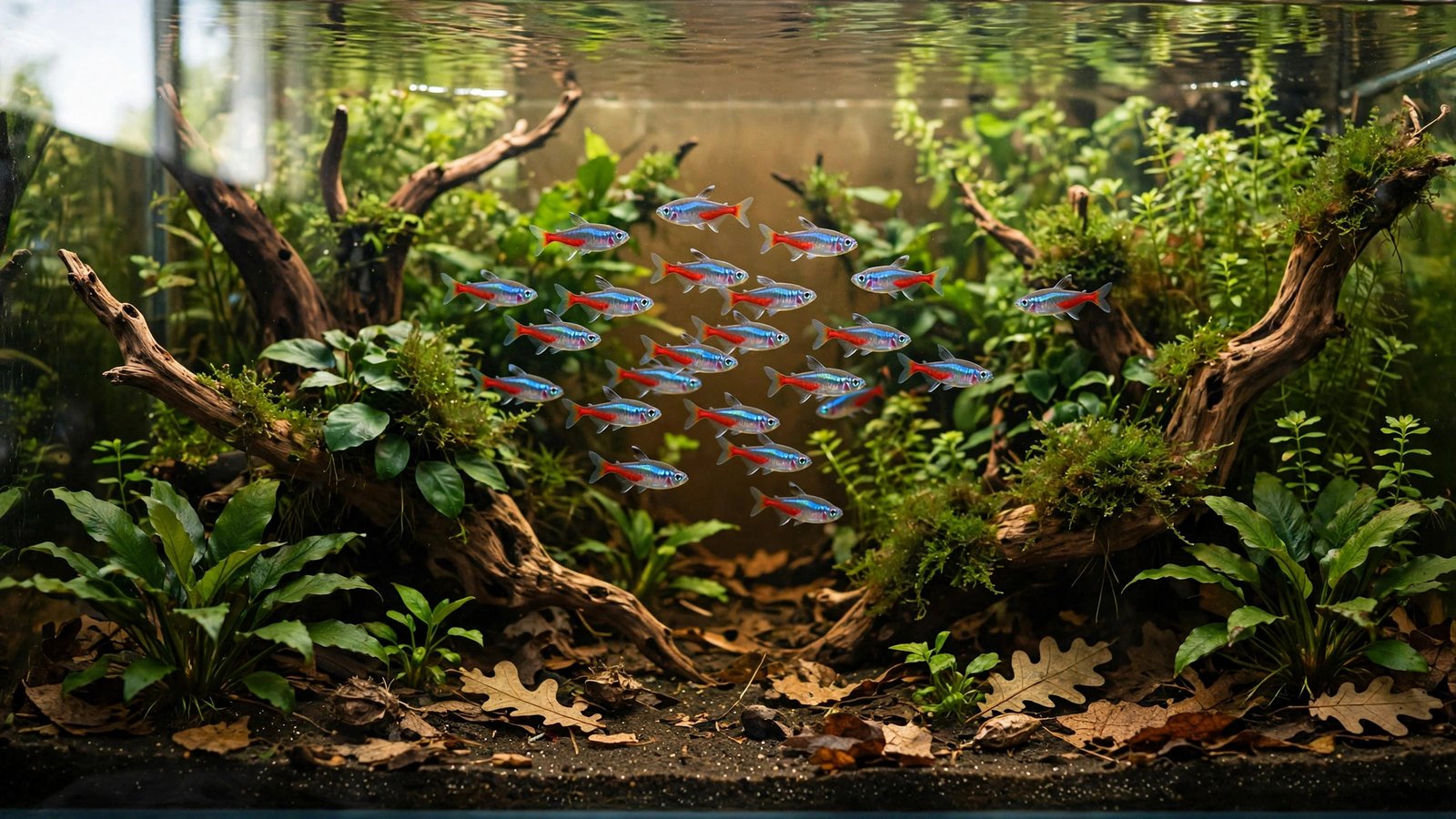
A school of thirty cardinals drifting through tea-stained water beneath a canopy of frogbit is the most electric sight in freshwater fishkeeping — and most keepers never see it, because they house cardinals like neon tetras. A proper cardinal tetra planted tank is built on blackwater, not the generic community recipe: warmer, softer, dimmer water where those red bellies and neon-blue stripes ignite. Below is the complete formula — parameters, plants, lighting, and tank mates — so your school actually schools like it means it.
Why cardinals are not neon tetras
Most shops sell them side by side, but treating them as interchangeable is the most expensive mistake in cardinal keeping. Cardinals (Paracheirodon axelrodi) grow larger — around 5 cm, close to the documented maximum size for the cardinal tetra — and come from warmer, softer blackwater than the neon tetra (Paracheirodon innesi), which is smaller, prefers cooler water, and is these days almost entirely tank-bred. Cardinals are still overwhelmingly wild-caught, which changes everything about quarantine and acclimation. Where the neon's red stripe fades halfway along the belly, the cardinal's red runs the full length. Even the planting list diverges: where neons tolerate brighter, stem-heavy layouts, cardinals want a lightly planted, low-tech layout and a shaded surface canopy. Build for neons when you keep neons — the planted neon tetra tank guide shows what changes.
| Feature | Cardinal tetra (P. axelrodi) | Neon tetra (P. innesi) |
|---|---|---|
| Adult size | ~5 cm (2 in) | ~4 cm (1.5 in) |
| Temperature | 24–28°C (75–82°F) | 20–24°C (68–75°F) |
| Sourcing | Mostly wild-caught | Mostly tank-bred |
| Red stripe | Full length of the belly | Rear half only |
| Water | Soft, acidic blackwater | Adapts to harder water |
Building a cardinal tetra planted tank: the blackwater formula
Start with 20 gallons (75 L) — cardinals need horizontal room, and a 24-inch tank lets a school of 12 stretch out. A 29-gallon is the sweet spot for a showpiece school of 20 or more. Water is the whole game: temperature 24–28°C, pH between 4.5 and 6.8, general hardness 1–6 dGH. Create the blackwater with botanicals — one large catappa leaf per 10 gallons, replaced monthly, plus alder cones to push the pH lower. Aim for weak tea, not coffee. Filtration should be gentle: a sponge filter or a hang-on-back with a baffled outflow, since cardinals come from slow tributaries and fight current instead of schooling in it. Cycle fully, then run 25–30% water changes weekly. This is a classic low-tech planted tank setup: no CO2 injection, a dimmable LED, and plants that feed from the water column rather than demanding high light.
| Parameter | Target |
|---|---|
| Tank size | 20 gal (75 L) minimum; 29+ gal for 20+ fish |
| School size | 10–12 minimum; 20+ recommended |
| Temperature | 24–28°C (75–82°F) |
| pH | 4.5–6.8 |
| Hardness | 1–6 dGH |
| Tannins | 1 catappa leaf per 10 gal, replaced monthly |
| Water changes | 25–30% weekly |
 ★4.8
Seachem Catappa Leaves 12-pack
Check Price on Amazon ★4.8Plants that thrive in dim blackwater
Your plant list writes itself once you accept the light will stay low — our fish-first plant guide rounds up dim-light plants for blackwater tetras and other low-light setups. Epiphytes are the backbone: Microsorum pterotioides (Java fern) tied to driftwood, and Taxiphyllum barbieri (Java moss) draped over rocks and wood, both of which genuinely prefer shade. Cryptocoryne wendtii fills the midground and tolerates warm, soft water without the melt that plagues crypts in unstable tanks. On the surface, Amazon frogbit and floating water sprite knit a living canopy that cuts light to dappled shade — the safety signal that makes cardinals color up. If you want more greenery without breaking the mood, a lightly planted layout with extra floaters fills the background while keeping the shade the fish need.
| Plant | Placement | Why it works here |
|---|---|---|
| Java fern (Microsorum pterotioides) | Driftwood, rocks | Prefers shade; no substrate needed |
| Java moss (Taxiphyllum barbieri) | Wood, rock crevices | Soft cover for shy fish |
| Cryptocoryne wendtii | Midground | Low light, warm-water tolerant |
| Amazon frogbit (Limnobium laevigatum) | Surface | Natural shade, calms the school |
| Water sprite (Ceratopteris thalictroides) | Floating | Fast cover, soaks up nitrates |
Light, substrate, and flow
Run a dimmable LED at 30–50% power on a 6–8 hour photoperiod — enough for the epiphytes and crypts, dim enough that the school stays out in the open. A dark substrate is non-negotiable: black aquasoil or dark sand makes the blue stripe fluoresce and the red belly pop, while pale gravel washes both out. Keep the current gentle everywhere; if food drifts past faster than a slow walk, baffle the filter.
 ★4.6
NICREW ClassicLED Plus planted aquarium light
Check Price on Amazon ★4.6Tank mates that won't dim the show
Cardinals are peaceful but tiny, so companions must be small, calm, and comfortable in warm, soft water — other blackwater schoolers work best.
| Species | Why it fits |
|---|---|
| Ember tetras | Same soft water, tiny, peaceful — see the ember tetra planted tank for their setup |
| Rummy-nose tetras | Classic blackwater schoolers; their red noses are a water-quality gauge — rummy-nose tetra planted tank |
| Dwarf corydoras | Gentle bottom crew, never bother midwater fish |
| Otocinclus | Peaceful algae crew for the leaves and glass |
| Amano shrimp | Too large to be eaten; excellent cleanup |
Skip angelfish (they eat cardinals), bettas (wrong temperament and flow), and any large or nippy tetra. One calm centerpiece like a single honey gourami works in 29+ gallons; more than that and the tank stops being about the school.
Quarantine: the wild-caught reality
Almost every cardinal in the trade was netted from a South American tributary weeks before you bought it, which means internal parasites and shipping stress are the norm, not the exception. Drip-acclimate over 45–60 minutes into a bare quarantine tank — never straight into the display. Hold new arrivals for 2–4 weeks, feed lightly, and watch for white stringy waste or clamped fins before they meet your main school. Run every batch through a proper fish quarantine routine for planted tanks; one skipped quarantine can wipe out a year-old school.
Frequently Asked Questions
How many cardinal tetras should I keep in a planted tank?
Ten to twelve is the minimum for confident schooling, and the display transforms at 20 or more. Small groups stay skittish, hide, and never color up fully. Stock one fish per two gallons to keep the bioload comfortable, and larger schools distribute stress so shy individuals gain confidence and the red belly stays lit all day.
Can cardinal tetras live with neon tetras?
They can share a tank, but one species always compromises: cardinals want 24–28°C soft blackwater while neons prefer 20–24°C and harder water. Keep them in separate species tanks if you want either at its best — if you must mix them, hold 23–24°C as the compromise point and accept duller color on both species.
Do cardinal tetras need CO2 or high light in a planted tank?
No — and both actively work against them. Cardinals color up best under dim light with floating-plant shade, and the plants that suit them (Java fern, mosses, Cryptocoryne, frogbit) all thrive without CO2. High light stresses the fish and grows algae on slow leaves. Build it low-tech and dim.
Why are my new cardinals pale and hiding?
Pale, clamped cardinals are almost always stressed, not sick: bright light, no surface cover, a too-small school, or clear water with no tannins. Dim the light to 30–50%, add frogbit or water sprite, and confirm the school is 10+. In a proper blackwater setup they color up within days to two weeks.
How long do cardinal tetras live?
Three to five years in a well-kept blackwater tank, with some reaching six. The biggest lifespan killers are cool water, skipped quarantine, and chronic stress from small schools. Warm, soft, stable water with weekly 25–30% changes is the longevity formula.
The payoff
Get the water warm, soft, and tea-stained, keep the light dim under a living canopy, and give them a school worth schooling in — then watch thirty red-and-blue embers move as a single animal.