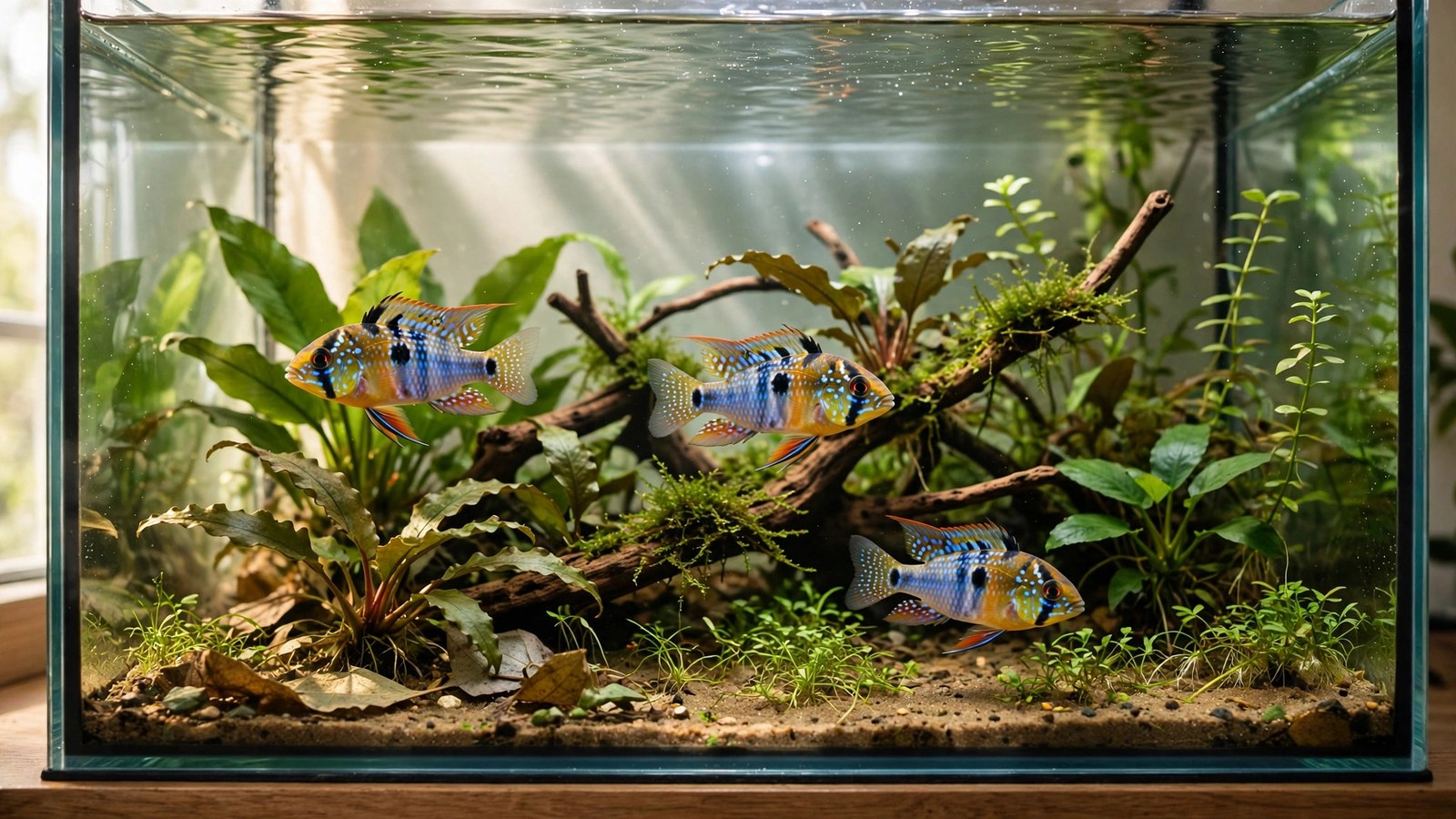
Few freshwater setups rival a tropical reef — but a german blue ram planted tank gets close: jewel-colored fish weaving through sun-dappled plants in warm, golden water. The catch? Rams demand 27–30°C, and half the plants sold for community tanks quietly stall or rot at that heat. Get the temperature-plant match right, and you have one of the hobby's most rewarding displays.
The Heat Question: Why a German Blue Ram Planted Tank Starts With the Thermostat
Mikrogeophagus ramirezi comes from sun-baked Orinoco savanna pools where water sits at 28°C and spikes higher. At 24–25°C — the community-tank default — rams eat reluctantly, fade, and die young. Hold 28°C, and the same fish ignites: iridescent blue scales, flushed red belly, and full courtship.
This is why a german blue ram planted tank is built backwards: lock in 28°C first, then pick plants that genuinely thrive in that warmth. The Seriously Fish profile for Mikrogeophagus ramirezi confirms the same 27–30°C window, backed by collection-locality data.
Tank Size and Territory: Giving a Pair Room to Be Rams
A bonded pair is the ideal stocking. Twenty gallons is the honest minimum — a 20-long beats a 20-high because rams live in the bottom third and value footprint. One 20-gallon tank holds exactly one territory, which suits an already-bonded pair.
For a community — or juveniles you hope will pair up — a 40-gallon breeder changes everything: separate corners per fish, real sight-line breaks, and room for a dither school like ember tetras in a warm planted setup, which coaxes shy rams out of hiding. If you're exploring the wider dwarf cichlid family, this build pairs well with the related apistogramma planted tank setup, which shares the soft-water, warm-tank DNA.
Plants That Actually Tolerate Ram Temperatures
Many popular plants stall at 28°C — and a stalled plant is an algae invitation. The species below grow actively in warm, soft, slightly acidic water. The fish-first guide to aquarium plants for fish tanks explains why stocking priority matters, and a easiest aquarium plants for a beginner community tank list adds fast growers for stability:
| Plant | Placement | Notes at 28°C |
|---|---|---|
| Anubias barteri | On wood/stone | Bulletproof at 28°C |
| Java fern | On wood/stone | Heat-tolerant; keep rhizome exposed |
| Cryptocoryne wendtii | Midground | Melts once, rebounds in 2–3 weeks |
| Vallisneria spiralis | Background | Loves heat; trim runners monthly |
| Amazon sword | Background focal | Heavy root feeder for back corners |
| Limnophila sessiliflora | Background stems | Fast grower; nitrate sponge |
Substrate, Hardscape, and the Spawning Stone
Fine sand isn't a preference — it's anatomy. Rams take mouthfuls of substrate and expel it through their gills, sifting out micro-foods; gravel blocks this and can injure gills. Use soft, inert fine sand 2–3 cm deep — its pale tone also makes ram colors pop.
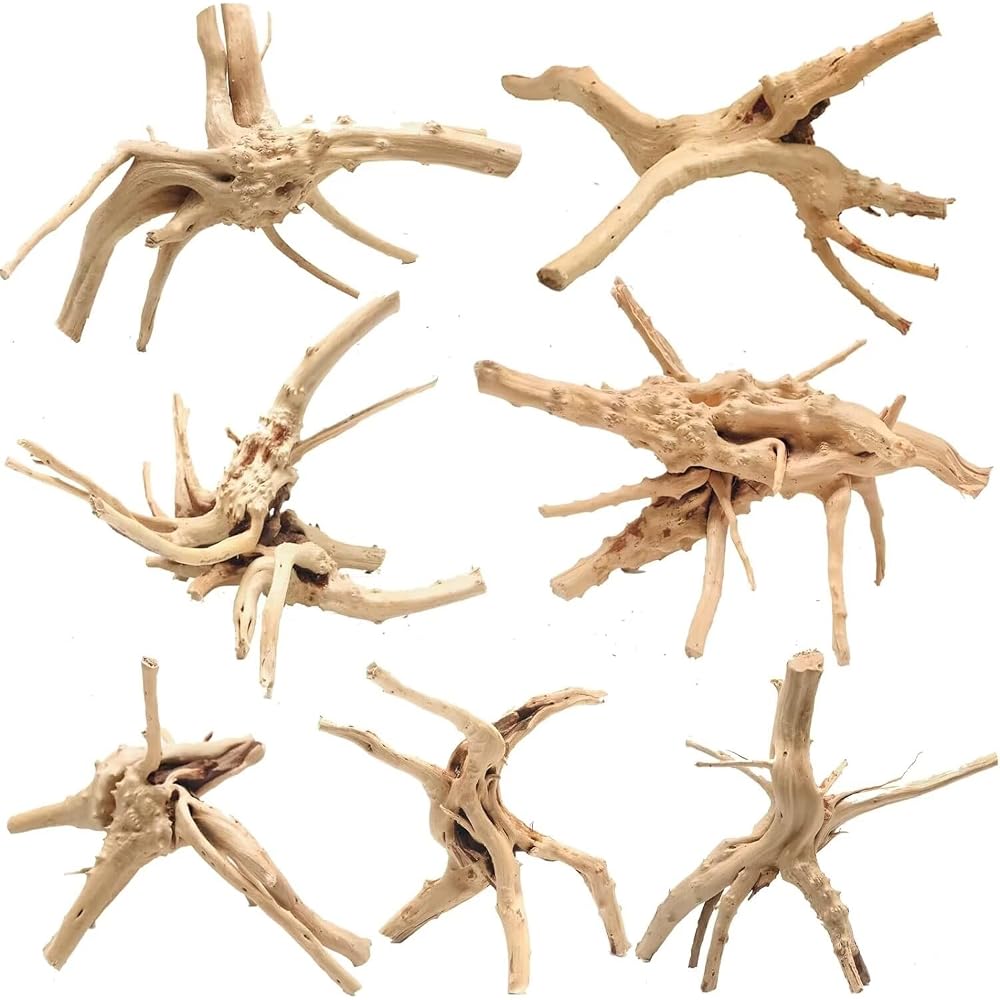
Arrange driftwood and 2–3 flat slate pieces to break the tank into visual zones — each flat stone is a potential spawning site. Place one flat stone near the front so you can watch the ritual.
Dense planting is a security blanket. Shy rams color up dramatically when hidden — crypts, anubias-covered wood, and vallisneria curtains make them bolder. For species-specific ideas, the best plants for cichlid tanks list explains why tough-leaf species survive cichlid attention.
 ★4.2
Hamiledyi Natural Spider Wood Driftwood
Check Price on Amazon ★4.2Water Parameters and the Cycling Rule
Rams need soft, slightly acidic water: pH 6.0–7.0, 3–10 dGH, nitrates under 20 ppm. Warm water holds less oxygen and accelerates waste breakdown, so run generous filtration and keep up 25–30% weekly water changes.
Never add rams to a new tank. Fishless-cycle 4–6 weeks, then confirm zero ammonia and nitrite for a full week — rams die in tanks that test "fine" to beginners. Bring rams in last, around week 8–10.
Equipment: Heaters, Thermometers, and Oxygen at 28°C
At 28–30°C there's no room for a cheap heater that swings ±2°C. Use an adjustable heater at roughly 5 watts per gallon plus an external temperature controller as a cut-off backup. Verify with a separate digital thermometer: daily for the first month, then weekly.
Warm water holds less oxygen, so add surface agitation — a rippled HOB outflow or a night air stone — plus 6–8× turnover and weekly 25–30% water changes.
Feeding and Tank Mates That Handle the Heat
Rams are omnivores with small mouths and a love of live and frozen foods: baby brine shrimp, daphnia, and grindal worms trigger their best color. Supplement with quality micro-pellets. Feed twice daily, only what vanishes in 60–90 seconds.
Tank mates must genuinely enjoy 28°C. Cardinal tetras are the classic — schools of 12+ doubling as dither fish, signaling "safe" to shy rams. Rummy-nose tetras school even tighter. On the bottom, kuhli loaches in a planted tank stay out of ram territory, sterbai corydoras are one of the few corys thriving at 28°C+, and otocinclus handle the heat while cleaning leaves.
Skip white clouds, zebra danios, and most barbs — they prefer it cooler and fade at ram temperatures. Warm-water surface dwellers like honey gouramis fit too. For full stocking philosophy, read the planted community tank setup guide.
Spawning Behavior in a Planted Tank
A bonded pair spawns without prompting — 28°C, clean water, and a flat stone is the whole recipe. They clean the stone for a day or two, the female lays 100–300 adhesive eggs in rows, and the male fertilizes.
Both parents guard fiercely, but community-tank eggs rarely survive — tetras steal them overnight. To raise fry, move the egg-covered stone to a 10-gallon rearing tank with matching water and an air stone, then feed newly hatched baby brine shrimp.
Frequently Asked Questions
Can German blue rams live at 25°C in a planted community tank?
Short-term they'll survive, but long-term health collapses: faded color, suppressed appetite, stunted growth, and vulnerability to hexamita and bacterial infections. Rams are warmth-adapted fish — 27°C is the realistic floor for thriving rather than merely surviving, and most community tanks simply run too cool for them.
What plants grow best at 28–30°C with rams?
Anubias, Java fern, Cryptocoryne wendtii, Vallisneria, Amazon swords, and Limnophila sessiliflora all grow actively at ram temperatures and handle soft, slightly acidic water. Avoid cool-water specialists and delicate red stem plants, which stall, lose color, and melt when held at 28°C+ for weeks on end.
How long should I cycle the tank before adding rams?
Plan on 8–10 weeks: 4–6 weeks to fishless-cycle with an ammonia source, then a few more with plants and a dither school established and growing. Rams go in last, with ammonia and nitrite at zero for a full consecutive week and nitrates under 20 ppm — they punish shortcuts harshly.
Do I need a male-female pair, or can I keep one ram?
A single ram does fine and is often the better choice for a 20-gallon community — no territorial disputes, no surprise spawns. Pairs need 20 gallons minimum and bond best naturally from juvenile groups. Never keep two males in a small tank; they will fight relentlessly until one is removed.
Why do my rams hide all the time?
Hiding usually means they feel exposed: add denser planting, driftwood cover, and a dither school of 10–12 cardinals or rummy-noses so the tank reads as safe. Check temperature too — rams under 26°C get lethargic and withdrawn. Secure, warm rams patrol the front glass constantly.
What tank mates are safe with ram eggs and fry?
In a community tank, expect zero fry survival — tetras and loaches pick off eggs and wrigglers overnight despite fierce parental guarding. To raise a spawn, move the egg-covered stone to a 10-gallon rearing tank with matching water and treat fry-raising as a separate project from the display tank.
Build around the heat, plant densely, and stock patiently — you'll be rewarded with glowing color, playful sifting, and courtship dances. Few setups repay planning as visibly as a well-run german blue ram planted tank.