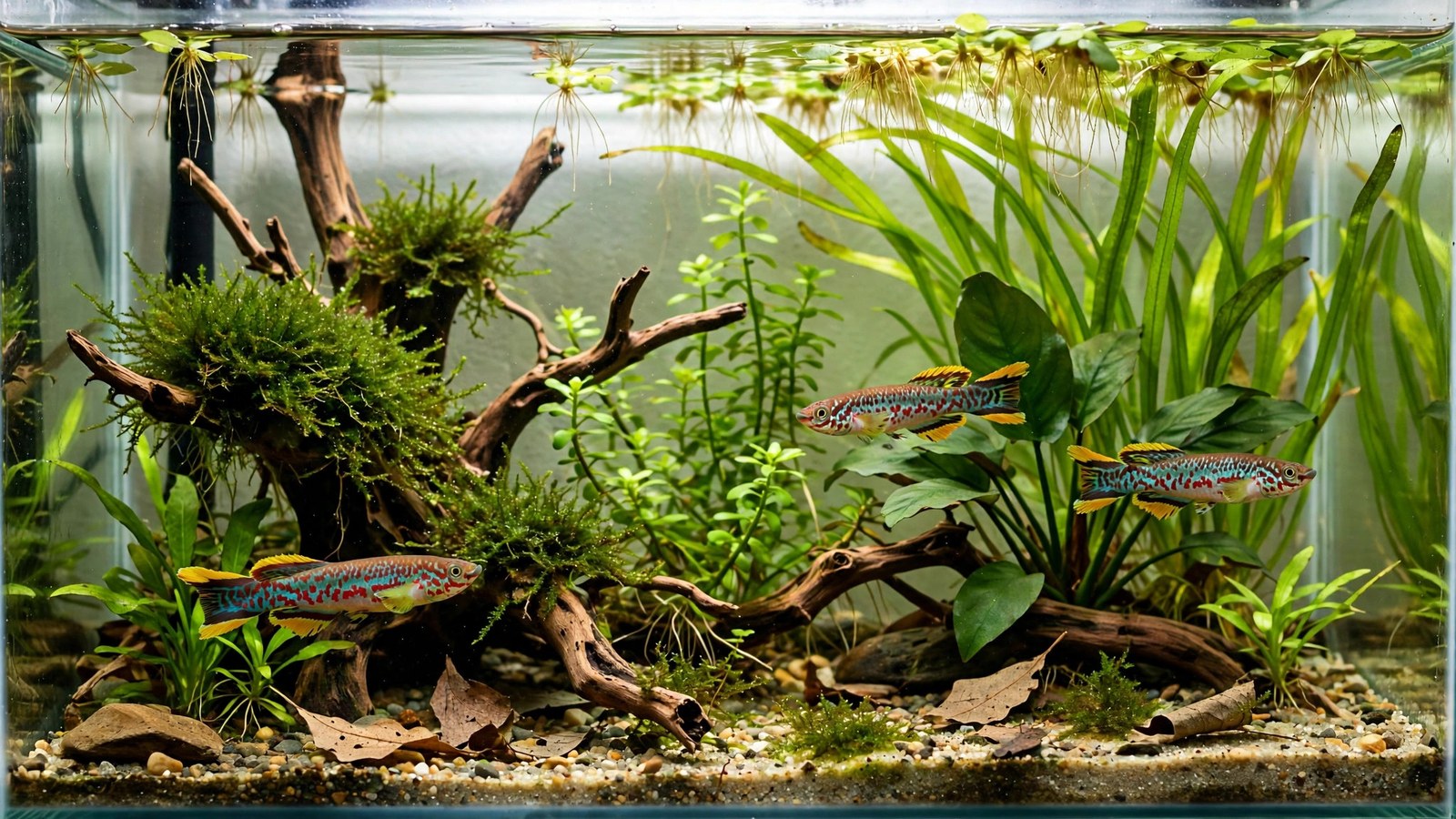
Almost every gardneri keeper learns the same lesson the hard way: they find their steel-blue male on the carpet behind the tank. That heartbreak is why a gardneri killifish planted tank is designed lid-first: Fundulopanchax gardneri, the classic beginner killifish, is equal parts jewel and athlete. Build around their instincts — sealed top, thickets of spawning mops and moss, soft calm water — and this 2.5-inch West African fish will color up, display, and breed in the greenery while you watch.
Setting Up Your Gardneri Killifish Planted Tank
Start with the plants — in this setup, they are the equipment. A back corner of dense spawning cover — see our Best Plants for Killifish Tanks: 12 Top Picks for Breeding & Display for species that double as egg beds — gives females somewhere to tuck eggs and escape an overeager male. Build three zones: a dim surface under floaters for security, a midwater thicket of moss and mops for spawning, and an open front lane where the male displays.
Use a dark substrate — fine gravel or sand — to make the steel-blue body and red spotting glow. Filter gently: one air-driven sponge filter is the classic choice for fish from slow tributary streams. Keep the build low-tech — a low-tech planted tank setup with easy species is plenty — which suits the subdued lighting gardneri prefer anyway.
Then the lid — and I mean sealed. A cut-to-fit glass canopy works, but stuff every filter and cable cutout with filter foam. They jump hardest at night and during water changes, when a startled fish can clear a gap you swore wasn't there.
Plants That Switch On Spawning Behavior
Gardneri are plant spawners: the female presses a few sticky eggs into fine cover nearly every day, and the male fertilizes them on the spot. The finer and denser the cover, the more eggs stick — and the more fry survive.
| Plant | Role in a gardneri tank |
|---|---|
| Java moss | The primary egg bed; fry hide in it for their first weeks |
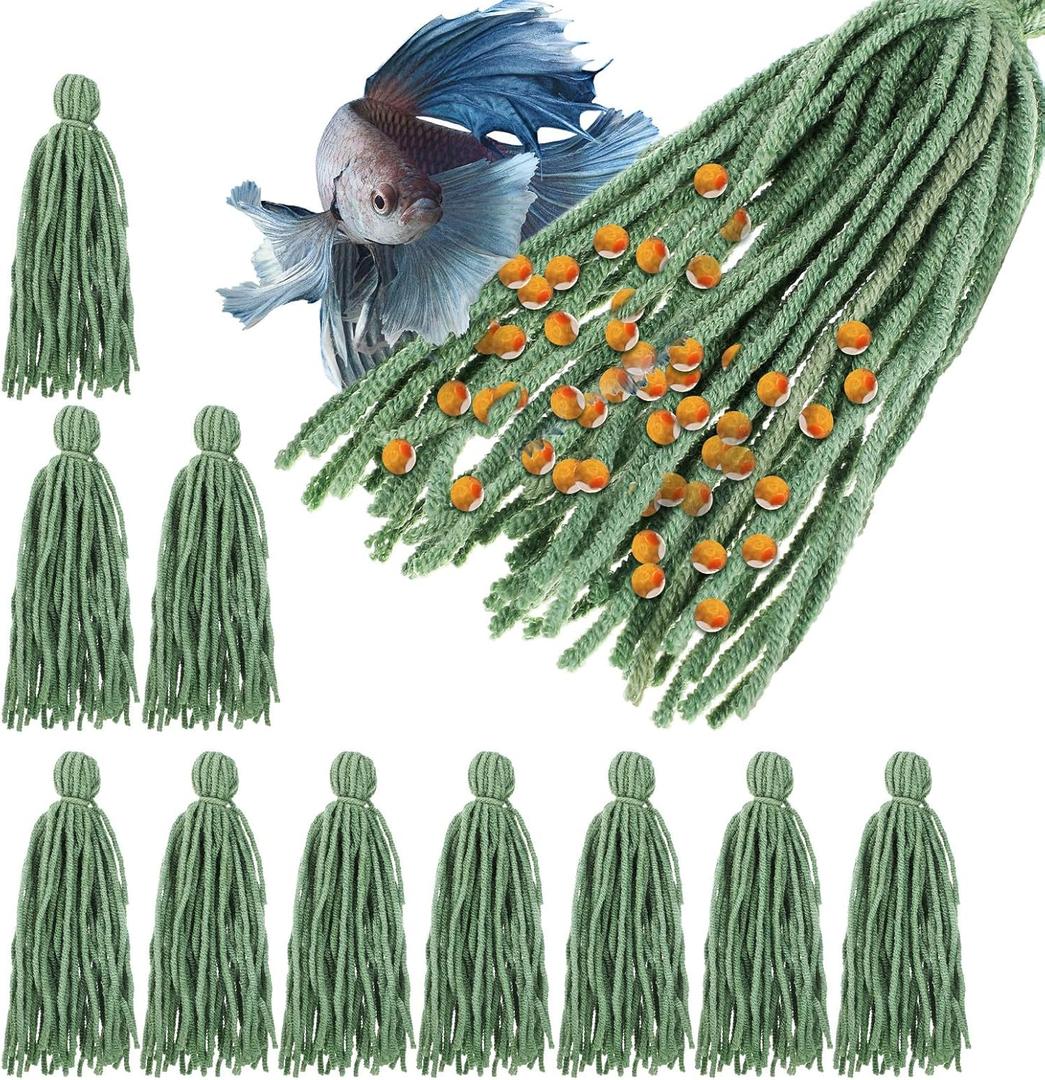
| Spawning mops (dark green acrylic yarn) | Removable egg collectors you can lift out and check every few days |
| Salvinia or frogbit (floating) | Dims the light, settles nervous fish, trailing roots add extra cover |
| Anubias nana on driftwood | Shaded structure that breaks the male's line of sight across the tank |
| Cryptocoryne wendtii | Soft-water-tolerant midground filler that females duck behind |
For the wider shortlist, the core aquarium plants for fish tanks guide covers easy species that slot into this layout. The moss-bed-as-nursery trick works across the killifish cluster — it is the backbone of our clown killifish planted tank too, scaled down for a smaller fish.
Water, Food, and Tank Mates
| Parameter | Target |
|---|---|
| Temperature | 72–79°F (22–26°C) |
| pH | 6.0–7.5; soft and slightly acidic is ideal |
| GH | 4–12 dGH |
| Ammonia / nitrite | 0 ppm |
| Nitrate | Under 20 ppm |
| Water changes | 25–30% weekly |
Gardneri come from the slow tributary streams and marshes of Nigeria and Cameroon: soft, slightly acidic, calm water suits them best, though captive-bred fish are flexible across the range above. They are micropredators with small mouths, so feed small — newly hatched brine shrimp, daphnia, grindal worms, frozen cyclops. Quality flake and micro pellets are accepted, but a week of live or frozen food before breeding visibly improves egg numbers.
Tank mates must be peaceful, small, and unhurried — never fast eaters that strip food first. Proven companions: chili rasboras (our chili rasbora planted tank runs a matching soft-water layout) and licorice gouramis, another calm blackwater fish (our licorice gourami planted tank uses near-identical water). Keep one male per tank — two males under 20 gallons spar relentlessly unless the planting is jungle-dense.
Breeding Gardneri in the Planted Tank
Here is the beginner-friendly part: gardneri eggs develop fully underwater — no peat incubation, no drying cycle, none of the annual-killifish ritual. A conditioned pair in a planted tank will simply start producing.
- Set the pair. One male with one or two females in the planted 10–20 gallon, with two or three mops or moss beds.
- Feed heavily. Live or frozen food twice daily for a week; you want the female visibly rounded.
- Collect eggs. Lift each mop every 2–3 days and pick the tiny clear eggs off into a shallow container of tank water.
- Incubate simply. Hold the container at 75–78°F with a drop of methylene blue against fungus; eggs hatch in about 14–21 days.
- Feed the fry. Fry take infusoria or vinegar eels for a day or two, then baby brine shrimp — after which they grow fast.
Leave the parents with the mops and the odd fry will still appear in the moss — gardneri do not hunt fry as relentlessly as top-dwelling predators like the golden wonder killifish — but pull the eggs for real numbers. Species parameters were cross-checked against the long-running steel-blue killifish profile at The Tropical Tank.
 ★3.8
Spawning Mops for Fish
Check Price on Amazon ★3.8Frequently Asked Questions
How long do gardneri killifish live?
Unlike annual killifish that live only months, gardneri are non-annual and typically live 2–3 years in a well-kept planted tank. Stable water, varied food, and low stress matter most. That lifespan is why they are the classic first killifish: you get years with the fish, not a single season.
Can gardneri killifish live with a betta?
Not recommended. A male betta reads the gardneri's flaring fins as a rival — expect fin damage, usually to the gardneri. Female bettas are calmer but will out-eat them at feeding time. For company, peaceful nano fish like chili rasboras are a far safer match.
Do gardneri killifish need a heater?
Only if your room drops below about 70°F. Gardneri thrive at 72–79°F — normal indoor room temperature. A small heater set to 75°F is cheap insurance in winter, but many keepers run gardneri tanks heater-free year-round.
Will gardneri killifish eat their own fry?
They will eat eggs and fry they find, though less aggressively than many killifish. In a moss-dense tank a few fry always survive unnoticed — part of the fun — but to raise a real batch, check the mops every couple of days and move eggs to a hatching container.
Are gardneri killifish really good for beginners?
Yes, with one asterisk. They are hardy, unfussy about food, breed without special tricks, and tolerate a wide pH range. The asterisk is the lid: the only way beginners lose gardneri is finding them dried on the floor. Seal the top and they are as easy as any community fish.
A Tank That Rewards the Patient
Do the unglamorous parts right — sealed lid, soft water, moss everywhere — and the gardneri repays you: a male in full flare over a dark moss bed at dawn, fins edged in yellow, red spots rippling. Then one morning, fry. That is the pitch of the classic beginner killifish — not a difficult fish made easy, but an easy fish that still feels like an achievement.