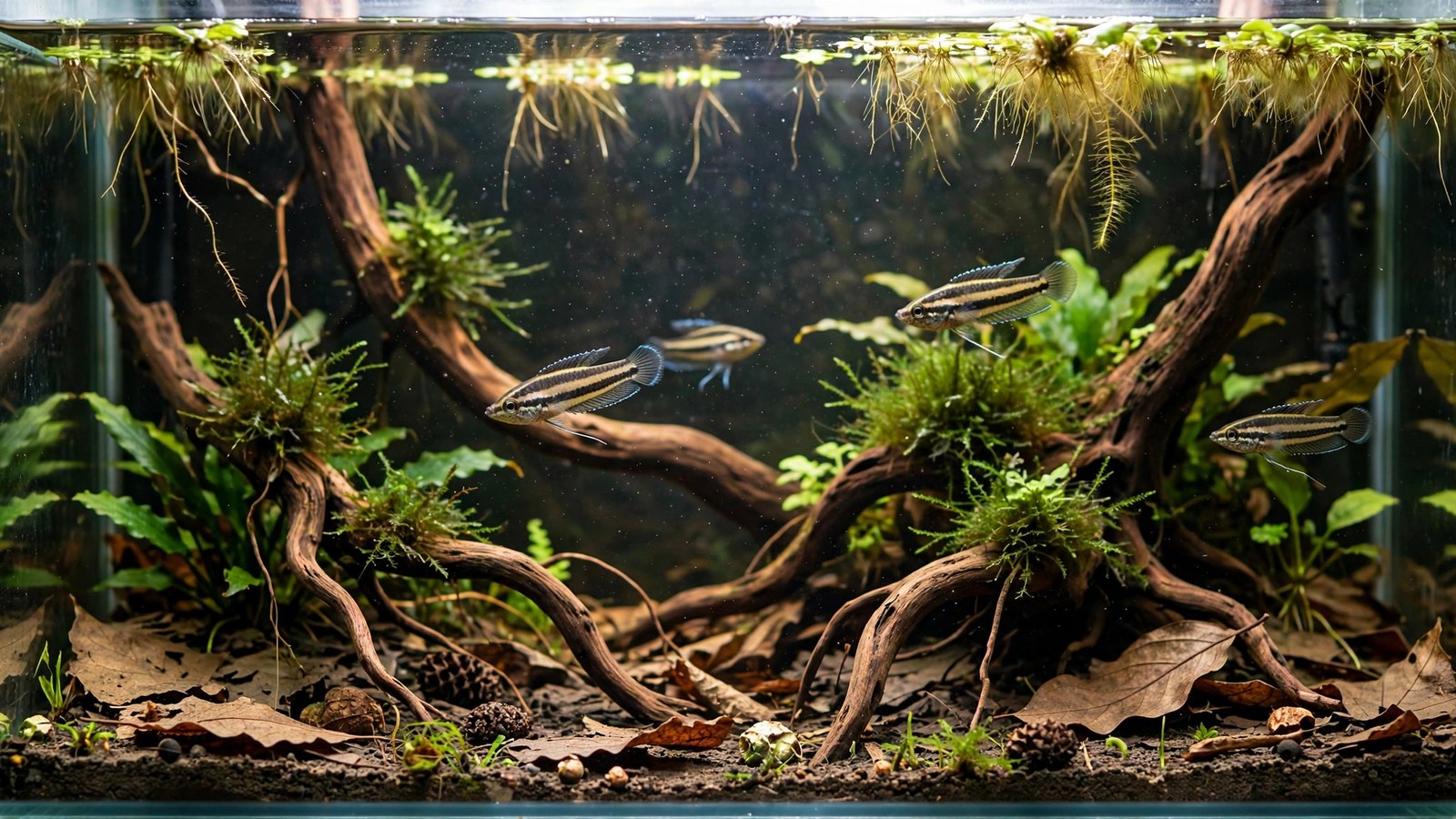
Most gourami advice targets dwarf, honey, and pearl gouramis — fish that shrug off ordinary community tanks. Licorice gouramis are nothing like them. A true licorice gourami planted tank recreates a Southeast Asian peat swamp: water so soft and acidic it barely registers on a test kit, tinted amber by tannins, dim enough that the males' jewel-like fins glow in the gloom. Here is how to build one.
Licorice Gourami Planted Tank: The Blackwater Blueprint
Every Parosphromenus species comes from the same unlikely home: shallow peat-swamp pools in Indonesia and Malaysia, where fallen leaves pile deep and the water reads pH 3.5–5.0 with almost no mineral hardness. Treat these fish like dwarf gouramis and they simply fade. Match their swamp and males flare fins of iridescent blue-green edged in black and red.
Your build rests on three pillars. First, chemistry: genuinely soft, acidic water, which means blending RO water with a little tap — most tap water is far too hard. Second, tannins: catappa leaves, alder cones, and driftwood tint the water tea-colored and release the humic compounds these fish evolved with. Third, cover: a dim canopy of floating plants suited to a shaded blackwater surface, plus driftwood tangles and leaf-litter beds where a 2-inch fish can vanish.
Chocolate gouramis are the closest comparison — see our chocolate gourami planted tank guide — but even they forgive more than Parosphromenus. There is no "close enough" with hard tap water. If you cannot commit to RO water and leaf litter, build a dwarf gourami planted tank instead and save yourself the heartbreak.
Water Parameters: The Softest Water You'll Ever Keep
This section decides everything: licorice gouramis are chemistry fish. Hit these targets and check them weekly while the tank matures.
| Parameter | Target | Notes |
|---|---|---|
| pH | 4.0–6.0 | Mid-5s ideal; stability beats precision |
| GH | 1–4 dGH | Under 1 risks pH crashes; over 5 stresses fish |
| KH | 0–2 dKH | Low KH lets tannins hold pH down |
| Temperature | 75–79°F (24–26°C) | Tight lid keeps surface air humid |
| Ammonia / nitrite | 0 ppm | Cycle fully first — 4–6 weeks |
| Flow | Gentle | Sponge filter or baffled hang-on-back |
Mix RO water with 10–20% tap for GH 2–3 dGH, then let catappa leaves (8–12 per 10 gallons, replaced monthly) and driftwood pull pH down. Never chase pH with chemical buffers — in water this soft, one overdose swings pH two points overnight. Aim for 30–80 ppm TDS. A sponge filter rated for 10–20 gallons gives biological filtration with almost no current.
Plants That Thrive in Shade and Tannins
Getting plants wrong wastes weeks, so choose species built for dim, acidic, tannin-stained water, following a fish-first approach to choosing aquarium plants: the fish's need for cover dictates every choice. Plant densely from day one — 60–70% coverage — because an exposed licorice gourami hides until it wastes away.
| Plant | Role | Why it works here |
|---|---|---|
| Amazon frogbit / salvinia | Floating canopy | Diffuses light; roots shelter fry |
| Java fern | Midground on wood | Thrives on driftwood down to pH 5.0 |
| Anubias nana | Foreground accents | Tough, low-light, tolerates acidic water |
| Cryptocoryne wendtii | Midground clumps | Softwater classic; melt passes in weeks |
| Java moss | Cave and wood dressing | Microfauna hotel for grazing fry |
| Bucephalandra | Hardscape detail | Slow, stunning, unbothered by blackwater |
Scaping for Shy Fish: Hides, Caves, and Calm
Scape this tank like a hiding place, not a display. Start with 1–1.5 inches of fine sand, then lay 2–3 inches of mixed leaf litter — catappa, oak, beech — across most of the floor, and add branching driftwood that breaks sightlines front to back.
Caves are not optional. Males are cave spawners: they claim a tight, dark crevice and court females to it. Halved coconut shells with a 1-inch entrance, sideways terracotta pots, or stacked slate all work — one cave per male plus a spare, in the dimmest corners. Our sparkling gourami planted tank guide uses the same cave-and-canopy logic: small shy gouramis breed only where they feel invisible.
Keep flow minimal and light dim — 0.3–0.5 watts per liter on a 6–8 hour photoperiod. The tank should look like dusk at the bottom of a forest pool, with the sponge filter hidden behind driftwood.
 ★4.8
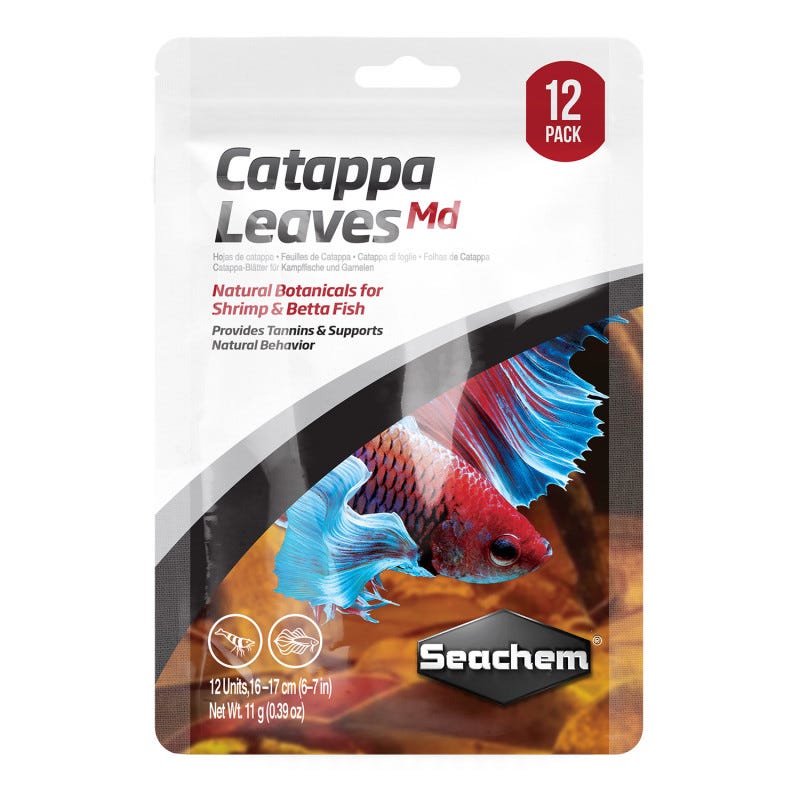
Seachem Catappa Leaves 12-pack
Check Price on Amazon ★4.8Feeding the Tiniest Gouramis
At barely 1.5–2 inches, licorice gouramis have pinhead-sized mouths, and most never touch flakes or pellets. Make live and frozen micro-foods the permanent diet: baby brine shrimp, microworms, grindal worms, frozen daphnia or cyclops — tiny portions twice daily, gone in two to three minutes. Uneaten food rots fast in warm, low-buffer water.
Culture one live food yourself: microworms cost almost nothing and need ten minutes a week. Fish eating well show it within a week — deeper color, active patrolling, males flaring along the glass.
Tank Mates: Keep It Calm or Keep It Solo
Safest is species-only: a pair or trio in 10 gallons, six to eight in a 20-gallon long with multiple caves. These fish are peaceful but profoundly timid — boisterous tank mates steal their food and pin them in hiding, a slow death sentence for a fish this specialized.
If you want company, stick to calm blackwater natives — ember tetras, chili rasboras, pygmy corydoras — added after the gouramis are settled and eating. Skip anything nippy, anything that outcompetes them at feeding time, and anything big enough to eat a 2-inch fish.
Frequently Asked Questions
Can licorice gouramis live in regular tap water?
Usually not. Most tap water runs pH 7.0–8.0 with GH above 8 dGH, while these fish need pH 4.0–6.0 and GH 1–4 dGH. In hard alkaline water they stress and rarely survive long. Blend RO water with a little tap, and verify with liquid test kits before the fish arrive.
How many licorice gouramis can I keep in a 10-gallon tank?
A bonded pair or a trio (one male, two females) suits 10 gallons. Males are territorial around caves, so give each male one cave plus a spare. In a 20-gallon long, six to eight fish with three or four caves diffuses aggression and gives a real shot at natural spawning.
Do licorice gouramis eat flake food?
Almost never. These micro-predators have tiny mouths, and most refuse dry foods for life. Feed baby brine shrimp, microworms, grindal worms, and frozen daphnia twice daily in portions finished within three minutes. Fish ignoring flakes is normal — switch to live or frozen food.
Why is my blackwater tank water yellow — is that bad?
The amber tint is tannins from leaves and driftwood — exactly what you want. Tannins gently lower pH, inhibit some pathogens and algae, and signal "home" to peat-swamp fish. Never run activated carbon to strip the color: it also removes the humic compounds your gouramis benefit from.
Can I breed licorice gouramis in a planted tank?
Yes — a mature blackwater planted tank is one of the best places. Condition a pair on live foods for two to three weeks, provide a tight dark cave, and keep the tank undisturbed. The male guards the eggs about 10–14 days until fry emerge; they graze infusoria in moss until they take baby brine shrimp.
A licorice gourami planted tank is not a beginner project, and it should not pretend to be one. But commit to soft acidic water, tiny live foods, and a tank that looks like a peat swamp, and you will keep one of the most jewel-like fish in the hobby. For a gentler start, the lightly planted setup guide is a good stepping stone before the blackwater plunge.
Species details such as maximum size and natural habitat are documented on the Licorice gourami Wikipedia page, and the licorice gourami profile at Aqua-Fish.net offers a useful second opinion on water parameters and feeding.