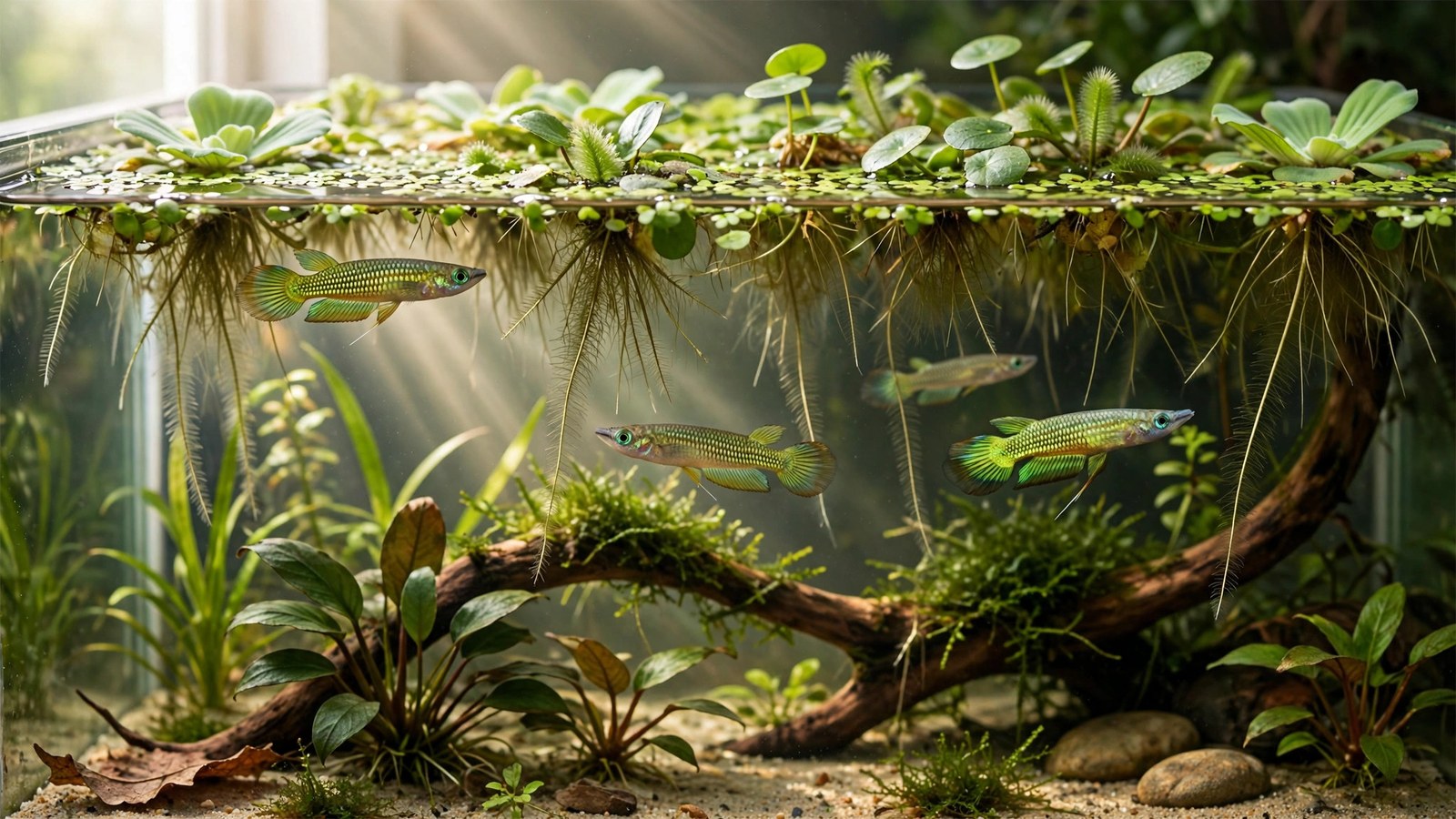
Most killifish die in home aquariums within weeks because hobbyists treat them like mid-water tetras. The golden wonder is different — it is a surface hunter, an ambush predator from the slow waters of India and Sri Lanka that spends its entire life in the top two inches of the tank. Build your golden wonder killifish planted tank around that one truth and you get a bold, hardy, constantly active fish. Ignore it, and you get a carpet surfer found behind the stand.
Building a Golden Wonder Killifish Planted Tank With a Floating Canopy
Everything about this fish points upward. The upturned mouth, the flattened back, the eyes set high on the head — Aplocheilus lineatus is built to strike insects off the surface film, exactly as it does in rice paddies and still backwaters. Your job is to recreate that air-water boundary inside the aquarium. A thick canopy of floating aquarium plants for beginners such as frogbit, red root floaters, and water lettuce does triple duty: it dapples the light as overhanging vegetation does in the wild, gives the fish cover and hunting ground, and softens the bright open surface that makes them nervous. Under a canopy they cruise, display, and feed boldly; under open bright light they pace the glass and jump more.
The canopy also deters jumping — a killifish does not leap into a mat of frogbit roots the way it leaps at a glaring open surface. Run the floaters in a corral or two rather than a wall-to-wall mat so your fish keeps strike lanes, and choose surface-cover plants for a top-dwelling hunter with long trailing roots, since the root tangle becomes a hunting ground for microfauna. Compare lid strategies in our open-top versus lidded tanks for jumpers guide.
 ★3.9
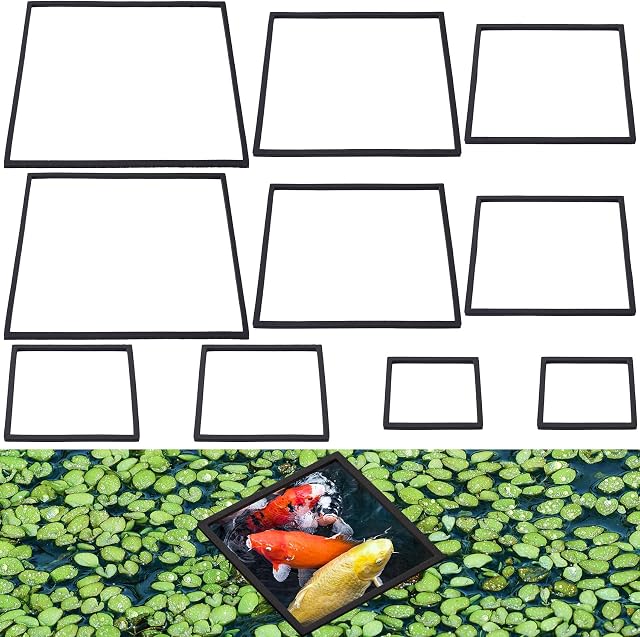
PAGOW Floating Plant Corral Rings
Check Price on Amazon ★3.9 ★4.6
NICREW ClassicLED Plus LED Aquarium Light
Check Price on Amazon ★4.6Water Parameters and Tank Size That Keep Panchax Calm
Golden wonders are genuinely hardy — they tolerate the standard planted-tank water parameters most community tanks already run. What they do not tolerate is a choppy surface: strong filter flow flattens the surface film they feed from and pins them in corners. Run filter output below the surface, keep agitation gentle, and clear protein film under the floaters with a surface skimmer on a timer. A long tank beats a tall one — a 20-gallon long gives a trio far more hunting territory than a 20 tall.
| Parameter | Target range | Notes |
|---|---|---|
| Temperature | 72–79°F (22–26°C) | Fine unheated in most rooms; add a heater only if nights drop below 70°F |
| pH | 6.5–7.5 | Adaptable — stability matters more than the exact number |
| GH / KH | 5–15 dGH | Handles moderately hard water well |
| Ammonia / nitrite | 0 ppm | Cycle the tank first; floaters help but are not a substitute |
| Nitrate | Under 30 ppm | Weekly 25–30% water changes keep it there |
| Surface flow | Gentle | The single most important "parameter" for this fish |
Feeding a Surface Hunter the Way It Eats
Watch a golden wonder feed once and you will never buy sinking pellets for it again. It hovers just under the surface, tracks the shadow of a fly, then strikes upward in a motion so fast you hear the click. Staple foods that land on top and stay there — pinhead crickets, flightless fruit flies, pre-soaked freeze-dried daphnia and bloodworms, and high-protein floating micro-pellets — match that instinct. Feed once or twice daily in amounts they finish in two minutes, and skip one day a week.
A wingless fruit-fly culture costs a few dollars, runs for weeks, and triggers the hunting behavior this fish is famous for — gold flanks flashing as it strikes. Frozen bloodworms and mysis work as backup; thaw them and offer at the surface with a feeding ring so they do not rain past the fish into the substrate.
Tankmates: Who Survives a Golden Wonder
Here is the honesty the species deserves: a full-grown golden wonder (males reach 4 inches, females slightly less) eats anything that fits in its mouth. Neon tetras, chili rasboras, cherry shrimp, and guppy fry are not tankmates — they are an expensive feeding program. Stock with that rule in mind and the fish is perfectly peaceful; break it and you will blame the killifish for being exactly what it is.
Good companions are calm fish too large to swallow: pearl and honey gouramis, larger rasboras, cherry barbs, and bottom-dwelling corydoras, which the killifish ignores. A school of dither fish in the mid-water — six or more of something sturdy — visibly relaxes golden wonders; a fish that sees other fish feeding calmly decides the area is safe and comes out of the roots. If you want schooling options suited to planted setups, see our list of schooling fish for planted tanks. Keep one male with two or three females; males spar with each other in small tanks, and the extra females spread the attention.
Frequently Asked Questions
Are golden wonder killifish good for beginners?
Yes — they are one of the hardiest killifish in the hobby. They accept a wide range of water conditions, eat eagerly, resist most common diseases, and live 3–5 years with basic care. The two beginner traps are a lidless tank (they jump) and tiny tankmates (they hunt). Get a tight lid and stock appropriately, and they are easier than most tetras.
How many golden wonder killifish should I keep together?
Keep one male with two to three females in a 20-gallon or larger tank. Males are territorial with each other and will spar, chase, and stress subordinates in confined space. A trio spreads male attention, gives females rest, and produces the best color and behavior from the male as he displays for his harem.
Why does my golden wonder keep jumping out of the tank?
Jumping is instinct, not misbehavior — in the wild they leap between pools and snatch low-flying insects. Triggers include bright open surfaces with no cover, sudden light changes at night, aggressive tankmates, and poor water quality. Add a floating-plant canopy, keep a sealed lid, and check ammonia and nitrite.
Can golden wonder killifish live with shrimp?
No — not safely. Cherry shrimp, baby amano shrimp, and all shrimplets are exactly the size this predator evolved to eat, and a golden wonder will hunt them relentlessly, even among plant roots. Large bamboo shrimp or fully grown adult amanos sometimes survive, but expect shrimplets to be picked off. Keep a separate planted shrimp tank instead.
Do golden wonder killifish need a heater?
Usually not. They thrive at 72–79°F, which matches normal room temperature in most homes year-round. Add a heater only if your room regularly drops below 70°F in winter. If you do use one, check our planted tank heater guide for sizing, and seal the cord cutout in your lid — the classic escape route.
The Payoff of Getting the Surface Right
A golden wonder killifish planted tank is one of the few setups where the least-planted zone — the surface — does the most work. Give this hunter its floating canopy, its sealed lid, and its daily insects, and it repays you with stalking, striking, flashing gold at a rival, and waiting at the surface each evening because it has learned your routine. Build the top two inches right and the rest of the tank almost takes care of itself. Read the Seriously Fish Aplocheilus lineatus profile for more on its wild behavior.