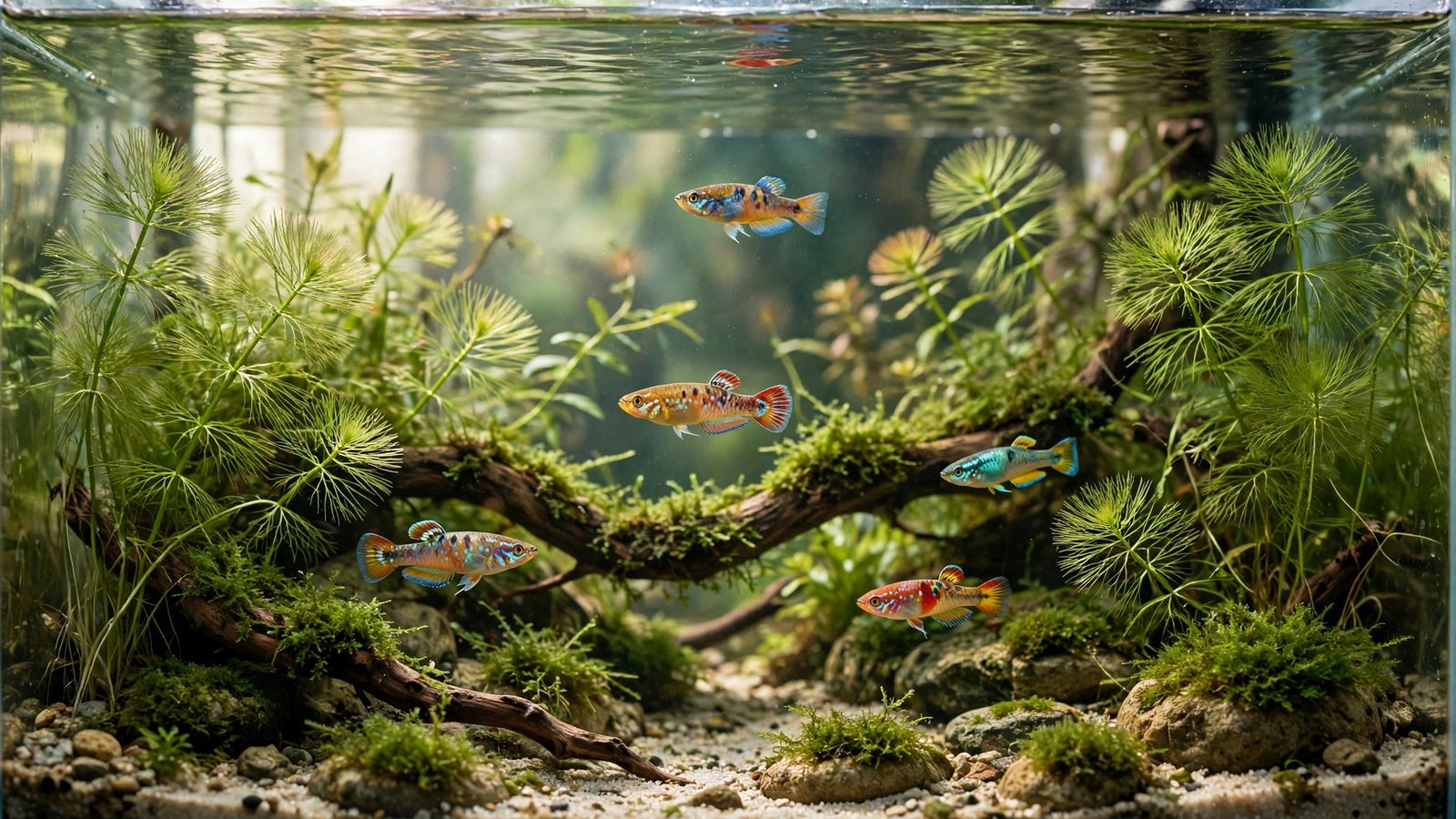
Most fish just need water. Killifish need a stage. Give them the best plants for killifish tanks and two things happen: skittish males stop pacing the glass and start showing color, and plant-spawning species tuck eggs into the fine foliage daily. This guide covers exactly which plants to pick — from hardy java moss to elegant water sprite — how to arrange them for breeding or display, and which species to avoid.
Why plants matter so much in a killifish tank
Killifish are nothing like tetras or guppies. Most species are small, territorial, and naturally shy — in the wild they live in shallow swamps and forest pools where overhanging vegetation is their whole world. Drop them into a bare glass box and you get washed-out colors, hiding fish, and zero breeding. The best plants for killifish tanks fix all three: fine foliage gives spawners somewhere to tuck eggs, plants break sightlines so males hold territories, floating cover dims the light and calms jumpers, and fast growers absorb nitrates in small, soft-water setups.
Know your killifish: spawning style decides your planting
Not all killifish use plants the same way, and buying the wrong plants for your species is the most common beginner mistake. There are three broad groups.
Plant spawners (permanent spawners)
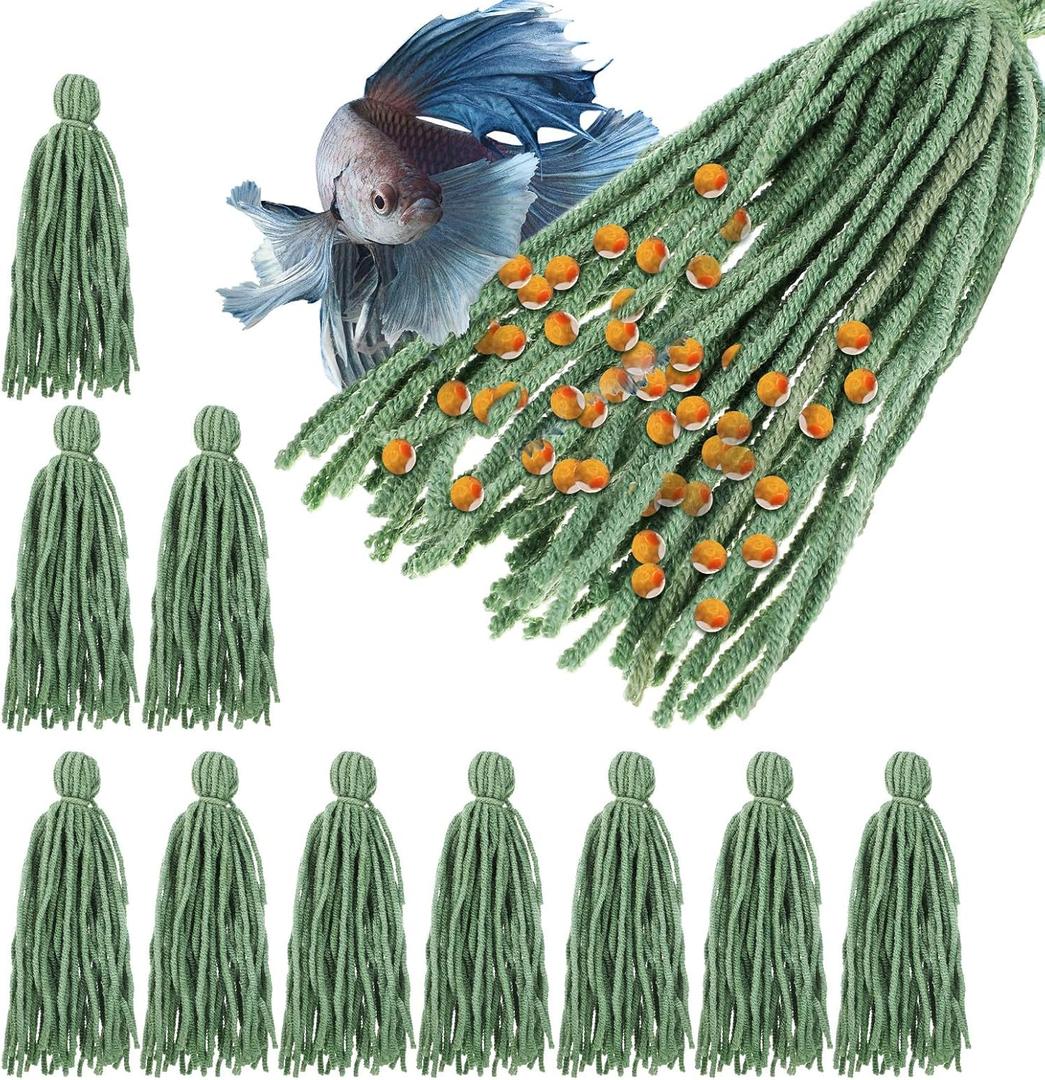
Species like Fundulopanchax, Aphyosemion, Gardneri killifish (F. gardneri), and Aphyosemion striatum scatter a few sticky eggs into fine-leaved plants every day, for months on end. The eggs cling to mosses and feathery foliage for 10–21 days before hatching — these are the fish this guide serves best, since a tank of the right plants is effectively a spawning machine. Breeders check the moss every few days and pull egg-laden clumps into separate containers. Many hang yarn spawning mops too, but live plants work as well or better — and they improve water quality while mops do nothing. See our guide to spawning plants for egg scatterers for the full technique.
Annual killifish (soil spawners)
African annuals like Nothobranchius rachovii, N. guentheri, and South American Austrolebias don't spawn on plants at all — they dive into peat moss or coconut fiber to bury their eggs. But plants are far from optional for annuals: these fast, nervous fish live hard and die young (often within 9–14 months), and a well-planted tank reduces stress and keeps aggression manageable in colonies. Choose plants that tolerate the cooler end of tropical, since many annuals do best at 68–74°F.
Good candidates include cold-water aquarium plants that shrug off unheated tanks, plus floating plants that keep the surface dim. Favor fast-growing background plants too, since annual tanks get torn down and reset frequently.
 ★3.8
Spawning Mops for Fish
Check Price on Amazon ★3.8The 12 best plants for killifish tanks
Every plant below grows in soft, slightly acidic water, survives low to medium light, needs no CO2, and serves as a spawning site, hiding place, or water purifier — usually two or three at once.
| Plant | Type | Light | CO2 | Temp (°F) | Best role |
|---|---|---|---|---|---|
| Java moss (Taxiphyllum barbieri) | Moss | Low | No | 59–82 | Egg sites, fry cover |
| Hornwort (Ceratophyllum demersum) | Stem/floater | Low–med | No | 59–86 | Spawning, nitrate removal |
| Water sprite (Ceratopteris thalictroides) | Fern | Low–med | No | 68–82 | Spawning site, floating or rooted |
| Amazon frogbit (Limnobium laevigatum) | Floater | Low–med | No | 64–86 | Surface cover, dimming |
| Red root floaters (Phyllanthus fluitans) | Floater | Med | No | 70–82 | Surface cover, striking color |
| Guppy grass (Najas guadalupensis) | Stem/floater | Low | No | 50–86 | Fry refuge, spawning |
| Dwarf sagittaria (Sagittaria subulata) | Foreground | Med | No | 60–82 | Carpet, territories |
| Java fern (Microsorum pterotoides) | Epiphyte | Low | No | 68–82 | Hardscape, shade |
| Anubias nana / petite | Epiphyte | Low | No | 72–82 | Structure |
| Cryptocoryne wendtii | Rosette/midground | Low | No | 72–82 | Midground |
| Brazilian pennywort (Hydrocotyle leucocephala) | Stem/floater | Med | No | 68–82 | Root egg sites |
| Anacharis / elodea (Egeria densa) | Stem | Low–med | No | 50–78 | Cool-tank background |
Java moss — the killifish breeder's number one
If you buy a single plant for a killifish tank, make it java moss. Plant spawners press their eggs directly into its dense, soft fronds, where they stay put for the full 10–21 day incubation. It grows in almost any water, tolerates temperatures from 59°F upward, and needs nothing but a tie-down point — driftwood, rock, or mesh. A golf-ball-sized clump becomes a fist-sized spawning bed in 6–8 weeks. Keep several clumps and rotate one into a hatching tub each week: pick eggs into tank water, swap in a fresh clump. Our best aquarium mosses guide compares java moss with Christmas moss and other alternatives.
Hornwort — the low-effort workhorse
Hornwort is the plant you throw in and forget about. Left floating, it forms long feathery strands that plant-spawning killies use enthusiastically; planted, it makes a fast background curtain. It grows in water as cool as 59°F, ideal for unheated annual tanks, and pulls nitrates out faster than almost any other common aquarium plant — which is why it stars in our roundup of fast-growing aquarium plants for new tanks. It can grow 2–4 inches per week, so trim regularly, and expect some needle-shedding when it first adjusts — it settles within a week or two.
Water sprite — spawning foliage and floating shade in one
Water sprite is the Swiss Army knife of killifish planting. Root it for a lacy midground bush that plant spawners lay eggs in, or let it float — it does both happily. Floating plants grow long trailing roots that killies weave through, and the roots collect infusoria that newly hatched fry graze on. It tolerates soft, acidic water and handles temperatures from 68°F up. Harvest the daughter plants that sprout on the leaves for your next killi tank.
Amazon frogbit and red root floaters — the stress killers
Ask experienced keepers what single change transformed their shy species, and floating plants come up again and again. Killies evolved under canopy shade; a bare, brightly lit surface makes them feel exposed, and exposed killies hide, lose color, and sometimes jump. Covering 50–70% of the surface with Amazon frogbit or red root floaters dims the tank and gives nervous fish the "roof" they expect. Frogbit is the tougher option — bigger leaves, handles lower light. Red root floaters are prettier (red roots, pink-tinged leaves) but want medium light and gentle flow. Scoop out a handful weekly to keep coverage self-regulated; our floating plants for beginners guide covers the full technique. Skip duckweed — same job, but it never leaves.
Guppy grass and Brazilian pennywort — fry insurance
Guppy grass (Najas) is arguably the best fry-survival plant ever sold. Its dense, brittle tangles are nearly impossible for adult killies to hunt through, so fry that hatch in it in a display tank actually survive. It grows floating or planted, handles 50°F water, and asks for nothing.
Brazilian pennywort plays a similar role with a different look: round lily-pad-like leaves plus a mass of fine roots when floated, which plant spawners deposit eggs among. Give it medium light or it goes leggy.
Dwarf sagittaria — the foreground that builds territories
Killifish males are territorial, and a flat empty foreground is a fighting arena. Dwarf sagittaria spreads by runners into a grass-like carpet 3–6 inches tall — enough to break sightlines and give each male a patch to claim, without hiding the fish from you. It carpets best in medium light and needs no CO2; a little root nutrition helps but isn't mandatory.
Java fern, anubias, and cryptocoryne — the bulletproof structure
These are your set-and-forget midground and background plants. Java fern and anubias attach to wood and rock (never bury their rhizomes), grow slowly in low light, and provide the dark backdrops that make killifish colors pop. Cryptocoryne wendtii fills the midground with broad leaves that shy species hover behind — and crypts love the soft, acidic, low-KH water that many other plants find tricky, as our guide to aquarium plants for soft water explains. Slow growth is a feature here: an inch a month means almost no trimming, and these species work in bare-bottom breeding tanks too.
Anacharis — the cool-water specialist
If you keep annual killifish in unheated tanks at 68–74°F, anacharis (Egeria densa) is one of the most reliable background plants you can buy: vigorous in cool water where tropical stems stall, heavy oxygenation, and dense whorled foliage that fry vanish into. It dislikes tanks above 78°F, so match it to your species' temperature range.
Layout plans: breeding tank vs. display tank
The plants don't change much between a breeding setup and a display tank — the arrangement does.
The breeding tank (10 gallons)
Think function over beauty. Bare bottom or thin sand (easier egg hunting), a gentle sponge filter, and three zones: a spawning bed of java moss and hornwort over one half, frogbit or water sprite over 60% of the surface, and an open third for courtship displays. Add driftwood with java fern for a territory anchor. Many killies breed better a few degrees cooler, so skip the heater if your species tolerates room temperature.
Collect eggs twice a week: lift moss clumps and floating roots, pick eggs into a small container of tank water, and incubate at the species' temperature.
The display tank (10–20 gallons)
Here you're building the flooded-margin habitat killies evolved in. Dark sand, a background of anacharis or hornwort, crypts and java fern on wood, a dwarf sagittaria carpet, and frogbit overhead. Against that dark backdrop, a male Fundulopanchax in full color is one of the hobby's great sights. Add guppy grass and some fry will survive even with adults present.
Plants to avoid in killifish tanks
Most aquarium plants are fine with killifish, but a few cause real problems:
- Duckweed — takes over permanently, shading out your spawning plants and clogging filters. Frogbit does the same job without the life sentence.
- High-light CO2 divas (dwarf baby tears, red stem plants) — killifish tanks run dim and low-tech; demanding plants melt, rot, and foul the water.
- Sharp or stiff foliage — killies are jumpers; rigid plants can injure fins during panicked dashes. Soft, flexible plants only.
- Untrimmed fast growers in 5-gallon tanks — aggressive species can suppress neighbors in tiny volumes; keep them trimmed.
- Plants needing hard, alkaline water — vallisneria and some swords sulk in the soft acidic water killies prefer. Most killies want it soft, so build the planting around that reality.
Quarantine new plants for a week or buy tissue-culture cups — pesticide residues from commercial growers can be dangerous in small killi tanks.
Frequently Asked Questions
Do killifish need live plants, or will spawning mops work?
Spawning mops work fine for collecting eggs from plant-spawning species, and many breeders use them. But live plants do everything mops do plus improve water quality, grow fry food, and reduce stress — and fish spawn more readily in planted tanks. For a display setup, plants are clearly better; for maximum harvest, combine moss clumps with one mop.
What temperature do killifish plants need?
Match the plants to your fish. Most tropical killies (Fundulopanchax, Aphyosemion) do well at 72–76°F, where every plant in this guide thrives. Annual Nothobranchius prefer 68–74°F, so lean on cool-tolerant species like hornwort, guppy grass, anacharis, and java moss. Avoid plants that demand 78°F+ — they'll stall in a cool killi tank.
Can I keep killifish with CO2 injection?
You can, but you almost certainly shouldn't. Killifish do best in calm, low-tech tanks, and CO2 brings pH swings and the risk of gassing small fish in low-volume tanks. Every plant here grows well without injected CO2 — a lightly dosed liquid fertilizer once or twice a week is all the supplementation a killi tank needs.
How much floating plant cover do killifish need?
Aim for 50–70% surface coverage. Less than a third and shy species still feel exposed; more than three-quarters and you starve submerged plants of light and risk overnight oxygen depletion. Scoop out a handful of floaters weekly to keep coverage self-regulated. If your killies hang at the surface gasping, you've gone too far — thin the floaters immediately.
Will killifish eat my plants?
Most killifish ignore plants completely — they're insectivores and micropredators, not herbivores. The exception is the American flagfish (Jordanella floridae), which grazes algae and will happily mow down soft plants; keep it with tough species like anubias and java fern.
What's the best plant setup for a 5-gallon killifish tank?
In a 5-gallon, go minimalist but complete: one golf-ball clump of java moss, a floating handful of hornwort, and frogbit covering half the surface. That's your spawning bed, nitrate filter, and stress reducer in three plants. Add a small piece of driftwood with java fern for structure. This exact trio also tops our list of easiest aquarium plants that need no CO2.
Start with moss, add shade, and watch them transform
The difference between a bare killifish tank and a planted one isn't subtle — it's the difference between fish that hide and fish that perform. A clump of java moss, a tangle of hornwort, and a layer of frogbit cost less than a bag of fish food and take an afternoon to arrange. Pick your species, match the temperature, and let the plants do the heavy lifting.