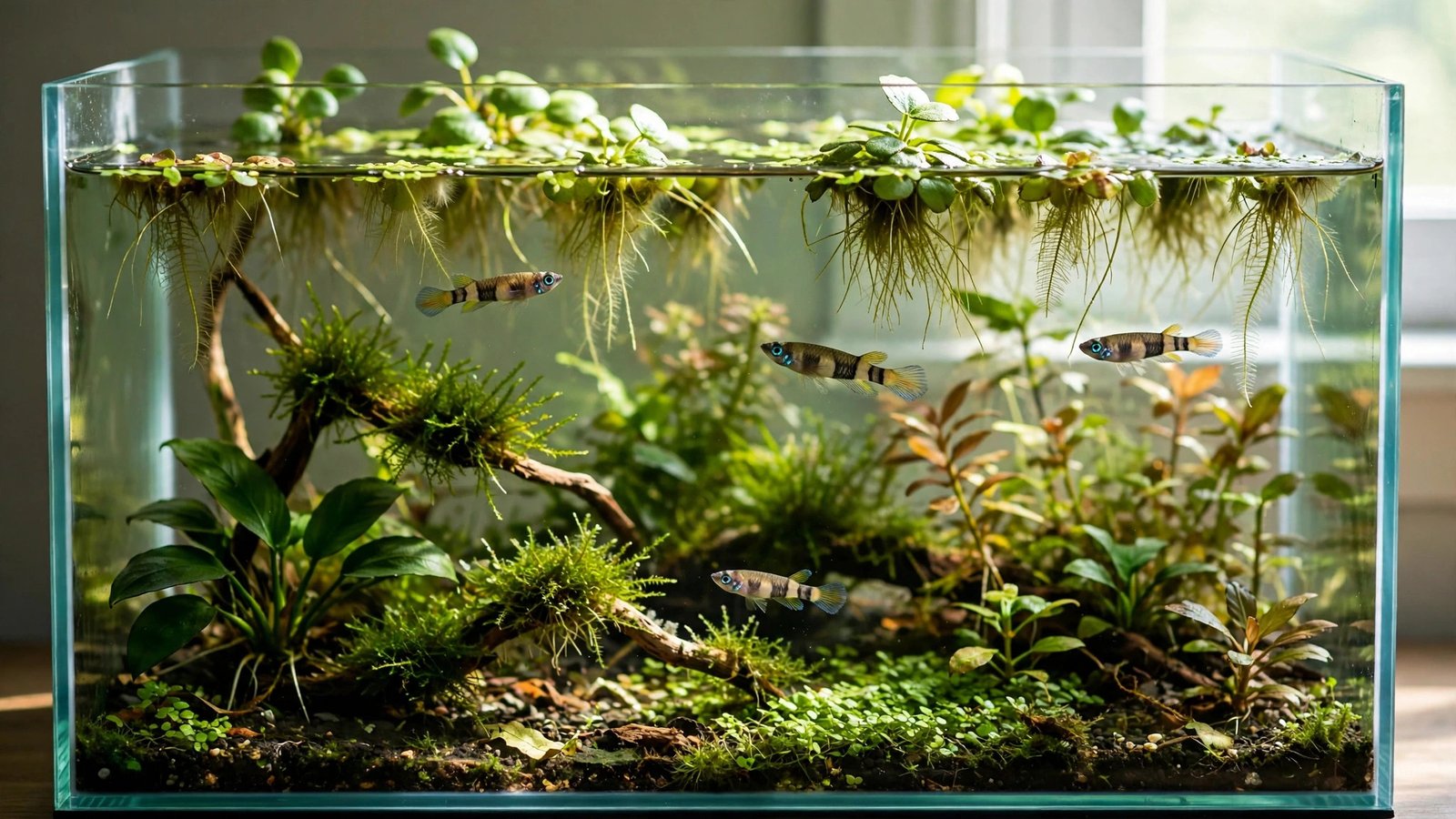
Most nano fish own the middle of the tank. The clown killifish owns the surface — a thumb-sized hunter from West African rice paddies that lives in the top two centimeters of water. Build your clown killifish planted tank around that thin slice — calm, plant-choked, mirror-still — and you will see what most aquarists never witness: males flashing their banded flanks beneath the roots, eggs tucked into root tangles, fry hunting from day one.
The Clown Killifish Planted Tank Is a Surface-Dweller's World
Epiplatys annulatus tops out around 3 cm, and the males earn the name: a cream-yellow body crossed with dark bands, a lyre-shaped tail edged in red and yellow, posturing at the waterline. Seriously Fish's Epiplatys annulatus profile counts them among the hobby's smallest killifish — and everything about their care follows from that size and that address. They hunt, court, and lay eggs in whatever dangles into the surface film.
That single fact dictates the whole build. Like another nano favorite, the celestial pearl danio, clown killies suit small, thoughtful tanks — but where danios use the whole water column, killies live on the ceiling. High flow ruins the setup: a filter that ruffles the surface pins these featherweight fish against the glass, scatters their live food, and leaves them stressed and washed-out.
Tank Size, Layout, and the Jumping Lid
A trio — one male, two females — is the classic starter group, and a 5-gallon is its minimum: small enough to keep tiny live foods dense and the surface calm. Scale to a 10- or 20-gallon for a colony of six to twelve. Footprint matters more than height; the fish never visit the bottom.
Scaping is upside-down relative to a normal planted tank. The underwater layer exists mostly for water quality: dark substrate, a few low crypts or anubias, maybe leaf litter. Our fish-first plant guide covers this balance — plants as life support, not the other way around. Spend your scaping budget on the ceiling; the floating canopy is the real aquascape here.
Put a lid on before the fish arrive. Clown killies are legendary jumpers. A tight-fitting nano lid with no gaps around cables is the most important purchase here; keep the waterline an inch below the rim as backup.
Floating Cover: The Non-Negotiable Layer
Treat floating plants as equipment, not decor. The dangling roots are the killies' shelter, spawning ground, and hunting cover. Cover 60–80% of the surface and leave one open lane for feeding. A mixed portion of frogbit and red root floaters is the easiest start — both root fast and grow the long tangles killies love.
| Floater | Why it works | Watch out |
|---|---|---|
| Amazon frogbit | Long dangling roots — the best spawning shelter | Melts under heavy lid condensation |
| Red root floaters | Compact rosettes, red roots | Needs decent light; dies back in dim hoods |
| Salvinia minima | Tough, fast, excellent fry cover | Shades everything below if unchecked |
| Dwarf water lettuce | Big rosettes, long roots | Needs airflow; too bulky for tiny nanos. Check local rules before buying — water lettuce is a prohibited exotic species in some states (e.g., Texas); never release it into the wild |
Corral the canopy with a loop of airline tubing so it stays out of the feeding lane, and thin it weekly — floaters double fast. See our floating plant picks for beginners for species-by-species help.
Still Water: Filtration Without Flow
The ideal filter is a simple sponge filter run on low air — it cleans and oxygenates while leaving the surface untouched. A hang-on-back works if you baffle the outflow and keep the water level high so the return does not splash. Never aim a powerhead or strong internal filter at the surface film.
Water changes need the same gentleness: 20–25% weekly, poured in slowly. Dechlorinate every batch and match temperature within a degree or two.
Water Parameters: Soft, Warm, Stable
Clown killies are forgiving on chemistry and demanding on consistency. Hit the ranges below, then leave them alone. Skip CO2 injection here — the surface agitation it needs works against the stillness they require, and the floating canopy grows fine on fish waste and modest light.
| Parameter | Target | Notes |
|---|---|---|
| Temperature | 72–78°F (22–26°C) | Room-temperature tanks often suffice |
| pH | 6.0–7.5 | Stability beats the exact number |
| GH / KH | Soft to moderate | 2–10 dGH |
| Ammonia / nitrite | 0 ppm | Cycle fully before adding fish |
| Nitrate | Under 20 ppm | The canopy drinks nitrates fast |
| Water changes | 20–25% weekly | Gentle pours; keep the surface calm |
Feeding Tiny Mouths: Live Food First
A clown killifish's mouth is a pinhead. Standard flakes are too big and sink too fast for a fish that eats only at the surface. The hierarchy: baby brine shrimp first, microworms second, grindal worms and wingless fruit flies for variety, crushed micro pellets only as backup. Feed small amounts twice daily.
A running DIY baby brine shrimp hatchery is the biggest upgrade you can make to this tank. Ten minutes a day, and the killies gather under the roots to pick orange nauplii off the surface one by one. Fry grow dramatically faster on live food than on any powder.
Breeding Mops and Colony Life
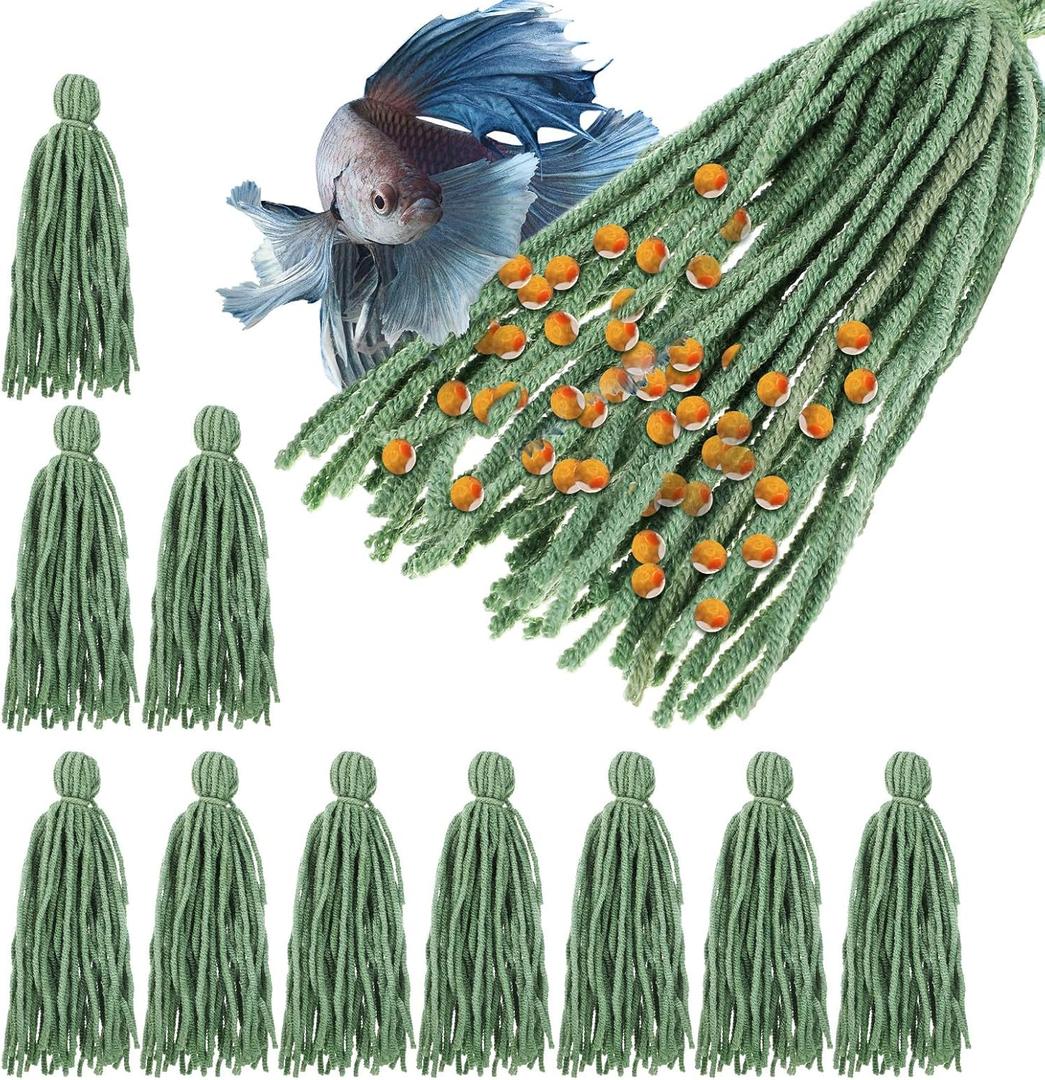
Clown killies are not annual killifish — no peat, no drying, no drama. Float a spawning mop of dark acrylic yarn at the surface, check it daily, and move the tiny clear eggs to a rearing container with matching water — or leave them in thick root tangles. Eggs hatch in roughly 12–14 days at 75°F, and fry take baby brine almost immediately.
In a well-planted tank the colony becomes quietly self-sustaining: adults spawn and some fry survive in the root zone. Keep one male per two to three females to spread out the sparring.
 ★3.8
Spawning Mops for Fish
Check Price on Amazon ★3.8Tank Mates and the Mistakes That Empty the Tank
Good neighbors are small, peaceful, and nowhere near the surface. See our guide to the best schooling fish for planted tanks — then cross off anything boisterous or surface-dwelling.
| Neighbors | Verdict |
|---|---|
| Chili rasboras, ember tetras | Peaceful; ignore the surface |
| Otocinclus, nerite and ramshorn snails | Algae crew; never bother killifish |
| Adult dwarf shrimp | Coexist fine; shrimplets get hunted |
| Bettas | Both claim the surface; bettas see flashing males as rivals |
| Guppies, zebra danios | Too boisterous; steal surface food |
Frequently Asked Questions
Do clown killifish really need floating plants?
Yes — treat them as mandatory, not decor. The roots are the killies' shelter, spawning ground, and hunting cover. Cover 60–80% of the surface with frogbit, red root floaters, or salvinia, leaving one open feeding lane. In a bare-surface tank they hug the corners, lose color, and jump more.
Can a trio live in a 5-gallon tank?
Yes — a 5-gallon is the classic minimum for one male and two females, small enough to keep tiny live foods dense and the surface calm. Two males in a 5-gallon will spar until one hides permanently. For a colony of six or more, move to a 10-gallon or larger; footprint matters more than height.
Will clown killifish jump out of the tank?
Yes — it is the most common way beginners lose them. Males spar at the surface and a startled fish can clear several inches. Run a tight-fitting lid with no gaps around cables, and keep the waterline an inch below the rim. Never treat a calm, peaceful tank as a safe open top.
What do clown killifish fry eat?
Newly hatched baby brine shrimp, almost immediately — a running hatchery is the difference between a few survivors and a real colony. Fry also graze infusoria off the floating roots for their first day or two, but do not rely on it. Feed tiny amounts two to three times daily, and sponge the filter intake.
A clown killifish tank asks for less than most setups and returns a living pond surface where tiny hunters work the root zone all evening. Give them the calm ceiling, the canopy, the live food, and the lid.