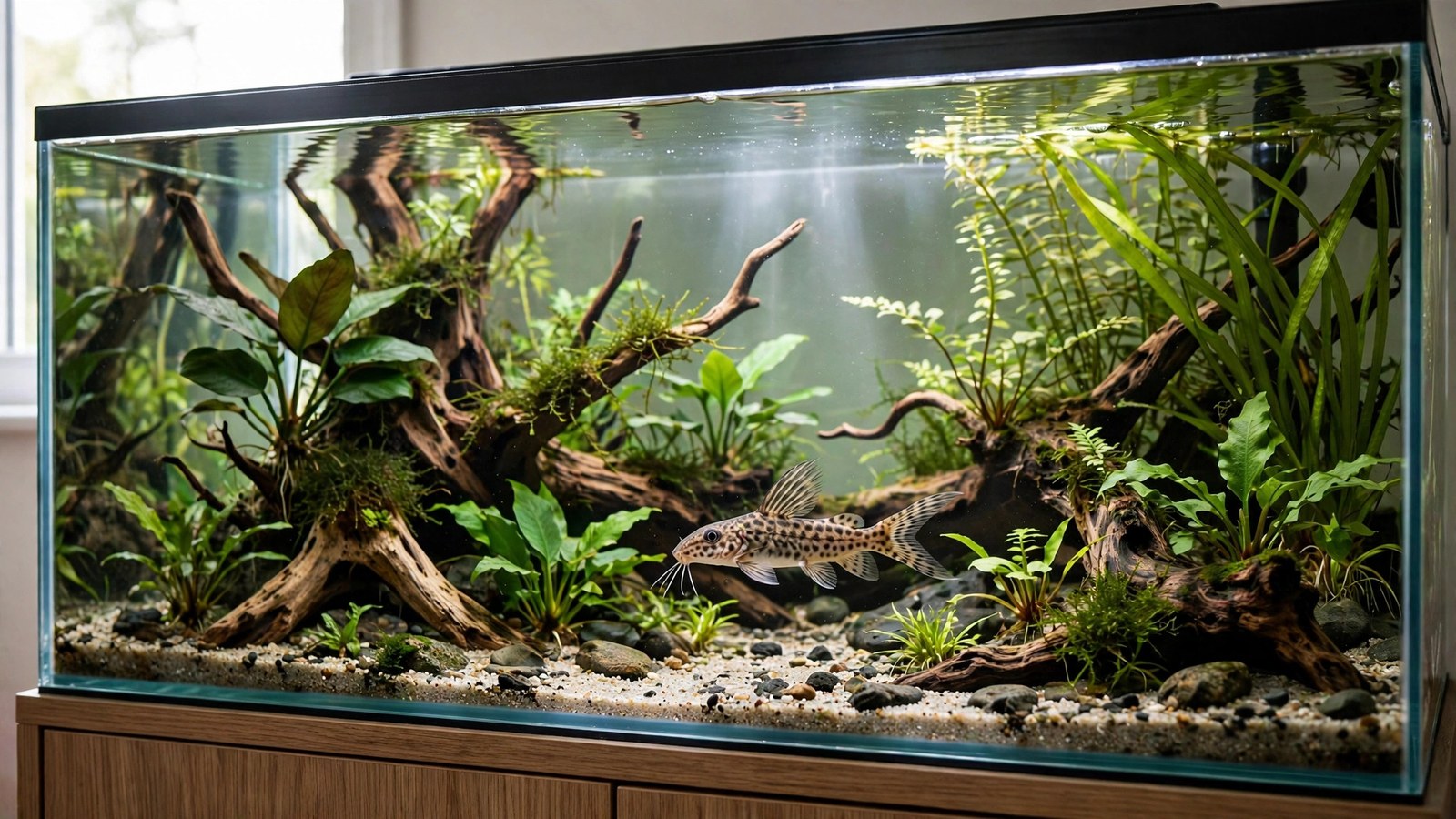
You will hear this fish before you really see it. Lights go out, the tank goes quiet, and a large shadow starts re-landscaping the gravel you levelled that morning — then squeaks if you ever try to net it. A featherfin squeaker planted tank works beautifully, but only if you design for a nocturnal, long-lived bulldozer first and a planted display second.
A featherfin squeaker planted tank needs at least 55 gallons, a 120 × 30 cm footprint, anchored caves, and hardy plants like Anubias and Vallisneria. Synodontis eupterus reaches 20–25 cm, is nocturnal, and gets its name from squeaking sounds made by rubbing its pectoral fin spines when stressed or netted — a warning to move it in a container, not a net.
Your featherfin squeaker planted tank starts with footprint, not height
Length matters more than litres on the label. An adult featherfin patrols the bottom in wide loops, turns in its cave, and needs room to forage without constantly bumping glass. A standard 55-gallon tank gives you that floor space. A tall, narrow 40-gallon does not, even if the water chemistry looks identical.
Plan for one fish. Two juveniles often coexist for a year, then the larger claims every cave and chases the other after dark. Unless you have 75 gallons or more with two separate cave systems at opposite ends, a single specimen is calmer and easier to feed.
For the wider planting framework, the complete guide to aquarium plants for a fish tank covers matching plant density to fish load — useful here, because a featherfin benefits from fast-growing plants pulling nitrate. For where a big bottom dweller fits in the crew picture, see our cleanup crew for a planted tank guide — with the honest caveat, covered below, that a featherfin also eats small crew members.
Build caves first, then plant around them
Start with hardscape on the glass, not on top of substrate. Place slate, river rock, or bogwood directly on the tank base, then add substrate around it. If you balance rocks on sand, your catfish will tunnel underneath, topple the stack, and can trap itself.
Give it at least two bolt-holes: one dark cave it can fully disappear into by day, and one overhang or wood tangle for evening foraging. Coconut caves and flat rock shelters work. Leave the front centre open as a feeding lane.
Use smooth sand or fine, rounded gravel — sharp gravel scrapes barbels as the fish sifts the bottom. A thin sand bed with root tabs under swords and Vallisneria is easier to keep clean.
 ★4.2
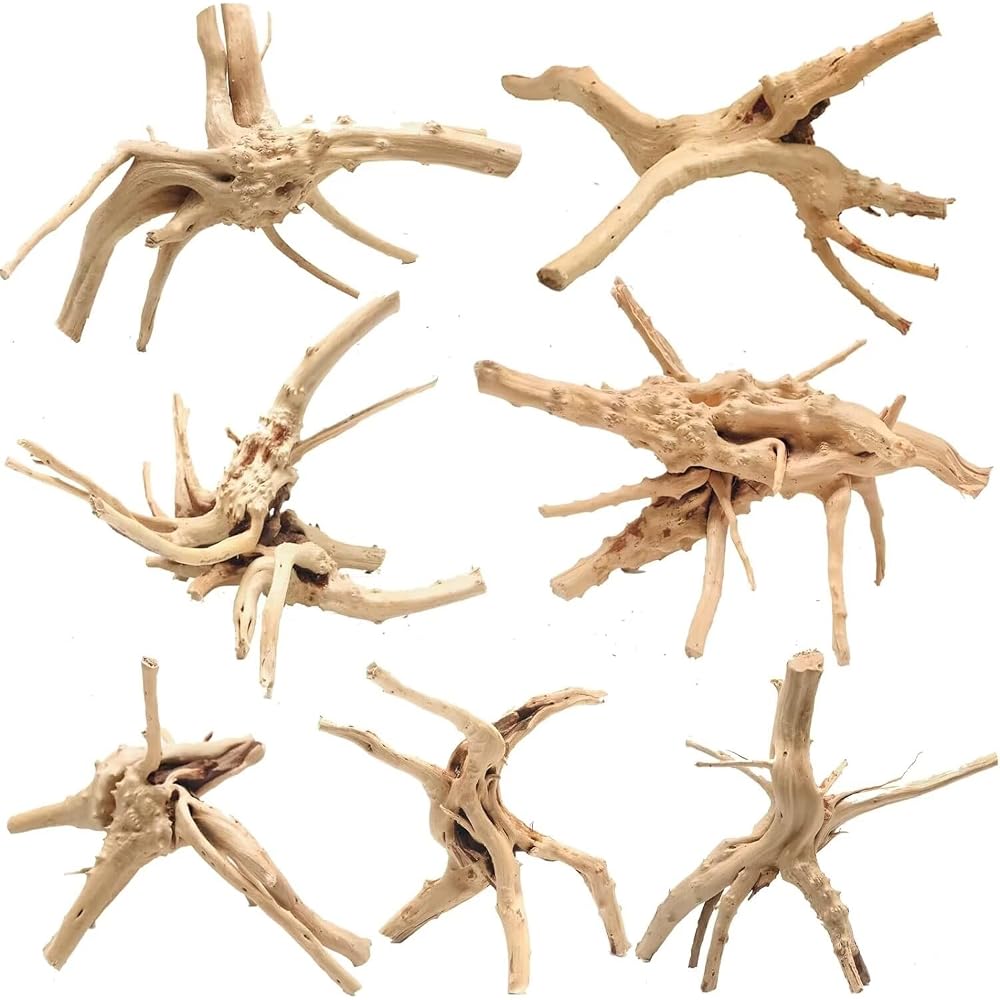
Hamiledyi Natural Spider Wood Driftwood
Check Price on Amazon ★4.2Plants that survive a rearranging catfish
Forget delicate carpets and freshly planted stems in open substrate. A featherfin rarely eats plants, but it digs and barges nightly, uprooting anything shallow. Success comes from plants that are tied, wedged, weighted, or deeply rooted.
Anubias and Java fern are your backbone — attach them to wood and rock, well above digging depth. Vallisneria roots deeply enough to hold once established, and Amazon swords develop heavy root systems, especially in a corner protected by hardscape. Floating plants finish the job, softening light from above.
This is a natural fit for a low-tech planted tank setup — none of these plants need injected CO2 or high light, which suits a fish that prefers shade.
Light, cover, and feeding after dark
Run moderate light for the plants, but break it up. Salvinia, red root floater, or a dense Vallisneria canopy creates the dappled shade this species expects. Without cover, most featherfins stay wedged in a cave until the room is dark, and you will rarely see the tall, sail-like dorsal fin that gives the fish its name.
Feed in two shifts: other fish by day, then sinking pellets, wafers, or frozen bloodworms for the featherfin 30–60 minutes after lights-out. A dim room light lets you watch it emerge — it learns the routine within a week and waits at the feeding lane.
Keep filtration strong but avoid a bare, high-current bottom. Do weekly 30–40% water changes, vacuum around caves where food collects, and check PlanetCatfish for Synodontis eupterus for collection data and keeper notes beyond a shop label.
Tankmates: the honest rules
Think in sizes, not labels that say “community.” Featherfins are not aggressive by day, but they are opportunistic at night. As Seriously Fish’s Synodontis eupterus profile notes, if a fish can fit across the width of the catfish’s mouth, it is not safe long-term.
Good tankmates are mid-water fish too large to swallow and too calm to nip fins: larger rainbowfish, Congo tetras, and peaceful medium cichlids. Avoid fin-nippers, which target the long dorsal finnage, and other large Synodontis competing for the same caves.
That changes its cleanup role. Cleanup-crew guides rightly celebrate bottom dwellers for eating leftovers — a featherfin does that well — but it is a predator of small crew members, not a nano cleanup fish. It will eat cherry shrimp, small snails, and fry.
| Trait | Featherfin squeaker (S. eupterus) | Upside-down catfish (S. nigriventris) |
|---|---|---|
| Adult size | 20–25 cm | About 10 cm |
| Minimum tank | 55 gallons, single specimen | 20–30 gallons, group of 5+ |
| Swimming | Upright, bottom-focused | Often upside-down under leaves |
| Small fish and shrimp | Unsafe — will eat them | Mostly safe with nano fish |
| Best role | Solo statement catfish, large tank | Small group, peaceful community |
That comparison matters because shops sell both as cute, spotted juveniles. A 4 cm featherfin looks harmless in a 20-gallon community. Two years later it is the largest fish you own. Buy for the adult size and lifespan, not the shop size.
Frequently Asked Questions
How big does a featherfin squeaker get in a planted tank?
Expect 20–25 cm, with a tall dorsal fin that makes it look even larger. Growth is fastest in the first two years, then slows. A 55-gallon tank is the minimum lifetime home; smaller tanks restrict activity long before they visibly stunt growth.
Will a featherfin squeaker eat my tetras and shrimp?
Yes, if they are small enough to swallow. Neon tetras, male guppies, baby fish, and cherry shrimp are all at risk, especially overnight. Larger tetras such as Congos are usually safe. No feeding trick reliably overrides size — choose tankmates it cannot fit in its mouth.
Why does my featherfin squeak and hide all day?
Hiding by day is normal for this nocturnal species, and squeaking is a stress sound made with its pectoral fin spines, most often during netting. If it never emerges at dusk, add floating cover, check it has a fully dark cave, and feed after lights-out.
Can I keep two featherfin squeakers together?
Only in 75 gallons or more, with separate cave territories at opposite ends and plenty of visual barriers. In smaller tanks one fish becomes dominant and chases the other from every shelter. For most planted tanks, one healthy specimen is the calmer choice.
What plants will a featherfin not uproot?
Anubias and Java fern attached to wood or rock are safest because their roots are out of digging range. Well-established Vallisneria and Amazon swords also hold once rooted deeply. Avoid freshly planted stems and carpets in open substrate — nightly digging, not plant-eating, destroys them.
A statement fish, if you plan for the adult
Kept well, a featherfin becomes the fish visitors remember: a sail fin rising from the plants at dusk, barbels tasting the sand, unbothered by the community above it. Give it footprint, anchored shelter, tough plants, and food after dark, and it will repay you with a decade or more of that quiet, after-hours presence.