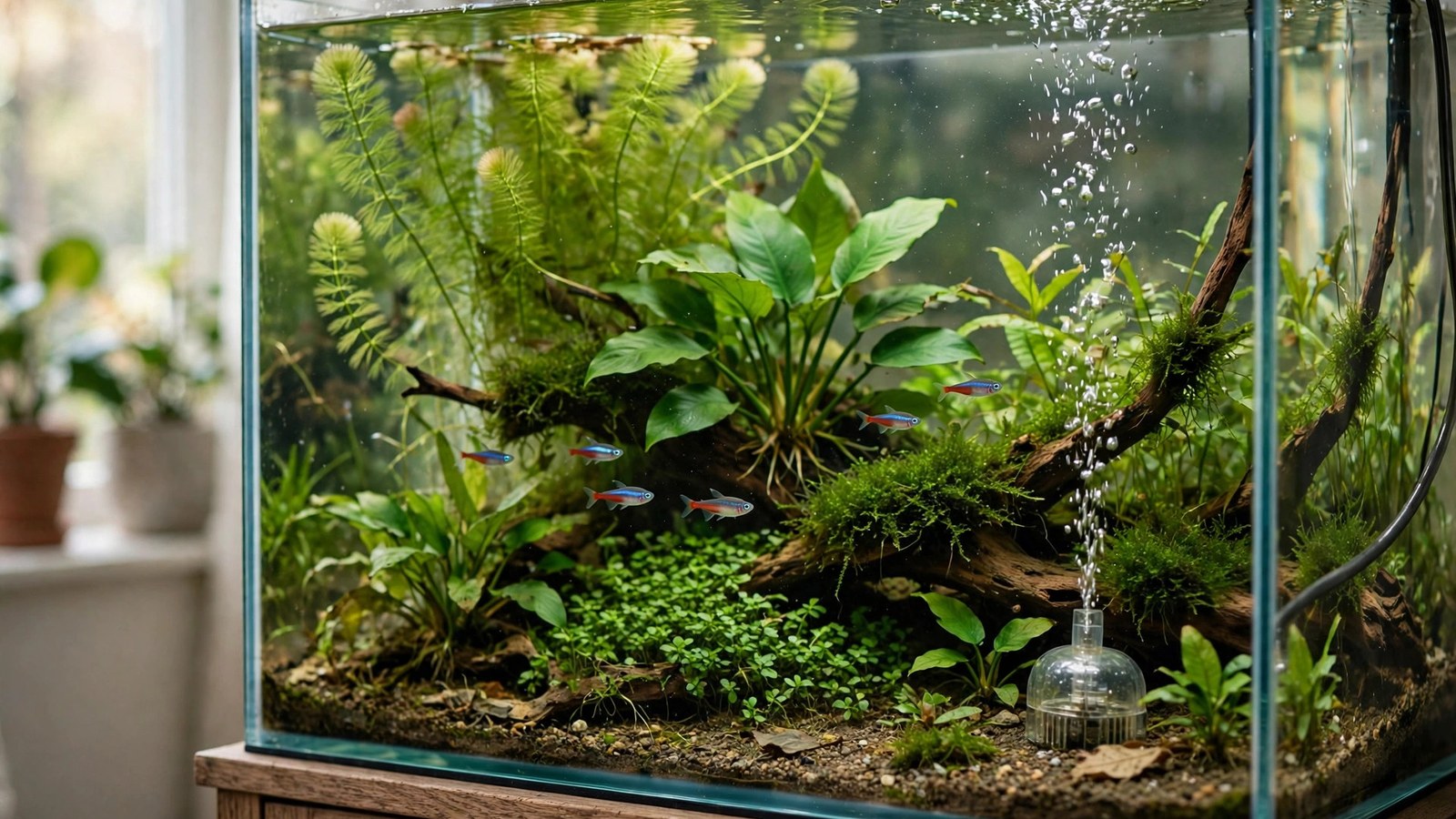
Here's the costly mistake almost every beginner makes: they set up a gorgeous planted tank, start injecting CO2, and then leave the air stone running 24/7 — literally bubbling their expensive CO2 straight out of the water. So, do planted tanks need an air stone? By the end of this guide you'll know exactly when aeration helps, when it sabotages injected CO2, and the day/night timer schedule that gives you both.
Do Planted Tanks Need an Air Stone? The Day/Night Truth
The honest answer: whether your planted tank needs an air stone depends on the hour, so the real question is when, not if. An air stone simply moves water to the surface and mixes in air, pushing dissolved gases toward atmospheric equilibrium. That equilibrium is the whole story, and it flips between day and night.
During daylight, healthy plants photosynthesize and release oxygen themselves — leaf pearling is oxygen your plants made for free. The problem: the same surface agitation that adds oxygen also strips dissolved CO2. A daytime air stone forces you to raise the bubble rate just to hold a stable concentration, and stability is what matters most. Our deep dive on surface agitation versus CO2 retention covers the gas-exchange physics.
At night the equation reverses: photosynthesis stops but respiration doesn't — plants, fish, shrimp, and bacteria all keep consuming oxygen and exhaling CO2. In a heavily planted, well-stocked tank, oxygen sags by morning and CO2 can accumulate to levels that stress livestock. That's the window where an air stone earns its place.
How an Air Stone Interferes With Injected CO2
CO2 off-gassing follows one rule: the more turbulent the surface, the faster dissolved CO2 escapes. The 2Hr Aquarist's guide to surface agitation in CO2-injected tanks explains the trade-off well. Symptoms: creeping algae (unstable CO2 feeds it), a drop checker stuck on blue despite a high bubble rate, and a CO2 cylinder that empties weeks early.
Without CO2 injection the trade-off barely exists — ambient CO2 is all you get, so a daytime air stone is harmless. Once you inject, the fix isn't choosing one or the other; it's separating them in time with a timer.
The Timer Schedule That Does Both Jobs
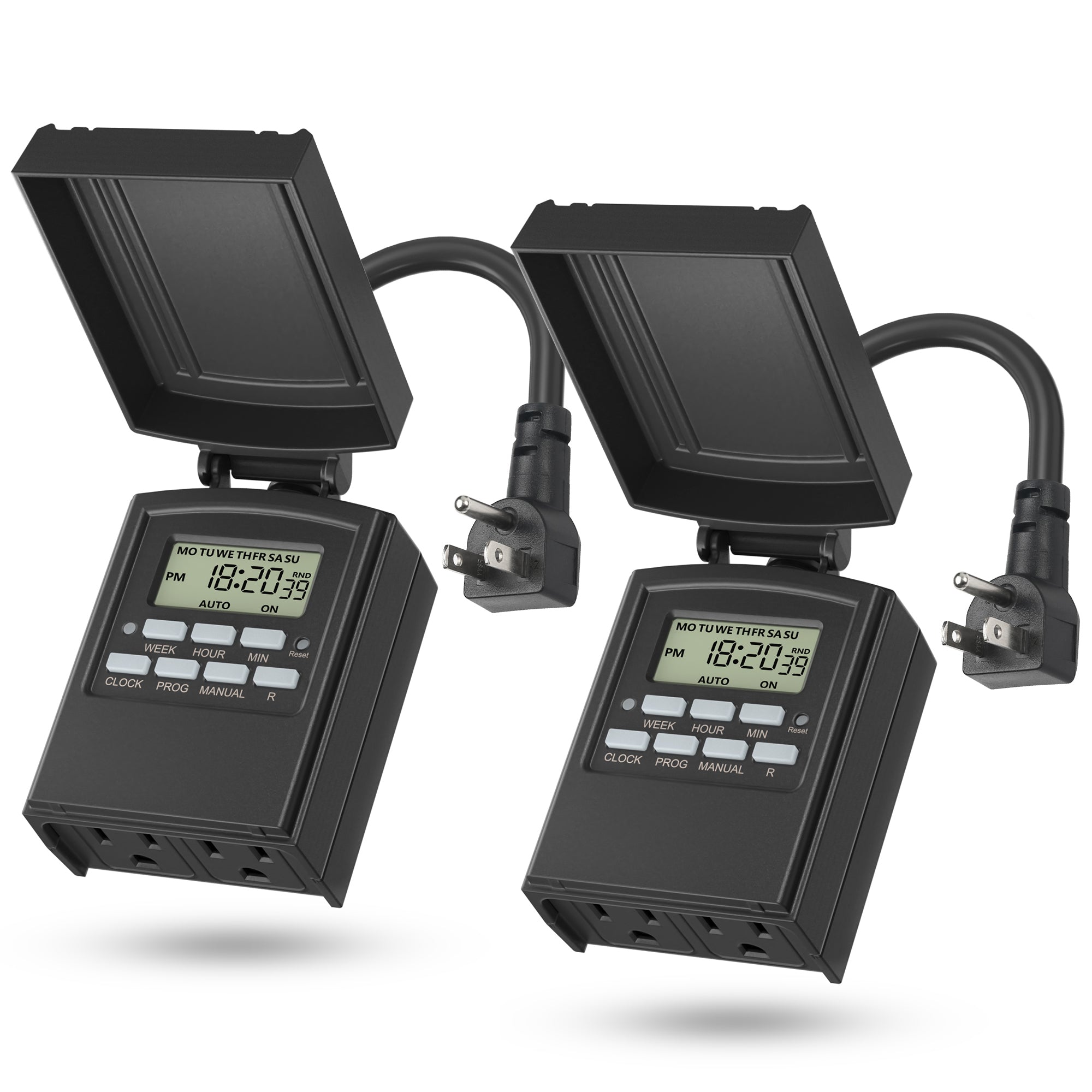
A two-outlet timer plug lets CO2 and aeration take turns: CO2 climbs to target before lights-on, holds steady through the photoperiod, then the stone takes the night shift.
| Time | Equipment | Why |
|---|---|---|
| 1 hour before lights-on | CO2 on, air stone off | CO2 reaches target before photosynthesis starts |
| Lights on (8–10 h) | CO2 on, air stone off | Stable CO2; plants release oxygen themselves |
| 1 hour before lights-off | CO2 off, air stone off | CO2 decays; drop checker drifts back toward blue |
| Lights-off | Air stone on | Oxygenates water while plants respire all night |
| 1 hour before lights-on | Air stone off | Surface calms so the next CO2 pulse builds fast |
A 4 dKH drop checker is your cheap referee: lime-green by day means ~30 ppm, blue means more CO2 (or less agitation), yellow means back off immediately — livestock are in danger.
 ★4.4
BN-LINK Digital Outlet Timer
Check Price on Amazon ★4.4When Night Aeration Is Non-Negotiable
Not every planted tank needs nighttime bubbling, but some setups genuinely do:
- Heavily stocked tanks: more fish means more nighttime oxygen demand. Fish hovering near the surface at dawn are asking for help.
- High CO2 dosing: if your drop checker sits lime-green-to-yellow, the stone blows off residual CO2 overnight so livestock recover before morning.
- Warm rooms: warm water holds less oxygen — tanks at 80°F (27°C) or above are strong candidates for night aeration.
- Medication treatments: many medications depress oxygen or stress gills — run the air stone around the clock until treatment ends.
- New tanks: during the first month of a planted tank, bacterial colonies are still establishing — night aeration is cheap insurance.
Our night aeration guide for planted tanks covers the full overnight routine in depth — this article is the decision guide; that one is the implementation manual. The UKAPS discussion on aeration and oxygenation with CO2 is also worth a read.
When You Can Skip the Air Stone Entirely
An air stone is genuinely optional in several common setups. If your filter outflow ripples most of the surface, you already get meaningful gas exchange — a hang-on-back filter on a planted tank aimed to break the surface gently often does the job alone. Lightly planted, lightly stocked tanks built from a lightly planted aquarium setup usually hold fine oxygen levels around the clock.
Livestock behavior is the decider: in the first hour after lights-on, fish cruising mid-water with calm gills means oxygen is fine; gasping at the surface or shrimp climbing the glass means add the stone on a timer and re-observe.
| Setup | Daytime air stone | Nighttime air stone |
|---|---|---|
| CO2-injected, medium–heavy stocking | No | Yes, on timer |
| CO2-injected, light stocking | No | Optional — watch livestock |
| No CO2, filter ripples surface | Optional | Optional |
| Planted community tank, no CO2 | Optional | Recommended on timer |
What to Buy (If You Decide You Need One)
Aeration gear is cheap: a small adjustable pump, a fine-pore ceramic air stone, a check valve, and a two-outlet timer cover the whole job for under $30. For bedroom tanks, pick a diaphragm pump under 35 dB and mount it above water level so a valve failure can't siphon.
Unsure about your source water? The Father Fish natural aquarium approach and our silent cycling guide cover water-stable setups that make aeration decisions simpler.
Frequently Asked Questions
Will an air stone remove CO2 from my planted tank?
Yes — surface agitation drives dissolved CO2 toward atmospheric equilibrium, far below the 20–30 ppm injected tanks target. A daytime stone strips CO2 as fast as you inject it, forcing higher bubble rates and unstable levels that trigger algae. Run it at night only, when CO2 off-gassing helps livestock instead.
Can I run an air stone and CO2 at the same time?
You can, but not during the photoperiod. Simultaneous aeration and injection fight each other: wasted CO2, unstable concentrations, and a CO2 spike risk if the stone's output changes. Standard practice is a timer — CO2 by day, air stone by night — so each works when the other isn't.
Do plants produce enough oxygen during the day that I don't need aeration?
In a healthy planted tank, yes. Photosynthesizing plants release significant oxygen — visible as pearling — and a gently rippling filter outflow handles the rest. Daytime aeration is redundant in most planted setups; the risk window is night, when plants consume oxygen instead of producing it.
How do I know if my tank needs night aeration?
Watch livestock in the first hour after lights-on: fish gasping at the surface, rapid gill movement, or shrimp climbing the glass signal low oxygen. Heavy stocking, water above 80°F (27°C), and aggressive CO2 dosing raise the odds. When in doubt, add a timer-run stone — gentle night aeration harms nothing.
Should the air stone be on during a CO2 blackout or algae treatment?
Run aeration around the clock during most treatments. Stressed plants photosynthesize less, medications can depress oxygen, and dying algae consume it as they break down. Pause CO2 injection during treatment, then resume your normal day/night schedule once the tank stabilizes.
The Bottom Line on Air Stones and Planted Tanks
You don't need to choose between aeration and CO2 — just stop running them at the same time. Kill the air stone during the photoperiod so CO2 stays stable and plants can pearl, then let a timer fire the stone up at lights-out so fish and shrimp sleep in oxygen-rich water. It's a $30 setup and a habit that pays off nightly.