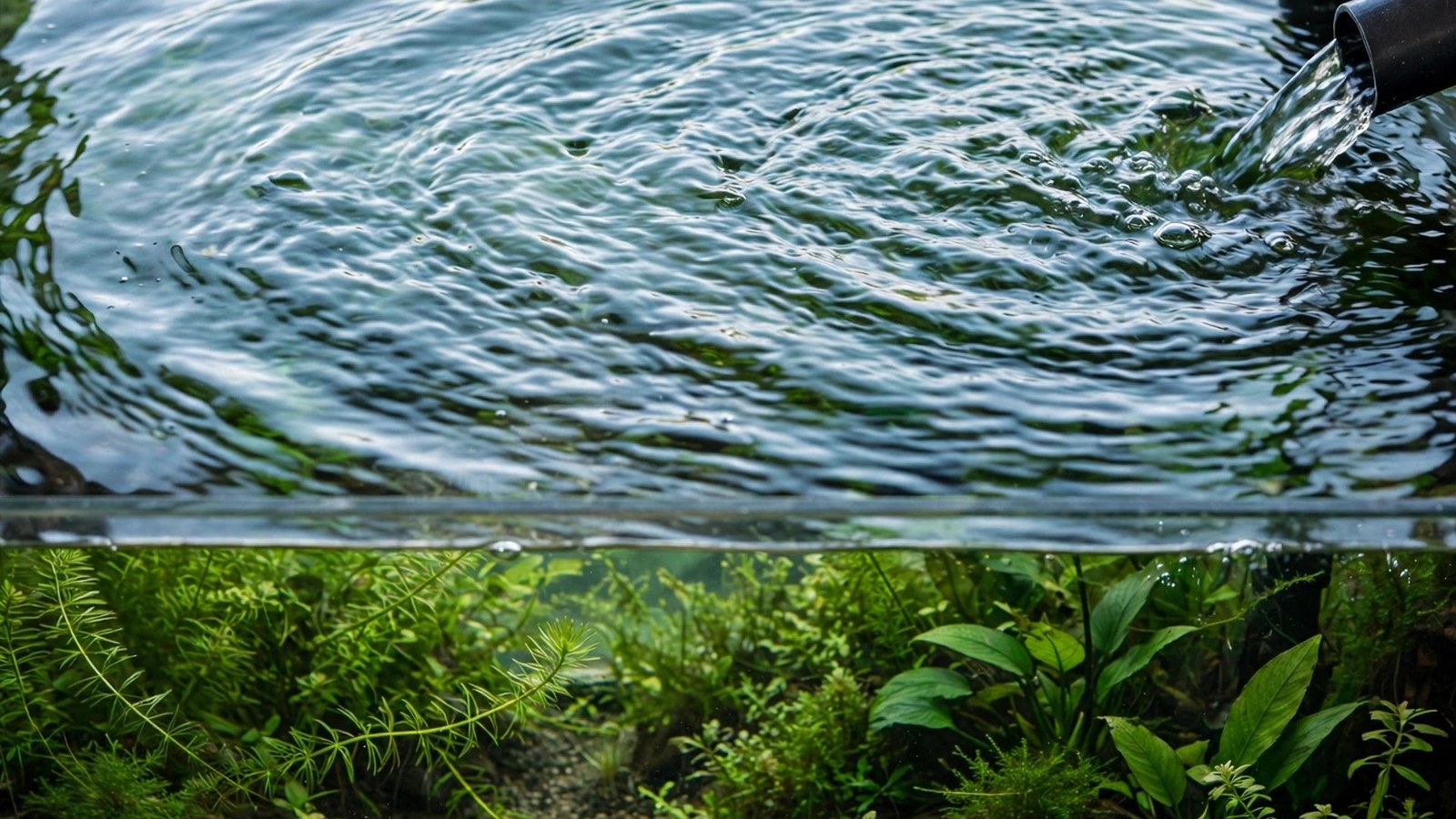
Here's the paradox that confuses every CO2 beginner: you've been told surface agitation drives CO2 out of the water — so you flatten the surface to glassy stillness to "save" your injected gas. Then your fish start gasping, your drop checker goes yellow, and growth stalls. Surface agitation vs CO2 isn't a war to win; it's a balance to strike. Get it right and everything gets easier.
What Surface Agitation Actually Does
Gas exchange at the water surface works in both directions, always pushing toward equilibrium with the air:
- It drives excess CO2 out. Injected tanks run 25–35 ppm; the air above wants ~3 ppm equilibrium. Agitation accelerates the off-gassing of that excess. Yes, this "wastes" some injected CO2.
- It drives oxygen in. Fish, plants (at night), and filter bacteria all consume O2; agitation replenishes it. This is the life-support function.
- It stabilizes the system. Strong gas exchange caps how high CO2 can climb — it's a passive safety ceiling that no timer or controller can replace.
 ★4.6
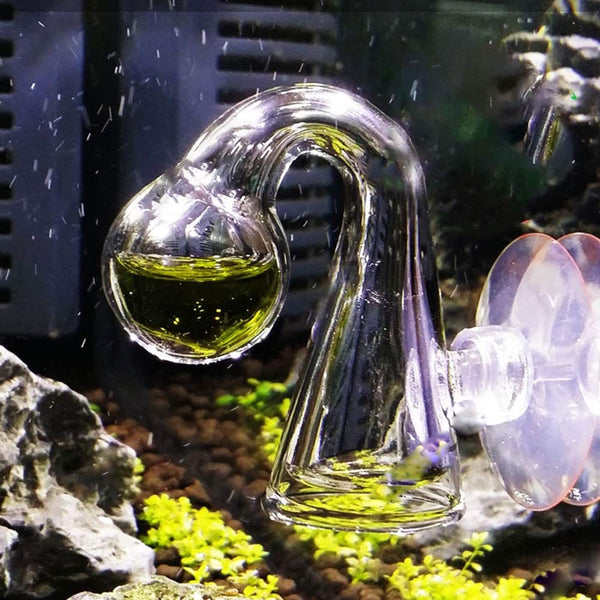
FZONE Glass CO2 Drop Checker Kit
Check Price on Amazon ★4.6The key insight: agitation doesn't prevent you from reaching target CO2 — it just means you inject slightly more to get there. A tank with good ripple might need 2.5 bubbles per second where a stagnant tank needs 1.5. That extra gas costs pennies per month. What you buy with it is enormous: oxygen security, a cap on CO2 spikes, and faster overnight degassing.
The Stagnant-Surface Trap
The beginner logic goes: still surface → less off-gassing → less CO2 needed → efficient. What actually happens:
- Oxygen crashes, especially at night. With no gas exchange, nighttime respiration by plants, fish, and bacteria draws O2 down with no replenishment. Fish gasp at dawn in tanks whose CO2 levels are technically "fine."
- CO2 becomes unstable and dangerous. Without the passive ceiling of gas exchange, any injection hiccup — a bumped needle valve, a warm day — accumulates instead of venting. The same bubble rate that's safe with ripple can be lethal without it.
- Surface film forms. That oily protein biofilm blocks what little gas exchange remains and looks terrible. Good ripple prevents it from forming.
- Drop checker lies by omission. It may read a perfect green while fish suffer from low oxygen — because the problem was never CO2 excess, it was O2 shortage, and the checker can't see oxygen.
If your fish gasp in the morning but your drop checker is green, suspect oxygen, not CO2 — and the fix is more agitation, not less gas.
What Good Agitation Looks Like
You're aiming for a gentle, continuous ripple across the entire surface — not a whitewater jacuzzi, not glassy stillness. Practical benchmarks:
- The surface shimmers and moves everywhere; no dead-calm patches in corners.
- Floating plants drift slowly rather than sitting motionless (if they're pinned in a corner by current, that's too much).
- No persistent surface film.
- Fish breathe normally at all hours, including pre-dawn.
How to achieve it: angle your filter outflow (spray bar or lily pipe) slightly upward so it breaks the surface gently; position a circulation pump to create surface movement in dead zones; or run an airstone. In nighttime operation, many aquarists run an airstone on an inverted timer (on at lights-off) specifically to boost overnight gas exchange. The 2Hr Aquarist CO2 guide recommends exactly this — a slight ripple across the whole surface — as part of standard CO2 setup, noting it prevents excessive CO2 build-up while preserving enough gas for plants.
Too Much Agitation: When to Dial Back
There is such a thing as too much. Signs you've overdone it:
- You need absurd bubble rates (5+ bps on a medium tank) just to hold a green drop checker — most of your gas is venting instantly.
- Plants are being physically battered; stems bend permanently, carpeting plants won't root.
- The tank is noisy enough to bother the room.
- CO2 levels swing wildly with any flow change.
The fix is directional, not binary: reduce the violence, keep the coverage. A wide, gentle ripple over the whole surface exchanges gas nearly as well as a churning waterfall in one spot, while wasting far less CO2 and stressing nothing. Spread the flow; don't just crank it.
Agitation Strategy by System Type
High-tech (injected CO2, medium-high light)
Run moderate, full-surface ripple 24/7. Set your bubble rate to hold a green drop checker with the agitation running — never tune CO2 with agitation off and then turn it on. Consider a nighttime airstone for oxygen security. This is the standard, safe, high-performance configuration.
Low-tech (no injected CO2)
Agitation is pure benefit here — there's no injected CO2 to lose, and maximizing oxygen helps everything. Run generous surface movement. (The small amount of naturally occurring CO2 you degas is negligible compared to the oxygen gain.) See whether plants need CO2 for the low-tech CO2 picture.
DIY CO2 (yeast/sugar)
Tricky: you can't shut DIY gas off at night, so overnight accumulation is a real risk. Run stronger-than-normal agitation, especially at night (airstone on a timer), to vent the continuous production. You sacrifice some daytime CO2 efficiency for nighttime safety — the correct trade. This limitation is a core reason pressurized systems outperform DIY CO2.
Shrimp and sensitive-species tanks
Err toward more agitation, lower CO2 targets (20–25 ppm). Shrimp are CO2-sensitive and oxygen-hungry; the ripple that costs you a little extra gas buys a lot of shrimp safety. Details in our CO2 and fish safety guide.
Tuning the Balance: A Practical Protocol
- Set agitation first. Establish your permanent surface ripple — the exact flow pattern you'll run long-term — before touching CO2.
- Tune CO2 to the agitation. Adjust the bubble rate until the drop checker holds green with agitation running. This is your real operating point.
- Verify oxygen. Watch fish at pre-dawn (lowest O2 point). Normal behavior = enough gas exchange. Gasping = more ripple needed, regardless of what the checker says.
- Verify stability. After a week, the checker should be boringly consistent. If CO2 swings with room temperature or filter flow changes, your agitation pattern may be uneven — fix coverage before chasing the bubble rate.
- Never "save gas" by killing the ripple. If cylinder costs bother you, improve diffusion efficiency (a reactor wastes far less than a coarse diffuser) instead of strangling gas exchange.
Equipment Notes
- Spray bars: the best tool for even surface ripple — a long bar with holes angled slightly up creates uniform movement across the whole surface.
- Lily pipes: beautiful and effective when positioned to create a gentle surface vortex; the classic ADA-style setup.
- Airstones: excellent for targeted extra agitation (especially nighttime), but the large bubbles are inefficient aerators per se — it's the surface disturbance they create that matters, not the bubbles themselves.
- Surface skimmers: remove biofilm (improving gas exchange) and add gentle surface movement; a nice complement to filter outflow in film-prone tanks.
Frequently Asked Questions
Does surface agitation waste CO2?
It increases off-gassing, so you inject somewhat more to hold your target — but "waste" is the wrong frame. What you buy is oxygen security, a passive cap on CO2 spikes, and overnight degassing. The extra gas costs very little; the safety is worth far more. Tune your bubble rate with agitation running and the cost becomes invisible.
Should I turn off my airstone during the day in a CO2 tank?
You don't need to. A gentle airstone's effect on daytime CO2 is modest — just tune your injection rate with it running. Many aquarists run the airstone only at night (on an inverted timer) to maximize daytime CO2 retention while guaranteeing overnight oxygen; that's a fine optimization, but 24/7 gentle aeration is also perfectly workable.
How do I know if I have enough surface agitation?
Three checks: the full surface ripples gently with no still patches; no persistent oily film forms; fish breathe normally at pre-dawn (the daily oxygen low point). If all three pass, your gas exchange is adequate. A dissolved-oxygen test kit can confirm, but observation is usually sufficient.
Can too much surface agitation cause algae?
Not directly — algae doesn't care about ripple. But excessive agitation that strips CO2 faster than you replace it creates fluctuating CO2 levels, and fluctuation stresses plants and invites algae. The problem isn't the agitation; it's CO2 that wasn't re-tuned to match it. Set agitation first, then tune gas to it, and the system is stable.
My filter outflow is underwater — does that count as agitation?
Only weakly. Submerged outflow creates circulation (good for distributing CO2 and nutrients) but little surface gas exchange. Gas exchange happens at the air-water interface — you need visible surface movement. Angle the outflow up, add a spray bar at the surface, or supplement with an airstone.
Do I need less agitation in a low-tech tank without CO2?
The opposite — run plenty. With no injected CO2 to protect, agitation is pure upside: maximum oxygen, no surface film, stable conditions. Low-tech tanks with strong surface movement are healthier and clearer than stagnant ones. There's nothing to lose and everything to gain.
Ripple First, Gas Second
The hierarchy is simple: establish healthy surface agitation as a non-negotiable, then tune CO2 to operate within it. Never sacrifice gas exchange to save gas — the savings are trivial and the risks (oxygen crashes, CO2 spikes, stressed livestock) are not. A tank with a lively ripple and a properly tuned bubble rate is the most forgiving, most stable configuration in the hobby. Let the surface breathe, and everything underneath breathes easier too.