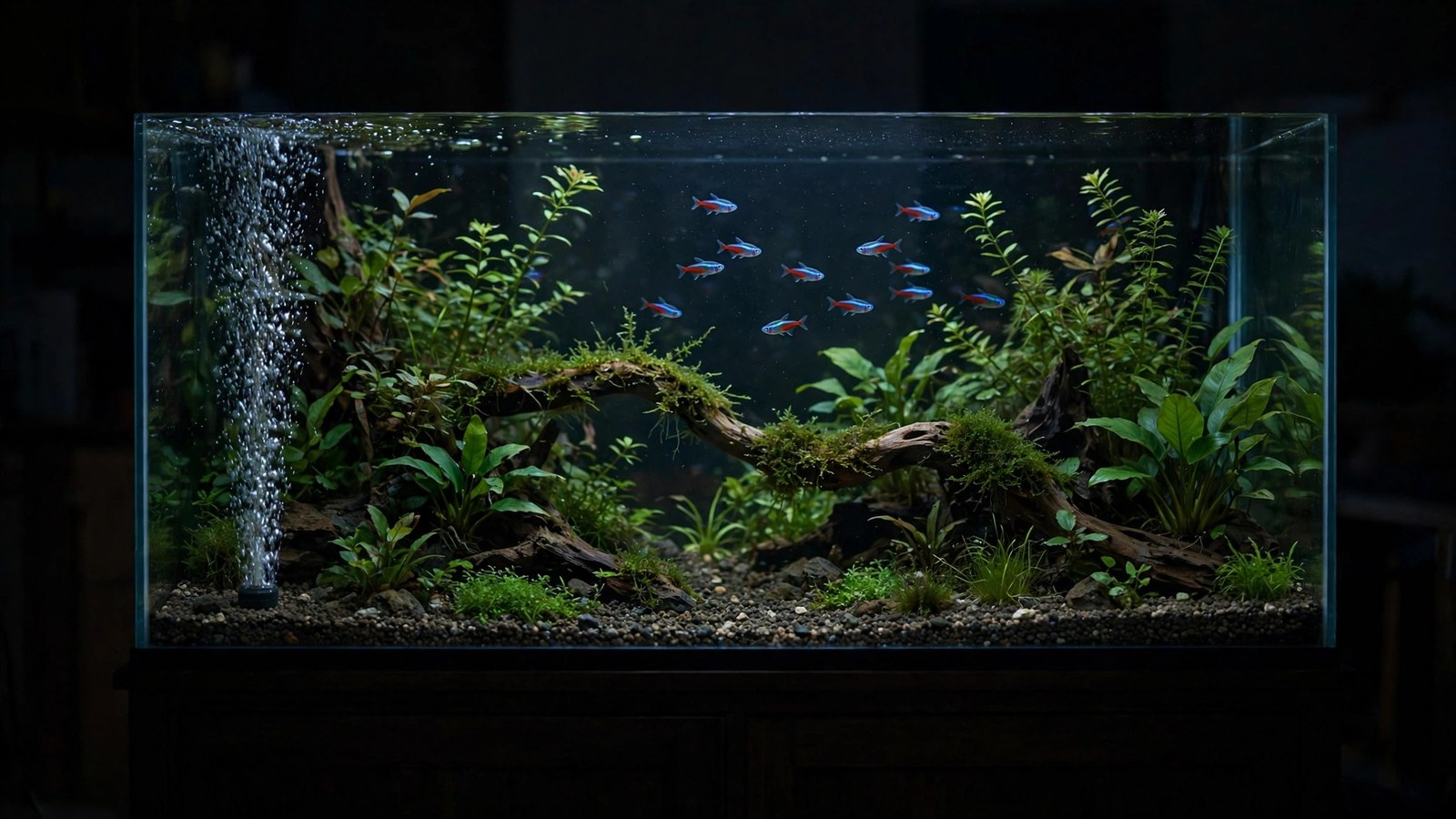
If you've been staring at your planted tank at lights-out wondering "should I run an air stone at night in my planted tank?", you're not alone. It's one of the most debated questions in CO2-injected aquascaping: by day your plants pump out oxygen, but at night every living thing in the tank — plants, fish, shrimp, and bacteria — is breathing it in. Night aeration in a planted aquarium is the simplest safety net for that oxygen dip, and in this guide I'll walk you through exactly why it happens, when you need it, and how to wire it on a timer so it runs itself.
Why Oxygen Drops at Night in a Planted Tank
During the photoperiod, photosynthesis dominates: plants consume CO2 and release oxygen, often saturating the water above 100%. But the moment lights go out, photosynthesis stops while respiration continues. Plants flip from net oxygen producers to net oxygen consumers, joining the fish, shrimp, and the massive bacterial colonies in your filter and substrate that never stop breathing. The result is a slow, steady decline in dissolved oxygen through the night — with the lowest point typically just before dawn. Aquaculture researchers call this predictable daily swing the diurnal oxygen cycle, and it applies to aquariums just as it does to ponds.
In a healthy tank this dip is small and harmless. But stack up enough oxygen demand — dense planting, warm water, a heavy fish load, a rich substrate, and CO2 injection running into the night — and that dip can become a trough. Fish showing rapid gill movement at the surface in the morning is the classic symptom.
This is distinct from simply shutting CO2 off at night: turning off the gas stops adding CO2, but it doesn't add oxygen. Night aeration addresses the other side of the equation.
How an Airstone Protects Fish at Night
An airstone doesn't inject oxygen into water directly. What it actually does is create surface agitation — the rising column of bubbles churns and renews the water surface, massively increasing gas exchange. That exchange works both ways: oxygen diffuses in, and excess CO2 diffuses out. Overnight, that's exactly what you want. The modest extra CO2 off-gassing doesn't matter because your plants can't use CO2 in the dark anyway, and your injection schedule should already account for it.
The key insight is that surface agitation and CO2 are only in real conflict during the photoperiod. At night, gas exchange is pure upside: oxygen climbs back toward safe levels while you're asleep. Many experienced aquascapers consider a night airstone a form of CO2 fish safety insurance — the cheap, simple layer of protection that keeps overnight conditions gentle even if something about your setup is borderline.
Do You Need Night Aeration? The Decision Checklist
Not every planted tank needs an airstone at night. Work through this checklist honestly; if two or more of these apply, aerating overnight is a smart move:
- CO2 injection on a timer — if you inject CO2, a night airstone off-gasses residual dissolved CO2 while topping up oxygen. They're complementary layers of CO2 timing and light scheduling.
- Water temperature above 26°C (79°F) — warm water holds less dissolved oxygen and speeds up every organism's metabolism. Summer heat waves are peak risk.
- Heavily stocked tank — lots of fish, shrimp, and snails all draw from the same overnight oxygen budget.
- Dense planting or thick carpet — more plant mass means more nighttime respiration. A heavily planted tank is a bigger oxygen consumer after dark than a lightly planted one.
- Nutrient-rich substrate or heavy feeding — decomposing organics feed oxygen-hungry bacteria.
- Morning symptoms — fish lingering at the surface at dawn, unusually rapid gill movement, or shrimp climbing the glass overnight.
Conversely, a lightly stocked, non-CO2 (low-tech) tank in a cool room with good surface ripple from the filter outflow probably doesn't need night aeration. The filter's surface movement is often enough in that case — dissolved oxygen rises and falls with plant activity over the day, and in a low-demand tank the overnight fall stays well above stressful levels.
The Night Aeration Protocol: Timers, Placement, and Bubbles
When to run the airstone
The cleanest setup is the inverse of your light schedule: the airstone runs only when the lights are off. A typical schedule looks like this:
| Equipment | Start | Stop | Notes |
|---|---|---|---|
| CO2 injection | 1–2 hours before lights on | 1 hour before lights off | Builds to target level just as photosynthesis starts |
| Lights | Morning (e.g. 10:00) | 6–8 hours later | Stable photoperiod matters — see aquarium light schedules for plants |
| Airstone / surface pump | Lights off | 1–2 hours before lights on | Overlaps with CO2 start so excess overnight CO2 off-gasses before injection builds up |
Stopping the airstone an hour or two before lights on matters: it gives the water a calm window so your CO2 injection can build back up to the target level before plants start photosynthesizing. If the airstone ran right up to lights-on, it would be stripping out the CO2 your morning injection is trying to accumulate.
Wiring it up with timers
You'll need two timers: one for CO2 (most planted tank keepers already have this) and one for the air pump. Practical options:
- Mechanical plug timers — cheap, reliable, and perfectly adequate. The air pump draws very little power, so any basic timer works.
- Smart plugs — lets you fine-tune start/stop times from your phone and see at a glance whether the pump is on.
- A single smart power strip — run both CO2 and the air pump on opposite schedules from one app.
Keep electrical gear in the usual safe spots: plugs above the water line, drip loops on every cord so stray drips can't run down into the outlet, and no dangling timers resting on a wet filter lid. Standard household electrical common sense — nothing here requires modifying wiring or doing anything beyond plugging a timer into an outlet.
Placement and bubble rate
Put the airstone low, toward the back or opposite the filter outflow, so the rising bubbles create a gentle upwelling rather than blasting directly across the tank. You want a soft, steady stream, not a frothing churn — moderate surface rippling is the target. Too much turbulence can stress fish and stir up a dirted substrate, so start gentle and increase slightly if you still see morning surface-gulping. Use a check valve on the air line (between the pump and the tank) so water can't siphon back into the pump if the power fails — a cheap part that prevents a real mess.
A bleed valve (airline T with a clamp or adjustable valve) lets you dial the bubble rate down without straining the pump. Most hobbyists find that a medium-fine bubble stream, running the full dark period, is the sweet spot. And if you use a drop checker, expect it to read bluer in the morning than it did at lights-out — that's the overnight off-gassing working as intended. Our CO2 drop checker guide explains how to read those color shifts correctly.
A quiet, reliable pump is the heart of the setup: Tetra Whisper air pump.
The timer flips aeration on exactly when lights go out: a programmable outlet timer.
Signs Your Tank Needs More Overnight Oxygen
Fish are the canary in the coal mine for low oxygen. Watch for these, especially in the first hour after lights-on:
- Gulping at the surface — fish hanging in the top centimeter of water, mouthing the surface film.
- Rapid gill movement — gill covers beating noticeably faster than during the day.
- Shrimp climbing glass or equipment overnight — invertebrates trying to reach oxygen-richer layers.
- Lethargy that clears after lights-on — fish perk up as plants restart photosynthesis, a classic low-overnight-oxygen pattern.
One nuance: fish at the surface in the evening is more likely to be about CO2 or something else, since oxygen is at its daily peak then. Surface behavior that appears specifically around dawn and resolves as the day goes on points squarely at the overnight dip. If symptoms persist through the day despite night aeration, re-check your daytime setup — possibly CO2 is too high or flow is poor — before adding more equipment.
Common Mistakes to Avoid
- Running the airstone 24/7 in a CO2-injected tank — this is the most common error. Constant surface agitation fights your CO2 injection all day, making your target concentration harder to hold and wasting gas. Timer it to the dark period only.
- Turning the airstone up so high it stresses livestock — blasting bubbles create current that small fish, bettas, and shrimp hate. Gentle and steady wins.
- Forgetting the check valve — a power outage with no check valve can back-siphon tank water into the air pump. This is the single most skipped step.
- Skipping the airstone off-gap before lights-on — ending the airstone right at lights-on means it strips CO2 while your morning injection is trying to build. Give it a 1–2 hour head start on calm water.
- Assuming plants don't need oxygen at night — they do. Roots especially depend on oxygenated water in the substrate zone. Severe overnight oxygen crashes can stall growth and encourage stem rot in aquarium plants in the most vulnerable stems.
Related night behavior worth understanding: pearling — those daytime oxygen bubbles on leaf surfaces — is a sign your system produces plenty of oxygen while lit, but it tells you nothing about what happens at 3 AM. Don't let daytime pearling talk you out of a night protocol.
Aeration vs Other Night-Safety Options
The night airstone is the most popular approach, but it's not the only way to keep overnight oxygen healthy. Here's how the options compare:
| Method | How it helps | Downsides |
|---|---|---|
| Timed airstone | Strong targeted gas exchange all night, automatic on a timer | Slight noise, needs an extra timer |
| Aiming the filter output at the surface overnight | Free; improves gas exchange | Hard to automate, disturbs scape look, affects daytime CO2 retention if left on |
| Running CO2 on a solenoid shutoff only | Stops adding CO2 at night | Adds zero oxygen — doesn't fix the dip itself |
| Lowering the water temperature slightly | Cooler water holds more O2 | Only a small effect; must stay within your livestock's comfort range |
The airstone-on-timer combo wins because it's automatic, targeted, and costs almost nothing to run. Combine it with a CO2 solenoid that shuts off at night and you have the standard overnight safety stack for an injected tank. For tanks focused on delicate bottom-dwellers like shrimp that graze on biofilm, that automatic oxygen floor matters even more, since shrimp are poor at tolerating low-oxygen spells.
Frequently Asked Questions
Should I run an air stone at night in a planted tank with CO2?
For most CO2-injected planted tanks, yes — it's the simplest way to keep overnight oxygen safe while off-gassing excess CO2. Run it on a timer that switches on at lights-out and off 1–2 hours before lights-on, so morning CO2 can build back up. Start with a gentle bubble rate, use a check valve, and observe your fish: no dawn surface-gulping means the setup is working.
Will a night airstone waste all my CO2?
It will off-gas some dissolved CO2 overnight, but that gas was doing nothing useful in the dark. Plants can't photosynthesize without light, so daytime CO2 is what matters. Ending the airstone an hour or two before lights-on gives your injection a calm window to rebuild to target levels before the photoperiod starts. Your morning CO2 schedule stays exactly the same.
Can aeration at night harm aquarium plants?
No — plants respire and consume oxygen at night just like animals do. Gentle aeration helps them, particularly roots in the substrate. Problems only arise from extremes: a violently churning tank can uproot new plantings or disturb the substrate, and constant 24/7 agitation fights daytime CO2 levels. A moderate stream on a night-only timer is safe for even delicate stems.
What if my tank doesn't have CO2 injection — do I still need night aeration?
Usually not. A low-tech tank without injected CO2 has a much smaller overnight oxygen swing, and normal filter surface movement is typically enough. Consider night aeration only if the tank is heavily stocked, runs warm, or you actually observe fish at the surface around dawn. When in doubt, watch the livestock — they're the most honest gauge you have.
How can I tell the airstone is actually helping?
Watch the dawn behavior. Before the airstone, note whether fish hover at the surface or breathe fast in the first hour after lights-on. Run the night airstone for a week and compare. A clear change — fish staying mid-water at dawn, calmer gill movement — means it was needed and is working. If nothing changed, your overnight oxygen was probably fine already, and you can keep or drop the protocol freely.
Is a night airstone noisy? I sleep near my tank.
It can be. Vibration against the stand and bubble splash are the two noise sources. Fix vibration with a foam pad or folded towel under the pump, and reduce splash by lowering the bubble rate — a gentle stream is nearly silent. Many hobbyists also switch to a diaphragm-style pump with a quiet rating. If the tank is in your bedroom, test the setup for a night before committing to it permanently.
Should I Run Air Stone at Night in a Planted Tank? The Direct Answer
Night aeration is one of those rare aquarium upgrades that costs very little, runs itself once wired, and quietly prevents the most common overnight risk in a planted tank. If you inject CO2, set the timer, fit the check valve, and let your fish sleep in oxygen-rich water — then watch your drop checker swing back to green right on schedule each morning. Combined with smart vertical aquascape design and a stable light routine, it's part of a tank that simply runs well around the clock.