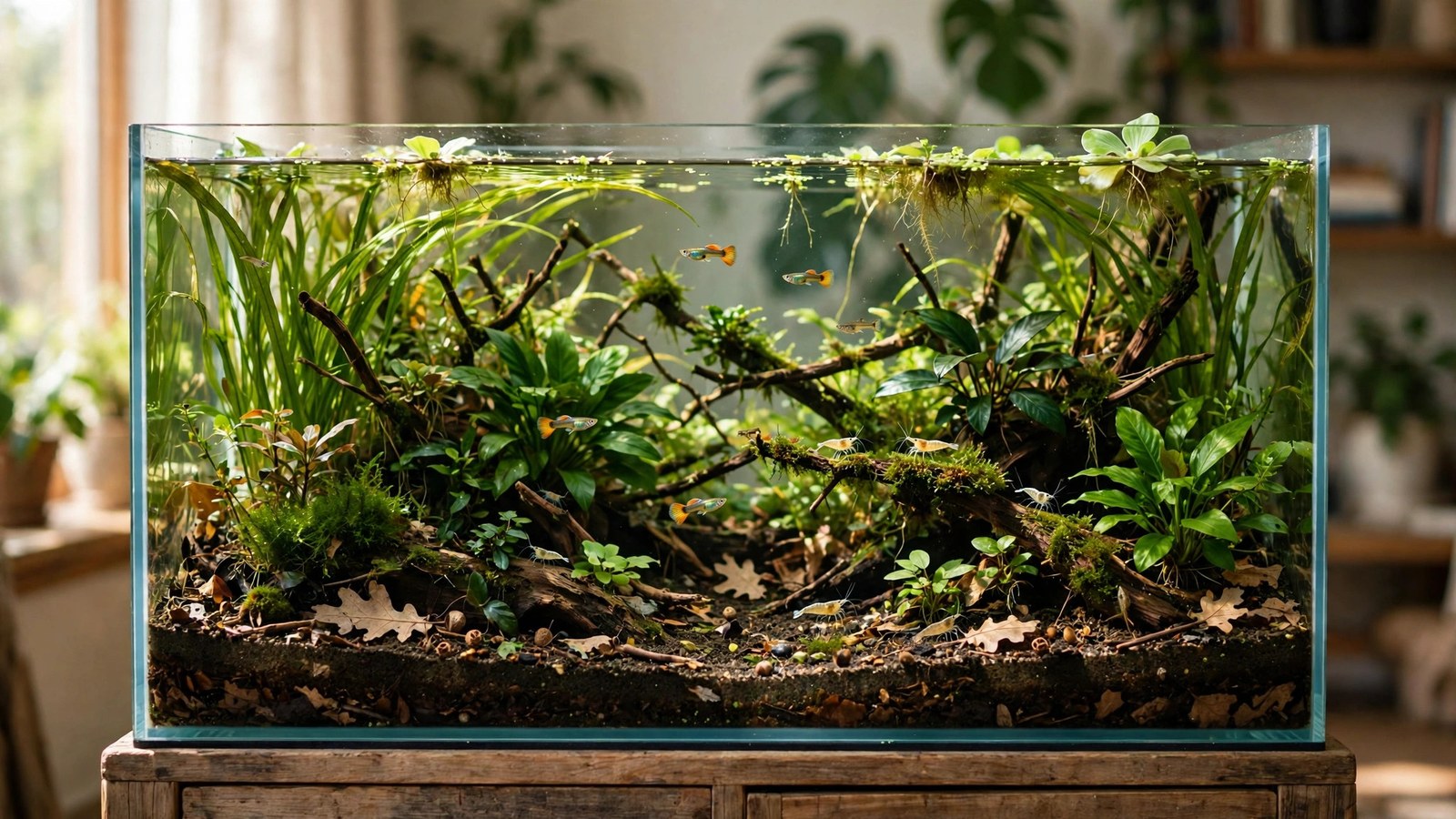
If you have watched the Father Fish channel, you have stared into one of those impossibly lush tanks — no CO2 cylinder, no cabinet of fertilizers, no Sunday water-change ritual — and wondered if it is a trick. It is not. The father fish natural aquarium is a decades-old approach that treats the tank as a small pond rather than a machine. This guide explains the philosophy, the biology, and the honest limits. It is not a build manual: for the hands-on construction, our step-by-step dirted tank setup guide covers that separately. This is the why behind the what.
The core philosophy: a pond in a glass box
Conventional wisdom says you control everything: injected CO2, scheduled fertilizers, weekly water changes, an oversized filter. The natural-aquarium philosophy asks how a pond manages itself with nobody doing water changes, and rebuilds the answer inside glass. Five principles carry the method:
- The substrate is the filter. A 3–4 inch layered bed carries most biological filtration.
- Plants outrank fish. Plant heavily on day one — 70–80% of final density — and stock fish only once plants are growing.
- Mulm is fertilizer, not dirt. That brown detritus releases nutrients as it decays — vacuuming it all away starves the plants.
- Stock lightly, feed sparingly. Fish numbers stay far below conventional rules, fed small portions two or three times a week.
- Interfere less. No CO2, no chemical algae killers, and water changes shrink to 10–25% monthly once mature.
Why the father fish natural aquarium works so well
Fish waste and uneaten food release ammonia, which nitrifying bacteria convert to nitrite and then nitrate — the standard nitrogen cycle detailed in UF/IFAS Extension's breakdown of biological filtration in aquatic systems. In a conventional tank the story ends there and you dilute nitrate with water changes. In a deep natural bed, the lower inches turn oxygen-poor, and anaerobic bacteria convert nitrate into nitrogen gas, which escapes harmlessly. Fast-growing plants also drink ammonia and nitrate straight from the water column, short-circuiting the cycle before nitrate builds up. Soil and clay bind dissolved nutrients and release them slowly to roots — the same principle behind commercial nutrient-concentrate substrates like Tropica Plant Growth Substrate. Bacteria, plants, and substrate chemistry overlap so none does all the work.
The substrate-layer logic
The layering is functional: a single bed of gravel does nothing for plants, while pure soil becomes an anaerobic swamp. The two-layer design balances nutrition against stability.
| Layer | Depth | What goes in | Its job |
|---|---|---|---|
| Base | ~1 inch | Mineral-rich pond soil or organic topsoil | Slow-release N, P, iron, and micronutrients; bacterial housing |
| Cap | 2–3 inches | Coarse sand or fine inert gravel | Seals soil from light and fish; roots punch straight through |
| Mulm (forms over time) | Up to ~½ inch | Settled detritus, shed leaves, snail droppings | Recycled slow-release fertilizer — leave it alone |
Under about 3 inches total you lose the oxygen-poor zone where denitrification happens; over 4 inches of compacted fine material, gas pockets can burp hydrogen sulfide into the water. Coarse sand at 2–3 inches over a modest soil base lands in the safe middle — poke the cap lightly with a skewer in the first month to release trapped gases early.
Stocking and feeding: less is the whole point
Most natural-aquarium failures trace back to one mistake: a fully stocked tank before the plants were ready. In month one, aim for roughly a quarter of what a conventional calculator calls "fully stocked" — a small school of hardy tetras or livebearers in a 20-gallon tank, not a centerpiece cichlid plus three schools. Add fish only when nitrate stays flat between tests and plants are gaining ground. Feed a pinch the fish finish in 60 seconds, two or three times a week, letting them graze biofilm and mulm between meals. Malaysian trumpet and ramshorn snails do real work here — covered in our planted snail tank setup, they turn the sand cap so it never packs into a dead crust.
What maintenance actually looks like
Abandon the weekly water-change habit, not the tank. The routine shifts from chemistry to observation:
- Top off evaporation with conditioned tap water — skipping water changes concentrates minerals, so conditioned water for top-offs still matters.
- Water changes of 10–25%, monthly or less, mainly in year one — skipping them forever lets minerals and organics accumulate.
- Prune plants aggressively. Fast stems are your nitrate export; every handful removed takes its absorbed nutrients with it.
- Leave the mulm. Spot-remove uneaten food, but never gravel-vacuum the whole bed.
- Watch, don't react. Test ammonia and nitrite weekly in month one, then relax — algae patches in weeks 3–6 are the system finding balance.
In a heavily planted, lightly stocked tank, plants produce more oxygen than the fish consume during the light cycle, so most natural setups need no added aeration. See our guide to whether planted tanks need an air stone for the exceptions, like warm rooms or very deep tanks.
Honest pros and cons
| Natural (Father Fish style) | High-tech planted tank | |
|---|---|---|
| Startup cost | Very low — soil, sand, light, plants | High — CO2 rig, fertilizers, powerful filter |
| Weekly time | Minutes after maturity | 1–3 hours of trimming, dosing, testing |
| Plant choices | Forgiving low-tech species only | Almost anything, including carpets |
| Algae risk | Moderate in weeks 3–8, then low | High if CO2 or dosing slips |
| Startup wait | 2–4 months to stability | Cycled and scaped in 2–6 weeks |
The pattern is clear: cheap, calm, and patient — but it will never grow a competition-grade carpet or a vivid red Rotala forest. If that is your dream scape, go high-tech.
Frequently Asked Questions
Do Father Fish style tanks really run with no filter?
Many run with no filter at all; the rest use only a gentle sponge or small pump for movement. The deep substrate carries the biological filtration — every grain of sand is surface area for nitrifying bacteria, and plants absorb ammonia directly. Filtration still happens; it just happens in the bed.
Can I convert my existing tank to this method?
Yes. Temporarily rehome the livestock, strip the tank to glass, build the soil-and-cap layers, replant heavily, and refill — a fresh start reusing your tank and light. Expect a mini-cycle of 2–4 weeks as the new bed colonizes. Read our silent cycling guide before restocking.
Why is the water brown and cloudy in the first few weeks?
Brown tint is tannins leaching from the soil — harmless, and fading over a few weeks. Cloudiness is a bacterial bloom colonizing the new substrate, usually clearing within 5–10 days. A light polishing pass with fine filter floss helps clarity without disturbing the bed; remove it once the water clears.
Do shrimp and snails work in a natural aquarium?
They are some of the best residents you can add. Snails turn the sand cap, preventing the compaction that causes gas pockets, and their droppings fertilize plant roots. Shrimp graze biofilm and algae all day without adding meaningful waste. Add them in week two or three, once ammonia reads zero.
How often should I test the water?
Test ammonia and nitrite weekly for the first month, and nitrate every two weeks to learn your baseline. Once ammonia and nitrite hold at zero and nitrate stays under about 20 ppm for a month, drop to a monthly spot check. In a mature natural tank, steady plant growth and clear water tell you more than any test strip.
The bottom line
The father fish natural aquarium is not anti-technology — it is a different technology, built from bacteria, roots, and patience instead of bottles and schedules. Give it a deep bed, heavy planting, light stocking, and four months of restraint, and it pays you back with a self-sufficient freshwater ecosystem. Pair it with our planted tank first month survival guide for those crucial early weeks, and let the ecosystem do the rest.