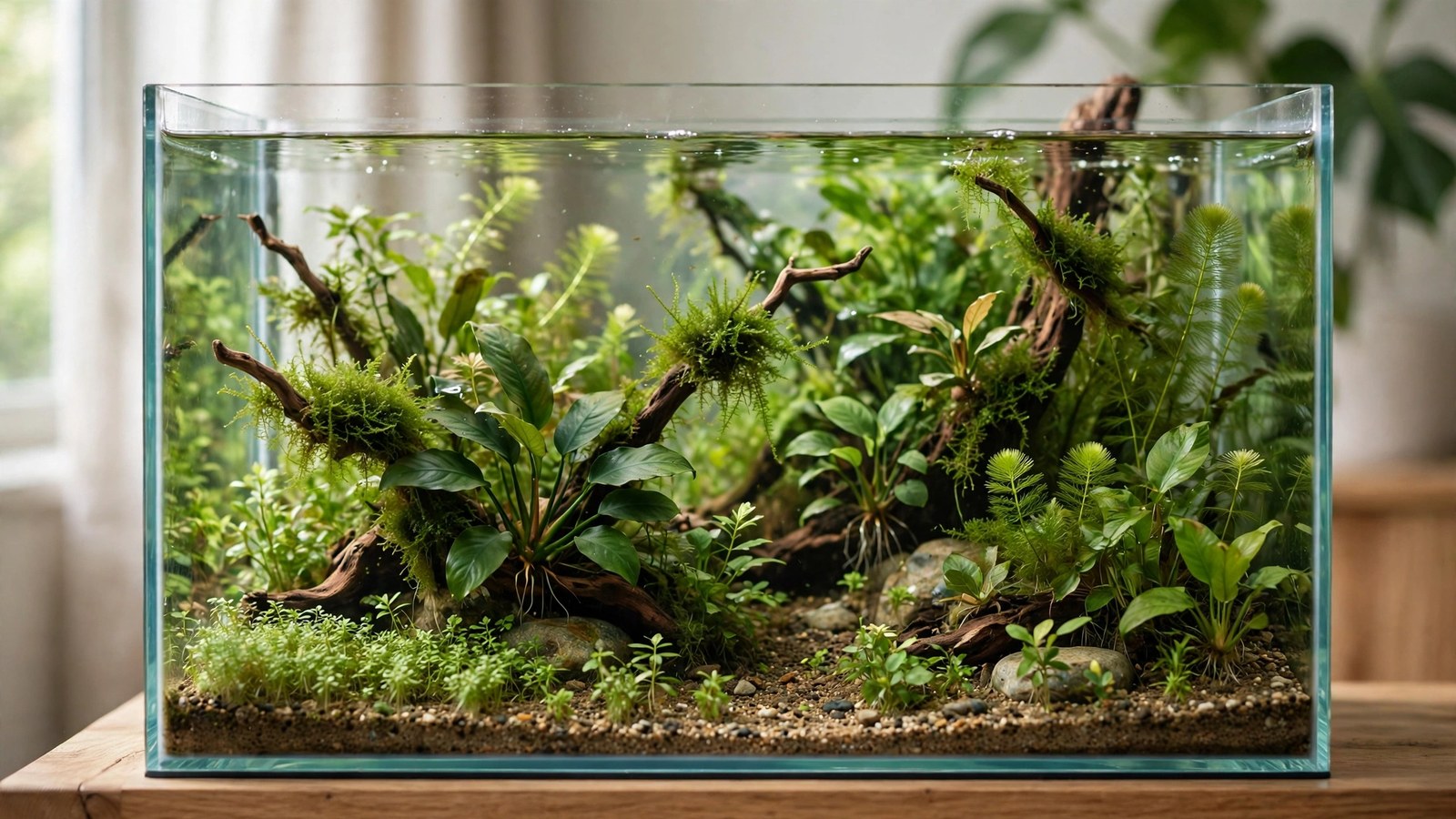
You do not need to wait six weeks before adding fish to a heavily planted aquarium — but you still need to "cycle" it. A silent cycle planted tank skips the bacteria-first route: you pack the tank with fast-growing plants from day one, and those plants absorb ammonia directly, preventing the toxic spikes a traditional cycle is designed to manage. Can your plants really do the cycling for you? Yes — provided you meet strict density and stocking rules most hobbyists never hear about.
What Silent Cycling Actually Is
Every aquarium accumulates ammonia from fish waste, uneaten food, and decaying plant matter. A traditional cycle grows nitrifying bacteria that convert ammonia → nitrite → nitrate over 4–8 weeks. Silent cycling takes a different route: you pack the tank with fast-growing plants from day one, and they consume the ammonia before it reaches dangerous levels. No bacterial bloom, no nitrite spike, no drama — hence "silent."
This is not a shortcut for impatient aquarists. It is the natural process behind the Walstad method: plants and microbes compete for the same nitrogen, and in a densely planted system the plants win. The catch is that it only works when plant growth outpaces ammonia production from day one. A silent cycle fails quietly — readings can look fine until one overstocking event overwhelms uptake overnight.
The Biology: Why Plants Can Replace Bacteria
Plants prefer ammonium (NH₄⁺) over nitrate (NO₃⁻). In typical aquarium water (pH 6.5–7.5), most "ammonia" exists as ammonium, which plants take up through leaves and roots and use directly to build amino acids — skipping the energy-expensive step of reducing nitrate. A tank of growing hornwort can pull measurable ammonia out of the water in a single photoperiod.
Nitrifying bacteria do the opposite job: they oxidize ammonia into nitrate. In a silent cycle, plants intercept the ammonia first, so the bacterial colony never gets the food source it needs to bloom. Bacteria still colonize filter media at low levels — but the plants, not the bacteria, carry the load, without producing nitrite as an intermediate.
Three facts determine whether it succeeds:
- Growth rate matters more than plant mass. A pound of slow-growing Anubias absorbs a fraction of what an ounce of fast-growing hornwort absorbs per day. Uptake is proportional to growth — you need plants putting out new leaves every few days.
- Light drives uptake. Photosynthesis powers nutrient absorption. With only 4 hours of weak light, even good plants barely pull ammonia; with 8–10 hours of proper lighting, uptake rises several-fold.
- Floaters are cheat codes. Floating plants access atmospheric CO₂ under the brightest part of the light. A handful of floaters does the nutrient-removal work of a much larger submerged planting.
What You Need Before Day One
Silent cycling is a day-one commitment. Everything below must be ready before the first fish or shrimp goes in.
1. Heavy initial planting — about 70% substrate coverage
This is the requirement most people get wrong. Three pots of Cryptocoryne in a 20-gallon is a sparsely planted tank, not a silent cycle. Aim for roughly 70% of the visible substrate occupied by growing plants on day one — for a standard 20-gallon long, 10–15 bunches of fast-growing stems plus a floater colony covering 30–50% of the surface. Size your order with our guide to how many plants a new aquarium needs.
2. The right species mix
At least half your plant mass must be fast growers (see the table below). Slow growers like Anubias, Java fern, and Bucephalandra are fine as accents but contribute almost nothing to ammonia uptake in the first month.
3. A small, controlled ammonia source
Yes, you still introduce ammonia — in small, plant-sized doses. A pinch of fish food left to decay, a single drop of pure ammonia per 10 gallons (~0.5 ppm), or your first tiny group of fish whose waste becomes the source. Plants need a food supply to keep growing; a sterile tank starves them into melting.
4. Light and nutrients on a schedule
Run a 6–8 hour photoperiod in week one (shorter than usual to hold off algae), then 8–10 hours by week three. Start a light all-in-one fertilizer at half dose from day three — plants cannot absorb ammonia efficiently if starved of potassium, iron, or phosphate. An aquarium dosing pump keeps levels rock-steady through the cycle.
The Best Plants for Silent Cycling
Not all plants are equal here. The species below are proven workhorses: fast growth, heavy ammonium appetite, and easy to keep alive. Tropica's plant database confirms each species' growth rate before you buy.
| Plant | Growth rate | Ammonia uptake | Best role in a silent cycle | Notes |
|---|---|---|---|---|
| Hornwort (Ceratophyllum demersum) | Very fast | Excellent | Free-floating or bunched stems | The classic silent-cycle plant |
| Anacharis (Elodea densa) | Very fast | Excellent | Background bunches | Grows inches per week; melts above 82°F. Anacharis is invasive/regulated in some regions — check local rules before buying, and never release aquarium plants into waterways. |
| Water sprite (Ceratopteris thalictroides) | Very fast | Excellent | Floater or rooted | Prolific once established |
| Frogbit / water lettuce | Fast | Excellent | Surface layer | Atmospheric CO₂ = fastest uptake |
| Guppy grass (Najas guadalupensis) | Fast | Good | Floating tangles | Nearly indestructible; great shrimp cover |
| Duckweed | Extreme | Excellent | Surface (use sparingly) | Unbeatable uptake, but spreads aggressively |
A red stem like Rotala macrandra can join once the cycle stabilizes — just do not rely on it for the heavy lifting in weeks one and two.
Your Silent Cycle Planted Tank Timeline, Week by Week
This schedule assumes a 20-gallon tank and heavy day-one planting. Nano tanks under 10 gallons need even more conservative stocking, since small water volumes spike faster.
Week 1: Plant and settle
Day one: fill the tank, plant densely, start the filter, and run a 6-hour photoperiod. On day two or three, add your ammonia source — a pinch of fish food or a 0.5 ppm dose. Test daily; ammonia should stay at or near 0. Past 1.0 ppm means planting is too sparse — add more fast growers. Expect some melting of emersed-grown stems; remove rotting leaves promptly. Begin half-dose fertilizer on day three.
Week 2: First livestock
Increase the photoperiod to 7–8 hours. If ammonia has held at 0 and nitrite at 0 for five consecutive days, add your first livestock group — no more than 25% of your planned stocking (six neon tetras, for example). Feed lightly once a day; test every other day. This is where most failures happen: add twenty fish at once and plant uptake cannot keep up. Gradual stocking is the entire method.
Week 3: Expansion
Plants should be visibly growing now. Bump the photoperiod to 8–10 hours and move fertilizer to full dose. If parameters held steady, add the second 25% of livestock. A little diatom or green-dust algae in week three is normal and fades as plants hit full growth speed. Do a 30% water change at the end of the week.
Week 4: Fully stocked (almost)
Add the remaining livestock over weeks four through six — never more than 25% of the planned total per week. By the end of week four the tank should run ammonia 0, nitrite 0, with nitrate slowly climbing, and you shift to your normal routine (see our planted tank maintenance schedule). A nutrient-rich substrate like UNS Controsoil leaches ammonia for its first 2–3 weeks, which feeds your plants — just stock even more gradually during that window.
Test-Kit Parameters: The Numbers That Matter
You cannot silent-cycle blind. A liquid test kit (the API Freshwater Master Test Kit; strips are not accurate enough) is mandatory. Test ammonia and nitrite every other day through week three, then weekly — and write down your readings. For the full story on these numbers, see our planted tank water parameters guide.
| Parameter | Target during cycle | Action if exceeded |
|---|---|---|
| Ammonia (NH₃/NH₄⁺) | 0 ppm (never above 0.5) | 0.5+: 50% water change; 1.0+: add more fast growers |
| Nitrite (NO₂⁻) | 0 ppm | Any reading: 30–50% water change, cut feeding, pause stocking a week |
| Nitrate (NO₃⁻) | Under 40 ppm (ideally 5–20) | Above 40: 30% water change; check for overfeeding |
| pH | 6.5–7.5 | Wild swings signal unstable CO₂ or substrate issues — investigate |
| Temperature | 74–78°F (species-dependent) | Keep stable; above 82°F slows fast growers and raises ammonia toxicity |
Silent Cycle vs Fishless Cycle vs Fish-In Cycle
All three methods end at the same place — a stable tank where ammonia never accumulates — but the routes, risks, and timelines differ:
| Factor | Silent cycle | Fishless cycle | Fish-in cycle |
|---|---|---|---|
| How it works | Fast-growing plants absorb ammonia directly | Bacteria grown with pure ammonia before fish arrive | Bacteria grown with fish present; water changes control toxins |
| Duration | 2–4 weeks to full stocking | 4–8 weeks before first fish | 4–6 weeks of managed risk |
| Upfront cost | Higher ($60–150 in plants for a 20-gallon) | Low (ammonia + test kit) | Low, but risks livestock |
| Fish safety | High, if stocking is gradual | Highest (no fish until done) | Lowest (fish endure ammonia/nitrite) |
| Skill required | Moderate (plant choice, light, testing discipline) | Low (follow dosing instructions) | High (constant testing and water changes) |
| End result | Established planted tank + light bacterial colony | Bare tank with mature bacterial filter | Stocked tank with mature bacterial filter |
| Best for | Planted-tank keepers who want fish in weeks, not months | Patient beginners, sensitive species, shrimp-first tanks | Emergencies only |
If the silent cycle's plant requirements feel daunting, the classic fishless cycling method for planted tanks is the safest alternative — slower, but nearly foolproof. Our cycling guide covers both paths, and these techniques to cycle a planted tank faster can shave time off either approach.
When Silent Cycling Fails (and How to Recognize It)
Silent cycles fail for a small set of predictable reasons:
- Sparse planting. Five plants in a 20-gallon is an uncycled tank with decoration. If ammonia exceeds 1.0 ppm in week one after only a 0.5 ppm dose, add more fast growers immediately.
- Stocking too much, too soon. Twenty fish on day seven overwhelms even a well-planted tank. The 25%-per-week rule exists because uptake scales with growth, and growth takes weeks to ramp up.
- Weak or short lighting. Plants in dim light absorb almost nothing. Stretching, pale, leggy stems are not pulling their weight — fix the light first.
- Plant melt with no cleanup. Emersed-grown stems shed old leaves in the first two weeks. Rotting leaves release uncontrolled ammonia — remove melting foliage daily during the transition.
- Fertilizer starvation. Plants cannot use ammonia without potassium, iron, or phosphate. Yellowing, stunted plants have stopped absorbing nitrogen.
The early warning signs: ammonia creeping above 0.25 ppm between water changes, any nitrite color on the test, an algae bloom that explodes instead of fading, or fish gasping at the surface in the morning. Any one of these means pause stocking, do a 50% water change, and add more fast-growing plants. Converting to a fishless cycle mid-stream is always an option — our beneficial bacteria guide explains how bacterial colonies establish when plants alone cannot carry the load.
Frequently Asked Questions
Do I still need to cycle a planted tank, or can I just add fish?
Yes — the nitrogen does not disappear just because plants are present. A silent cycle IS the cycling process; it just uses plants instead of a bacteria-first approach to hold ammonia at zero. Adding fish to a sparsely planted tank with no cycle is simply fish-in cycling with extra risk.
How long does a silent cycle take compared to fishless cycling?
A silent cycle typically reaches full stocking in 2–4 weeks versus 4–8 weeks for fishless cycling, because plants start absorbing ammonia within hours of planting. The trade-off is cost and discipline: more spent on plants upfront, plus gradual stocking and regular testing.
Can I silent-cycle with only slow-growing plants like Anubias and Java fern?
No. Slow growers absorb a fraction of what fast stems and floaters do — not nearly enough to protect fish from waste spikes. For the cycling phase, at least half your plant mass must be fast growers like hornwort, anacharis, water sprite, or floaters. You can swap in prettier plants later.
Do I need a filter during a silent cycle?
Yes. Plants handle the ammonia, but the filter provides circulation (delivering ammonia to leaves and roots), mechanical filtration, and a surface for the low-level bacterial colony that still develops. It is redundancy, not the main engine — and it catches the overflow if plant uptake falters.
Why is my tank getting algae during the silent cycle?
Some algae in weeks two and three is normal — nutrient levels fluctuate while plants establish. A severe bloom usually means too much light for your plant mass, excess ammonia, or both. Cut the photoperiod by 2 hours, check ammonia, remove decaying leaves, and ease off fertilizer. It fades as growth accelerates.
Can I use a silent cycle for a shrimp tank?
Yes — it is arguably the best method for shrimp. Shrimp are extremely sensitive to ammonia and nitrite, and a densely planted silent cycle holds both at zero while providing biofilm and cover from day one. Stock even more gradually than with fish: start with 5–10 shrimp, wait two weeks of clean tests, then add more.
Is Silent Cycling Right for Your Tank?
If you want fish within weeks rather than months, the silent cycle is the fastest safe path — provided you respect its rules. Buy the plants first, plant heavily on day one, test religiously, and stock in small waves. Skip steps and you will learn that there is no such thing as skipping the cycle, only choosing which method does the work.