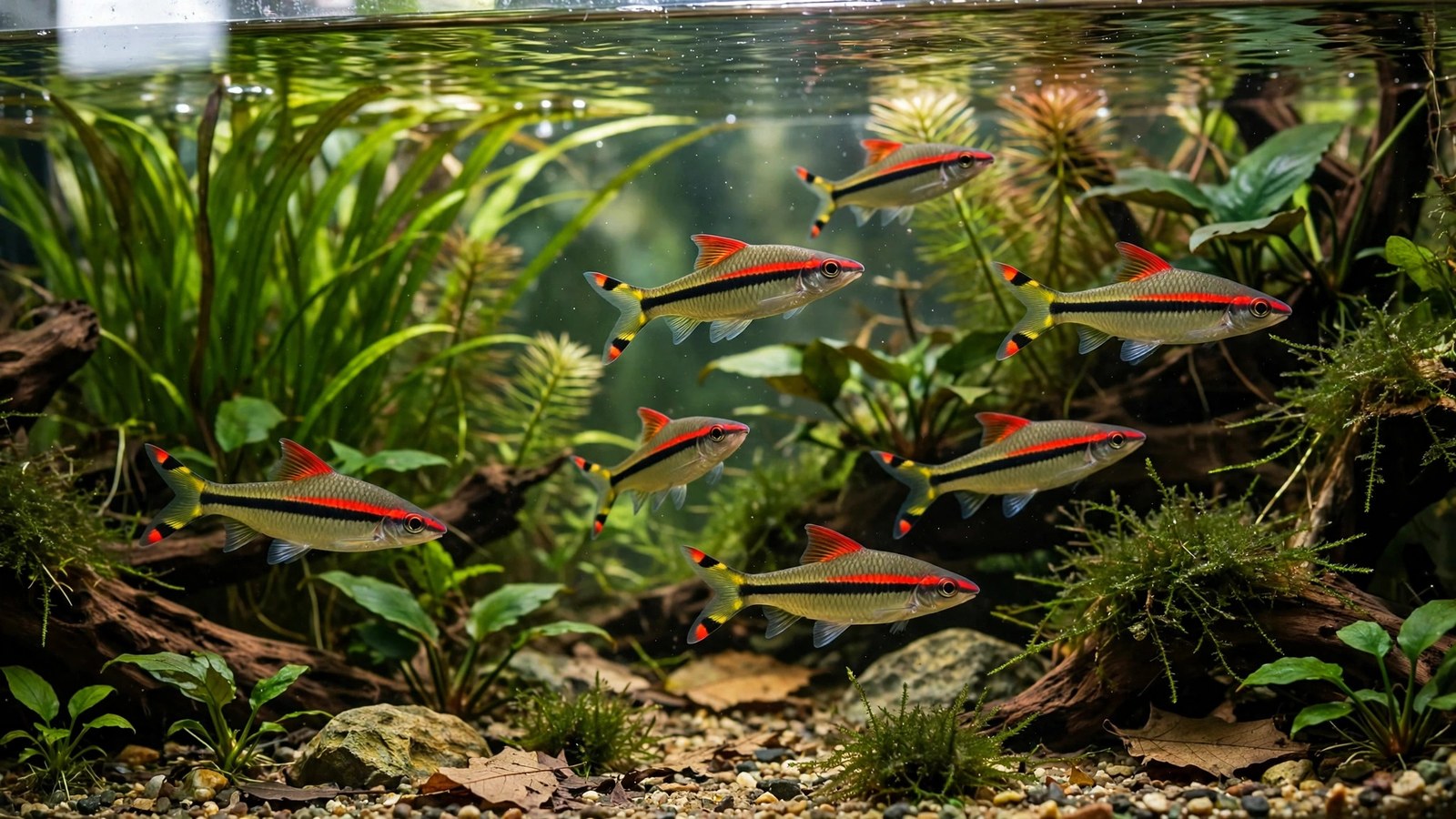
Most planted tanks are built around small, unhurried fish. A denison barb planted tank flips the formula: a school of silver torpedoes, each wearing a scarlet racing stripe, holding formation over an open central lane while tough green plants frame the margins. Give them the lane, cool oxygen-rich water, and a gapless lid.
Direct answer: A denison barb planted tank needs a minimum 55-gallon aquarium with at least 36 inches of uninterrupted horizontal swim lane for a school of six Sahyadria denisonii. Plant the margins, not the middle — Anubias and Java fern tied to driftwood survive their nibbling — and keep water cool (65–77°F) with strong flow and high oxygen. A tight, gapless lid is non-negotiable: this 4–6 inch torpedo barb jumps, especially during its first week.
Your denison barb planted tank: the racetrack layout
The classic planted layouts all assume one thing: a Dutch stem wall or an Iwagumi carpet fills the middle of the tank. That is exactly the middle a denison barb needs empty. Adults reach four to six inches, and a school needs an uninterrupted lane of at least 36 inches to hold formation instead of pacing the glass.
Build a racetrack instead: driftwood and stone along the back and sides, every plant on that perimeter, the front third of the footprint left open. Tie plants to the perimeter hardscape — turning torpedoes uproot anything rooted where they bank.
The right tank and school size
Six fish is the minimum school and 55 gallons the minimum tank — treat both as floors, not targets. A standard 48-inch 55-gallon grows a decent school of six; a 75 or 100 gallon running eight to ten shows the real behavior: tighter formation and synchronized flashing as the red stripe intensifies.
Length matters more than volume, because the limiting resource is horizontal runway. In cramped quarters the school breaks down into pacing, and pacing fish nip fins. If 55 gallons is your ceiling, start from a 55-gallon planted tank setup re-shaped for speed — and add all six at once to an established tank.
Cooler water and stronger flow
In the Western Ghats, S. denisonii lives in fast, cool hill streams — clear water, constant current, oxygen to spare. Keep the tank at 65–77°F and resist the 78–80°F tropical default; warm water holds less oxygen, and oxygen is the currency this fish spends.
Run filtration at five to eight times the tank volume per hour, with a spray bar along the back glass so current sweeps the whole lane, angled slightly upward for surface agitation. Read how circulation works in a planted tank before aiming a powerhead — one focused jet creates dead corners elsewhere. A canister filter sized for planted tanks delivers the turnover while keeping equipment out of the swim lane.
| Parameter | Target range |
|---|---|
| Temperature | 65–77°F (18–25°C) |
| pH | 6.8–7.8 |
| Hardness | 5–25 dGH (moderate) |
| School | 6 minimum; 8–10 ideal in 75+ gallons |
| Filtration | 5–8× tank volume per hour |
Plants that survive a torpedo
Denison barbs are not plant-eaters like goldfish, but they are relentless nibblers and clumsy gardeners: delicate stems get tasted bare, rooted plants in the lane get bulldozed mid-turn. The answer is epiphytes — thick-leaved plants tied to wood or stone, never buried in the lane.
Anubias barteri and nana have leaves too leathery to interest a barb's mouth; Java fern and Bolbitis heudelotii shrug off nibbling and current; Java moss glued into crevices softens the look. Pick from plants that can survive a tank full of fish first, then narrow to these torpedo-proof picks:
| Plant it | Skip it |
|---|---|
| Anubias barteri / nana — tied to wood; leathery leaves barbs ignore | Rotala / Ludwigia stems — nibbled to skeletons |
| Java fern — tied to rock; thrives in the current | Monte Carlo / HC Cuba carpets — uprooted by turning fish |
| Bolbitis heudelotii — anchored to wood along the flow | Cabomba / soft-leaf stems — shredded within weeks |
| Vallisneria spiralis — back-wall straps that bend, not break | Anything newly planted and loosely rooted |
 ★4.6
Gorilla Micro Precise Super Glue Gel
Check Price on Amazon ★4.6Hardscape, substrate, and the lid that keeps them alive
Keep hardscape on the perimeter: branchy driftwood and smooth river stones form the planted spine and give the school reference points for its turns. Denison barbs sift substrate while foraging, so choose sand and rounded substrates that are gentle on bottom-sifting fish over sharp crushed rock.
Then the lid — the most skipped piece of this setup. These fish are powerful jumpers that aim for the smallest gap: filter cutouts, feeding hatches, the half-inch behind a hang-on-back. Use a tight glass canopy, seal the cutouts, and do not "try open-top for a week." Read the open-top-versus-lid case for planted tanks — this is the species that argues for glass.
Stocking and feeding the school
Stock around the school, not instead of it. Good tank mates are peaceful, quick, and comfortable at 65–77°F: giant danios, congo tetras, pearl danios. A flow-loving bottom crew like hillstream loaches fits the current; skip slow long-finned fish and anything small enough to be eaten. More ideas in the best schooling fish for planted tanks.
Feed the omnivores they are: sinking micro-pellets as staple, rotated with frozen daphnia, brine shrimp, and an occasional blanched vegetable or spirulina wafer. Two small feedings beat one big one — full fish graze less, and less grazing means untouched Anubias.
One naming note: "roseline shark," "red-line torpedo barb," and "Miss Kerala" are all trade labels for S. denisonii — see the Seriously Fish species profile for Sahyadria denisonii if a shop tag confuses you. Keep S. chalakkudiensis separate: a different species, not a denison variant.
Frequently Asked Questions
Can denison barbs live in a planted tank?
Yes — if the plants are chosen for the fish. A denison barb planted tank works with tough epiphytes like Anubias, Java fern, and Bolbitis tied to hardscape at the margins, leaving the school an open swim lane. Delicate stems and carpets get nibbled or uprooted — build from plants the barbs cannot damage.
How many denison barbs should I keep in a 55-gallon tank?
Six is the minimum for a stable school and, in a 55-gallon, also the sensible maximum. Fewer than six and the fish turn anxious and nippy; more and the swim lane gets crowded. For eight to ten fish — where schooling looks best — step up to 75 gallons or more.
What temperature do denison barbs need?
Keep them at 65–77°F (18–25°C), cooler than the standard tropical community. They come from fast, oxygen-rich hill streams, and warm water lowers dissolved oxygen and dulls their activity. A heater set near 72°F with a thermometer as backup holds the sweet spot.
Are roseline sharks and denison barbs the same fish?
Yes. Roseline shark, red-line torpedo barb, and Miss Kerala are all trade names for Sahyadria denisonii — one species, different labels. The exception is Sahyadria chalakkudiensis, a genuinely separate species with a duller stripe and a dorsal-fin marking.
Do denison barbs jump out of the tank?
They are among the hobby's most reliable jumpers, aiming for the smallest gaps — filter cutouts and feeding hatches, not the covered center. A tight glass canopy with every equipment gap sealed is mandatory; most escapes happen in the first week.
Build the racetrack, plant the margins with things they cannot kill, keep the water cool and moving, seal the top — and this becomes the tank guests stop in front of: six scarlet stripes running laps in silent formation.