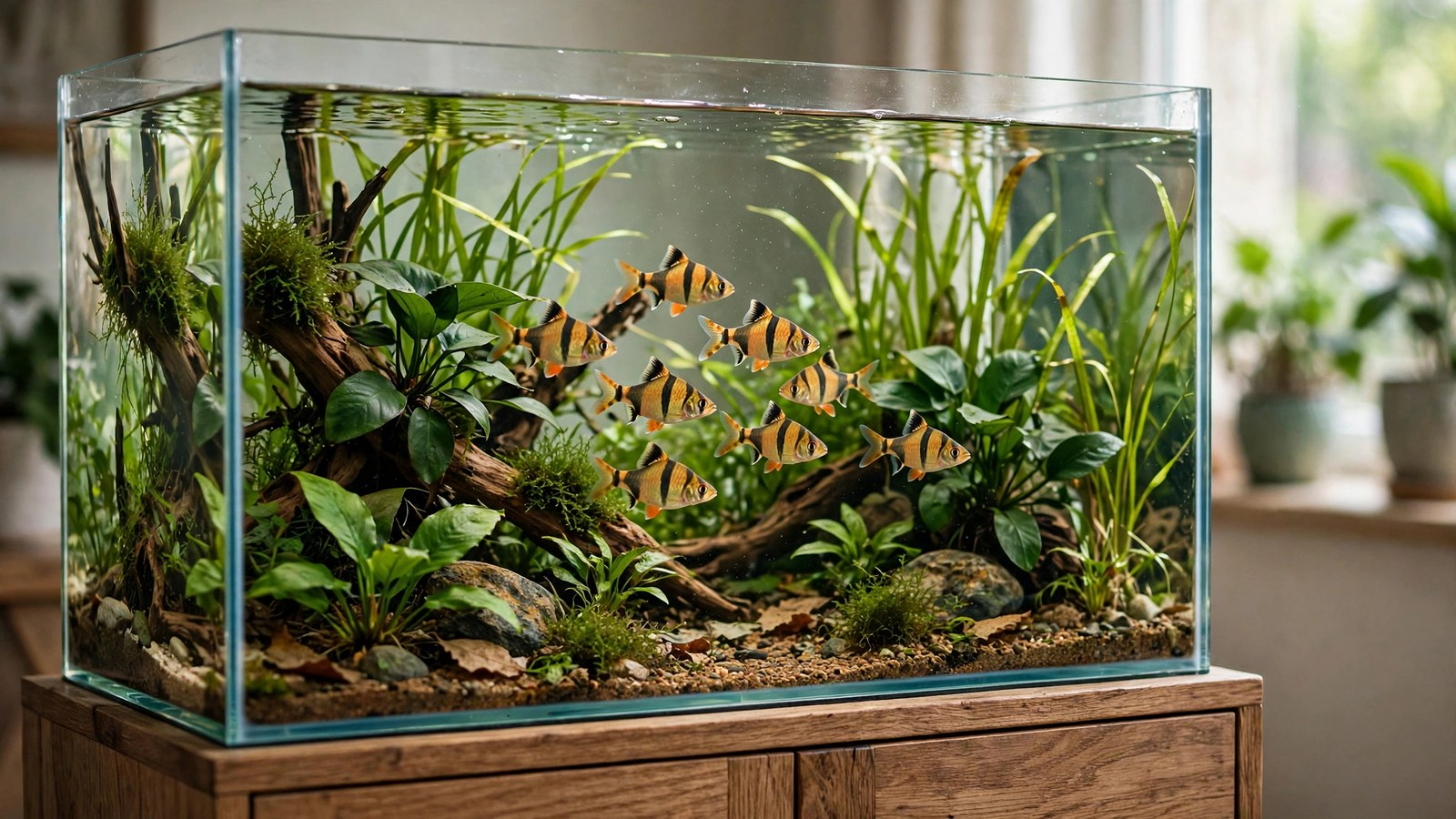
Tiger barbs are the tank bullies nobody warns you about properly — and the number-one mistake is treating them like peaceful cherry barbs. Kept wrong, they shred fins and terrorize tankmates. Kept right, a big school weaving through a dense planted tank is one of the most energetic sights in the hobby. Here's how to build a tiger barb planted tank that turns all that feistiness into healthy schooling instead of aggression.
Why a tiger barb planted tank is the opposite of a cherry barb setup
If you've read our planted cherry barb tank setup guide, flip your instincts. Cherry barbs are gentle and forgiving of sparse planting. Tiger barbs are confident, competitive stream fish that need a crowd and enough visual clutter to break up chases. In a group of five or fewer, the boldest fish bullies the weakest constantly; in a school of ten or twelve, that social energy distributes across the group as harmless jockeying. This single fact determines everything about stocking, layout, and tank size.
The ideal tiger barb planted tank layout
Think of your tank as two zones. The front and middle should be an open swim lane — a clear runway of 60 cm or more where the school can sprint side by side. The back and sides should be a dense thicket: tall background plants, driftwood, and rocks that break the tank into compartments. When one barb chases another, the pursued fish ducks around a plant clump and the chase ends.
Use fine gravel or sand — a darker substrate makes their orange-and-black striping pop. Plant in odd-numbered clusters and leave the front third nearly bare: tiger barbs are mid-water swimmers and use every centimeter of open water.
Plants that survive constant nipping
Tiger barbs are curious grazers. They'll mouth leaves the way toddlers mouth toys, and soft, thin-leaved plants come back looking like torn confetti. The fix is plant choice: give them leathery, tough, or fast-growing species that shrug off the attention (our aquarium plants for fish tank guide covers the fundamentals of matching plants to stock).
| Plant | Placement | Why it works here |
|---|---|---|
| Anubias barteri | Tied to wood/rock | Leathery leaves; barbs ignore it |
| Java fern | Tied to wood/rock | Tough; forms chase-break clumps |
| Vallisneria spiralis | Background | Runners outgrow nibbling |
| Cryptocoryne wendtii | Midground | Dense clumps; plant before fish arrive |
| Java moss | Wood/corners | Expendable grazing moss |
| Amazon sword | Background corner | Thick leaves resist grazing |
Plant the tank densely before the barbs arrive, and give the plants 2–3 weeks to root in. Fish introduced to an established thicket explore instead of bullying; to a bare tank, they claim territories. That head start matters more than any decoration.
Tankmates that work — and the ones that never will
Here's the hard line: never put slow, flowing-finned fish with tiger barbs. Bettas, guppies, angelfish, and long-fin danios will have their fins shredded — the most common and most heartbreaking mistake in tiger barb keeping.
The safest tankmates are bottom-dwellers the barbs barely notice. Kuhli loaches are a perfect match — our kuhli loach planted tank guide shows how their nocturnal, burrowing lifestyle keeps them out of the fray. Dwarf chain loaches are another strong option, covered in our dwarf chain loach planted tank guide; active yoyo loaches also hold their own on the bottom. Skip paradise fish — the paradise fish planted tank guide is great reading, but they're too territorially assertive to share space with a boisterous barb school. Even peaceful picks like honey gouramis only work in 40+ gallon tanks with truly dense planting — and even then, watch for fin damage and be ready to rehome.
Equipment: what you need
Tiger barbs are hardy, but their activity level punishes weak gear. A 30+ gallon tank is the true minimum for a school — 20 gallons works for juveniles only as a temporary grow-out. A tight-fitting lid is non-negotiable: startled barbs jump, and a vertical chase ends on your floor.
Filtration should be rated for roughly double the tank volume — a hang-on-back rated for 60 gallons on a 30-gallon tank, or a modest canister. A dozen active barbs produce real waste, and strong turnover keeps oxygen high. A reliable heater holding 25–26 °C keeps metabolism steady; swings below 23 °C stress barbs and make them more aggressive.
For food, stock quality micro flakes or small pellets as the staple and frozen bloodworms and daphnia two or three times a week. Protein-rich food brings out their deep orange color and reduces the plant-nibbling bored, underfed barbs are famous for. Feeding time is your behavioral barometer — a barb that stops competing for food is your first sign something's off.
Water, cycling, and adding the school
Cycle the tank fully before any barbs arrive — 30% water changes weekly keep nitrates under 20 ppm. Tiger barbs tolerate pH 6.0–7.5, but stability beats perfection: match your tap water rather than chasing a number. Add the whole school at once (8–12 fish): a lone barb added later gets tested mercilessly, while a new school negotiates its hierarchy all at once. Quarantine newcomers for 2 weeks.
Frequently Asked Questions
How many tiger barbs do I need to stop them nipping?
A minimum of 8, and 12 or more is genuinely better. The nipping instinct never disappears — it's how they socialize — but in a large school it gets distributed across the group as harmless jockeying instead of concentrated on one victim. School size is the single most effective aggression fix.
Can tiger barbs live with live plants?
Absolutely — planted tanks are ideal because plants break sightlines and reduce chasing. The catch is plant choice: tiger barbs mouth leaves constantly, so stick to tough species like Anubias, Java fern, Vallisneria, and Cryptocoryne, planted densely before the fish arrive. Delicate stem plants will look tattered within weeks.
Will tiger barbs eat shrimp or snails?
They'll hunt shrimp relentlessly — don't mix them with cherry or crystal shrimp. Larger snails like nerites and mysteries are usually ignored once past quarter size. If you want a cleanup crew for a tiger barb tank, nerite snails are your safest bet.
What size tank do 12 tiger barbs need?
A 30-gallon tank (around 90 cm / 36 inches long) is the realistic minimum for a school of 12. Footprint matters more than volume: tiger barbs are horizontal sprinters, so a long tank beats a tall one. For schools of 15 or more, or peaceful tankmates as well, step up to 40 gallons.
Are tiger barbs good for beginners?
They're hardy and forgiving of water mistakes, but their behavior management — school size, tankmate selection, sightline breaks — demands research beginners often skip. If you're new and committed to a proper school and setup, they can work. If you want an easy, peaceful barb, cherry barbs are the safer first barb.
Why are my tiger barbs hiding instead of schooling?
Usually one of three causes: a school that's too small (under 8), a too-sparse tank with no cover, or bullying from an incompatible tankmate. Small groups feel vulnerable and scatter instead of schooling confidently. Add more barbs, thicken the planting, and check that no single fish is being targeted.
Bringing it all together
A tiger barb planted tank rewards the keeper who respects what these fish are: social, competitive stream fish that need a crowd, a chase to run, and somewhere to hide when they lose. Give them 8 or more schoolmates, a thicket of tough plants, an open swim lane, and tankmates they can't bully — and skip every slow-finned fish you're tempted to add. For species background, the SeriouslyFish tiger barb species profile is the most reliable reference, and Tropica's plant database is the gold standard for unpalatable species. Build it once, build it right, and you'll have the most alive-looking tank in your house.