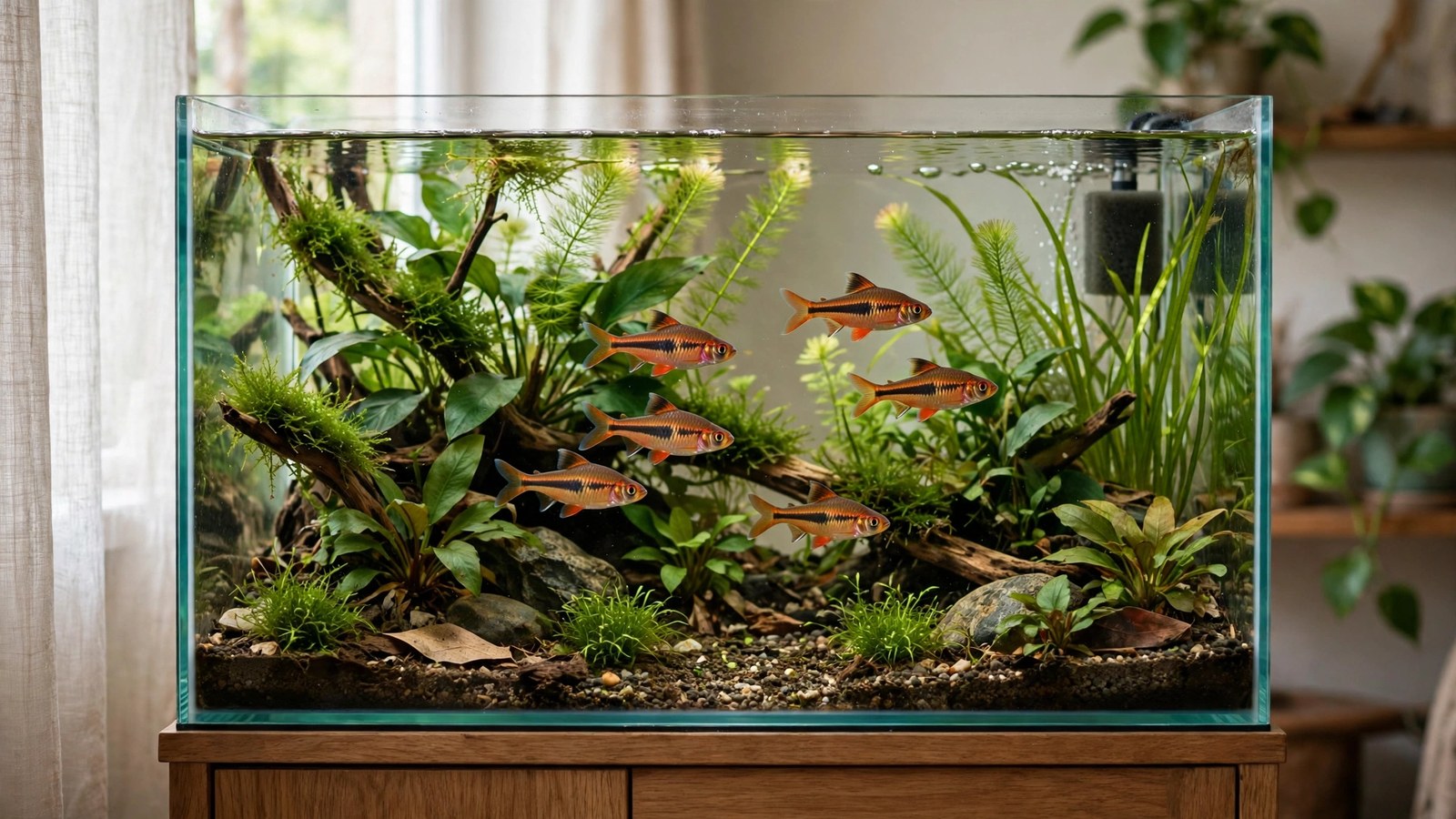
Most cherry barbs in pet stores look like washed-out goldfish rejects — pale, skittish, and huddled in a bare glass box. Put the same fish in a proper cherry barb planted tank and they transform: the males ignite into deep cherry red, the school stops hiding, and you get one of the most rewarding beginner community setups in the hobby. By the end of this guide you'll know exactly how to size, aquascape, plant, stock, and maintain one.
Why Cherry Barbs Belong in a Planted Tank
Cherry barbs (Puntius titteya) evolved in the slow, shaded streams of Sri Lanka, where overhanging vegetation filters the light and breaks up sight lines. That history explains their behavior in your tank: in a sparse, bright aquarium they feel exposed, wedge into corners, and fade to dull amber. In a planted tank with soft light and cover, the same fish school out in the open and develop the deep red the males are named for.
They're also one of the few classic community fish that are genuinely better in a planted tank. They stay small (about 2 inches), rarely nip fins, don't uproot plants, and their moderate bioload fits a planted system's balance. If you want a community tank that looks like a slice of a tropical stream and largely takes care of itself, this is one of the easiest ways to get there — see this low-tech planted tank setup for the no-CO2 philosophy behind it.
Tank Size and Foundations
Cherry barbs are active horizontal swimmers that live in groups, so footprint matters more than height. A 20-gallon long (30″ × 12″ × 12″) is the ideal beginner tank: room for a school of 8–12 plus real aquascaping space. A standard 20-gallon high works, but the long footprint produces noticeably more confident schooling. This 20-gallon planted tank setup guide covers the exact equipment list; 29, 40, and 55-gallon tanks simply scale everything below up.
A 10-gallon can hold 6–8 barbs short-term, but parameters swing faster and algae is harder to control in small volumes. Core equipment for the 20-gallon:
- Filtration: A gentle hang-on-back or sponge filter rated 20–40 gallons. Cherry barbs come from slow water and hate strong current — baffle the flow if needed. Sponge filters are nearly ideal: gentle, cheap, and fry-safe.
- Heater: A 100-watt adjustable heater plus a separate thermometer. Sustained 80°F+ makes barbs more aggressive and shortens their lifespan.
- Lighting: A basic full-spectrum LED on a timer, 6–8 hours daily. Floating plants will diffuse it naturally.
- Substrate: 2–3 inches of dark aquasoil or fine dark gravel. Dark substrate grows plants better and intensifies the barbs' red, because fish adjust their pigment to their background.
The 10-gallon starter bundle matches the tank size the section recommends for beginners: a 10-gallon starter kit like the Aqueon LED bundle.
Aquascape Design: What Cherry Barbs Actually Need
Design the layout as a shallow "U" or horseshoe: dense planting along the back and sides, one or two pieces of driftwood creating shade, and an open swimming lane across the front. A single centerpiece rock with negative space everywhere is for photography, not for fish that evolved under vegetation.
Hardscape earns its place by creating territories and sight breaks. A branchy piece of driftwood, positioned off-center, gives subdominant males somewhere to retreat when a dominant male gets pushy during courtship. A few dried botanicals (almond leaves or alder cones) leach mild tannins and pull pH down slightly — cherry barbs color up beautifully in lightly tannin-stained water.
Add floating plants — frogbit, salvinia, or red root floaters — to cover 30–40% of the surface. They soften the light, give the barbs overhead security, and soak up excess nutrients that would otherwise feed algae. Keep the front third of the surface clear so foreground plants still get light.
Medium light grows the zone plants listed without inviting algae; sized for a 20-gallon long: a full-spectrum planted light like the NICREW ClassicLED Plus.
 ★4.6
NICREW ClassicLED Plus planted aquarium light
Check Price on Amazon ★4.6Choosing Plants by Zone
Pick plants that thrive in the same conditions your fish want: low to medium light, soft-to-moderate water, mid-70s temperatures. Every plant below is beginner-friendly and does fine without CO2.
| Zone | Plants | Why it works here |
|---|---|---|
| Background | Vallisneria spiralis, Hygrophila polysperma, Amazon sword (Echinodorus bleheri) | Tall, fast growers that form the back wall and drink up nitrates |
| Midground | Java fern, Anubias barteri, Cryptocoryne wendtii | Epiphytes and crypts for driftwood; create shade and sight breaks |
| Foreground | Dwarf sagittaria, Marsilea hirsuta, Cryptocoryne parva | Low carpets that keep the front swimming lane open |
| Floating | Frogbit, Salvinia minima, red root floaters | Diffuse light, reduce shyness, outcompete algae for nutrients |
| Spawning mops | Java moss, guppy grass, fine-leaved stem cuttings | Cover where barbs scatter eggs; also shelters shrimplets |
Attach Java fern and Anubias to wood or rock with thread or glue — burying their rhizomes rots them. Heavy root feeders like Amazon swords and cryptocorynes want a root tab beneath them every 2–3 months. Everything else feeds from the water column, so a once-weekly all-in-one liquid fertilizer at half the label dose is enough to start; increase only if new leaves come in pale or pinhole-riddled. Plant densely from day one — aim for roughly 70% of the substrate covered at setup. Dense planting starves out algae and gives the barbs cover while the tank cycles.
Water Parameters and Cycling
Cherry barbs are forgiving, but they do best in the stable, moderately soft water that planted tanks naturally settle into. Get the parameters right before the fish arrive.
| Parameter | Target | Notes |
|---|---|---|
| Temperature | 73–79°F (23–26°C) | Cooler end extends lifespan; avoid sustained 80°F+ |
| pH | 6.5–7.5 | Aquasoil and driftwood pull it down naturally |
| Ammonia / nitrite | 0 ppm | Non-negotiable — cycle fully before stocking |
| Nitrate | Below 40 ppm (under 20 ppm ideal) | Plants consume nitrate; test weekly |
| GH / KH | 3–12 dGH | Soft to moderately hard is fine; avoid extremes |
Cycle the tank fishless first — dose ammonia and wait for full conversion to nitrate, usually 3–5 weeks. Plants absorb ammonia too, so a planted tank cycles more forgivingly than a bare one, but you still need an established bacterial colony in the filter. This planted tank cycling guide walks through the plant-assisted version. Never add cherry barbs to an uncycled tank "to help it cycle" — ammonia burns their gills and permanently stunts them. For a deeper reference, bookmark this planted tank water parameters guide.
Cycling is only real if you test; the section's fishless cycle needs this kit: a liquid test kit like the API Freshwater Master Test Kit ★4.8.
Stocking Your Community
Keep the barb school itself at 8–12 — below 6 they get shy and nippy, and the color display never develops. Build the rest of the community around fish that occupy different tank levels so nobody competes for the same space.
| Species | Number | Role |
|---|---|---|
| Cherry barb | 8–12 | Centerpiece shoal, mid-water |
| Neon tetra or harlequin rasbora | 8–10 | Second mid-water school; different color palette |
| Corydoras (panda or bronze) | 6 | Bottom dwellers; sift substrate harmlessly |
| Otocinclus | 4–6 | Algae cleanup on leaves and glass |
| Honey gourami | 1 pair or single | Top-water focal fish; peaceful like the barbs |
That's a full but comfortable 20-gallon — if you take the rasboras, skip the gouramis, or vice versa. For snails and shrimp, nerites are ideal (they can't reproduce in freshwater); cherry shrimp work in heavily planted tanks, though the barbs will eat newborn shrimplets. See this cleanup crew guide for planted tanks for the full roster. Avoid: tiger barbs and other fin nippers, aggressive cichlids, bettas, anything big enough to eat a 2-inch fish, and large plecos that rasp on broad leaves.
Feeding: Small, Varied, and Often
Cherry barbs are enthusiastic omnivores, and their red depends heavily on diet — a single flake food won't cut it long-term. Feed twice daily, only what they finish in about two minutes, and rotate the menu:
- Daily staple: high-quality micro pellets or crushed flakes with a color-enhancing formula.
- 2–3 times a week: frozen daphnia, baby brine shrimp, or microworms — the protein and carotenoids that make males glow.
- Weekly: blanched zucchini, spinach, or spirulina flakes for vegetable matter.
They'll also graze biofilm and soft algae off leaves — one more reason a planted tank suits them. One fasting day per week is fine and helps digestion.
Weekly Maintenance Routine
A planted cherry barb tank is one of the lowest-maintenance setups you can run, because the plants absorb the waste that makes fish-only tanks so labor-intensive. The routine takes about 30 minutes a week:
- Water change: 25–30% weekly with temperature-matched, dechlorinated water. Vacuum only the open front areas — leave the mulm under dense plants; it feeds them.
- Test: Check nitrate weekly. Above 40 ppm means bigger water changes or less food.
- Trim: Cut back fast stems and thin floating plants so they don't shade everything below. Replant the healthiest stem cuttings to fill gaps.
- Filter: Rinse sponge media in old tank water monthly — never tap water, which kills the bacteria colony.
- Glass and equipment: Scrape viewing panes and clean the heater and intake monthly.
This planted tank maintenance schedule adds monthly and seasonal tasks if you want a complete checklist.
Breeding: It Will Probably Happen on Its Own
Cherry barbs are egg scatterers that breed readily in planted tanks without intervention. When a male's red deepens and he starts dancing around a female, spawning — usually at dawn — is imminent. The pair darts into fine-leaved plants, scatters a few dozen adhesive eggs, and immediately forgets they exist. In a community tank nearly all fry get eaten. To raise them, move a java-moss "mop" into a small bare-bottom tank the night before, remove the adults after spawning, and feed the fry infusoria then baby brine shrimp.
Frequently Asked Questions
How many cherry barbs should I keep together?
At least 6, but aim for 8–12. In small groups they hide, lose color, and occasionally nip each other's fins from stress. A school of 10 in a 20-gallon is the classic sweet spot: large enough for natural behavior and the males' courtship displays, small enough to leave room for tankmates.
Can cherry barbs live in a tank without CO2 injection?
Absolutely — they're low-tech favorites. The barbs don't care about CO2, and the plants recommended here (Java fern, Anubias, cryptocorynes, Vallisneria) thrive without it. Moderate light, root tabs, and weekly liquid fertilizer will grow a lush tank. Add CO2 later only if you want demanding red or carpeting plants.
Are cherry barbs aggressive like tiger barbs?
No — despite the shared name, cherry barbs are among the most peaceful barbs in the hobby. They don't nip fins or harass tankmates. Breeding males may briefly chase each other, but it's ritualized displaying, and it stops the moment a subdominant male swims into cover — which is why sight breaks matter.
Will cherry barbs eat my shrimp?
They'll leave adult cherry shrimp alone but will hunt newborn shrimplets relentlessly — like most community fish. If breeding shrimp is your goal, set up a dedicated shrimp tank. If you just want a working cleanup crew, a starter colony in a heavily planted tank sustains itself well enough to be useful.
Why did my cherry barbs lose their red color?
Fading color almost always traces to four causes: too few fish in the school, a bright bare tank with no cover, a pale substrate they blend into, or a monotonous diet lacking carotenoids. Fix the environment first — add plants, darken the substrate, dim the light — then add frozen daphnia or brine shrimp a few times a week. Males should color up within 1–2 weeks.
What temperature is best for cherry barbs in a planted tank?
Keep them at 73–79°F (23–26°C). The mid-70s are ideal for a planted community: warm enough for active behavior and plant growth, cool enough to keep oxygen high and aggression moderate. Skip the common mistake of running 80°F+ "for tropicals" — barbs live longer and stay more peaceful at the cooler end of their range.
Bringing It All Together
A cherry barb planted tank succeeds because fish and plants want the same things: soft light, calm water, and cover. Start with a 20-gallon, plant it densely from day one, cycle it fully, then add a school of 8–12 barbs and a few peaceful tankmates. Within a month you'll have males flashing cherry red through a green jungle — proof that the best-looking community tanks aren't decorated around the fish, they're grown around them. For authoritative species-level detail, the Seriously Fish cherry barb profile is the hobby's gold-standard reference, and the Tropica plant database is the best place to research any plant on the list above before you buy.