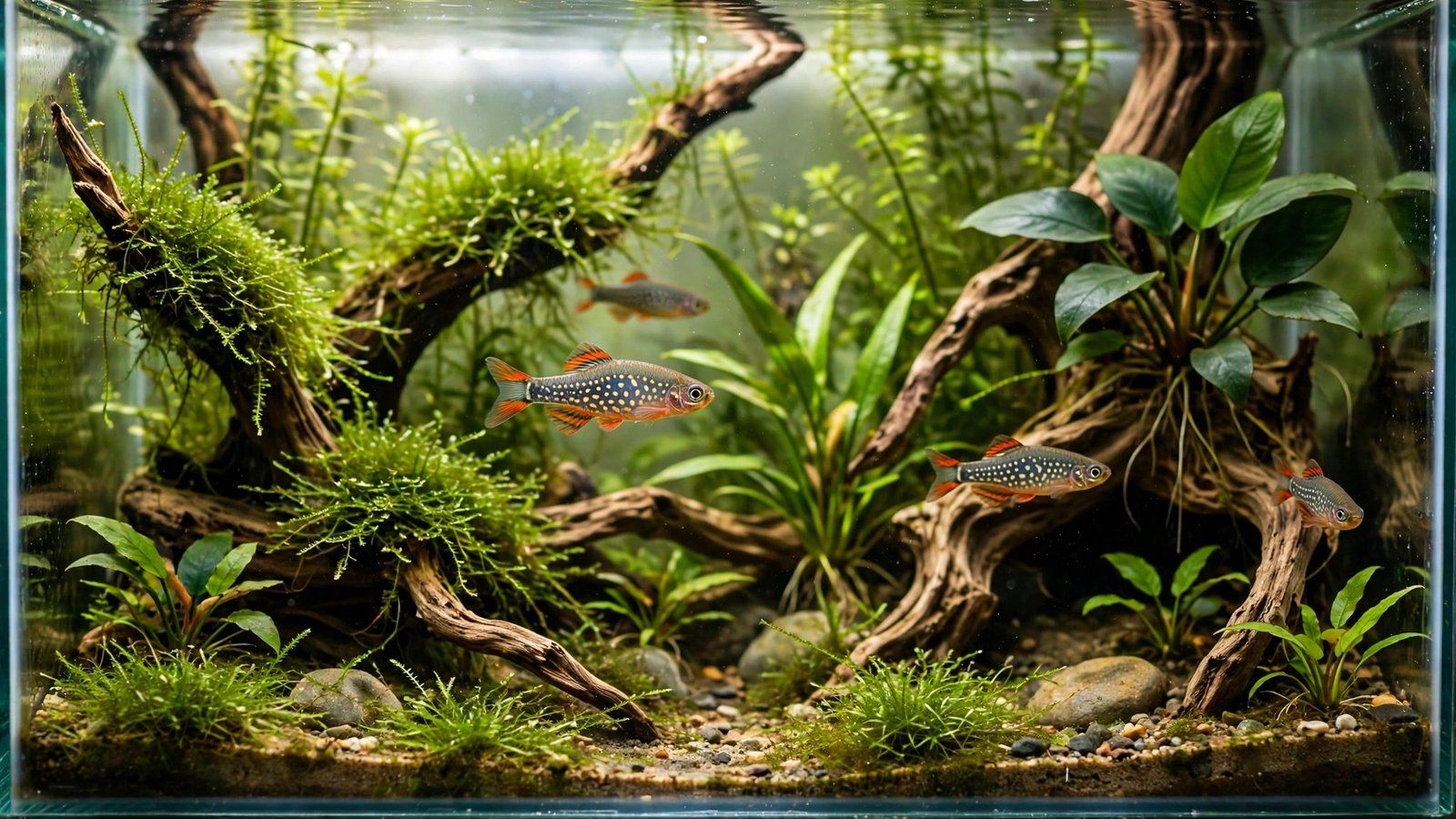
There's a moment every planted tank keeper lives for: a school of fish so jeweled they look painted onto the water. A celestial pearl danio planted tank delivers exactly that — ruby-red fins, a sapphire-blue body dusted with pearl-white spots, drifting through dense green stems. Better known as the galaxy rasbora, Danio margaritatus is the hobby's premium nano fish: small enough for a 10-gallon, peaceful enough for shrimp, and shy enough that the planting itself decides everything. Get the cover, the cool water, and the company right, and timid hiders become confident, schooling showpieces.
If you're weighing which schoolers belong in a planted nano, start with our roundup of the best schooling fish for planted tanks, where the galaxy rasbora earned its place as the premium pick — then skim our nano planted tank ideas for scaping a tank this small.
Why a Celestial Pearl Danio Planted Tank Matches Their Wild Home
Galaxy rasboras come from shallow, densely vegetated ponds in Myanmar's Shan State — discovered near Hopong in 2006, per the species' Wikipedia entry. At over 1,000 meters of elevation, their home water is cool, still, and choked with plants. That habitat explains everything: they are hoverers, not sprinters, happiest holding station beside a clump of stems. Drop them in a sparse, bright tank and they vanish into a corner for weeks; give them a thicket and the same fish patrol in the open, males flashing red fins in slow, circling displays. A dark substrate makes the pearl spots pop — aquasoil or dark sand, never pale gravel.
Tank Size and Equipment: Cool, Calm, and Covered
Ten gallons is the honest minimum for a school of 10–12; 15–20 gallons gives a group of 15 room to school properly and forgives beginner mistakes. Filtration should be gentle — a sponge filter or a hang-on-back with baffled flow — because these fish dislike current. A tight lid is non-negotiable: startled galaxy rasboras jump. For full parameter ranges, our planted tank water parameters guide covers everything this setup needs.
Do You Need a Heater?
Probably not. If your room stays above 19 °C (66 °F) year-round, skip it. If winters dip lower, add a small adjustable heater set to 21 °C (70 °F) as insurance. Cooler water slows their metabolism, which is why galaxy rasboras routinely live 3–5 years — push them to 26 °C and you'll burn through that lifespan fast.
Planting a Tank That Turns Shy Fish Bold
Cover is not decoration here; it is the behavior dial. Fill 60–70% of the tank volume: background walls of Rotala rotundifolia or Ludwigia repens, midground clumps of Cryptocoryne wendtii, and generous pads of java moss — which double as spawning substrate later. Floaters like Salvinia minima dapple the light and tell the fish no predator is circling above. CO2 is unnecessary; all of these grow fine low-tech under medium light.
Water Parameters and the Cycling Rule
This is the unforgiving part. Galaxy rasboras — especially wild-caught lines — react badly to ammonia and nitrite, and a freshly set-up planted tank will spike both. Cycle the tank for 4–6 weeks first, and add the fish only after ammonia and nitrite read zero for a full week. Target these numbers:
| Parameter | Target range |
|---|---|
| Temperature | 20–24 °C (68–75 °F) |
| pH | 6.5–7.5 |
| GH | 4–10 dGH |
| KH | 3–8 dKH |
| Ammonia / nitrite | 0 ppm, always |
| Nitrate | Below 20 ppm |
| Water changes | 25–30% weekly |
Feeding Tiny Mouths: Small Food, Real Variety
These fish have genuinely tiny mouths — standard flakes are boulders to them. Feed what they'll finish in two minutes, twice daily: crushed high-quality flake or micro granules (Hikari Micro Pellets and Sera Micron are proven staples), frozen daphnia or cyclops, and live baby brine shrimp two or three times a week. The live food is what turns males from "pretty" to spectacular: the red fin edging intensifies within two weeks on a varied diet. Skip a day once a week; a fasting day keeps nano tanks cleaner than any gadget.
Tank Mates: The Peace-First Shortlist
Galaxy rasboras want calm, small, cool-water company. Cherry shrimp are the classic pairing — our planted shrimp tank setup guide shows how to run both together — and a hillstream loach shares their love of cooler water. Small snails (nerites, ramshorns) are safe cleanup crew. Skip bettas, large tetras, and anything nippy or boisterous. Note the temperature catch: neon tetras prefer warmer water, so if your room runs tropical, build the planted neon tetra tank instead, or browse other calm schoolers in our planted rasbora tank setup guide.
Breeding in a Planted Tank: Let the Moss Do the Work
This is where a planted setup pays for itself. Galaxy rasboras are egg scatterers: at dawn, a male herds a female into fine moss, she drops a few sticky eggs, and he fertilizes them. The catch is that adults eat their own eggs and fry. The fix is simple: once a week, move a moss clump into a 5-gallon rearing tank with matching water. Eggs hatch in 3–5 days; fry take infusoria the first week, then baby brine shrimp. One school of 12 can quietly produce a colony of 30+ fish in a year.
Are Galaxy Rasboras Worth the Price?
At $5–8 each in the US, a school of 12 runs $60–100 — roughly four times the cost of the same number of neon tetras. What you get: a genuinely uncommon fish that breeds freely in your own tank, lives 3–5 years, and turns a 10-gallon into a centerpiece. If your tank is planted, cool, and cycled, they're worth every cent. If it's bare, warm, and fresh — spend the money on plants first.
Frequently Asked Questions
How many celestial pearl danios should I keep in a 10-gallon?
Ten to twelve is the sweet spot. Below eight, they stay permanently hidden and stressed, because the school is their entire sense of safety. Above twelve in a 10-gallon, feeding competition and nitrate creep become real problems.
Do galaxy rasboras need a heater?
Only if your room drops below 19 °C (66 °F) in winter. They thrive at 20–24 °C on room temperature alone. If you do add a heater, set it to 21 °C as a floor — constant tropical warmth shortens their lifespan noticeably.
Can celestial pearl danios live with cherry shrimp?
Yes — it's one of the best pairings in the hobby. Adults ignore adult shrimp completely, though they will snack on newborn shrimplets; dense moss lets enough babies survive to keep the colony growing. Add the shrimp first and let them breed for a month.
Why are my celestial pearl danios always hiding?
Hiding means something is missing: too few fish (under 8), too little cover, too much flow, or a tank that's too new. New arrivals need 1–2 weeks. Fix it in order: grow the school to 10+, thicken plants past 60% of the volume, baffle the filter, dim the light with floaters.
Will galaxy rasboras eat their own babies?
Yes, both eggs and free-swimming fry get eaten in the main tank, though a few fry still survive in moss-dense setups. For reliable breeding, move moss clumps carrying eggs into a separate 5-gallon rearing tank weekly and feed the fry infusoria, then baby brine shrimp.
The Galaxy Tank Payoff
Plant it dense, keep it cool, feed it small, and be patient through the first two weeks — your celestial pearl danio planted tank will reward you with one of the most jewel-like schools the freshwater hobby offers, and quite possibly a self-sustaining colony.