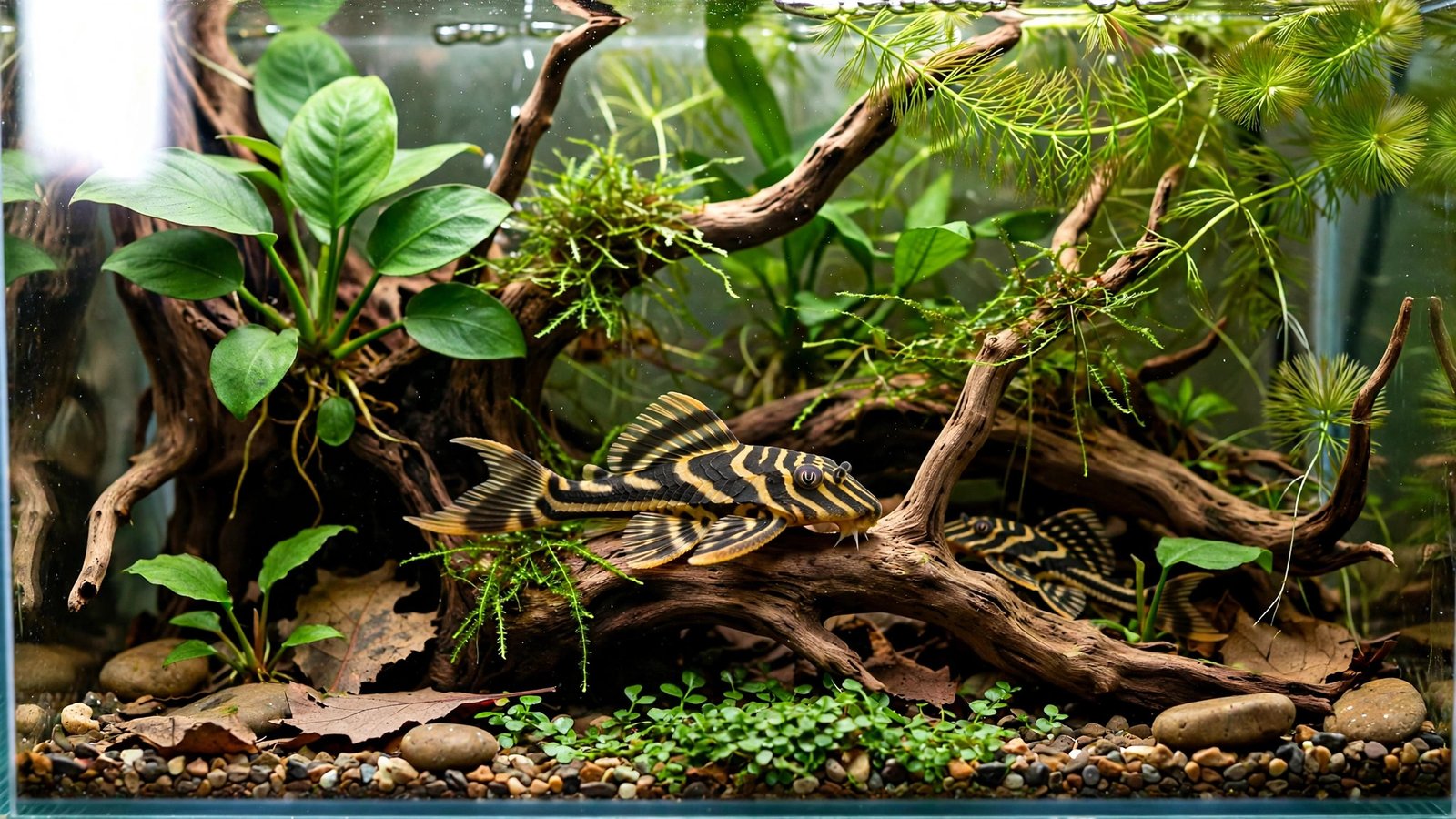
The striped pleco labeled "clown pleco" at the shop is very often a candy striped pleco, Peckoltia vittata (L015) — the small, calm loricariid the trade constantly confuses with its wood-chewing cousin. Good news for plant keepers: a candy striped pleco planted tank is among the lowest-risk pleco setups: a 3.5–4 inch fish that grazes biofilm without eating your aquascape.
Candy striped pleco vs clown pleco: the mix-up worth understanding
Half the fish sold as "clown pleco" are actually candy striped plecos. A true clown pleco planted tank is built around a wood-eater that must chew driftwood for digestion; the candy striped pleco is an omnivore that grazes whatever grows on the wood. Check the pattern before buying: clean cream-to-gold stripes over dark brown, breaking into an irregular pattern on the head. The Aquarium Wiki profile of Peckoltia vittata documents its timid, nocturnal habits and tolerance of planted environments.
| Trait | Candy striped pleco (L015) | Clown pleco (L104) |
|---|---|---|
| Scientific name | Peckoltia vittata | Panaqolus maccus |
| Diet | Omnivore, protein-leaning | Wood fiber staple |
| Wood relationship | Grazes biofilm on wood | Chews and consumes wood |
| Plant behavior | Ignores healthy leaves | Possible rasping on soft leaves |
Building a candy striped pleco planted tank: the small-tank case
A candy striped pleco planted tank earns its place in the 20–30 gallon range because the fish's footprint is tiny: roughly one square foot of bottom, daylight hours spent inside a cave. That makes it the honest answer to the small-tank pleco question, where the bristlenose pleco is usually recommended. The bristlenose is a fine algae worker, but it grows to 5–6 inches and will occasionally rasp soft leaves; the candy striped pleco stays smaller and is gentler on plants. In a 20-gallon, keep one fish with a mid-water school. In a 30-gallon, a pair works — but give each fish its own cave on opposite ends, or males will spar over the best hide. Start with plant picks that plecos leave alone.
Driftwood as functional hardscape, not decoration
In this tank, driftwood is equipment. The pleco spends its active hours working across the wood's surface, scraping off the biofilm, soft algae, and microfauna that colonize it — a meaningful part of its diet. Choose one or two dense pieces of Malaysian driftwood or mopani. Position the main piece mid-tank as the aquascape's anchor, one end tucked behind rocks so it cannot shift. When you are planning hardscape and substrate together, place the wood before planting and arrange caves around its footprint — the pleco treats the wood-plus-cave cluster as one territory. Avoid grapevine and soft woods, which go mushy in warm water.
 ★4.2
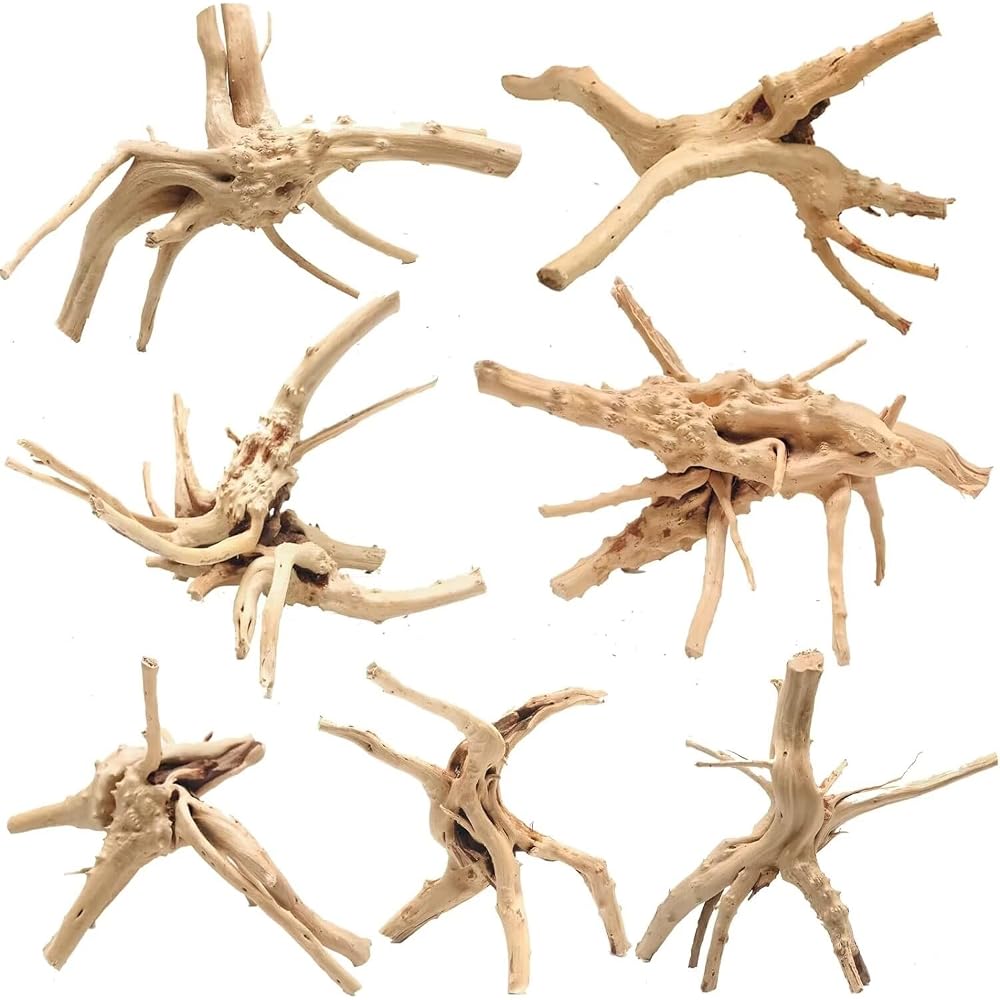
Hamiledyi Natural Spider Wood Driftwood
Check Price on Amazon ★4.2Plant-safe — with one honest exception
The candy striped pleco does not eat healthy plants. Anubias, Java fern, Bolbitis, and Amazon swords all survive it untouched. The honest exception is mechanical: this fish is a heavy-bodied bottom scraper, and a freshly planted, unrooted stem will get nudged loose at night. The fix: use tough plants for a pleco tank, tie epiphytes to driftwood and rocks, and let stems root for four weeks. Keep the zone around the wood and caves planted with your hardiest species — or leave it as a deliberate sand patch.
Feeding an omnivore: algae wafers, protein, and wood fiber
The candy striped pleco is an omnivore with a protein bias, not the dedicated algae machine the shop label implies. Build the diet on three pillars: algae wafers, a meaty sinking food, and the wood itself for fiber. Feed after lights-out, when the fish is actually active — daytime food gets eaten by tetras first. A weekly rhythm that works:
| Day | Evening feeding |
|---|---|
| Mon / Wed / Fri / Sun | 1 wafer per pleco, under the wood overhang |
| Tue / Sat | Thawed bloodworm, daphnia, or mysis (one small cube) |
| Thu | Blanched zucchini slice on a veggie clip, removed after 12 hours |
Adjust by observation: a gently rounded belly by morning means the ration is right. Do not count its grazing as your algae strategy — pair it with the rest of your planted-tank cleanup crew and let each member do the job it is built for. Wafers still on the bottom at dawn mean cut back.
Caves and the shy daytime fish
You will barely see this fish during the day, and that is correct. Candy striped plecos are nocturnal and genuinely timid; a fish pressed inside a cave at noon is a comfortable fish. Provide at least two caves per pleco — ceramic pleco caves, coconut shells, or stacked slate — one against the driftwood, one in a shaded corner. The payoff comes after dark: a well-furnished fish patrols a predictable circuit of wood, glass, then substrate. If yours never emerges at night, check for boisterous feeders stealing its food.
Tank mates and water parameters
Choose peaceful mid-water and surface fish that will not compete at the bottom: tetras, rasboras, platies, and small gouramis are the safe set. Under 30 gallons, avoid other bottom-dwellers — the candy striped pleco defends its cave zone and loses food fights to bolder eaters. In 30+ gallons, a second small species such as a rubber lip pleco can work with distinct cave territories per fish.
| Parameter | Target |
|---|---|
| Temperature | 75–82°F (24–28°C) |
| pH | 6.0–7.5 |
| Hardness | Soft to moderate (3–12 dGH) |
| Ammonia / nitrite | 0 ppm at all times |
| Nitrate | Below 20 ppm |
Acclimate slowly — float the bag for 15 minutes, then drip-acclimate over 45 minutes. Have the caves in place before the fish goes in: the first cave it finds becomes its anchor.
Frequently Asked Questions
How big does a candy striped pleco get?
Adults reach 3.5–4 inches (9–10 cm), occasionally 5 inches in very old specimens. That makes it a genuine small-tank pleco: one fish lives its full 8-10 year lifespan comfortably in a 20-gallon. Females run slightly larger and broader than males. Unlike a common pleco, it will not quietly outgrow your tank.
Will a candy striped pleco eat my aquarium plants?
No — it does not eat healthy plants. It grazes biofilm and soft algae off leaf surfaces without chewing them. The real risk is mechanical: its heavy body can uproot freshly planted, unrooted stems. Tie epiphytes to hardscape and let stems root for four weeks.
Does a candy striped pleco need driftwood?
Yes, treat driftwood as required equipment. The fish rasps wood surfaces for the biofilm and microfauna living on them, which supplements its diet and aids digestion. It will not destroy the wood the way a clown pleco does. One dense piece per tank is standard.
Can I keep two candy striped plecos together?
Yes, in 30 gallons or more. Give each fish a cave on opposite ends of the tank, because males spar over a single prime hide. Two females or a male-female pair are calmest. Under 30 gallons, keep a single pleco.
Why is my candy striped pleco always hiding?
Daytime hiding is normal — this is a nocturnal, timid species. Expect it to emerge 30–60 minutes after lights-out and patrol until dawn. If it never appears at night, check cave count, food reaching the bottom after dark, and no boisterous tank mates.
The small pleco that keeps its promises
The candy striped pleco is what the shop label claims the clown pleco is: a small, peaceful, genuinely plant-safe bottom-dweller for a normal-sized planted tank. Driftwood to graze, caves to vanish into, food after dark — and it will hold its corner of the tank for the better part of a decade.