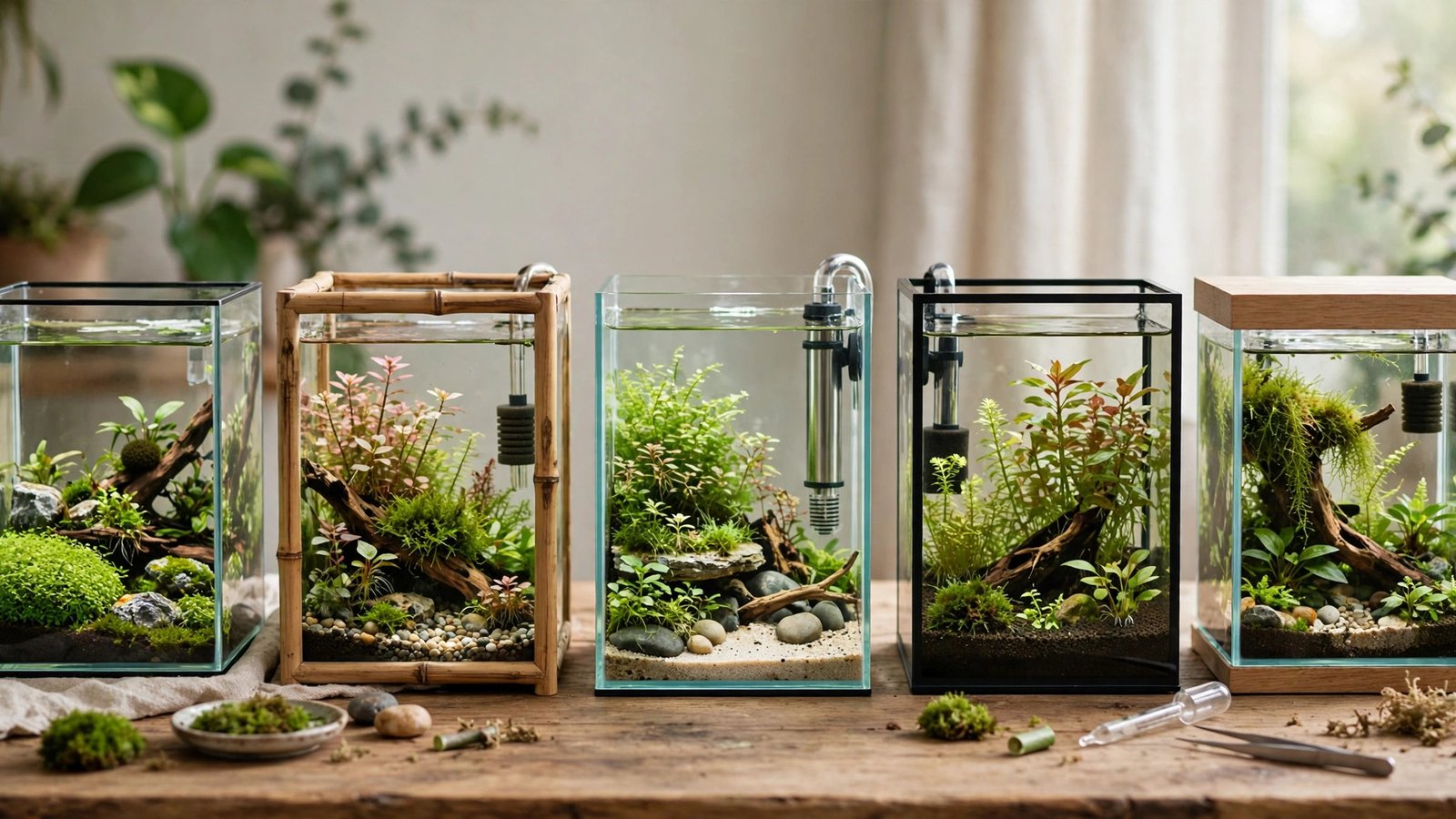
Most nano kits sell you a beautiful glass box and leave out the two things that decide whether plants survive: usable light and gentle flow. The best nano aquarium kit for a planted tank isn't the cheapest all-in-one — it's the one whose light grows plants without an upgrade and whose filter won't blast shrimp across the tank.
The short answer: the best nano aquarium kit for a planted tank is the Fluval Spec V for most beginners: 5 gallons of real scaping room, a 7000K LED that handles low- to medium-light plants, and rear-chamber filtration you can baffle for shrimp. The catch: no kit under about $150 ships with a heater, and the Spec V's pump is rated 55–80 gallons per hour, so shrimplet keepers need a prefilter sponge. On a tight budget, the NICREW Nano Nature 2.5G works — but 2.5 gallons punishes every skipped water change.
What to Look for in the Best Nano Aquarium Kit
Light first. The LED in the box decides your plant list. Look for 6500–7000K: mosses and anubias survive under almost anything, but a hairgrass carpet needs roughly 30+ PAR at the substrate. Our best aquarium lights for planted tanks guide explains the numbers.
Flow second. Nano filters often run too strong: shrimp hate being tumbled, and shrimplets get pulled into unguarded intakes. Baffle the output or add a prefilter sponge — see our best filters for planted tanks roundup.
Heat third. The part listings bury: none of these kits include a heater until roughly $150. If your room holds above 72°F year-round, skip it; if not, add a 25–50W adjustable heater and a thermometer — see our heater for planted tanks guide.
Stability fourth. Small volumes amplify every mistake — one overfeeding, one missed water change. The jump from 2.5 to 5 gallons matters more than any feature on the box; then browse our nano planted tank ideas guide for layout ideas.
The 5 Kits, Compared Side by Side
Five kits, budget to premium. Prices are typical US street bands, not promises.
| Kit | Size | Light | Filtration | Heater? | Price | Trade-off |
|---|---|---|---|---|---|---|
| NICREW Nano Nature 2.5G | 2.5 gal | NICREW clip-on LED | Hang-on-back | No | $40–$55 | Cheapest way in; modest light, unforgiving volume |
| Marineland Portrait 5G | 5 gal | Built-in LED, day/moonlight | Hidden rear 3-stage | No | $80–$100 | Sleek but hard to scape; flow runs strong |
| Fluval Spec V | 5 gal | 7000K LED, dimmable | Rear-chamber 3-stage, adjustable pump | No | $110–$130 | Best all-rounder; baffle the pump for shrimplets |
| Aquael Shrimp Set Smart 30 | 7.9 gal | Leddy Smart LED | Internal filter | Yes (50W) | $120–$150 | Only kit with a heater; tame the filter flow |
| Waterbox Cube 10 | 10 gal | None — tank only | None — your choice | No | $110–$140 tank; $250+ equipped | Premium glass, not a kit; cost doubles equipped |
A Closer Look at Each Kit
Fluval Spec V — the default recommendation
A 20.5-inch footprint that's fun to scape, a dimmable 7000K LED, and a rear chamber hiding pump and media. The catch is flow: the Spec V's published specs rate the pump at 55–80 GPH — 11 to 16 turnovers per hour. Turn the nozzle down, add a prefilter sponge, and it's the most forgiving first nano you can buy.
Marineland Portrait 5G — the desk showpiece
A tall column of water with a sliding glass canopy and hidden filtration — it looks like modern art. The LED handles low-light plants, but the tall shape is hard to aquascape and stock flow is strong for shrimp. If shrimp are the plan, read our planted shrimp tank setup guide before stocking.
Aquael Shrimp Set Smart 30 — the complete package
The only kit here with a heater (50W adjustable), plus a dimmable LED with sunrise/sunset modes and nearly 8 gallons of stable volume. Aquael is European, so US parts take patience, and the internal filter runs strong for shrimplets.
NICREW Nano Nature 2.5G — the budget entry
Rimless tank, clip-on LED, hang-on-back filter, leveling mat, lid — everything for about fifty dollars. The light grows mosses, anubias, and java fern, not carpets, and 2.5 gallons means temperature swings and fast evaporation.
Waterbox Cube 10 — the premium blank canvas
Not a kit: a bare low-iron glass cube. You choose light, filtration, and heater — no compromises. The all-in cost roughly doubles once equipped, so it suits someone who knows their setup.
Setting Up Your Kit Without the Usual Crashes
Rinse with water only — never soap — then lay substrate, hardscape, and plants before adding water. Plant heavily from day one; in a nano, plants are part of the filtration. Then cycle 2–6 weeks like a big tank: our planted tank cycling guide covers the fishless method.
Going low-tech? Follow our lightly planted aquarium setup guide for plant choices that thrive on kit lighting. Stock slowly — shrimp once biofilm develops, a betta once parameters hold. Feed sparingly the first month.
Frequently Asked Questions
Do any nano aquarium kits include a heater?
Almost none — of these five, only the Aquael Shrimp Set Smart 30 ships with one (50W adjustable). If your room stays above 72°F year-round, shrimp and bettas do fine without. Below that, budget $25–35 for a 25–50W adjustable heater plus a thermometer; temperature swings kill fastest in small volumes.
Can I keep shrimp in any of these kits?
Yes, with one fix: every filter here needs its flow tamed for shrimplets. Add a prefilter sponge over the intake and baffle the output, especially on the Spec V and Portrait, whose pumps run strong. Cycle fully first — shrimp are far more sensitive to ammonia than the hardy fish these kits are marketed for.
Is 2.5 gallons too small for a planted tank?
Not too small to work, but too small to forgive. A 2.5-gallon swings several degrees between day and night and accumulates waste fast, so it needs small, frequent water changes. For a first planted tank, 5 gallons is dramatically easier — the extra volume buys time to notice and fix mistakes.
Do I need CO2 in a nano kit?
No — everything the stock lights on these kits can grow thrives without injected CO2. Anubias, java fern, mosses, cryptocorynes, and dwarf sagittaria all do well low-tech with basic fertilizer. CO2 only pays off if you upgrade the light and want demanding carpets or red stems.
How often should I do water changes in a nano planted tank?
Change 20–30% weekly once the tank is cycled, and twice weekly for the first month while the system settles in. In tanks under 3 gallons, top off evaporation between changes with dechlorinated water only — evaporation concentrates everything dissolved in the tank and spikes TDS quickly.
Can I upgrade the stock light later?
Usually, yes. Clip-on and gooseneck LEDs fit any rimless nano for $20–40, so a budget kit isn't a trap — the glass and filter stay, only the light gets replaced. Check the new light's PAR at your tank's depth first, and dim it for two weeks to avoid an algae bloom.
Start with the light and the filter, and the glass becomes the easy part. Pick the kit that matches your livestock, give it a real cycle, and your nano will outshine most big tanks by month six.