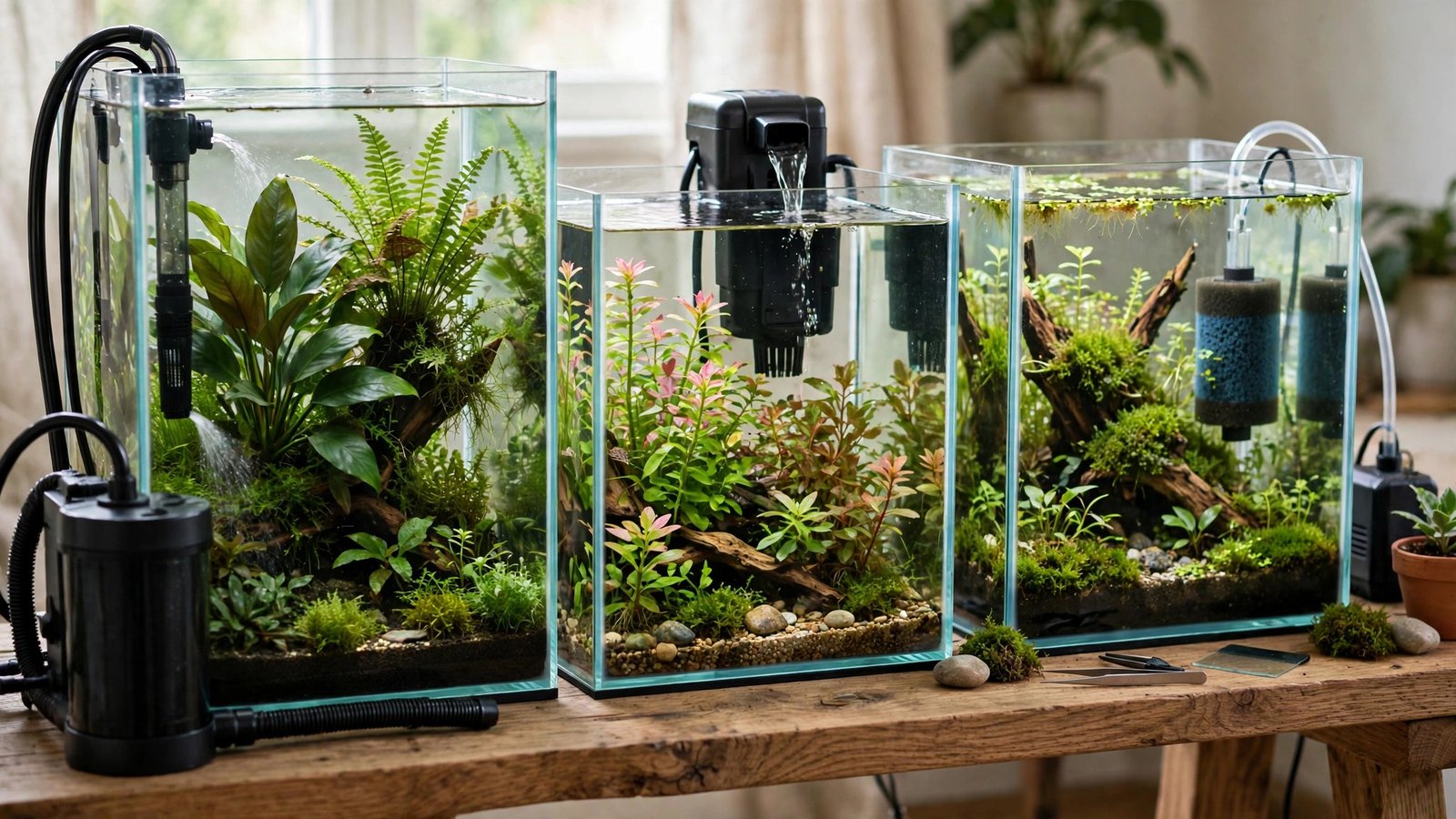
Most planted-tank owners buy a filter rated for their tank size, mount it, then watch their injected CO2 bubble straight out of the water's surface. Choosing the best filter for planted tank use is less about raw power and more about three things the box never lists: how much CO2 the filter wastes, how gently it moves water, and how quietly it runs. This guide compares the four real options — canister, hang-on-back, sponge, and internal — then names the product picks we would buy ourselves. A low-tech planted tank setup does not need the same hardware as a CO2-injected display, so every recommendation is matched to a planting style.
What a planted tank actually needs from a filter
Fish-focused guides rank filters by ammonia processing. Planted tanks need a different scorecard — the filter is also the circulation system and, on CO2 setups, the biggest CO2 leak. Judge any filter on five things:
- Real turnover: 4–6× tank volume per hour after media and head height. Loaded, expect 40–60% of the printed number.
- CO2 retention: aggressive surface agitation trades dissolved CO2 for oxygen — raising your gas bill and destabilizing the drop checker.
- Flow distribution: gentle, even circulation reaching every leaf, not one jet flattening stems on one side.
- Media capacity: planted tanks produce plant debris, not just fish waste. More room means longer intervals between cleanings.
- Noise: most planted tanks live in living rooms. A filter you stop noticing on day one beats one you unplug on day thirty.
A lightly planted aquarium setup needs far less of everything above — which is why the comparison below is organized by planting intensity, not just tank size.
Canister vs HOB vs sponge vs internal: the honest comparison
| Filter type | Best planted-tank use | CO2 friendliness | Media capacity | Noise | Maintenance rhythm |
|---|---|---|---|---|---|
| Canister | 20+ gal, CO2-injected tanks | Excellent — sealed, no waterfall | Large | Very quiet | Deep clean every 6–8 weeks |
| Hang-on-back (HOB) | Nano and low-tech tanks | Moderate — baffle the outflow | Small | Audible hum + trickle | Quick rinse weekly |
| Sponge | Shrimp and breeding tanks | Good — gentle surface movement | Small | Near-silent | Squeeze in tank water biweekly |
| Internal | Backup, quarantine, temporary | Moderate | Small–medium | Varies | Frequent, cramped cleanings |
Canister filters are the planted-tank standard: sealed plumbing wastes almost no CO2, large media baskets hold weeks of debris, and they accept glass lily pipes that disappear into an aquascape. The tradeoffs are price and a 15–20 minute cleaning ritual. See our canister filter sizing and setup guide.
HOB filters win on simplicity and price, and on a 5–10 gallon low-tech tank they are genuinely enough. Their weakness is the waterfall return, which vents CO2 — keep the waterline near the lip and add a baffle, as shown in the HOB setup guide with CO2-saving tweaks.
Sponge filters are the shrimp keeper's default: shrimplet-safe, near-silent on a decent air pump, and almost free. The weakness is aesthetics and limited media for heavy debris — compared head-to-head in our sponge vs HOB guide.
Internal filters suit quarantine duty but eat in-tank space; sumps fit very large displays, though their open design off-gasses CO2 aggressively.
The best filter for planted tank: our product picks
No invented ratings or prices — each pick has an honest downside.
EHEIM Classic 150 (2211) — the small-tank canister standard. Rated for 50–150 liters at 300 L/h on 5 watts, famously quiet, with parts available decades later — see EHEIM's published specs for the Classic 150. Cons: mouth-siphon priming, fiddly hose clamps, modest media volume — on a 40-gallon high-tech tank, step up to the Classic 250.
OASE BioMaster 2 Thermo 350 — the clean-scape canister. Built-in heater keeps glass hardware out of the aquascape; the pre-filter module rinses without opening the canister. Cons: a clear price premium, and the integrated heater adds a failure point — if it fails, the whole filter goes to service.
AquaClear 20 — the HOB we would actually recommend. Adjustable flow throttles to a trickle, and the basket takes loose media instead of disposable cartridges. Cons: the waterfall off-gasses CO2 unless the waterline stays high and baffled; small media volume means weekly rinses on stocked tanks.
hygger Double Sponge Filter — the shrimp-tank workhorse. Near-silent on a quality air pump, shrimplet-safe by design, cheap enough for every breeding tank. Cons: a sponge sitting in your aquascape (hide it behind hardscape), and no fine-pad polishing.
CO2 and surface agitation: the tradeoff nobody explains
CO2 injection and surface agitation pull in opposite directions. Agitation drives gas exchange: great for oxygen at night when plants respire, terrible for the CO2 you pay to dissolve by day. Aim for a surface that ripples — visible movement, no breaking water. Churning water can strip a tank of injected CO2 in hours.
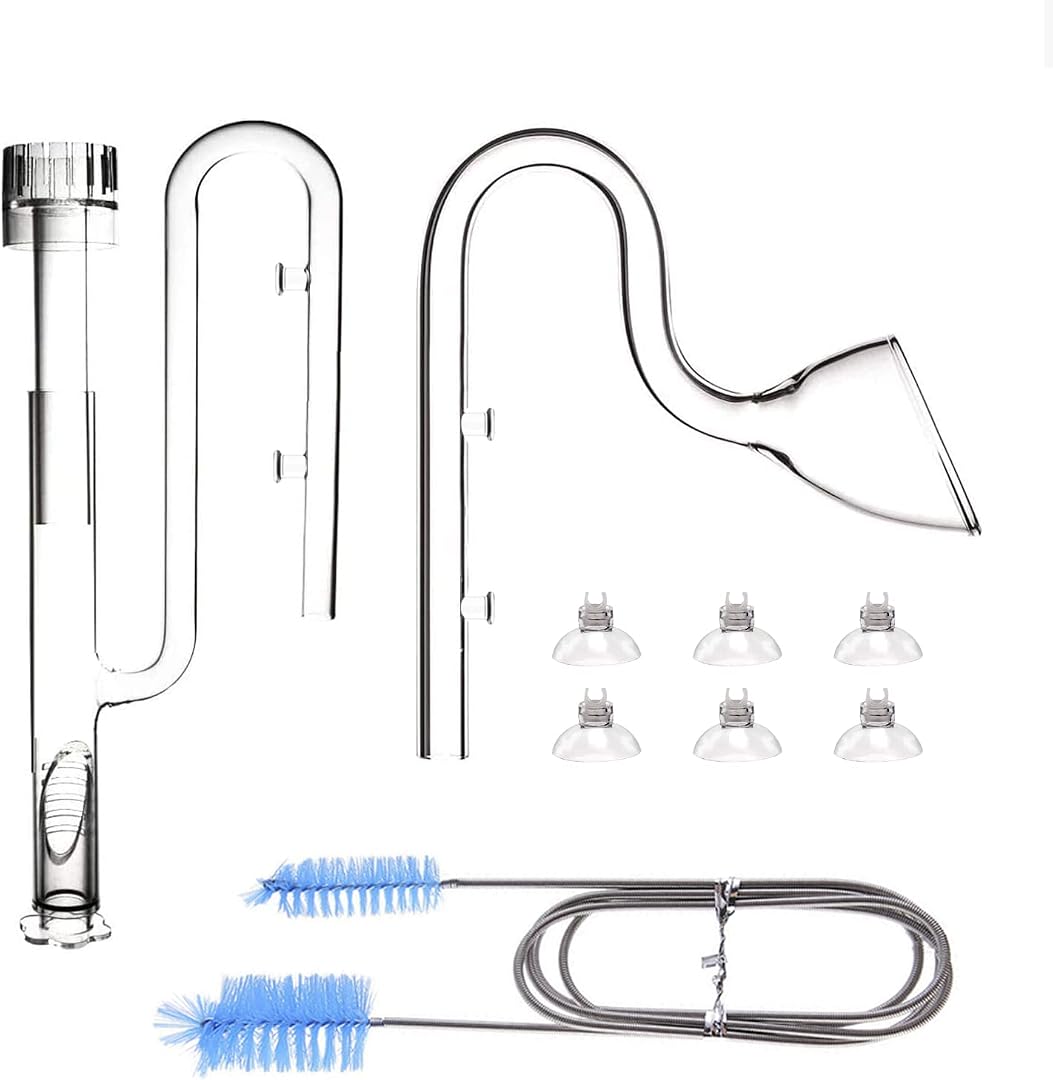
A spray bar along the back glass, just below the surface and angled slightly down, spreads flow evenly and is easiest to tune. A lily pipe sits about an inch below the surface, angled slightly up so the return gently dimples the water — nearly invisible glass for display scapes; a lily pipe set with a built-in skimmer, like the FZONE Aquatic set, also clears the protein film that dulls light on CO2 tanks. For placement and dead spots, see our guide to water flow and circulation in planted tanks.
 ★4.0
FZONE Aquatic Glass Lily Pipe Set with Skimmer
Check Price on Amazon ★4.0Shrimplet-proofing and gentle flow
If shrimp breed in your tank, the intake is enemy number one. A prefilter sponge slipped over any intake stops shrimplets from being drawn in and protects the impeller from plant debris — at the cost of a sponge you rinse weekly (a multi-pack like the AQUANEAT pre-filter sponges ★4.5 covers every intake; see our guide to prefilter sponges). Keep the intake a few inches above the substrate so it does not vacuum aquasoil dust, and aim outflows to create a slow gyre.
Noise and maintenance: the ownership test
Buy for maintenance reality. Canisters ask for a 20-minute deep clean every 6–8 weeks; HOBs and sponges ask for two minutes weekly or biweekly, but constantly. Miss a month on a canister and it shrugs; miss a month on a small HOB and flow collapses. Rinse media in old tank water, never chlorinated tap, and never scrub every stage at once — stagger cleanings so biofilm always has a refuge.
Frequently Asked Questions
What turnover rate is best for a planted tank?
Aim for 4–6× tank volume per hour of real, loaded flow — roughly half the printed number once packed with media. High-tech tanks: err high. Low-tech nanos: 3–4× is fine.
Do hang-on-back filters waste CO2?
Yes. The waterfall return churns the surface and vents dissolved CO2. On injected tanks, keep the waterline near the filter lip, baffle the outflow, and verify with a drop checker. Higher bubble rates just waste gas.
Can I run a sponge filter on a high-tech CO2 tank?
You can, but it is a compromise. Sponge filters are gentle on CO2 and excellent biologically, yet they lack a canister's fine polishing and strong circulation. They shine in shrimp and breeding tanks; for a display-grade high-tech scape, a canister with a lily pipe performs better.
Lily pipe or spray bar — which outflow is better?
Both work. Lily pipes are nearly invisible glass, ideal for display scapes, but need careful positioning an inch below the surface. Spray bars distribute flow more evenly and are easier to tune, at the cost of visible plastic. Either way: ripple, never churn.
Should the filter run at night when CO2 is off?
Always — filtration runs 24/7. At night plants respire and consume oxygen, which is exactly when you want steady circulation. Turning the filter off nightly starves bacteria of oxygen and causes the pH and oxygen swings that stress livestock.
The bottom line: match the filter to the planting style
There is no single best filter for every planted tank — only a best filter for your planting style. CO2-injected display? A canister with a lily pipe or spray bar, sized generously and throttled down. Low-tech nano? An adjustable HOB with a baffled outflow. Shrimp colony? A sponge filter. Get turnover, surface agitation, and shrimplet safety right, and the setup around the filter matters most.