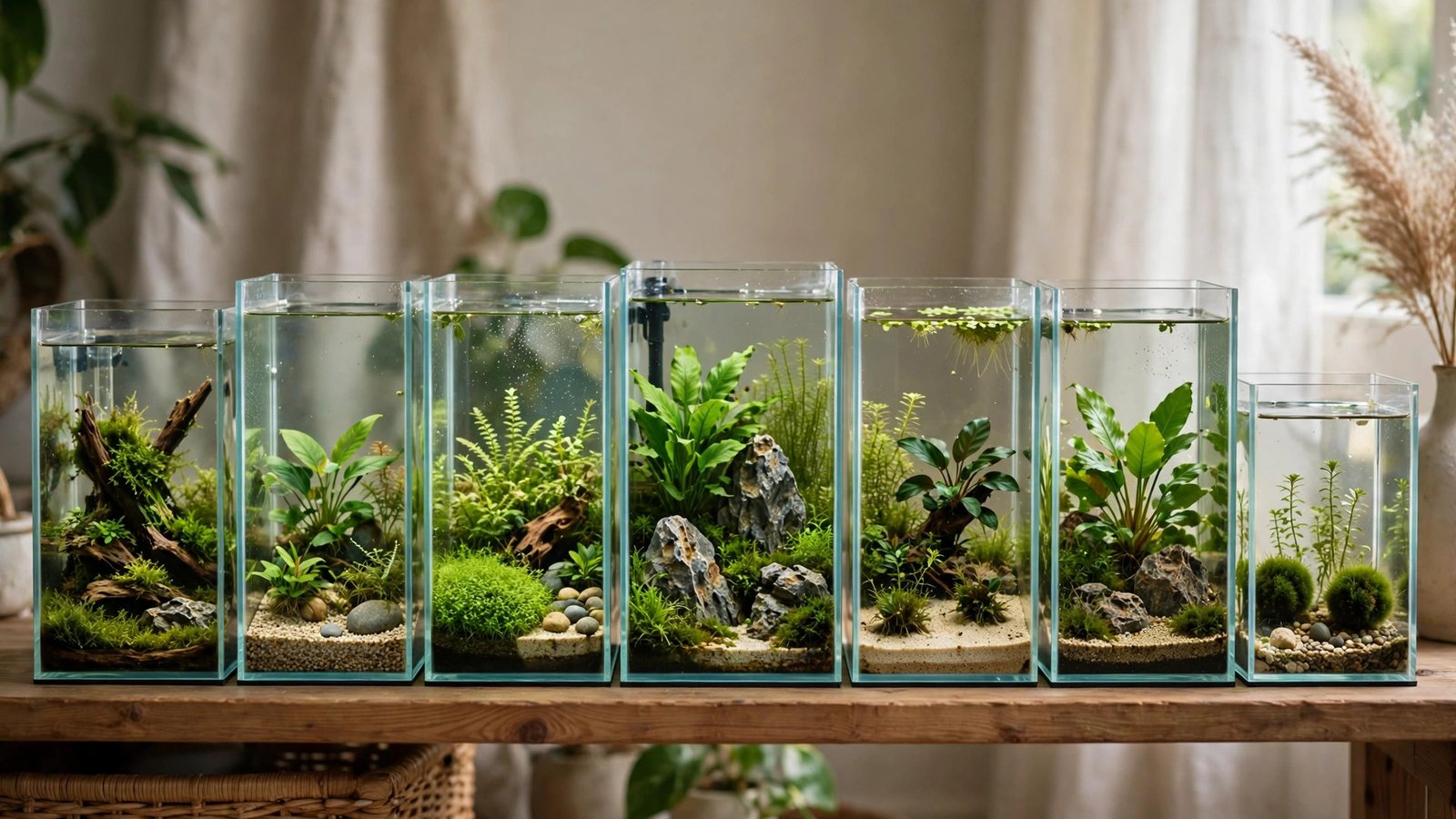
Finding the best planted aquarium kit 2026 buyers can actually grow plants in is trickier than it looks. Most aquarium kits are lit to show off fish, not to drive photosynthesis — which is why so many first-timers end up buying a replacement light within a month of filling the tank. A planted-ready kit needs four things: a light that reaches the substrate with enough useful output, gentle but thorough circulation, enough water volume to keep parameters steady, and honest disclosure about what the box leaves out. We evaluated ten popular kits against those criteria, and seven earned a place here — with the gaps in each stated plainly so you can plan the few extras you will still need.
What Makes an Aquarium Kit "Planted Ready"?
Before the picks, it helps to know what you are actually judging, because the box art will not tell you. Three variables decide whether live aquatic plants thrive or melt: light strong enough to power photosynthesis, flow that moves water and dissolved gas across leaves, and volume that keeps temperature and chemistry stable. Miss any one of the three and you get an algae problem instead of an aquascape.
Light is where nearly every kit falls short. Wattage and lumen counts look impressive on packaging, but they say almost nothing about how much usable light reaches the substrate, where your plants live. Aquatic plants respond best to a full spectrum with white and red components (roughly 6500–7500K), while blue-only or color-changing "party" lighting does almost nothing for stems and carpets. A light with a built-in or plug-in timer is a major plus, because a consistent 6–8 hour photoperiod is one of the most important variables in a planted tank.
Finally, check what the box quietly leaves out. Substrate, heaters, thermometers, liquid test kits, and dechlorinator are absent from most kits. A "complete" kit that omits the heater is not a complete first purchase — it is a second trip to the store. We flag these gaps for every pick below.
The Best Planted Aquarium Kit 2026 Picks: 7 Evaluated Options
1. Fluval Flex 9 Gallon — Best Overall Light for Live Plants
The Fluval Flex 9 is the kit we recommend first to anyone whose question is specifically about growing plants. Its 7500K white-plus-RGB LED array is marketed for plant growth support rather than just for viewing fish, and it is fully adjustable so you can dial the spectrum. The multi-directional dual outlet aims flow around a scape, and the curved front with its honeycomb wrap hides the filter compartment so a planted layout looks deliberate.
- Pros: LED array designed for plant growth; adjustable 7500K white + RGB spectrum; oversized 3-stage media; 9 gallons is a genuinely useful aquascaping size with real carpet potential
- Cons: the priciest option among the nano and mid-size kits; the FLEXPad remote adds electronics and effects most planted keepers never use
What to add before planting: a plug-in timer (the remote handles effects, not a photoperiod), a real thermometer, a heater for tropical setups, substrate, and liquid fertilizer. This kit is also a solid stepping stone toward a high-tech planted tank setup later, since the light quality is already halfway there.
2. Marineland Portrait 5 Gallon — Best Turnkey Nano Display
The Marineland Portrait is the most heavily reviewed kit here, with over 10,000 owner ratings, and the reason is design. Rounded corners, a clear glass canopy, and a hidden 3-stage filtration compartment make the tank viewable from multiple angles, so a small planted scape reads as a display piece. The hinged LED light and sliding canopy let you plant without removing the light assembly.
- Pros: huge, long-term owner review base; hidden filtration keeps equipment out of the view; daylight and moonlight LED modes; easy canopy access
- Cons: five gallons suits low plant biomass, not dense aquascapes; no heater included; the hidden filter compartment is easy to neglect at media-swap time
Stick to anubias, java fern, crypts, and mosses under the stock LED; plan a grow-light upgrade before attempting stems or carpets.
3. Aqueon 20 Gallon Starter Kit — Best Value Complete Package
The Aqueon 20 is the most complete bundle here, and completeness is what a first planted tank needs. The box includes the glass tank, a low-profile hood with cool-white LED and a feeding door, SmartClean filtration, a preset heater, thermometer, net, fish food, and water conditioner. Twenty gallons is the size where a planted aquascape stops being a novelty — there is real room for a proper layout.
- Pros: most complete out-of-box bundle (heater, food, conditioner included); no assembly; 20 gallons gives stability and real scaping room
- Cons: the supplied LED is weak for densely planted setups — most serious growers add a grow light; the SmartClean filter's intake can pull in small fish and shrimp without a pre-filter sponge; the sticker thermometer is unreliable
Budget a grow light alongside the kit, fit a pre-filter sponge on the intake before filling, and rinse the cartridge in old tank water instead of replacing it.
4. Tetra Color Complete 20 Gallon — Best Kit That Puts Decor in the Box
This is the only kit here that ships with anything resembling planting: two plastic plant multipacks and a blooming anemone decor piece, so the tank looks arranged on day one. The color-changing LED can be paused on any color, and the Whisper 20 filter runs quiet for its size.
- Pros: instant finished look with included decor; quiet filtration; good value for a 20-gallon bundle with heater and filter
- Cons: the inline on/off switch means no external timer — a real problem, since planted tanks need a consistent photoperiod; the light is built for color display, not growth; the included plants are plastic and will want replacing
Buy it for the tank, heater, and filter at a fair price — not for the light. For a genuinely planted build, the Aqueon 20 above is the stronger pick.
5. Fluval SPEC 2.6 Gallon — Best Desktop Nano
Light per liter of water is the number that matters in a nano tank, and the SPEC packs a high-output 7000K LED in a waterproof aluminum housing into just 2.6 gallons. Owners describe it as bright enough to keep low-light plants thriving and make livestock color pop. The 3-stage filtration hides behind a honeycomb wrap so the tank looks clean from the front.
- Pros: genuinely bright 7000K plant-capable LED for the footprint; complete filtration kit included; compact desktop size; long-proven design with thousands of owner reviews
- Cons: 2.6 gallons is one of the smallest real tanks — parameters swing fast; high price per gallon; no heater included
A shrimp or betta tank, not a community — keep the bioload light, add a nano heater, and fit a pre-filter sponge for shrimp. A low-tech planted tank setup is the perfect match for this footprint.
6. Koller Products 5 Gallon — Best Budget Start
The Koller kit exists to let you learn the mechanics cheaply, and on that job it performs. The 30-LED light has white, warm, blue, and mixed modes plus a 2/4/8-hour timer with memory that holds your photoperiod across power cuts. The one-piece impact-resistant plastic body eliminates leak risk entirely, which also makes it the most sensible pick for a child's room.
- Pros: least expensive way into a planted setup by a wide margin; light timer with memory; 45 GPH internal filter gives real circulation; leak-proof one-piece body
- Cons: plastic scratches more easily than glass; five gallons is small for dense aquascapes; replacement filter cartridges are a separate, recurring cost
Anubias, java fern, and crypts do fine on six to eight hours; stems and carpets do not. Add a grow light before choosing demanding plants, not after.
7. hygger Horizon 8 Gallon — Best Light Control
The light is why people buy this tank: an 18W LED array on extendable brackets with an external digital controller — five brightness levels from 10% to 100%, three color modes, and a 3/6/12-hour timer. Dimming the light and shortening the photoperiod is exactly the control you need to drive growth while holding algae off, and no other kit here offers it.
- Pros: the most controllable light in this roundup — dimmable with a real timer; 8-gallon curved-front glass adds depth to a scape; two interchangeable filter nozzles
- Cons: the permanently installed 3D rockery background is hard to clean, grows algae, and works against a self-built aquascape; the 110 GPH filter is too strong for small livestock without a pre-filter sponge; no lid included
Superb lighting control on a tank whose fixed background fights your aquascaping. Tame the filter flow from day one, treat the background as decoration, and check your stand's rating — it weighs around 68 pounds loaded.
The curved-front Flex remains the style pick of the lineup: Fluval Flex 9-gallon kit.
The budget entry that still grows plants: Aqueon 10-gallon starter kit.
Kit Comparison at a Glance
| Kit | Volume | Light | Filter | Heater included | Best for |
|---|---|---|---|---|---|
| Fluval Flex 9 Gallon | 9 gal | 7500K white + RGB, adjustable, plant-oriented | 3-stage, oversized media | No | Plant growth in a mid-size tank |
| Marineland Portrait 5 Gallon | 5 gal | Daylight/moonlight LED | Hidden 3-stage | No | Turnkey nano display |
| Aqueon 20 Gallon | 20 gal | Cool-white LED (weak for dense plants) | SmartClean internal | Yes (preset) | First complete planted tank |
| Tetra Color Complete 20 Gallon | 20 gal | Color-changing LED, no timer support | Whisper 20 | Yes | Instant decor, light upgrade planned |
| Fluval SPEC 2.6 Gallon | 2.6 gal | High-output 7000K LED | 3-stage, hidden | No | Desktop shrimp/betta nano |
| Koller Products 5 Gallon | 5 gal | 30-LED, 4 modes + timer memory | 45 GPH internal | No | Budget first tank |
| hygger Horizon 8 Gallon | 8 gal | 18W, 5 brightness levels, 3 modes, timer | 110 GPH internal (strong) | No | Light control on a budget |
Which Kit Should You Actually Buy?
No kit on this list is a complete planted aquarium out of the box: nearly all of them still need substrate, a liquid test kit, dechlorinator, and a real thermometer, plus a heater where the box omitted one. Avoid the two most common beginner mistakes — adding livestock before the cycle completes, and over-lighting a small tank. Start with a six-hour photoperiod, extend it only once plants are clearly growing and algae is not, and settle into a steady planted tank maintenance schedule once livestock is in.
- Plants are the priority — Fluval Flex 9. The light is the point of the purchase.
- One box, no second trip — Aqueon 20 Gallon, then budget the grow light.
- Desk or dorm — Fluval SPEC 2.6 for a shrimp or betta display; Marineland Portrait 5 for more scaping room.
- Tightest budget — Koller 5 Gallon. Spend the savings on substrate and a timer-verified photoperiod.
- Lighting experiments — hygger Horizon 8, accepting the fixed background and strong filter as the trade.
Whatever you choose, the plants you pick matter as much as the box: hardy, low-demand species from a reputable source like the Tropica plant database (which lists each species' light and CO2 needs) forgive an imperfect first kit far better than a demanding carpet species will. If this is your very first tank, our first planted tank shopping list covers the extras no kit includes.
Frequently Asked Questions
Can I grow real plants with just the light that comes in the kit?
Sometimes — and it depends entirely on the kit. The Fluval Flex and Fluval SPEC ship with genuinely plant-capable LEDs that will grow low- and medium-demand species. The Aqueon 20 and Marineland Portrait LEDs handle easy species like anubias, java fern, and crypts but will not carry stems or carpets. Anything with a blue-only or color-party light, like the GloFish-style kits, grows effectively nothing. When in doubt, plan a grow-light upgrade from day one rather than discovering the gap a month in.
What size aquarium kit is best for a first planted tank?
Twenty gallons is the sweet spot for a first planted tank: enough water to keep parameters steady, enough footprint for a real aquascape, and cheap enough to equip. Nanos of 5 gallons and under are beautiful but punishing — temperature and ammonia spike fast in small volumes, so they suit a second tank more than a first. If your space only fits a nano, pick the kit with the best included light, stock lightly, and be strict about weekly water changes.
Do I need CO2 for a kit-based planted tank?
Not to start. Every kit in this guide is realistically a low-tech setup: easy plants, moderate light, and liquid fertilizer will thrive without injected CO2. CO2 becomes worth considering only when you want fast stem growth or demanding carpets, and it pairs best with a strong light and a consistent fertilization routine. Most beginners get better results from mastering a low-tech tank first and upgrading later than from bolting CO2 onto a kit whose light cannot use it.
Why do my plants melt even though the kit said "for plants"?
Melting is usually transition stress, not a bad kit. Most aquarium plants are grown emersed (out of water) at the nursery and shed those leaves to regrow submerged ones — this looks alarming but is normal for the first two to four weeks. True kit-caused melting comes from too little light at the substrate, no fertilizer, or an uncycled tank with ammonia spikes. Give new plants a month, keep the photoperiod at six hours, dose fertilizer lightly, and only then judge whether the light needs upgrading.
Should I keep the filter cartridge the kit came with?
Yes — do not replace filter cartridges on the schedule printed on the box. Those cartridges hold the beneficial bacteria that process ammonia, and swapping them out throws your cycle away and restarts the most dangerous phase of a new tank. Rinse the cartridge in removed tank water during water changes and reuse it until it is physically falling apart. If the kit uses proprietary cartridges, consider adding your own biomedia (ceramic rings or sponge) in any spare filter space so you are not dependent on replacements.
Is a timer really necessary for a planted aquarium?
Yes — a consistent photoperiod is one of the highest-leverage variables in a planted tank. Plants adapt to a fixed daily light schedule, while algae exploits irregularity: lights left on "whenever" invite blooms. Six to eight hours daily on a plug-in timer beats twelve erratic hours every time. If your kit's light has an inline-only switch with no timer support, that is a genuine mark against it, because you cannot automate the schedule the plants need.
Start With the Light, End With the Scape
A planted aquarium kit is a head start, not a finished product — and the kits that respect that distinction are the ones worth buying. The best planted aquarium kit 2026 shoppers can choose is the one whose light, filter, and volume line up with the plants they actually want to keep, with the missing pieces (substrate, heater, timer, test kit) budgeted honestly from day one. Pick the Flex 9 if plants are the priority, the Aqueon 20 if completeness is — then cycle patiently and plant generously.