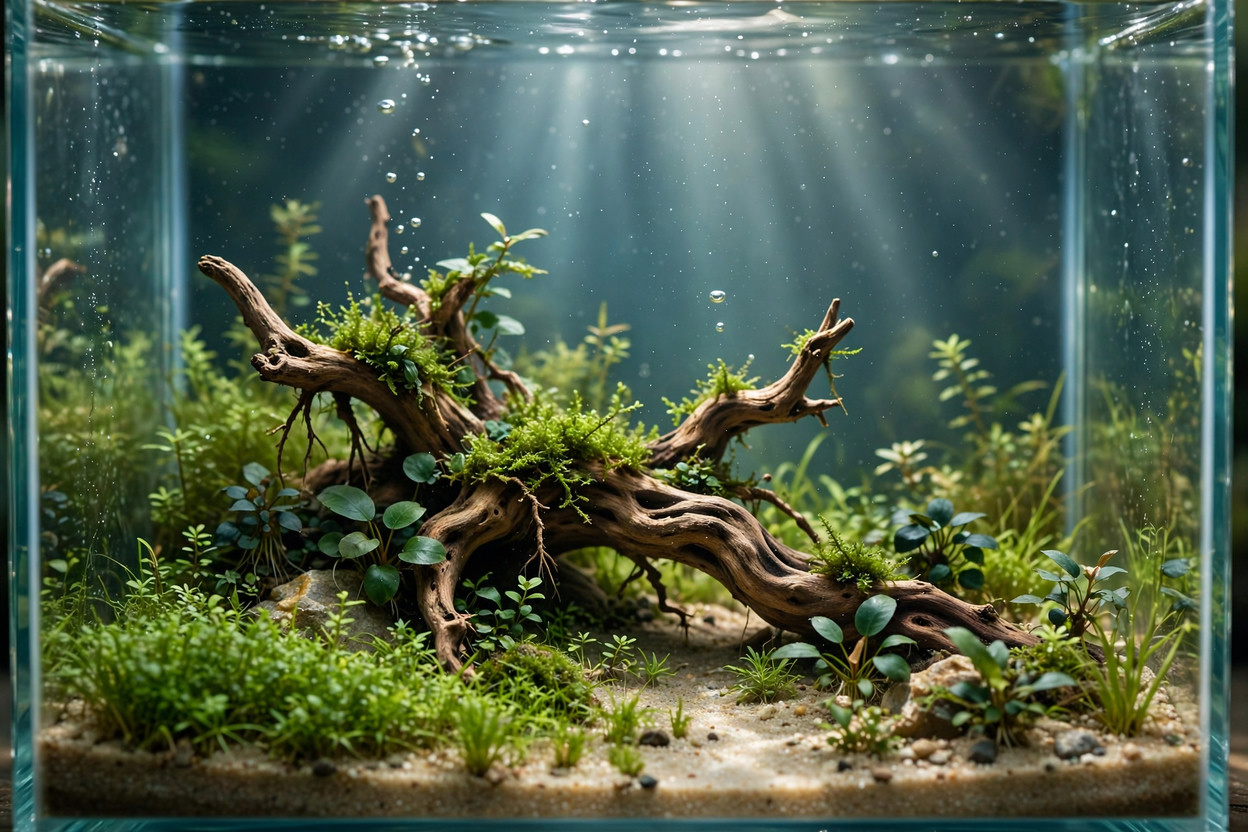
Small tanks force big creativity. A 5- or 10-gallon planted tank is a haiku — every plant, stone, and inch of substrate has to earn its place — and the results can outshine tanks ten times the size. These 15 nano planted tank ideas each include a concept plus a plant list, so you can pick a vision and plant it this weekend.
All fifteen work low-tech (no CO2), since nano CO2 is fiddly and usually unnecessary. If you’re building specifically for a betta, pair these with our planted betta tank setup guide.
The Ground Rules for Nano Planting
- Scale is everything. A plant that looks delicate in a 40-gallon is a monster in a 5-gallon. Choose species that stay small or trim well.
- Odd numbers and triangles. Groups of 3 or 5, hardscape following the rule of thirds — small tanks punish symmetry.
- One hero, supporting cast. Every great nano has a single focal point (a striking wood piece, one red plant cluster) with everything else supporting it.
- Negative space is a plant. Empty sand or open water in a nano isn’t wasted — it’s what makes the planted areas look intentional.
1. The Forest Floor
A single spider-wood “tree” with moss canopy over a dwarf sagittaria lawn. Plants: Christmas moss, dwarf sagittaria, anubias nana ‘petite’ on the wood base.
2. Iwagumi Mini
Three small stones in classic odd-number arrangement, carpeted with Marsilea hirsuta. The most disciplined nano style — restraint is the design. Plants: Marsilea hirsuta, nothing else. Maybe a single anubias nana ‘petite’ if you must.
3. Betta Jungle
Maximum shelter: frogbit canopy, java fern on driftwood, crypt wendtii midground, dwarf sag foreground. Built for a betta’s happiness, not a contest. Plants: frogbit, java fern, Cryptocoryne wendtii, dwarf sagittaria.
4. Shrimp Paradise
Moss everywhere — moss wall background, moss-covered rocks, floating salvinia. Shrimp graze biofilm off every surface. Plants: Java moss, Christmas moss, salvinia minima, anubias nana ‘petite’.
5. The Red Accent
Green foundation (crypts, anubias, dwarf sag) with one cluster of Ludwigia ‘Super Red’ as the exclamation point. Strong light required for the red. Plants: Cryptocoryne wendtii ‘green’, anubias nana, dwarf sagittaria, Ludwigia ‘Super Red’.
6. Blackwater Biotope
Tannin-tinted water, leaf litter, spider wood, and shade-tolerant plants — an Amazon stream edge in 10 gallons. Plants: Java fern, anubias barteri, Amazon sword (dwarf variety), frogbit.
7. The Meadow
Vallisneria nana background flowing like grass in wind, Staurogyne repens midground, open sand foreground. Movement is the feature. Plants: Vallisneria nana, Staurogyne repens, one red root floater accent.
8. Moss Canyon
Two rock ridges forming a valley, every surface moss-draped, dwarf hairgrass tufts in the valley floor. Plants: Java moss, Christmas moss, Eleocharis parvula, anubias nana ‘petite’.
9. The Dutch Corner
Mini Dutch style: terraced rows of contrasting stems — green, red, feathery — in a 10-gallon. High-maintenance but spectacular. Plants: Rotala rotundifolia, Ludwigia repens, Pogostemon helferi, Staurogyne repens.
10. Epiphyte-Only Minimalist
No substrate planting at all: dragon stone piled artfully, every crevice holding anubias, java fern, or Bucephalandra. Sand foreground. Impossible to mess up, striking to behold. Plants: Anubias nana ‘petite’, java fern ‘Windelov’, Bucephalandra ‘Wavy Green’, moss.
11. The Island
Single mound of aquasoil planted densely (crypts, Staurogyne, moss-covered stone), surrounded by open sand “water.” Negative space as design. Plants: Cryptocoryne wendtii, Staurogyne repens, Christmas moss, dwarf sagittaria accents.
12. Guppy Grass Jungle
For breeders: guppy grass and hornwort thickets wall-to-wall, frogbit on top. Ugly-beautiful and the most functional nano on this list. Plants: Najas guadalupensis, hornwort, frogbit, java moss. (See best plants for guppy tanks for the breeding logic.)
13. The Cliff Face
Vertical seiryu or dragon stone stacked at the back, moss and anubias ‘petite’ in every crack, dwarf sag carpeting the base. Dramatic height in a small footprint. Plants: Anubias nana ‘petite’, java moss, dwarf sagittaria, Bucephalandra.
14. Low-Tech Carpet Lab
Proof that carpets don’t need CO2: Marsilea hirsuta lawn, dwarf sag borders, one spider-wood accent with moss. Patience required — the carpet takes months, not weeks. Plants: Marsilea hirsuta, dwarf sagittaria, Christmas moss.
15. The Seasonal Tank
Designed to evolve: fast stems (water sprite, anacharis) that you trim into shape monthly, so the scape is never the same twice. For tinkerers who get bored. Plants: Water sprite, anacharis, Ludwigia repens, frogbit.
Nano Equipment Notes
- Light: A small clip-on or nano LED is plenty. Nanos need less light than you think — small water volumes grow algae fast under strong fixtures.
- Filter: Nano sponge filter or small HOB with baffle. Gentle is the goal.
- Heater: 25W adjustable for 5-gallon; presets are unreliable at this scale.
- Fertilizer: Quarter to half doses — nano tanks concentrate everything, including your mistakes.
Stocking Nanos Thoughtfully
A planted 5-gallon suits one betta or a shrimp colony. A 10-gallon opens to small schools — ember tetras, chili rasboras — covered in our schooling fish guide. Resist overstocking: in a nano, every extra fish visibly degrades water quality and the scape’s tranquility.
Frequently Asked Questions
Are nano tanks harder than big tanks? Less forgiving of parameter swings, yes — but easier to plant, cheaper to equip, and faster to scape. The difficulty is overstated for planted (not reef) nanos.
How often do nano plants need trimming? Fast stems every 2–3 weeks; slow epiphytes almost never. Small tanks show overgrowth fast, so trim a little often rather than a lot rarely.
Can I do CO2 on a nano? You can, with a paintball or nano kit, but most of these ideas don’t need it. Master the low-tech nano first.
The Bottom Line
Pick the idea that made you picture it in your room — that’s the right one. Start with the plant list, follow the nano ground rules (scale, odd numbers, one hero), and plant heavier than feels sensible. Small tanks reward decisiveness: commit to a vision, plant it densely, and let it grow in.
Detailed Build Notes for Selected Ideas
The Forest Floor — Build Order
Place the spider wood first, angled as a leaning tree. Tie Christmas moss to the upper branches (thin layers — thick wads rot inside). Plant dwarf sagittaria in a drift across the foreground, denser on one side. Tuck anubias nana ‘petite’ into the wood’s base crevices. The moss “canopy” takes 2–3 months to fill; be patient and resist over-tying.
Iwagumi Mini — Stone Selection
Iwagumi lives or dies on stone choice: one large “master” stone, one medium companion, one small accent — all the same rock type. Position the master at a thirds intersection, leaning slightly. The Marsilea carpet takes months; plant tissue-culture portions 1 inch apart for fastest fill. No fish for the first month — let the carpet root.
Shrimp Paradise — Water Notes
Neocaridina shrimp (cherry shrimp) breed freely in this setup; caridina (crystal shrimp) need soft, acidic water and active buffering soil. Match the shrimp to your tap water rather than fighting it. Moss walls: sandwich moss between two mesh panels, suction-cup to the back glass — a living backdrop that shrimplets graze constantly.
Substrate Choices for Nanos
- Aquasoil: Best growth, buffers pH down, but leaches ammonia initially — cycle carefully in small volumes. The premium choice for scaped nanos.
- Sand + root tabs: Clean look, cheap, predictable. Perfect for epiphyte-heavy designs (ideas 6, 10) where substrate nutrition barely matters.
- Dirted: Maximum growth per dollar, but the ammonia pulse is concentrated in small tanks — mineralize well and plant extremely heavily. See our dirted guide.
Maintenance Realities
Nano planted tanks need frequent small maintenance rather than occasional big sessions: 20% water changes weekly (a 2-gallon change on a 10-gallon takes five minutes), glass wiped weekly (algae shows fast at this scale), and stem trims every 2–3 weeks. The total weekly time is under 15 minutes — nanos are low-effort, just not no-effort. Neglect shows in days, not weeks, because small volumes amplify every imbalance.
Photography Tips
Nano tanks photograph beautifully — they’re the most-shared tanks online for good reason. Clean the glass (inside and out), turn off room lights to kill reflections, shoot slightly downward through the front glass, and photograph 30 minutes after lights-on when plants pearl and fish are active. A black background (poster board works) makes greens and fish colors explode.
More Build Notes: Ideas 5–15
The Red Accent — Light Requirements
Ludwigia ‘Super Red’ needs medium-high light to hold its color — in dim tanks it reverts to green. Place the red cluster directly under the light’s brightest zone, keep it trimmed to 4–5 inches so lower leaves don’t shade out, and dose iron (included in comprehensive fertilizers). One red cluster maximum in a nano — restraint makes it striking; two looks accidental.
Blackwater Biotope — Tannin Management
Alder cones, catappa leaves, and driftwood create the tea color; replenish leaves monthly as they decompose (they’re also shrimp food and have mild antifungal properties). The tint deepens over the first month then stabilizes. If it gets too dark to enjoy, activated carbon or Purigen in the filter clears it without removing the benefits — run it for a week, then remove.
The Meadow — Flow Matters
Vallisneria’s flowing effect needs gentle current — position the filter outflow to create a slow sweep across the background. Without flow it stands stiff; with too much it flattens. A small circulation pump on a timer (a few hours daily) creates the “wind” that makes this scape magical.
Epiphyte-Only — The Hardscape Is Everything
With no substrate planting, stone selection and arrangement carry the entire design. Use odd numbers, vary heights, and leave sand open in front — the contrast between textured stone and smooth sand is the aesthetic. Bucephalandra is the premium epiphyte here: slower than anubias but with iridescent leaves worth the price for a show nano.
The Island — Soil Containment
The mound wants to slump. Contain aquasoil with a ring of small stones at the base, or use a shallow bowl buried in the sand as the island’s core. Plant the mound’s top densely immediately — roots stabilize it. The surrounding sand stays pristine if you feed carefully and siphon debris weekly.
Nano Livestock Pairings
- Shrimp-only: Ideas 4, 10, 14. Neocaridina colonies are self-sustaining and endlessly watchable.
- Single betta: Ideas 3, 6, 11. The betta becomes the living focal point.
- Nano school: Ideas 1, 5, 7, 9, 15. Chili rasboras, ember tetras, or CPDs — 10–15 fish.
- Breeding project: Ideas 8, 12. Function over form; the plants are infrastructure.
Whatever you choose, quarantine new livestock — treating disease in a planted nano is miserable, as most medications harm plants and invertebrates. Prevention is the entire strategy.
More Nano Ideas: Variations
16. The Riverbank (bonus): Sloped substrate from back-high to front-low, vallisneria and crypts on the “bank,” open sand “water” in front. A circulation pump creates gentle flow. Plants: Vallisneria nana, Cryptocoryne wendtii, dwarf sagittaria.
Seasonal rescape calendar: Nano tanks are cheap to rescape — embrace it. Spring: jungle grow-out. Summer: trim into Dutch streets. Autumn: blackwater conversion with leaf litter. Winter: minimalist epiphyte rest. Four tanks a year from one setup, each teaching different skills.
Troubleshooting Nanos
- Algae explosion: In a nano, this is almost always too much light. Cut to 6 hours immediately, 30% water change, manual removal. Nanos recover fast — small volumes respond quickly to corrections too.
- Plants melting: New-tank adaptation, usually. If it persists past 3 weeks, check temperature stability — nano heaters cycle more dramatically than large ones.
- Shrimp deaths: Test GH/KH — neocaridina need minerals to molt. Copper contamination (plant fertilizers with copper, tap water from new pipes) is the silent killer; use shrimp-safe products.
- Evaporation: Nanos lose significant water to evaporation — top off with dechlorinated water (not tank water) every few days. A glass lid cuts evaporation 90% and is worth it.
Nano Tank FAQ
What’s the smallest viable planted tank? 5 gallons for fish (one betta), 2–3 gallons for shrimp-only. Below 5 gallons, temperature and parameter swings demand real attention — possible, but not beginner-friendly.
How do I clean such a small tank? A turkey baster for spot-cleaning, a small siphon for water changes, and a razor blade or old credit card for glass. The whole maintenance kit costs under $15.
Can nanos run filterless? Heavily planted shrimp nanos can (Walstad-style), but fish nanos should be filtered. The margin for error without a filter at this scale is razor-thin.