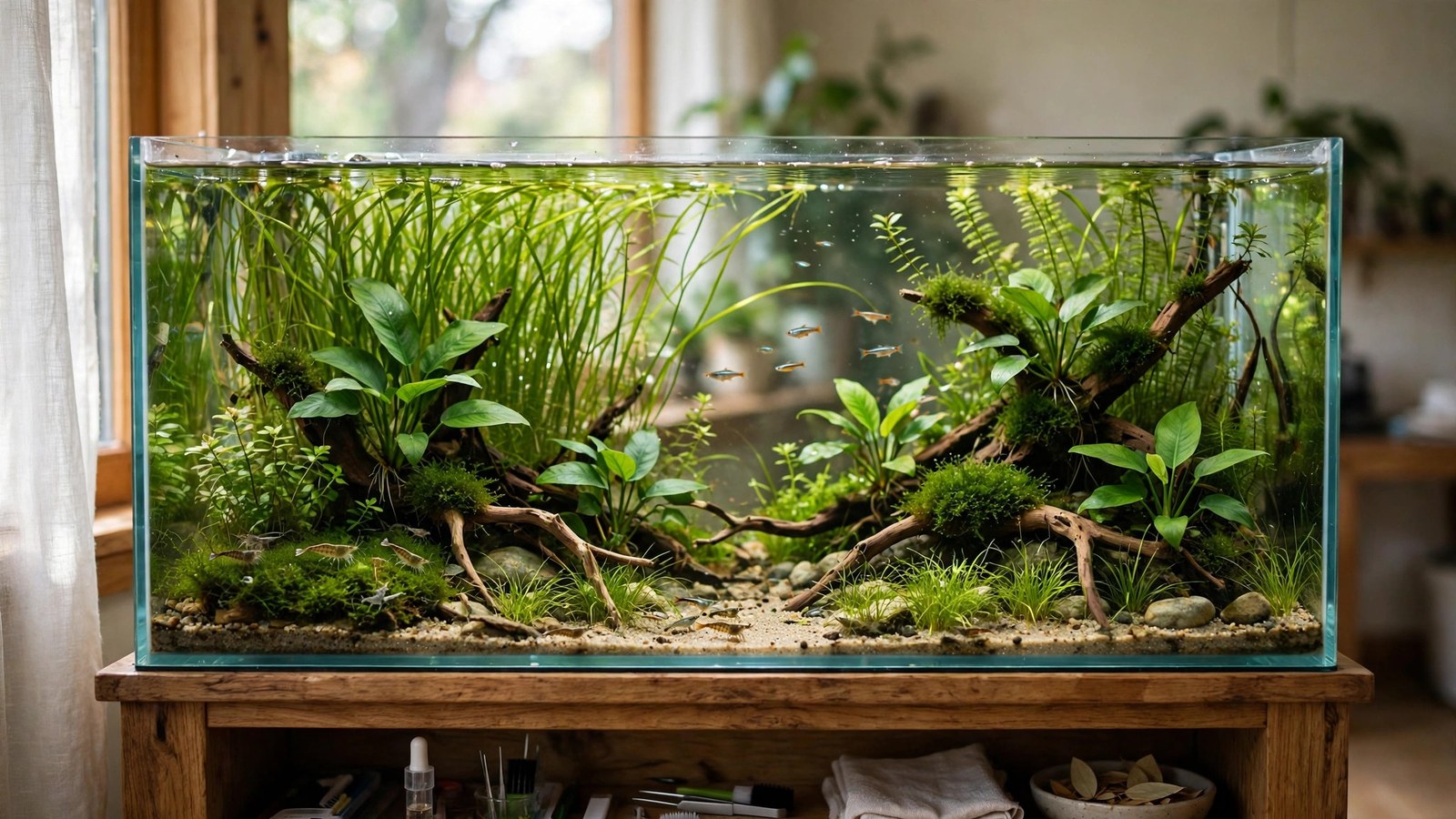
When you are deciding does a planted tank need a heater, the short answer is: it depends entirely on the species you keep and the temperature of the room your tank lives in. A planted tank is not a heater-less-or-not proposition based on the plants themselves — most of the world's popular aquatic plants tolerate a wide temperature band. The decision comes down to whether your livestock, and your tank's stability, need water held at a steady tropical temperature, or whether your home naturally stays inside the range your chosen plants and animals thrive in.
This guide walks you through that decision properly: how room temperature and species choice interact, the rules of thumb for heater sizing, where to place a heater in a planted layout, which heater designs are safest around shrimp and snails, what heating actually costs to run, and what to do when your room gets cold. By the end, you will know exactly whether your setup needs one — and if it does, how to size and install it like a seasoned aquarist.
Does a Planted Tank Need a Heater? Start With the Species, Not the Equipment
The most common beginner mistake is buying a heater before choosing livestock. Heater or no heater is a biological question first and a shopping question second. Most hobbyists stock a mix that falls into one of two camps.
Tropical setups that need a heater
If your stocking list includes fish like bettas, tetras, gouramis, dwarf cichlids, livebearers, or discus — plus warmth-loving plants — you need a heater unless your room never drops below about 74°F (23°C). These animals evolved in stable tropical water, and chronic cool temperatures weaken their immune systems, slow their metabolism, and leave them vulnerable to opportunistic infections. Fisheries extension guidance likewise notes that tropical freshwater fish require supplemental heating through winter in cool climates (CCARI aquarium maintenance extension folder). Most tropical community fish do best between roughly 76°F and 80°F (24–27°C).
Room-temperature setups that often skip one
If your home holds a steady 68–72°F (20–22°C) year-round and you choose livestock matched to that range — white cloud mountain minnows, most danios, hillstream loaches, Endler's hybrids kept on the cool side, cherry shrimp and many snails — a heater is optional. Many classic aquarium plants grow beautifully in this band too. If this cool-water path appeals to you, build your plant list around it deliberately from day one rather than improvising later.
The Decisive Factors: Room Temperature and Stability
Even the right species can suffer if the tank's temperature swings. A room that is warm at noon but chilly at 3 a.m. can push tank water through a daily 5–6°F cycle — and plants and animals alike dislike that roller coaster. What matters is not just the average temperature, but the floor and the swing.
- Measure your room for a week. Before buying anything, leave a cheap thermometer near the tank and note the lowest reading, especially in the early morning and during cold snaps. The lowest number decides, not the average.
- Air conditioning and central heating count. If your home's climate control is reliable year-round and holds the room inside your livestock's comfort band, that room is your heater.
- Glass loses heat fast. A small tank on an exterior wall or near a window cools noticeably faster than a large one in a central room. Placement is part of the heating decision.
A good rule of thumb: if your room's lowest temperature stays within your livestock's safe range, and daily swings are under about 2–3°F, you can usually run heater-free. If the room floor drops below that range — or swings wildly — a thermostat-controlled heater is the cheapest insurance you can buy. Our guide to planted tank water parameters covers temperature as one of the core parameters worth tracking weekly.
How to Size a Heater: Wattage Rules of Thumb
Heater sizing in the hobby runs on conservative, time-tested rules of thumb. The most widely used one is 3–5 watts per gallon (roughly 1 watt per liter) for a tank in a normally heated room — the same range recommended in Chewy's aquarium heater sizing guide. So a 10-gallon tank typically wants a 50-watt heater, a 20-gallon tank wants about 100 watts, and a 40-gallon tank lands around 150–200 watts.
| Tank size | Typical heater wattage | Notes |
|---|---|---|
| 5 gallons | 25 watts | Oversizing is the main risk — buy adjustable, not fixed |
| 10 gallons | 50 watts | The most common planted-tank starter size |
| 20 gallons | 100 watts | Consider one 100W or two 50W for even heat |
| 40 gallons | 150–200 watts | Two 100W heaters placed apart beat one big one |
| 55+ gallons | 200–300 watts | Split across two units for redundancy |
When to adjust the rule
Size up when the room is cold or unheated — a tank in a basement that sits at 60°F needs noticeably more wattage to hold 78°F than one in a 72°F living room. Size down when the room is already warm and the heater is only covering a small gap. Two smaller heaters are often better than one large one in tanks over 20 gallons: they distribute heat more evenly across a planted aquascape and, if one sticks in the "on" position, the other thermostat provides a buffer against runaway heating. A heater without a thermostat is a risk most hobbyists no longer take — always pair the element with its thermostat and an accurate thermometer so you are managing to a number, not a dial position. When planning a new build, factor the heater into your first planted tank shopping list so it arrives before the water does.
The "start low, observe" safety habit
With any new heater, start the thermostat a degree or two below your target, confirm the actual water temperature with an independent thermometer after 24 hours, then dial in. Cheap stick-on thermometers can read off by several degrees; a glass or digital probe thermometer is worth the few extra dollars. This single habit prevents the most common heater mistake: trusting the dial. As with all aquarium electrics, plug the heater through a GFCI-protected outlet and arrange the cord with a drip loop so water cannot run into the socket — standard hobby practice.
The planted-tank heater benchmark: accurate, shatter-resistant, and adjustable: EHEIM Jager aquarium heater.
Heater Placement in a Planted Layout
Heaters warm water best when flow moves past them. In a planted tank, that means placing the heater where your filter current actually reaches — near the filter outflow, or in the path of a circulation pump — so warm water is carried through the scape instead of pooling in one corner.
- Hide it behind hardscape. A heater tucked behind driftwood, rocks, or a dense stem-plant thicket disappears visually while still sitting in the current. Position it vertically or diagonally where the flow crosses it.
- Keep it fully submerged and off the substrate. Exposed heating elements can crack from thermal shock; suction cups hold the heater a finger's width above the gravel or aquasoil.
- Leave room for planting around it. Do not bury the heater in substrate or wedge it so tightly among stems that water cannot circulate — a heater heating a dead pocket of water is how cold spots and algae blooms begin.
- In-line heaters on canister filter tubing remove the visible heater entirely — a popular choice for showcase aquascapes where every distraction counts.
Placement also interacts with your cover choice: a lid slows heat loss significantly compared with an open top, so open-top tanks in cool rooms often need a slightly larger heater than the same tank with a glass lid.
Shrimp-Safe and Livestock-Safe Heater Choices
Cherry shrimp, amano shrimp, baby snails, and small fry can be injured or killed by traditional glass heaters: tiny animals crawl into the gap between a glass heater and its suction-cup guard, get pinned, and are cooked against the hot element. This is a well-known hazard in planted shrimp tanks, and it shapes which heaters most shrimp keepers buy.
Safer designs for invertebrate tanks
- Fully encased / plastic-bodied heaters. A shatterproof polymer shell has no exposed hot glass to pin animals against, and doubles as protection against impacts in a planted tank you are constantly working in.
- Heater guards. Aftermarket plastic cages snap over glass heaters to keep livestock at a distance — an effective retrofit if you already own a glass unit.
- External or in-line heaters. No heater body in the tank at all means no heater hazard for shrimp, snails, or fry — the preferred solution in dedicated planted shrimp tank setups.
Whatever style you choose, mount the heater where shrimp traffic is low — not directly beside the feeding dish or the densest moss, where baby shrimp congregate. And remember that stability matters to invertebrates as much as the temperature number: shrimp are especially sensitive to rapid swings, so a quality thermostat and that independent thermometer check are non-negotiable.
What Heating Actually Costs to Run
Heater running cost worries a lot of beginners, but the math is friendly. A 50-watt heater does not draw 50 watts continuously — it cycles on only when the water needs warming. In a normal heated home, most hobbyists find a small-tank heater adds the equivalent of a few dollars a month to the electricity bill.
The big cost drivers are tank size, room temperature gap, and lack of a lid. A 5-gallon desk tank in a warm apartment barely registers. A large open-top tank in a cold basement runs its heater nearly constantly and can cost ten times as much. If you want a realistic estimate before buying, multiply the heater's wattage by your hours-of-use and your local per-kWh rate — conservative planning assumes the heater runs about a third to half the time in winter. For a fuller picture of where the money goes in this hobby, see our planted aquarium cost breakdown.
Simple ways to cut heating cost: add a glass lid, move the tank off exterior walls and away from drafty windows, and choose livestock suited to your actual room so you are not fighting a 15°F gap all winter.
Summer, Outages, and When the Room Cools
What if the room gets too warm?
Heaters only add heat — they cannot cool. In summer, a planted tank in a warm apartment can climb past 82°F, stressing livestock and accelerating algae. Common responses include running the lid open, adding a small clip-on fan for evaporative cooling, reducing lighting intensity, and keeping the tank out of direct sun. Our summer heat guide for planted tanks walks through cooling tactics in detail.
Power outages and cold snaps
When the power goes out in winter, a planted tank starts losing heat immediately — small tanks within an hour or two, large tanks over several hours. Wrap the tank in blankets or towels to slow heat loss, resist the urge to open the lid (every peek dumps heat), and do not feed the livestock, since their metabolism slows in the cold and uneaten food fouls the water. Battery air pumps keep oxygen moving if the outage stretches. Our full power outage guide for planted tanks covers hour-by-hour response, including how to safely rewarm the tank once power returns — bring it up gradually, a couple of degrees per hour, never with sudden hot water.
Frequently Asked Questions
Does a planted tank need a heater if I only keep plants?
If the tank has no livestock, a heater is rarely necessary. Most popular aquatic plants tolerate 65–80°F, and a room-temperature tank grows them fine as long as the temperature is reasonably stable. The heater decision only becomes critical when you add fish, shrimp, or snails with specific temperature needs — tropical livestock is what turns an optional heater into a required one.
Can I use a preset (non-adjustable) heater in a planted tank?
You can, but most hobbyists prefer adjustable heaters. Preset heaters are fixed around 78°F and their thermostats vary in accuracy, so you cannot dial them to match your livestock's ideal range or to seasonal room changes. An adjustable heater with an independent thermometer gives you control worth far more than the small price difference, especially in shrimp or sensitive-species tanks.
Is one big heater or two small heaters better?
Two smaller heaters are the safer, more even choice in tanks over about 20 gallons. They spread heat across the aquascape, so planted areas far from the outflow stay in range, and if one heater's thermostat fails "on," the second unit cycles off and limits how far the temperature climbs. In small nano tanks, a single correctly sized heater is usually fine.
Do betta fish need a heater in a planted tank?
Yes, in most homes. Bettas are tropical fish that need roughly 76–80°F water, and room-temperature homes in winter typically run cooler than that. A cold betta becomes lethargic, stops eating, and gets sick more easily. A small adjustable heater — 25 watts for a typical 5-gallon planted betta tank, with a thermometer to verify — is standard equipment.
Should I turn my heater off in summer?
Do not unplug it; just let the thermostat do its job. A heater only turns on when water drops below its set point, so in a warm summer room it simply idles. The exception is a heatwave that pushes the tank far above the set point — then the concern is cooling, not heating, and the heater sitting idle is harmless. Keep it plugged in for cool nights and air-conditioned rooms.
How do I know my heater's thermostat is accurate?
Cross-check it with an independent thermometer 24 hours after setup and again each season. Glass and stick-on thermometers can drift several degrees, and heater dials are approximate. If the dial says 78°F but a trusted thermometer reads 74°F, manage to the thermometer. Rechecking seasonally catches thermostats that drift with age — a thirty-second habit that prevents the most common heating failures.
The Bottom Line
So, does a planted tank need a heater? Match the heater to the livestock, not the plants. Choose tropical species and you need one — sized by the 3–5-watts-per-gallon rule of thumb, thermostat-controlled, placed in the filter current, and verified with an independent thermometer. Choose cool-water species in a stable, warm-enough room and you can skip it entirely and spend the money on plants instead. Either way, measure your room's lowest temperature first, buy once, and let a thermometer — not the dial — have the final word. Once your heating decision is settled, a planted tank maintenance schedule that includes a monthly thermometer cross-check will keep the whole system stable for years.