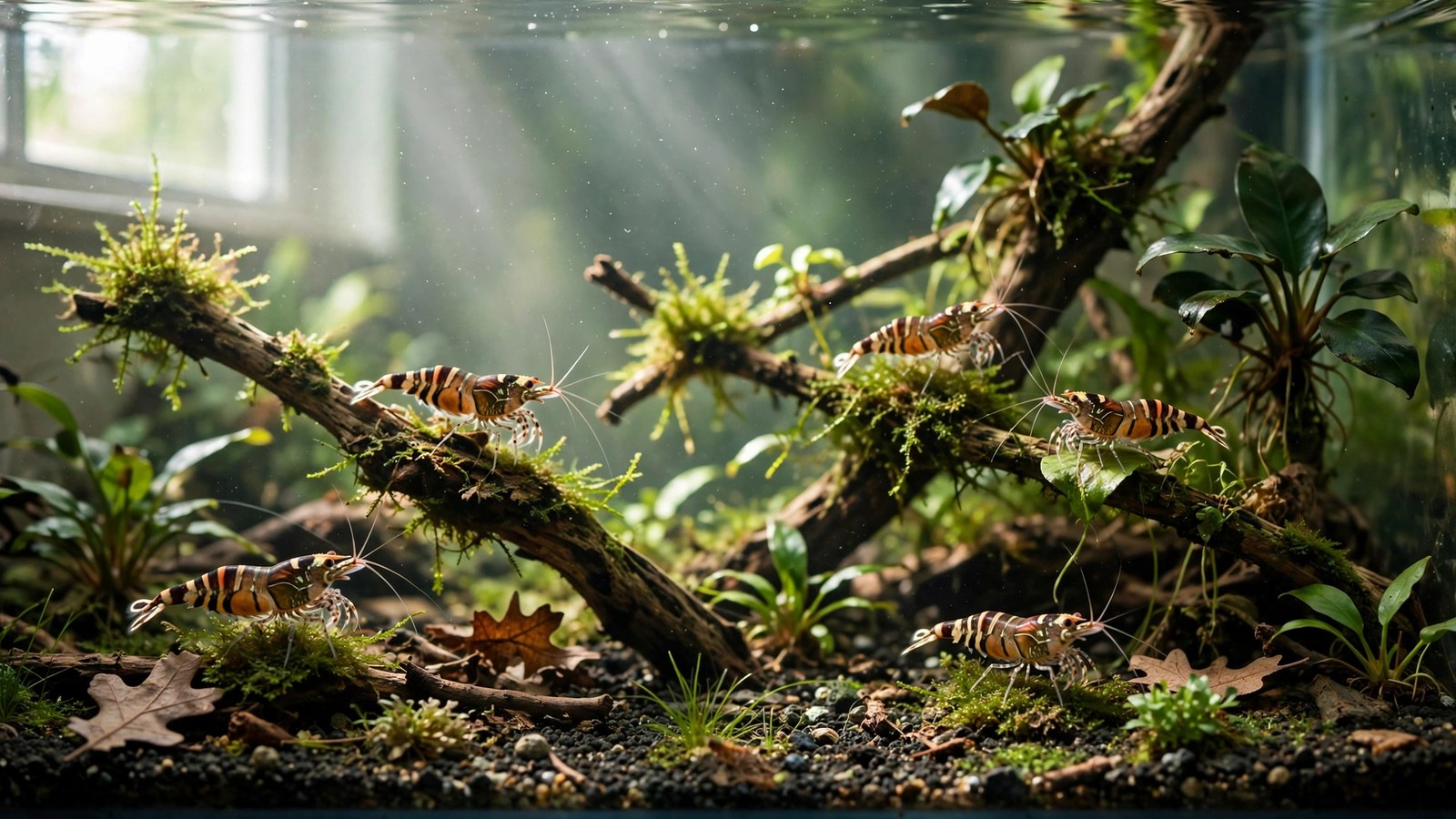
Most keepers kill their first caridina colony with kindness — soft water in a bucket, a splash of liquid food, and a heater set for neocaridinas. Tiger shrimp forgive almost everything except that routine. Get this guide's five water numbers right and Caridina mariae rewards you with a self-sustaining colony: tiger shrimp care is the gentlest possible door into the caridina world.
Quick answer: Tiger shrimp thrive in soft, slightly acidic water — pH 6.2–7.2, GH 4–6, KH 0–1, TDS 120–160 — at 68–75°F in a planted 5–10 gallon tank with a sponge filter, mature biofilm, moss, and leaf litter. Feed sparingly, change 10–15% of water weekly, and they breed on their own: females carry 20–40 eggs for 3–4 weeks, then release fully formed shrimplets, since tiger shrimp skip the larval stage entirely.
Why Tiger Shrimp Care Belongs Before Taiwan Bees
If you have ever admired Taiwan Bees — blue bolts, red pandas, shadow pandas — but flinched at their razor-thin tolerances, tiger shrimp are your training ground. They tolerate a wider pH band and breed in water that would stall a crystal red colony, so six months here builds the water habits harder morphs demand.
Get the taxonomy straight first, because the hobby is sloppy here. Caridina mariae was described in 2014 from Guangdong, China — a sister species to C. cantonensis, not a variety of it. Wild tigers wear the classic stripes the trade named them for; every shop morph is line-bred from that wild form.
Tiger Shrimp Care Parameters at a Glance
Hold these numbers steady and everything else gets easier. Tigers forgive parameter choices but never forgive swings — a stable pH of 7.0 beats a yo-yoing 6.4.
| Parameter | Target range | Notes |
|---|---|---|
| pH | 6.2–7.2 | Aim 6.5–6.8 for blue strains; wild-type handles up to 7.2 |
| GH | 4–6 dGH | Below 4 risks failed molts; above 8 stalls breeding |
| KH | 0–1 dKH | Effectively zero; buffering soil locks this in |
| TDS | 120–160 ppm | Remineralized RO water gives you exact control |
| Temperature | 68–75°F (20–24°C) | Keep it below 77°F sustained; add a cooling fan in summer |
| Tank size | 5–10 gallons | 10 gal gives a steadier colony for beginners |
Above 25°C (77°F) sustained, breeding stalls, lifespans shrink, and bacterial infections rise. A clip-on cooling fan dropping the tank 2–4°F costs less than a replacement colony.
The parameter table targets GH 4–6 via remineralized RO water — the GH+ is exactly how readers hit it (product listing itself names tiger shrimp): Salty Shrimp Bee Shrimp Mineral GH+ ★4.8.
Tiger Shrimp Strains: Picking Your Color Line
| Strain | Look | Notes |
|---|---|---|
| Wild-type tiger | Amber body, bold black stripes | Rare in shops; hardiest genetics, best for colony founders |
| Blue tiger | Blue body, dark tiger stripes | The classic morph; stable lines widely available |
| Royal blue tiger | Deep opaque blue, almost black | Needs the softest, most acidic water of the bunch |
| OEBT (orange-eye blue tiger) | Blue body, striking orange eyes | Breeds blondes that must be culled to hold the blue line |
| Super tiger | Extra-broad bold stripes | A pattern line rather than a color line |
One honest caveat: some retailers list OEBT stock as cf. cantonensis instead of mariae — the hobby's long-running tiger-line taxonomy dispute. Read labels as "tiger-line morph" rather than forcing one Latin name; the care is identical. Garnelio's own tiger shrimp profile lists theirs under cf. cantonensis, which shows how common the split is.
Setting Up a Tiger Shrimp Tank
A 10-gallon with five elements is the whole recipe: active buffering soil, a sponge filter (gentle flow, zero shrimplet casualties), dense moss — Java moss is the workhorse — for grazing and hiding, leaf litter and botanicals that feed biofilm as they decay, and a tight-fitting lid, because shrimp explore.
Keep planting light and moss-forward: a lightly planted aquarium setup guide approach — mosses, anubias, floaters — covers shrimplets without CO2. Pick an active buffering soil made for shrimp tanks and green it with the easiest aquarium plants for beginners.
 ★4.7
ADA Aqua Soil Amazonia Ver 2
Check Price on Amazon ★4.7Feeding Tiger Shrimp Without Fouling the Tank
Biofilm is the main course; you are only seasoning. A colony of 20 grazes microfilm, leaf edges, and algae all day. Supplement 2–3 times weekly: a pinch of shrimp granules, one blanched nettle or spinach leaf, plus frozen daphnia protein twice a week for egg development.
Uneaten food rots, spikes ammonia and bacterial load, and invites planaria. Feed only what vanishes within two hours; remove leftovers. Slightly hungry colonies breed better than pampered ones.
Breeding Tiger Shrimp: What to Expect
Once parameters are stable, breeding needs no help. A berried female carries 20–40 eggs for 3–4 weeks, fanning constantly — then releases fully formed 1 mm shrimplets. Tiger shrimp develop directly: no free-swimming larval stage. The babies hide in moss and graze biofilm within hours.
Parents ignore their young, so shrimplets stay in the tank. Survival rests on biofilm density — mature beats powdered food — and filtration: sponge filters are shrimplet-proof; HOB intakes need a pre-filter sponge. 60–70% first-generation survival is excellent.
Keep it species-only if line purity matters: tigers cross freely with other Caridina, and mixed genetics show within two generations.
The Step Up: From Tigers to Advanced Caridina
When your tiger colony breeds on autopilot — berried females monthly, parameters rock-stable for six months — you are ready for the next rung. Blue bolt shrimp take everything you learned and shrink the tolerances: cooler water, lower TDS, zero mistakes. And when shrimp arrive by mail, drip acclimation is the single highest-ROI habit in the caridina hobby.
Frequently Asked Questions
Are tiger shrimp good for beginners?
Yes — they are the recommended first caridina. Tiger shrimp tolerate a wider pH and temperature range than crystal reds or Taiwan Bees, breed readily in stable soft water, and forgive the small mistakes beginners make. They are harder than cherry shrimp (neocaridina), so they teach you caridina water habits gently.
How long do tiger shrimp live?
Expect 18–24 months with cool, clean water. Heat is the main lifespan shortener: colonies kept at 70–72°F routinely outlive those run at 76°F+. Stable parameters and a varied diet with regular protein also matter more than any supplement marketed for longevity.
Can tiger shrimp live with cherry shrimp?
They coexist peacefully, but they want different water: cherries thrive in harder, alkaline water while tigers need it soft and acidic. At a compromise pH around 7.0 both survive but neither thrives, and breeding slows. More importantly, tigers crossbreed with other Caridina species — so keep tiger lines in a species-only tank if line purity matters, and don't mix them with crystal reds or other Taiwan Bees.
How many tiger shrimp should I start with?
Start with 10–15 from a single breeder's line for a 10-gallon tank. This gives a healthy male-to-female mix (females are larger with a curved underbelly and a visible saddle) while keeping genetic diversity reasonable. A single strain from one source also avoids the mismatched line-crossing that muddies colors.
Do tiger shrimp need a heater?
Usually not — and often the opposite. Tiger shrimp prefer 68–75°F, so in most homes room temperature is perfect year-round. Heaters become relevant only in cold climates. In warm climates, a clip-on cooling fan matters far more, since sustained water above 77°F suppresses breeding and invites bacterial disease.
What do tiger shrimp eat in a planted tank?
Biofilm first — they graze it all day off glass, moss, and leaves. Supplement 2–3 times weekly with quality shrimp granules, blanched vegetables like nettle or spinach, and protein (frozen daphnia) twice a week for egg development. Feed only what vanishes in two hours; overfeeding is the most common colony killer.
Tiger shrimp ask one thing: steady, soft, slightly acidic water — and they return a colony that runs itself. Plant moss-first, feed sparingly, and within six months your planted shrimp tank setup holds berried females. Patience at setup, restraint at feeding, trust in biofilm.