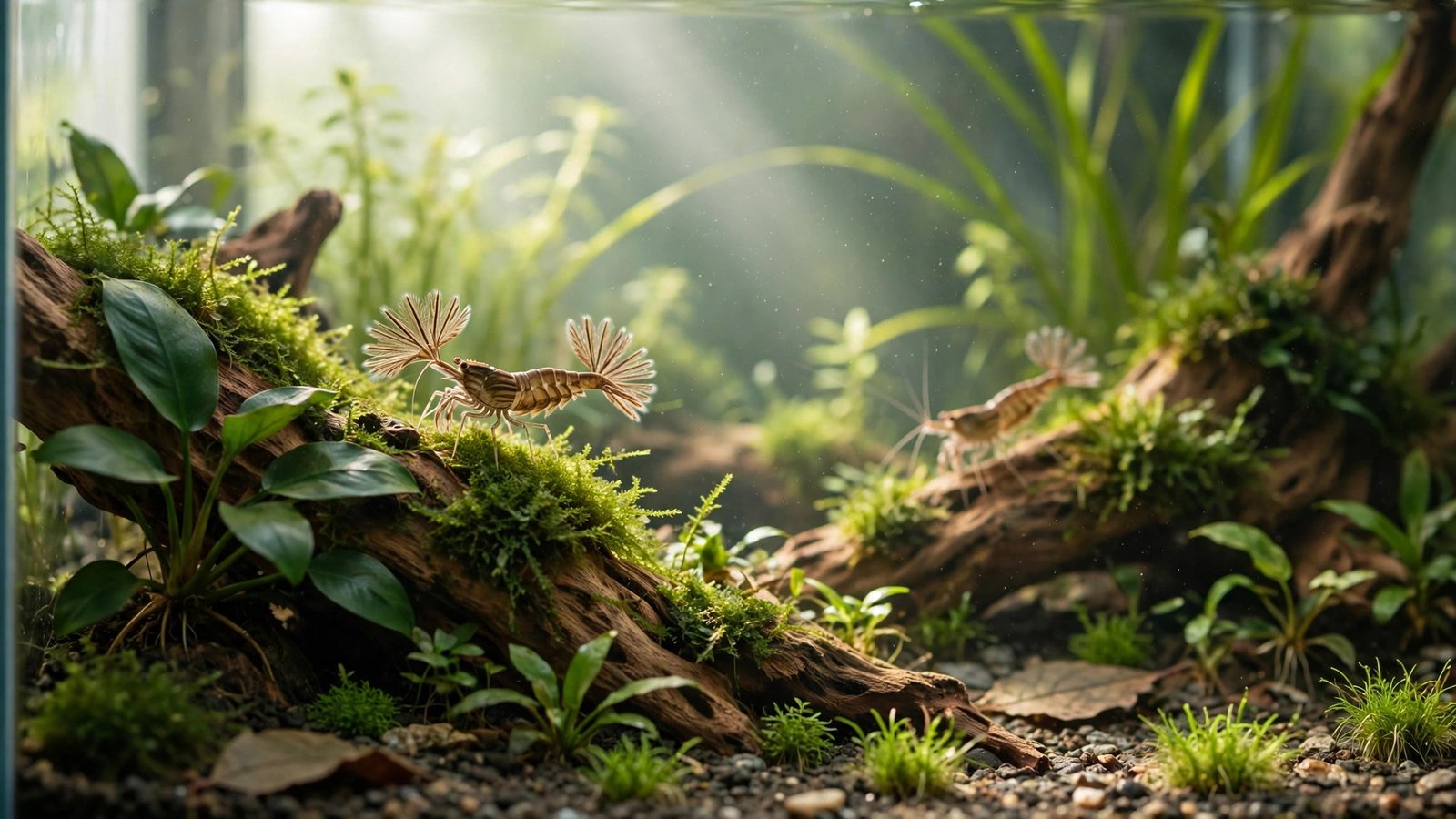
Most people buy a bamboo shrimp like a cherry shrimp — toss it in, wait for it to graze, done. Three months later it's dead. The truth: this is the one common freshwater shrimp that can't graze. Get bamboo shrimp care right and you get a 3-inch gentle giant fanning the current; get it wrong and it starves in slow motion while your other shrimp thrive. Here's how.
Why Bamboo Shrimp Feed Unlike Any Other Shrimp
Cherry shrimp, amano shrimp, ghost shrimp — they all walk around picking food off surfaces. Your bamboo shrimp (also sold as wood or flower shrimp) evolved for a different job: in Southeast Asian streams it wedges onto a rock in the current, opens two feathery fans, and lets the river deliver lunch. That is bamboo shrimp care in one sentence: no food drifting in the water column, no dinner. Full stop.
This also settles the "are they good algae eaters?" question: they're not. If you want grazers, see how cherry shrimp vs amano shrimp compare as algae eaters; the bamboo shrimp belongs to a different feeding world entirely, and your cleanup crew for your planted tank should list it under "entertainment," not "algae duty."
Don't confuse them with vampire shrimp (Atya gabonensis) — bigger (5–6 inches), more nocturnal, needing 30–40 gallons and stronger flow. Everything below is tuned for bamboo shrimp.
Bamboo Shrimp Care Basics: Tank Setup That Actually Works
Filter feeders need a mature, stable home — a brand-new tank has almost nothing suspended for them to catch, which is why many keepers wait until a tank has run six months or more. As you plan your planted shrimp tank setup, schedule the bamboo shrimp for the established phase, not the cycling phase.
| Parameter | Target | Why it matters |
|---|---|---|
| Tank size | 20 gallons minimum | Stability + room for the flow zone without blasting tankmates |
| Temperature | 72–82°F | Cooler tanks slow metabolism; hotter tanks speed starvation if food is thin |
| pH / hardness | 6.5–7.5, GH 5–10 | Tolerant, but sudden swings trigger stress molts |
| Nitrate | Under 20 ppm | Filter feeders are sensitive to dirty water — clean water, dirty current |
| Flow | Moderate, directed | The shrimp must be able to sit in the current with fans out |
| Medications | Copper-free only | Copper kills shrimp at trace doses — check every label |
Hardware-wise, you need two things: flow and a perch. Aim a small powerhead across midwater to create a feeding lane, or angle your filter output at tall driftwood or a high rock — the shrimp will claim the best spot itself, so give it options. Dense plants behind the perch matter too: the best aquarium plants for shrimp tanks give cover after molting, when it's soft and vulnerable, and the aquarium plants for fish tanks guide covers hardy species that share a shrimp's parameters.
How to Feed Bamboo Shrimp So They Don't Starve
This section decides whether your shrimp lives two months or five years. Aquarium water is far cleaner than a jungle stream — no well-run tank has enough drifting food to sustain a filter feeder. You must feed them directly, with food that stays suspended.
The method: mix a pinch of powdered food into tank water, suck it into a pipette or turkey baster, and release it slowly just upstream of the shrimp so the current carries the cloud through its fans. Once or twice daily. Good powders: spirulina powder, a ground algae wafer, filter-feeder blends (GlasGarten Bacter AE, Shrimp King Atyopsis), or fry foods like Golden Pearls (5–50 micron). Getting water flow in planted tanks right — a steady lane, not chaotic turbulence — keeps the food plume on the fans.
One caution: powerful mechanical filtration polishes out exactly the particles your shrimp eats. Skip running fine filter floss at maximum polish in a bamboo shrimp tank — the target-fed cloud is the meal; the filter just sets the table.
Scraping the Substrate Means Starving: The Warning Sign
Here's the sign experienced keepers swear by, confirmed by Aquarium Co-Op's freshwater shrimp guide: a bamboo shrimp picking through the substrate like a cherry shrimp is not "adapting" — it's hungry. Persistent bottom-foraging means the water column isn't delivering enough food.
If you see this, act within days: target-feed twice daily, add a taller perch in the current, and check your flow hasn't weakened. A shrimp back on its perch with fans open is your confirmation. The detailed bamboo shrimp care guide stresses the same principle: feed suspended particles, never anything that sinks.
Molting, Tank Mates, and Common Mistakes
Bamboo shrimp molt regularly as they grow. You'll find an empty, translucent shell — don't panic, and don't remove it right away; the shrimp often eats it to recover minerals. Keep calcium available, leave the shrimp alone for a day after a molt, and make sure dense plants give it cover while the new shell hardens.
They're peaceful to a fault, so tankmates must be too. Small schooling fish, corydoras, and dwarf shrimp all work — a sparkling gourami planted tank or a pygmy cory planted tank makes an excellent neighborhood, since neither species bothers shrimp. Avoid anything big enough to see a molting shrimp as a snack: cichlids, large barbs, and bettas are all bad ideas.
Two final beginner mistakes to skip: (1) adding them to a new or uncycled tank — ammonia kills invertebrates fast, and there's nothing suspended to eat; (2) copper-based medications, which are lethal to shrimp at doses fish shrug off. Read every label. One last responsibility note: bamboo shrimp are non-native to most local waterways — never release aquarium livestock or tank water into ponds, rivers, or storm drains. If you must part with one, rehome it through your local fish club.
Frequently Asked Questions
Can bamboo shrimp live with cherry shrimp?
Yes. Cherry shrimp graze biofilm off surfaces while bamboo shrimp filter the water column, so they never compete for food. Both need stable, copper-free water. Just keep feeding the cherries their own pellets or blanched vegetables, since the bamboo's powdered diet won't sustain them.
How often should I target-feed a bamboo shrimp?
Once or twice daily: mix a pinch of powdered food into tank water and release it upstream of the shrimp with a pipette so the current carries it through the fans. If your shrimp starts scraping the substrate, increase to twice daily and check your flow hasn't weakened — bottom-foraging is the hunger signal.
Why is my bamboo shrimp hiding all the time?
New bamboo shrimp often hide for a few days — that's normal. Persistent hiding points to three culprits: water parameter swings, aggressive tankmates, or a molt (they hide until the shell hardens). A shrimp that hides and never fans in the current may also be underfed, so try target-feeding near its spot.
Do bamboo shrimp breed in freshwater aquariums?
No. Like amano shrimp, bamboo shrimp larvae need brackish or saltwater to develop, so they can't complete their life cycle in freshwater. You may see a berried female carrying eggs, but the larvae won't survive. The upside: no population explosions, unlike cherry shrimp.
What's the difference between bamboo shrimp and vampire shrimp?
Vampire shrimp (Atya gabonensis) are the larger cousins: 5–6 inches, more nocturnal, with mood-dependent color changes, needing 30–40 gallons and stronger flow. Bamboo shrimp (Atyopsis moluccensis) reach 2–3.5 inches, fit in 20 gallons, and stay visible in the day. Both are peaceful filter feeders, but bamboo shrimp suit beginners better.
The Gentle Giant Your Planted Tank Deserves
A bamboo shrimp is the freshwater hobby's whale shark: a peaceful giant that eats by straining the current. Give it a mature 20-gallon tank, a perch in honest flow, daily powdered feedings upstream of its fans, and copper-free water — and you'll get up to five years of one of the hobby's most mesmerizing behaviors.