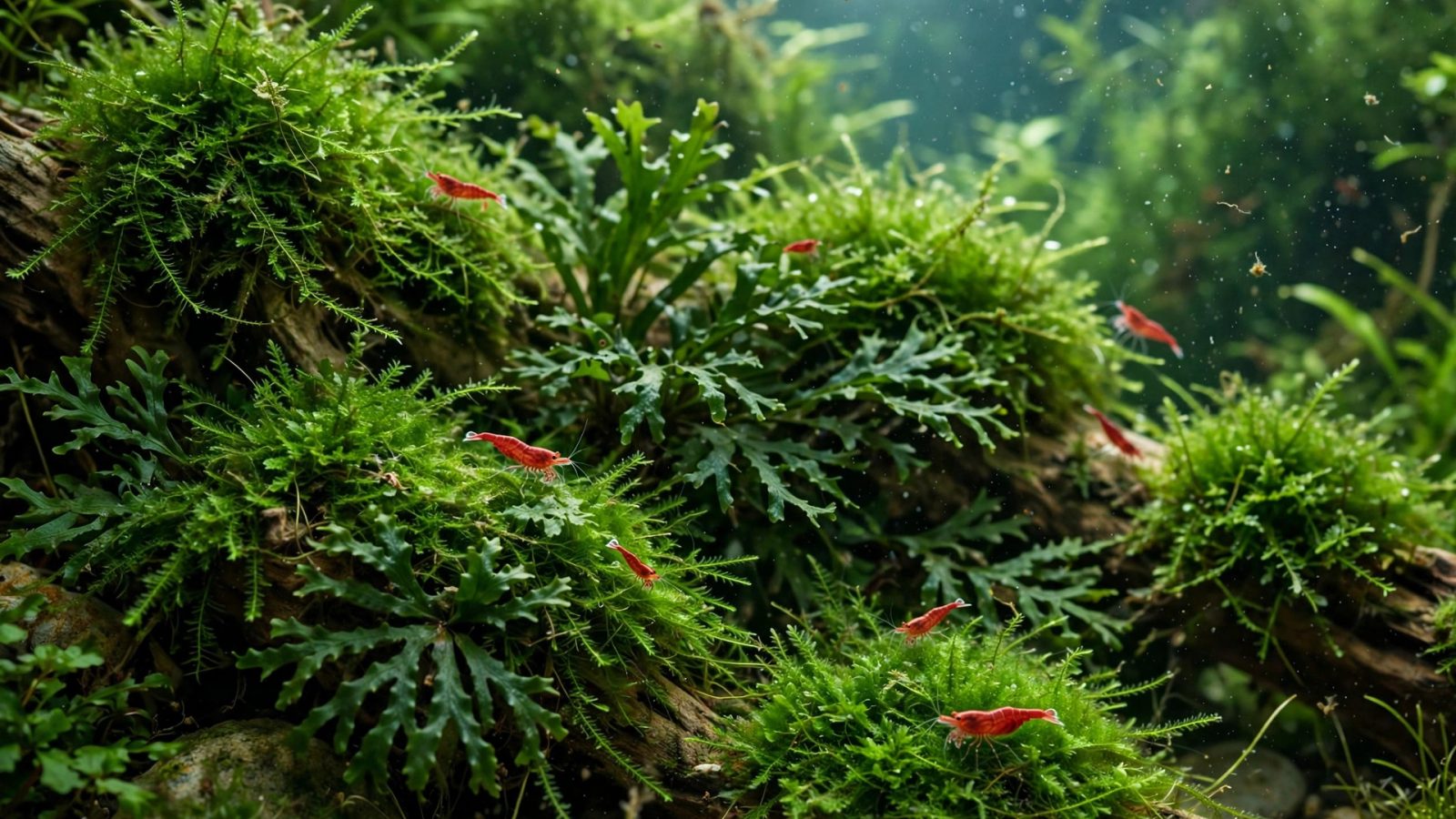
Shrimp don’t eat plants — they graze the microscopic biofilm (bacteria, microalgae, and detritus) that coats every underwater surface. That single fact reframes plant selection: the best aquarium plants for shrimp tanks aren’t chosen for looks alone, but for surface area. Fine-leafed, dense, complex plants grow exponentially more biofilm than broad, smooth ones, turning your aquascape into a self-replenishing buffet. These ten species maximize grazing surface while meeting shrimp’s other needs — shelter for molting, cover for shrimplets, and water conditions that won’t harm sensitive invertebrates.
Shrimp have one non-negotiable requirement that shapes every plant choice: no copper. Many plant fertilizers and medications contain copper at levels safe for fish but lethal to shrimp. Use shrimp-safe fertilizers (or dose lean), never use copper-based algae treatments, and quarantine new plants — some commercial growers use pesticides. A 1:20 bleach dip or alum soak before planting protects your colony.
What Shrimp Need From Plants
- Maximum surface area: mosses, fine-leafed stems, and textured plants grow the most biofilm per square inch.
- Dense shelter: freshly molted shrimp are helpless for hours; shrimplets are prey-sized. Thick plant mass is survival infrastructure.
- Gentle conditions: shrimp prefer stable, moderate light and low-tech setups — high-light CO2 tanks with big parameter swings stress them.
- No sharp edges: avoid stiff, spiky plants that can damage shrimp during molting scrambles.
The 10 Best Aquarium Plants for Shrimp Tanks
1. Java Moss (Taxiphyllum barbieri)
The quintessential shrimp plant, and it earns the title. Java moss’s tangled fine branches create more biofilm surface per volume than almost any other plant, and its dense interior is the #1 hiding spot for newborn shrimplets — colonies breed exponentially better with moss present. Attach it to wood, rock, or mesh; it needs no substrate and tolerates the low light shrimp prefer. Trim periodically to prevent the interior from dying off. Every shrimp tank should have moss; this is the one if you choose only one.
2. Christmas Moss (Vesicularia montagnei)
Christmas moss does everything Java moss does with a neater, more structured look — triangular fronds that branch like tiny firs. It’s slightly slower-growing but forms denser, more defined mounds that aquascape better. Shrimp graze it identically. Use Christmas moss where the moss is visible (foreground rocks, branch tips) and Java moss where it’s purely functional (filter covers, breeding corners). Both attach with thread or glue per our substrate-free guide.
3. Subwassertang (Lomariopsis lineata)
Subwassertang is a shrimplet paradise — its tangled ribbon-like masses create a three-dimensional maze too dense for even small fish to hunt in effectively. Unlike moss, it has no roots or stems to rot; it’s a liverwort that simply exists as a green tangle. Wedge it into crevices or let it form loose balls. It grows slowly and prefers stable, clean water — exactly what a mature shrimp tank provides. Breeders consistently rank it among the top shrimplet-survival plants.
4. Anubias nana ‘Petite’
Broad-leafed plants seem counterintuitive for biofilm, but anubias earns its place differently: its large, stable leaves grow a mature biofilm — the thick, established kind rich in the microorganisms adult shrimp prefer. Watch a shrimp tank and you’ll see shrimp methodically grazing anubias leaves for hours. ‘Petite’ suits the small tanks shrimp favor; glue it to rock or wood. It’s indestructible, needs no special care, and provides the “grazing pasture” complement to moss’s “nursery.” If leaves yellow, see anubias troubleshooting.
5. Bucephalandra
Buce serves the same role as anubias — broad, permanent leaves growing mature biofilm — with more visual variety: small, often colorful or textured leaves in varieties from deep green to purple-bronze. Its ultra-slow growth means the biofilm community on a buce leaf is undisturbed for months, developing the complexity shrimp prefer. Cluster it on midground rockwork. It’s the premium grazing leaf for aquascaped shrimp tanks.
6. Pearl Weed (Hemianthus micranthemoides)
Pearl weed is the best stem plant for shrimp tanks: tiny leaves (enormous collective surface area), fast growth, and a bushy habit that shelters shrimplets. Trimmed short, it forms a dense carpet shrimp graze through constantly; left taller, it’s a midground thicket. It tolerates the low-tech conditions shrimp need and propagates from every trimming. The one maintenance note: thin it occasionally, or the interior gets too dense and the lower portions die back.
7. Frogbit (Limnobium laevigatum)
Floating plants are shrimp-tank essentials, and frogbit is the best-behaved floater. Its roots dangle several inches into the water, creating a root forest — shrimplets cling to the roots grazing biofilm, and the roots themselves grow thick microbial coatings. Frogbit also does critical water-quality work: as a fast-growing floater with atmospheric CO2 access, it absorbs excess nutrients aggressively, stabilizing the clean, low-nitrate water shrimp need. Corral it with airline tubing to keep 50–70% of the surface clear. More floaters in our floating plant guide.
8. Monte Carlo (Micranthemum tweediei)
A carpeted shrimp tank is a foraging paradise, and Monte Carlo is the ideal shrimp carpet: dense, low, small-leafed, and tolerant of the moderate light shrimp prefer. Shrimp graze across it continuously, and shrimplets vanish into it safely. It carpets without CO2 (slowly) and needs no special treatment beyond moderate light and occasional trimming. Pair it with moss-covered hardscape for the complete shrimp habitat — carpet pasture plus moss nursery. Planting technique in our carpeting guide.
9. Cryptocoryne parva
The smallest crypt forms a slow, tidy foreground of narrow green leaves — a lower-maintenance alternative to Monte Carlo for shrimp keepers who don’t want to trim carpets. It’s nearly indestructible once established, tolerates low light, and its dense leaf bases shelter shrimplets. The tradeoff is speed: parva is genuinely slow, taking months to fill in. Plant densely from the start and be patient. Standard crypt rules apply — root tabs, don’t move it, wait out the initial melt.
10. Marimo Moss Balls
Marimo balls are shrimp enrichment: shrimp climb over them, graze their surfaces, and push them around (yes, really — shrimp will herd a marimo ball across the tank). They need zero planting, zero care beyond occasional rolling and rinsing, and they’re completely shrimp-safe. They won’t grow biofilm as fast as moss, but as supplementary grazing objects and visual interest in a shrimp tank, they’re charming and functional. A few marimos among moss and carpet complete the habitat.
Setting Up the Shrimp Plant Habitat
Substrate: active buffering soil (aquasoil) is the standard for Caridina shrimp (crystal reds, Taiwan bees) — it holds pH in the acidic 6.0–6.8 range they need. Neocaridina (cherry shrimp) are flexible and thrive in inert sand or fine gravel. Either way, keep the substrate mature: shrimp graze biofilm in the substrate too, and a brand-new sterile substrate supports no one. Hardscape: cholla wood is the shrimp keeper’s classic — hollow tubes that grow biofilm inside and out, providing perfect shrimplet tunnels. Combine with moss-covered rocks for variety.
Planting density: shrimp tanks should look overplanted by conventional standards. Dense planting isn’t just aesthetics — it’s the food web. A sparsely planted shrimp tank starves its colony between feedings; a jungle sustains continuous grazing. Plant at least twice as heavily as you think necessary, and let it grow wild. The “messy jungle” look is the optimal shrimp habitat.
Feeding: Plants Are the Base, Not the Whole Diet
Biofilm sustains shrimp between meals, but a breeding colony needs supplementation: shrimp-specific foods (mineral-rich pellets), blanched vegetables (spinach, zucchini), and occasional protein (frozen daphnia). Leaf litter — dried Indian almond or oak leaves — is the advanced keeper’s secret: leaves grow extraordinary biofilm as they decompose, provide grazing for weeks, and release beneficial tannins. Add 2–3 leaves per 10 gallons, replacing as they disintegrate. Your shrimp will swarm a new leaf within hours.
Fertilizing in shrimp tanks stays lean: dose a shrimp-safe all-in-one at half strength, or rely on fish waste and leaf litter in shrimp-only setups. The plants on this list are chosen partly for low nutrient demands — they thrive in the lean, stable conditions shrimp prefer. If plants show deficiencies, increase feeding (more shrimp food = more waste = more plant nutrients) before reaching for the fertilizer bottle.
Frequently Asked Questions
How many plants do I need for 10 shrimp?
Think habitat, not headcount: a 10-gallon shrimp tank should be at least 60–70% planted with moss, carpet, and hardscape cover. Ten shrimp in a jungle breed into a hundred; ten shrimp in a sparse tank merely survive.
Will shrimp eat my plants?
Healthy plants, no — shrimp lack the mouthparts to damage living tissue. They eat dead or dying leaves, algae, and biofilm. If shrimp are “eating” a plant, the plant was already dying; investigate the plant’s needs rather than blaming the shrimp.
Can I keep shrimp with CO2 injection?
It’s risky. CO2 swings stress shrimp, and the high-light setups that need CO2 usually run leaner, less stable conditions. The low-tech approach in our no-CO2 guide is safer and grows every plant on this list well.
What’s the single most important plant for breeding?
Moss — Java moss specifically. Shrimplet survival rates multiply with dense moss present. If you add one plant to improve breeding, make it moss.
Shrimp-Safe Tank Mates (and Plants That Protect From the Rest)
The safest shrimp tank is shrimp-only, but many keepers want fish. The rule: any fish big enough to fit a shrimplet in its mouth eventually will. The genuinely safe options are otocinclus (peaceful algae eaters that ignore shrimp entirely), small chili rasboras and ember tetras (mouths too small for adult shrimp, though shrimplets remain at risk), and pygmy corydoras. Even “safe” fish eat newborn shrimplets — dense moss and subwassertang aren’t decoration here, they’re the reason any babies survive.
Avoid bettas (individual temperament varies, but most hunt shrimp relentlessly), gouramis, angelfish, and any cichlid. If you must mix, plant the tank as a jungle first and add shrimp second — an established colony in dense cover sustains itself against light predation, while shrimp added to a sparse tank with fish simply become expensive fish food.
Water Parameters: Stability Over Perfection
Neocaridina (cherry shrimp and color morphs) are forgiving: pH 6.5–8.0, temperature 65–75°F, moderate hardness. They adapt to most tap water and breed readily — the ideal beginner shrimp. Caridina (crystal reds, Taiwan bees) demand more: pH 5.8–6.8, soft water, cooler temperatures, and the buffering soil mentioned above. Match your shrimp to your water rather than fighting chemistry; a thriving cherry colony beats a struggling crystal colony every time.
What both need is stability: shrimp molt on a cycle tied to water conditions, and sudden changes cause failed molts — the #1 killer. Keep temperature steady (no unheated tanks in drafty rooms), change water in small amounts (10–15% weekly, temperature-matched), and never chase pH with chemicals. The plants help: a densely planted tank buffers against parameter swings naturally, absorbing the nitrate spikes and pH dips that stress shrimp. This is another reason the “overplanted jungle” isn’t just aesthetics — it’s life support.
Minerals matter specifically: shrimp need calcium and magnesium for shell-building. If your water is very soft (GH below 4), add a shrimp mineral supplement (GH+ for Caridina, GH/KH+ for Neocaridina) during water changes. White ring of death — a clear band behind the head where the old shell split incompletely — signals mineral deficiency, not disease. Properly mineralized water plus biofilm-rich plants produces the deep color and constant breeding that make shrimp keeping addictive.