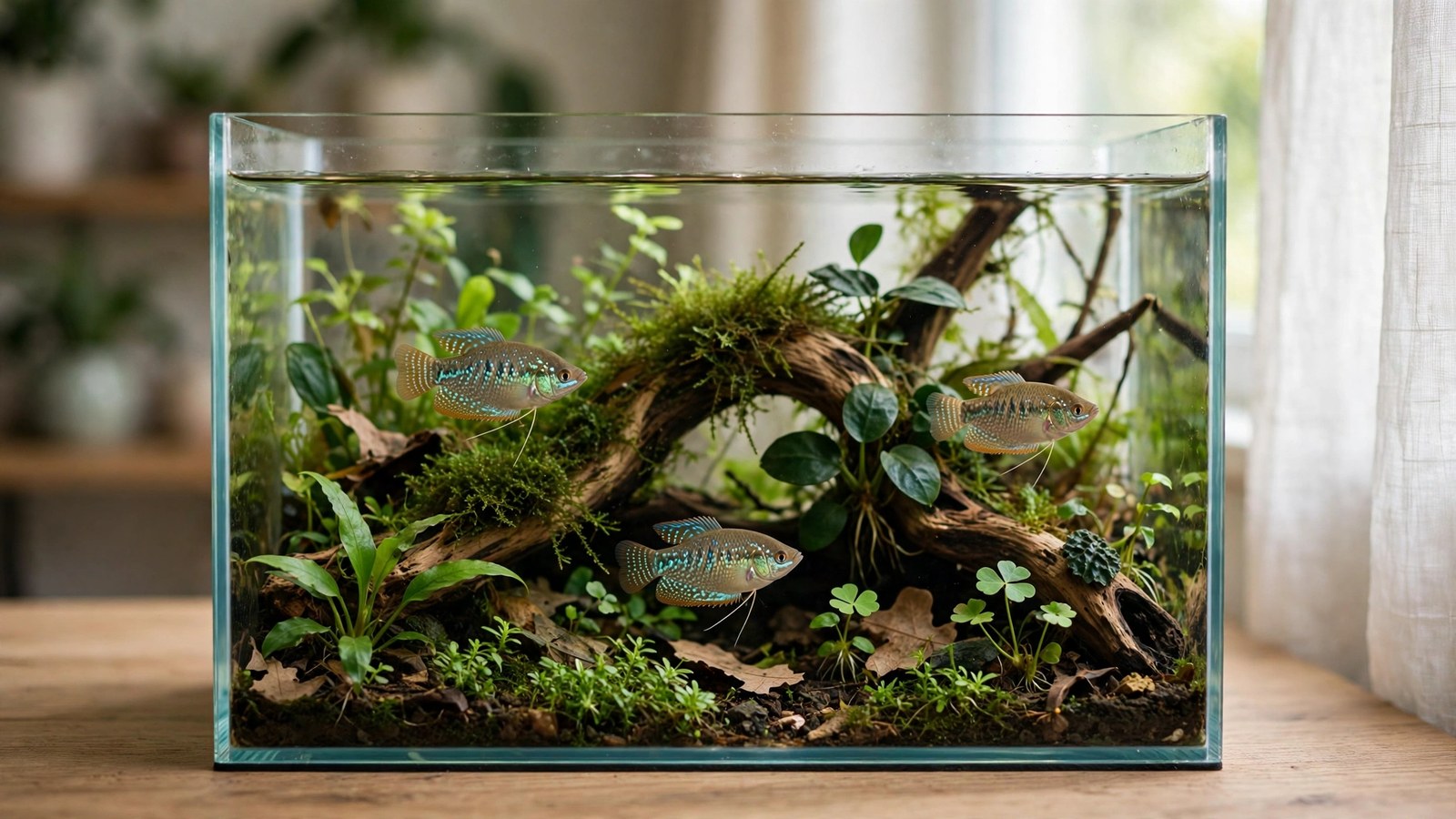
The sparkling gourami is only about 1.5 inches long, but it croaks like a frog, flares like a betta, and builds bubble nests under floating leaves. Most keepers sabotage their sparkling gourami planted tank setup before the fish even arrive — with a filter too strong for a fish that evolved in still blackwater ditches. This guide builds you a calm, plant-choked nano species tank where Trichopsis pumila colors up, croaks, and breeds.
Sparkling Gourami Planted Tank Setup: Step by Step
Sparkling gouramis come from slow, heavily vegetated streams and ditches in Southeast Asia, where the water barely moves and the surface is a raft of fallen leaves. Rebuilding that habitat is the entire game — and a planted nano tank does it better than any bare species tank ever could.
1. Pick the right footprint
A standard 10-gallon (20×10×12 in) beats a tall cube every time. These fish live in the top third of the water column, patrolling surface territories, so horizontal surface area matters far more than depth. A 5-gallon works for a single pair, but a trio-plus-male group needs the 10-gallon footprint so the male can claim a corner without harassing the females.
| Tank size | Stocking | Best for |
|---|---|---|
| 5 gallon | 1 male + 1 female | Single breeding pair |
| 10 gallon | 1 male + 2–3 females | Best all-round species group |
| 20 gallon long | 2 males + 5–6 females | Colony with two territories |
The popular 10-gallon planted tank setup layout translates perfectly — just budget extra surface space for floaters. If you're torn between nano sizes, the 5-gallon planted tank setup guide covers the mini build, and our nano planted tank ideas roundup has layout inspiration sized for this kind of species tank.
2. Keep the flow whisper-quiet
Labyrinth breathers that gulp air at the surface don't want a current shoving them around, and bubble nests disintegrate in anything more than a gentle ripple. A small sponge filter on an adjustable air pump is ideal: biological filtration, fine flow control, and a sponge surface that grows biofilm the fish will graze between feedings.
If you must use a hang-on-back filter, baffle the outflow with a cut water bottle or a pre-filter sponge and float a corral of plants under it to kill the current. Full detail on calibrating current lives in our guide to planted tank water flow and circulation.
3. Build a floating-plant ceiling
Floating plants are the single most important scaping element for Trichopsis pumila. Males anchor their bubble nests to the undersides of floating leaves — no floating cover, no nests, no courtship, and noticeably shyer fish. Cover 40–60% of the surface with frogbit or red root floaters, leaving one small bare "feeding ring" for micro foods.
4. Scape the lower two-thirds loosely
This isn't a plant-picking article — our best aquarium plants for gourami tanks guide has the species lists — but the layout rules matter. Give the male a defined territory: a corner anchored by driftwood with broad-leaf plants behind it. Break sight lines with mid-height stems so subordinate fish can vanish. Keep the front-center open so you can watch them hunt.
A low-tech planted tank setup is more than enough — skip injected CO2 entirely. For the general principles, our aquarium plants for fish tanks guide covers the fish-first planting approach.
Managing Male Sparkling Gourami Territoriality
Males are the divas of this species. Once a male claims a floating-leaf corner and starts croaking (yes, you can hear the little clicks during courtship), he will chase rival males relentlessly and court females with flared fins and an iridescent throat display. The magic ratio in a 10-gallon is one male to two or three females: his attention gets distributed and no single female gets harassed.
Two males can coexist only in 20 gallons or more with the tank divided into separate floating-plant territories at opposite ends. In a 10-gallon, a second male is a punching bag. Buy your group as juveniles from one tank — they grow into a stable hierarchy instead of an established bully meeting newcomers.
Feeding: Think Tiny
Sparkling gouramis have mouths the size of a pinhead, and this is where most keepers fail. Standard community flakes go uneaten and rot. What actually works:
- Micro pellets (0.5–0.8 mm) — crush them between your fingers as they hit the water; brands like Hikari Micro Pellets and New Life Spectrum Small Fish Formula are proven.
- Frozen daphnia — the perfect staple; small enough to eat whole, nutritious, and available everywhere.
- Live baby brine shrimp — triggers hunting behavior and is the best conditioning food for breeding pairs.
- Frozen cyclops / microworms — excellent fry food once a nest hatches.
Feed small amounts twice daily, only what they finish in about two minutes. Unlike their bigger cousins — see our honey gourami planted tank setup guide — sparkling gouramis need the fine-dining menu.
Water, Light, and the Blackwater Touch
Sparkling gouramis are unfussy about exact numbers but emphatic about stability. Keep temperature steady at 76–82°F with an adjustable heater, pH between 5.0 and 7.5, and do 25% weekly water changes with dechlorinated, temperature-matched water. Wild-caught fish especially appreciate tannins: a few catappa leaves or alder cones tint the water tea-colored and give them something familiar to hide under.
Keep light low to medium — bright blasting light makes them retreat into the plants permanently. SeriouslyFish's Trichopsis pumila species profile is the gold standard reference for the parameters behind these recommendations, and FishBase's Trichopsis pumila summary confirms the species' small adult size and native range.
Frequently Asked Questions
How many sparkling gouramis should I keep together?
One male with two to three females per 10 gallons is the ideal ratio. Males are territorial toward each other, so a second male needs 20 gallons and a separate floating-plant territory at the opposite end. A lone pair can live in 5 gallons, but a small group shows far more natural croaking and courtship behavior.
Do sparkling gouramis need floating plants?
Yes — practically mandatory. Males build bubble nests under floating leaves, and without surface cover the fish stay shy, wash out, and rarely breed. Cover 40–60% of the surface with frogbit or red root floaters, and leave a small bare feeding ring so micro foods don't drift into the plants.
Can sparkling gouramis live with shrimp or snails?
They're excellent shrimp-tank companions — too small and gentle to bother adult cherry shrimp, though newborn shrimplets may get picked off. Nerite and ramshorn snails are completely safe. Avoid larger or nippy tankmates; nano rasboras and ember tetras are the safest fish companions.
Why won't my sparkling gouramis eat flake food?
Their mouths are tiny — standard flakes are simply too big. Switch to micro pellets (0.5–0.8 mm), frozen daphnia, and live baby brine shrimp, fed twice daily in two-minute portions. Most "refusing food" cases are actually "wrong food size" cases, and the fish start eating immediately once you downsize.
Do I need CO2 for a sparkling gourami planted tank?
No. These fish come from slow blackwater ditches, not high-tech show tanks, and a low-tech setup suits them perfectly. Injected CO2 is harmless to the fish but unnecessary — spend the money on quality floating plants, a good sponge filter, and frozen foods instead.
Your Croaking Corner Awaits
A sparkling gourami planted tank setup rewards patience more than equipment. Give them a calm 10-gallon, a leaf-raft ceiling, gentle water, and food that fits their mouths, and within weeks you'll spot a frothy bubble nest under the frogbit. Start with the floating plants and the sponge filter — everything else falls into place around them.