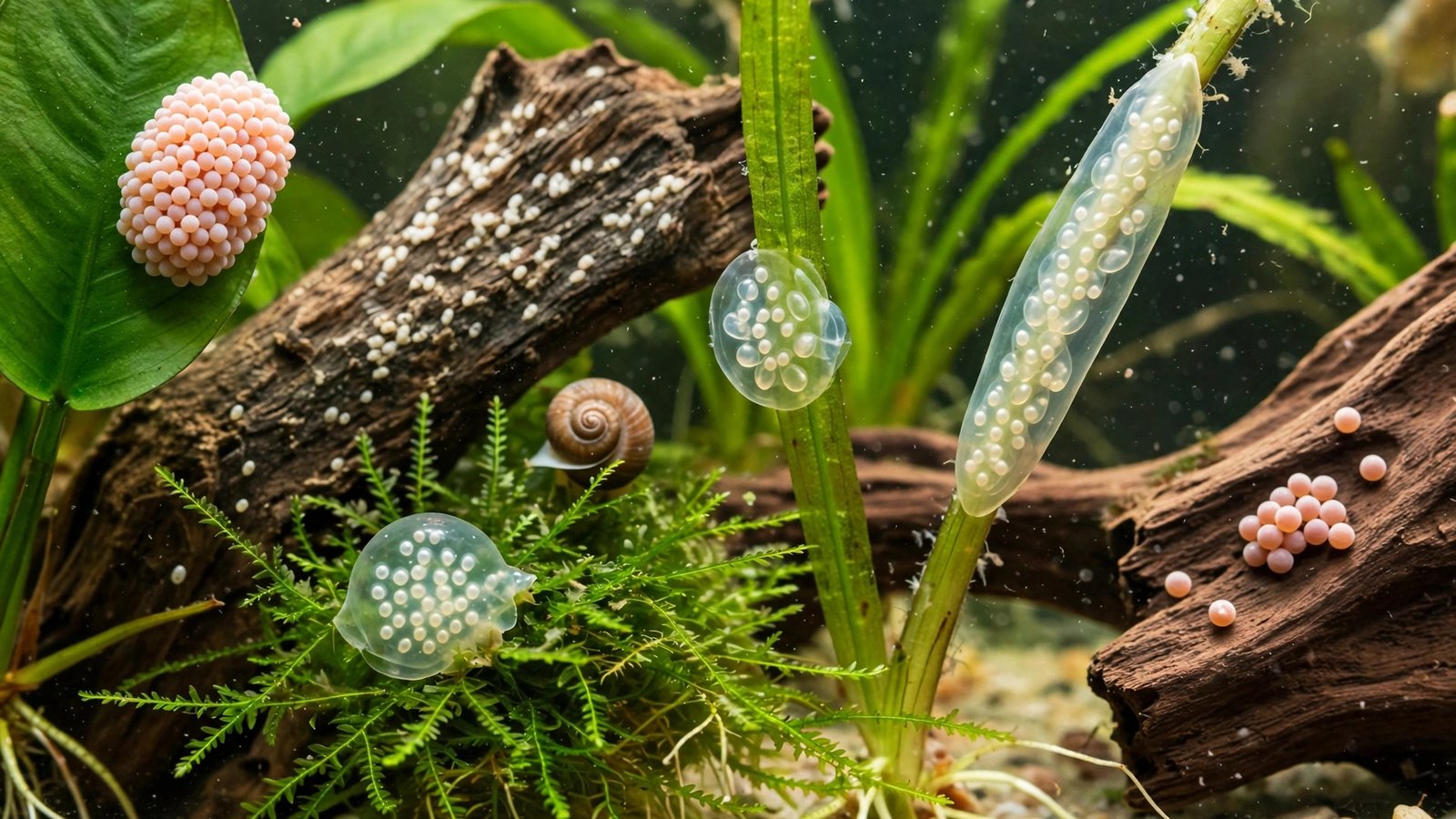
You open the lid and there it is: a pink, raspberry-like blob glued above the waterline, somewhere it absolutely was not yesterday. Before you scrape it off in a panic, stop. Aquarium snail eggs identification is a shape-and-location puzzle — and once you learn each species' signature clutch, you will know within seconds whether you are looking at future cleanup crew or a pest outbreak in the making.
Aquarium snail eggs identification comes down to clutch shape, egg color, and where the eggs are laid. Mystery snails lay a pink clutch (2–5 cm, 25–100 eggs) above the waterline, hatching in 2–4 weeks. Nerites lay single white sesame-seed eggs underwater that never hatch in freshwater. Ramshorn, bladder, and pond snails lay clear jelly clutches with tiny dots. Assassin snails lay solitary 1–2 mm translucent eggs. One citable rule: eggs above the waterline are always mystery snail — no other common aquarium snail lays out of water.
Aquarium Snail Eggs Identification: The Three Clues That Solve Every Case
Every clutch tells you three things: location, shape, and color — the same approach any proper nerite snail care guide uses. Mystery snails are the only common species that crawl out of the water, so a clutch on the lid or rim ends the investigation immediately. Then match shape: raspberry-sized mass (mystery), sesame-seed dots (nerite), jelly disc with dots (ramshorn/bladder/pond), one solitary capsule (assassin). Color confirms it: bright pink fading pale, chalk-white, clear jelly with amber-to-black dots, or nearly transparent.
Species-by-Species Clutch Profiles
Mystery snail: the pink clutch
A single pink mass of 25–100 eggs, 2–5 cm across, laid at night above the waterline. It needs humidity, not submersion — a submerged clutch drowns. At ~78°F (26°C) it hatches in 2–4 weeks, shifting from vivid pink to dull pink-white as babies develop. Keep the lid closed if you want babies; otherwise scrape the clutch off and bin it — never flush eggs into waterways.
Nerite snail: white sesame seeds that never hatch
Dozens of single hard white eggs, ~1 mm each, scattered across driftwood, rocks, and glass. They cause more false alarms than any other species — yet they cannot hatch in freshwater, because nerite larvae need brackish or marine water. Cosmetic, not a population problem, as Aquarium Co-Op's nerite snail guide explains.
Ramshorn snail: jelly discs with visible dots
Clear jelly discs, 0.5–1 cm wide, with 10–40 tiny amber dots on leaves, glass, and filter intakes. Hatch in 1–3 weeks. A few clutches are fine — ramshorns eat algae and detritus, and fish and shrimp eat the hatchlings. Dozens signal overfeeding: remove them and cut food.
Bladder and pond snails: the tiniest jelly clutches
Clear jelly under 0.5 cm with very tiny dots. Bladder snail eggs hatch in just 6–9 days at 77°F — the fastest in this guide. These classic hitchhikers arrive on new plants, so rinse every new leaf: healthy aquarium plants for a fish tank start with quarantine habits. One clutch becomes dozens of snails within a month, so removal is the default.
Assassin snail: the solitary square egg
A single 1–2 mm translucent, slightly squarish capsule laid alone on driftwood, rocks, or filter tubing. Hatches in 3–8 weeks. Because each egg is laid individually, populations grow slowly — keep every egg if you have pest snails, as Seriously Fish's assassin snail profile confirms.
Side-by-Side ID Table
| Species | Clutch look | Where laid | Hatch time (~77°F) |
|---|---|---|---|
| Mystery snail | Pink mass, 25–100 eggs, 2–5 cm | Above the waterline | 2–4 weeks |
| Nerite snail | Single white sesame-seed eggs | Underwater on hardscape/glass | Never (freshwater) |
| Ramshorn snail | Clear jelly disc, 10–40 dots | Leaves, glass, intakes | 1–3 weeks |
| Bladder / pond snail | Clear jelly, very tiny dots | Leaves, glass | 6–21 days |
| Assassin snail | Solitary 1–2 mm translucent capsule | Driftwood, rocks, tubing | 3–8 weeks |
Remove or Hatch: The Decision Matrix
A well-planned planted tank cleanup crew can turn a "pest" into a genuinely useful resident:
| Species | Hatch if… | Remove if… | How |
|---|---|---|---|
| Mystery snail | You want babies or have buyers | You can't house 25–100 juveniles | Scrape clutch off lid; trash, don't flush |
| Nerite snail | Always — they never hatch | Never needed | Razor blade on glass if needed |
| Ramshorn snail | You want an algae crew | Clutches appear faster than weekly | Pinch jelly off leaves; reduce feeding |
| Bladder / pond snail | You want detritus cleaners | Default: populations explode | Remove clutch; dip plants; cut feeding |
| Assassin snail | You have pest snails to hunt | Rarely — they breed slowly | Relocate adults if needed |
The rule of thumb: keep the eggs of snails you bought on purpose (mystery, nerite, assassin) and be selective about hitchhikers (bladder, pond, ramshorn). One bladder snail clutch becomes fifty snails within six weeks at 77°F — respect that math. If a population has already exploded, switch to a proper outbreak plan: our pest snail outbreak guide for planted tanks covers traps, predators, and dips.
Tricky Cases: When the Clutch Won't Behave
Four situations cause most confusion. Infertile mystery snail clutches: a lone female can still lay, but the eggs stay pink, never darken, and crumble. Ramshorn vs. bladder: clutches under 0.5 cm are hard to separate — treat them the same. Livebearers: Japanese trapdoor snails lay no eggs at all, so a clutch in their tank isn't theirs. Eggs on filters and heaters are almost always ramshorn or bladder snails. For a snail-first tank — a planted snail tank setup for breeding mysteries — leave emergent hardscape and lid space, and plant broad leaves: easy beginner aquarium plants like anubias are the jelly-layers' favorite laying surfaces.
Frequently Asked Questions
Can I identify the snail from a single clutch?
Yes, in most cases. Location, shape, and color identify every common species: pink mass above the waterline is always a mystery snail; white sesame-seed eggs underwater are always nerite; clear jelly with dots is ramshorn, bladder, or pond; solitary capsules are assassin. Only ramshorn and bladder clutches are ambiguous — removal decisions are identical.
Will mystery snail eggs hatch if they fall in the water?
No — submerged mystery snail eggs drown; they need humid air, which is why the female lays them on the lid or rim. Remove a fallen clutch promptly. If you want the babies, keep the lid closed to hold humidity and give the clutch 2–4 weeks at around 78°F.
Are nerite snail eggs a sign something is wrong?
No — egg-laying means a healthy, well-fed female. The eggs cannot hatch in freshwater, so they never become a population. The only downside is cosmetic: the hard white dots are difficult to scrape off driftwood. Accept them as the price of excellent algae control.
How fast do pest snail eggs multiply?
Bladder snail eggs hatch in as little as 6–9 days at 77°F, and each juvenile can reproduce within weeks — one overlooked clutch can become fifty or more snails in about six weeks. Removing one jelly blob now prevents hundreds of snails later, especially combined with reduced feeding.
Should I remove assassin snail eggs?
Almost never. Assassin eggs are laid singly and take 3–8 weeks to hatch, so populations cannot explode like pest snails. Keep every egg if you have a pest snail problem — each assassin is a hunter. If numbers ever concern you, relocate adults rather than destroying eggs.
The pink clutch above the waterline doesn't have to be a panic moment. It belongs to a mystery snail, the white sesame seeds on your driftwood are nerite eggs that will never hatch, and the jelly blob on your anubias leaf needs a decision within days. Take the photo, check the table, and choose remove or hatch on purpose.