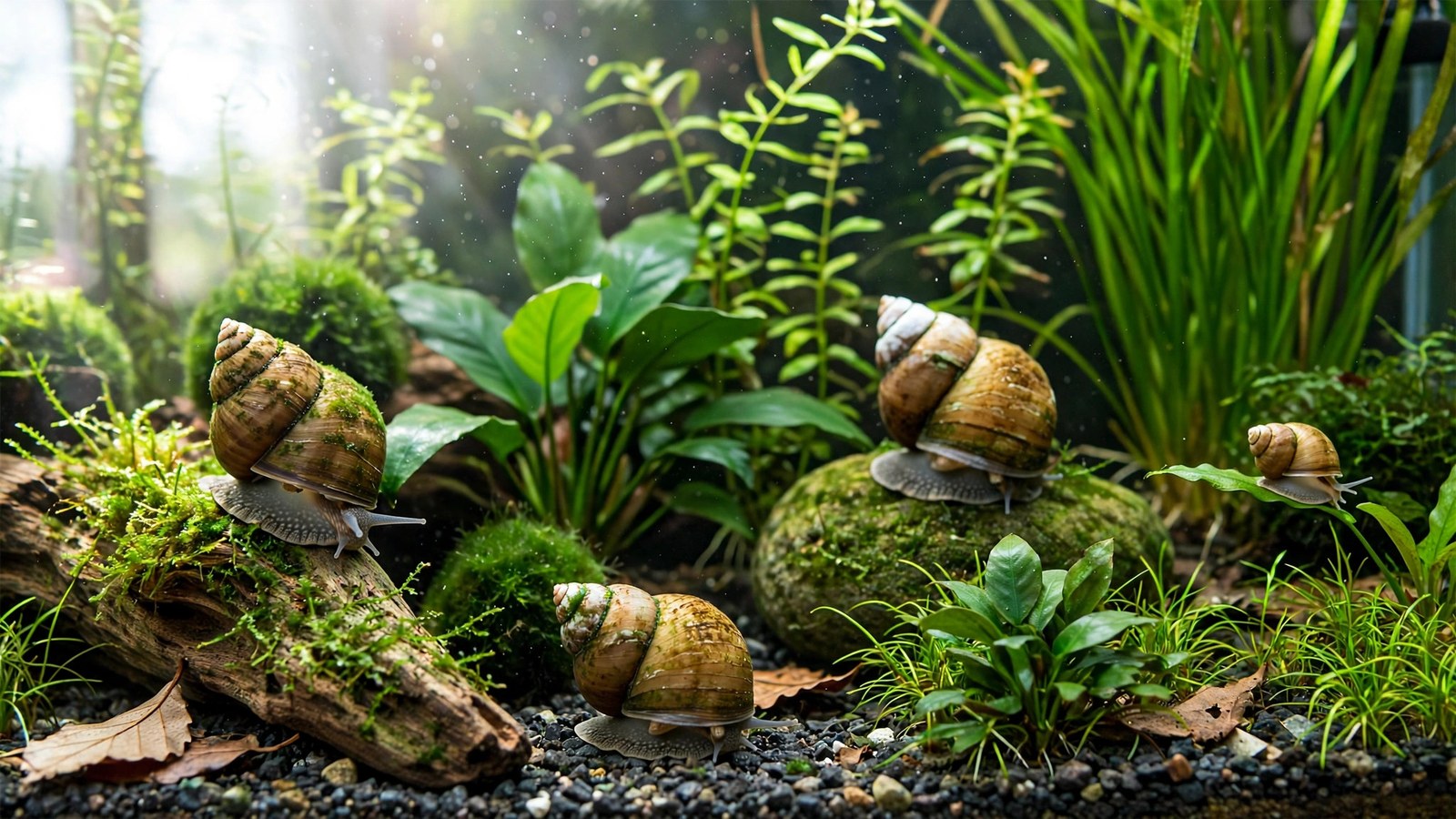
It grazes your glass like a nerite, climbs the tank walls at night, and gives birth to live babies instead of plastering eggs across your lid — yet most planted-tank keepers walk right past it in the shop. A japanese trapdoor snail planted tank is one of the calmest cleanup pairings in the hobby: Viviparus malleatus spends its days on algae duty, ignores healthy plants, and tolerates water cold enough to trouble almost any other algae eater.
Japanese Trapdoor Snail Planted Tank Setup
Start with a lid. Trapdoor snails are gilled, fully aquatic snails — they do not breathe air — yet they regularly climb to the waterline and sometimes over it. A tight-fitting cover is the single most important piece of setup gear.
Substrate can be sand or smooth gravel. These snails half-burrow through the top layer, aerating it without uprooting stems. Avoid sharp-edged gravel, which chips shell rims. Give them plenty of surface area — rock, wood, and broad leaves are all grazing territory, and that grazing is the plant-safe algae control in a planted fish tank that makes them worth keeping.
Stock one snail per 5–10 gallons; more than that and they will strip the tank's natural food and depend on you for every meal. Drip-acclimate new arrivals over 45–60 minutes — a snail dropped straight from a warm shipping bag into cool water will seal its operculum, the "trapdoor", and may not open for days. A dedicated snail tank setup lets you tune substrate and stocking exactly to their habits.
What They Eat (and What They Don't Touch)
Trapdoor snails are generalist grazers: brown diatoms, soft green film algae, bacterial biofilm, decaying leaf tips, and leftover fish food. In a mature planted tank with moderate light, three or four snails keep glass and leaf surfaces visibly clean with no extra feeding.
Still, supplement once or twice a week with blanched zucchini, spinach, or cucumber — weighted down overnight, removed in the morning. This keeps them off slow-growers like Anubias and Bucephalandra when algae runs thin. Calcium matters as much as calories: tuck a piece of cuttlebone behind the hardscape and offer calcium-rich foods like blanched kale, or new shell growth comes in thin and pitted.
Critically, they do not eat healthy plants. The Japanese trapdoor snail (Viviparus malleatus, also listed as Cipangopaludina malleata) is not the apple snail Pomacea canaliculata, the notorious plant destroyer that shops sometimes confuse it with. Trapdoors clean plants; apple snails eat them.
| Japanese trapdoor snail | Pest snails (bladder, ramshorn, pond) | |
|---|---|---|
| Reproduction | Live birth, ~20 young per female lifetime | Rapid egg-laying, populations explode |
| Plant safety | Eats algae and detritus only | Mostly safe, but swarms stress delicate plants |
| Size | 2–3 inches, hardy, long-lived | Under half an inch |
| Population control | Built in — low birth rate | Manual removal, predators, or starvation |
If you want to compare the other popular algae grazers before choosing, our nerite snail care guide covers a smaller, warm-water alternative that cannot reproduce in freshwater at all.
Cold Water, Hard Water: The Parameters That Matter
Cold tolerance is the trapdoor snail's superpower. Trapdoors stay active down to about 50°F (10°C) — most cleanup crews fade below 65°F — and have survived freezing winters in outdoor ponds. Keep them under 86°F (30°C); sustained heat shortens their lifespan.
The harder requirement is mineral content. Aim for pH 7.0–8.0 and at least moderately hard water. In soft, acidic water, shell erosion shows as white pitting near the growing edge — crushed coral in the filter or a cuttlebone in the tank fixes it gently. These are the same water parameters your plants and snails both need for leaves and shells to grow well together.
Live-Bearing: The Breeding Advantage
Here is the trait that makes trapdoors nearly cheat-proof against the pest-snail problem: females release fully formed juveniles — roughly a quarter inch across, about 20 per female over her whole life, a few at a time.
There is no egg stage: no clutches on the glass or above the waterline, and no population explosion when you overfeed. Most juveniles become fish food in a community tank; to raise them, move a few babies to a planted breeding box with powdered spirulina.
Tank Mates and the Copper Rule
Trapdoors are peaceful toward everything. They share tanks well with shrimp, peaceful tetras, rasboras, guppies, and bottom-dwellers like the farlowella twig catfish, which ignores snails completely. They also pair nicely with filter feeders such as the Asian gold clam, since both thrive in stable, well-mineralized water.
The bad company list is short but absolute. Loaches (especially clown and yoyo), large puffers, and assassin snails eat trapdoors — babies first, then adults. Boisterous cichlids harass them. If you are comparing larger ornamental snails, rabbit snails are the warm-water showpiece alternative, though they prefer softer, warmer water than trapdoors.
Frequently Asked Questions
Will Japanese trapdoor snails eat my aquarium plants?
No. They eat diatoms, film algae, biofilm, and decaying plant matter — not healthy leaves. The plant-damage reputation belongs to the apple snail Pomacea canaliculata, a different species shops sometimes confuse with trapdoors. If yours are rasping leaves, the leaves were already dying, or the snails are hungry and need blanched vegetables.
Why is the scientific name sometimes spelled "Viviparus malleattus"?
"Malleattus" is a widespread misspelling — the correct spelling is Viviparus malleatus (Reeve, 1863), with one "t". Modern taxonomy lists the species as Cipangopaludina malleata; Viviparus malleatus is the accepted synonym most shops use. A listing that says "malleattus" is the same animal with a typo, not a different species.
Will they overrun my tank like pest snails?
No — that is why planted-tank keepers prefer them. Females give live birth to roughly 20 young over their whole lives, a few at a time, and community-tank fish eat most of the babies. There is no egg stage and no population explosion, so a group of three or four stays a group of three or four.
Can they really survive cold water and outdoor ponds?
Yes. They stay active down to about 50°F (10°C) and survive near-freezing winters in outdoor ponds by burrowing into the substrate. That cold hardiness is unusual — most algae eaters stop working below 65°F. Indoors they thrive at normal tropical temperatures of 65–78°F (18–26°C).
Do I need to feed them, or is tank algae enough?
In a mature planted tank with moderate light, algae and detritus usually cover their needs. Still, offer a blanched vegetable (zucchini, spinach, cucumber) once or twice a week — it keeps them off slow-growing plants when algae runs thin, and calcium-rich foods plus a cuttlebone keep shell growth thick and unpitted in softer water.
Why does my trapdoor snail sit at the waterline?
Climbing to the waterline is normal behavior — they graze the biofilm there. It is not an escape attempt or a sign of bad water on its own. Just keep a lid on the tank, because they occasionally keep climbing past the rim. If several snails crowd the waterline at once and refuse to graze lower, then test your water parameters.
The Bottom Line
If you want a cleanup crew that eats algae, ignores plants, never overruns the tank, and shrugs off cold water, buy three or four, add a lid and some calcium, and they will quietly do their job for years.