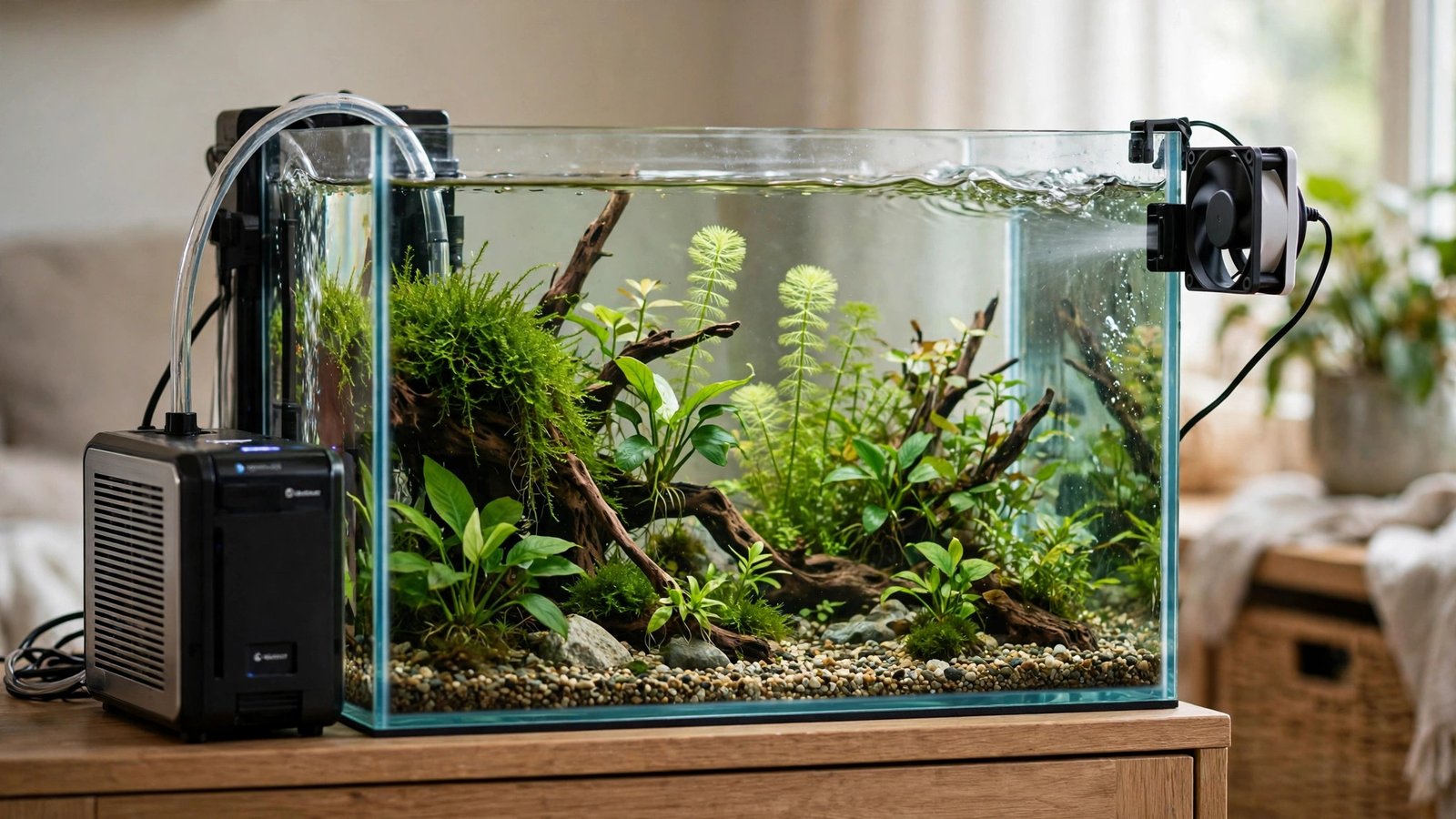
Every summer, planted tank keepers buy clip-on fans, watch the thermometer barely budge, then buy an aquarium chiller anyway — spending twice and losing a season of growth. This aquarium chiller vs cooling fan comparison shows which tool your tank actually needs, so you buy once. For the fan side alone, see our guide to aquarium cooling fans for planted tanks.
Aquarium Chiller vs Cooling Fan: The Real Decision
A cooling fan blows air across the water, accelerating evaporation — each escaping drop carries heat away. A chiller pumps water through a refrigerated titanium heat exchanger, forcing the temperature down like a fridge:
| Cooling fan | Aquarium chiller | |
|---|---|---|
| Cooling power | 2–4°F (1–2°C) | 10–30°F below room temp |
| Upfront cost | $25–80 | Low hundreds to $1,000+ |
| Power draw | 2–10W per fan | ~200–700W while compressor runs |
| Noise (estimate) | 25–35 dB hum | 45–55 dB compressor cycling |
| Evaporation | High — top off often | Low |
| Humidity limit | Fails above ~80% RH | Works regardless |
| Heats the room | No | Yes |
| Best for | Small tanks, dry air, 2–4°F needed | Large tanks, humid air, 10°F+ needed |
Fans fail gradually; chillers fail expensively. Your climate and tank size decide which to accept.
How Aquarium Chillers Actually Work
Water is pumped through a titanium heat exchanger — titanium resists corrosion in fresh and salt water — while a compressor circulates refrigerant around it, like a window AC. A digital thermostat (typically ±1°F) cycles the compressor to hold the set point. Chillers don't care about humidity: refrigeration removes heat by compression, so it performs identically in muggy and dry rooms. That single fact is why hot-climate keepers graduate to them — see how to keep a coldwater planted tank if your livestock needs genuinely cool water.
Sizing a Chiller: HP Ratings vs Tank Volume
Chillers are sold by compressor horsepower, but what matters is pull-down: how far below room temperature the unit can hold, at what volume. JBJ's published Arctica specifications — a long-standing benchmark — show the math:
| Size | Max volume (est.) | Pull-down (manufacturer figures) | Flow range |
|---|---|---|---|
| 1/15 HP | ~40 gal | Light pull-downs | 100–200 GPH |
| 1/10 HP | ~80 gal | 10°F up to 80 gal · 30°F up to 30 gal | 240–960 GPH |
| 1/4 HP | ~200 gal | 10°F up to 260 gal · 20°F up to 130 gal · 30°F up to 90 gal | 480–1,920 GPH |
Volume and pull-down trade off: cooling 75 gallons by 5°F needs roughly the same unit as cooling 30 gallons by 15°F. Start from your worst-case gap — "room hits 88°F, I need 74°F" is a 14°F pull-down — and pick a unit rated for your volume at that pull-down, one size up.
Article's sizing examples reference the JBJ Arctica line; natural fit at the sizing discussion: the JBJ Arctica 1/4 HP chiller ★4.1.
The Hidden Costs: Energy, Noise, and Heat Exhaust
Energy. 1/15 HP draws ~2 amps (~230W), 1/10 HP ~2.6 amps (~300W), 1/4 HP ~6 amps (~690W) while the compressor runs. With the compressor cycling half the day, a 1/4 HP unit can add several kilowatt-hours daily all summer (estimate — check your local rate).
Noise. Compressors kick on with a thunk and hum at roughly 45–55 dB — audible through a cabinet, noticeable in a quiet room (estimates). Fans hum at 25–35 dB and never surprise you. Hear one in person before a bedroom or office install.
Heat exhaust. A chiller moves heat from water into your room. In a small, closed fish room the temperature creeps up and the chiller works harder in a feedback loop. Give it open airflow on all sides — sealed cabinets are explicitly warned against.
Chiller Plumbing Basics
Chillers ship without pumps. The simplest freshwater setup: splice the chiller into your canister filter's return hose so filtered water flows through it back to the tank. Flow must sit inside the chiller's rated range (too little can freeze the exchanger; too much rushes water through before it cools). Keep runs short, prime the loop fully before first power-on — an air-locked chiller running dry can damage the compressor — and maintain strong oxygenation in your planted tank, since cooling's whole point is giving livestock breathing room. An external controller like the Inkbird ITC-308 ★4.2 (dual heating/cooling relay, compressor delay protection) adds a safety layer over the built-in thermostat.
When Fans Mathematically Can't Win
Evaporative cooling can only reach the wet-bulb temperature — the reading of a wet thermometer in your room's air. In a dry 86°F (30°C) room at 40% humidity, the wet bulb is ~70°F (21°C): fans work brilliantly. At 80% humidity, the same room's wet bulb is near 81°F (27°C) — no fan can push water below that line, because the air can't absorb more moisture. Target 74°F with a wet bulb of 81°F and fans cannot win, period. This ceiling bites hardest in tropical regions, sealed apartments, and fish rooms of open-top tanks. Breeding setups needing rock-solid temperatures are prime chiller candidates.
Fans also evaporate heavily: a fan-cooled 75-gallon tank in dry air can lose 1–2 gallons a day (estimate) — skip top-offs and hardness and fertilizer concentrations swing. Fan-cooled tanks need an automatic top-off system — nearly mandatory.
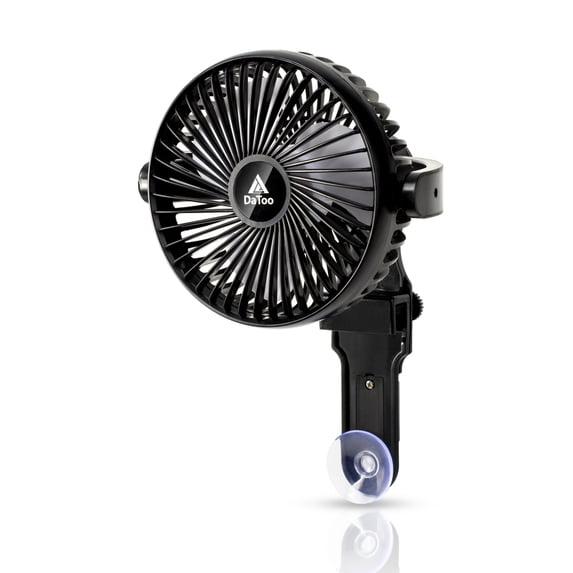 ★3.8
DaToo Aquarium Cooling Fan
Check Price on Amazon ★3.8When a Chiller Is Overkill
For most planted tanks, chillers are wonderful and wildly unnecessary. Under 20 gallons in a dry or air-conditioned room, needing a 2–4°F shave: a fan pair plus a temperature controller solves it for a fraction of a chiller's price. Most low-tech planted tanks and lightly planted aquariums live here — their plants tolerate 78–80°F fine.
A chiller earns its keep when any of these hold: the room regularly tops 85°F, humidity stays above 80%, the tank is 40+ gallons, or livestock demands cool water — crystal shrimp, hillstream loaches, plants that melt above 80°F. Check first: a chiller won't fix a tank overheating from a hot light fixture or a heat-dumping pump. Fix the heat source before buying refrigeration — and keep a clean prefilter sponge, since a clogged one chokes chiller flow.
Frequently Asked Questions
Can I run a chiller and fans together?
Yes — a smart combo in marginal climates. Fans on a controller handle small rises; the chiller engages only when fans can't hold the set point, cutting its duty cycle and your bill. Top off diligently, since the pair moves a lot of water into the air.
Do aquarium chillers work on nano tanks?
They work, but they're usually overkill. Nano units (1/15–1/10 HP) cool 10–40 gallon tanks reliably, yet nano heat is almost always fixable cheaper — one clip-on fan, a cooler LED, or moving the tank out of a sunny window. Only buy one if the cheap fixes genuinely failed.
How much will a chiller raise my electric bill?
It depends on unit size, your rate, and compressor duty cycle. A 1/4 HP unit draws ~690W while cooling; running 8 hours a day in summer, that's roughly 5.5 kWh daily (estimate). At typical US residential rates that's on the order of a dollar a day — meaningful over a heat season, but not catastrophic. Fans cost pennies by comparison.
Can I plumb a chiller into my canister filter?
Yes — the most common freshwater setup. Splice the chiller into the canister's return hose. Confirm your canister's flow sits inside the chiller's rated range after head loss, match hose barbs, and give the unit open ventilation below or beside the tank so exhaust heat escapes freely.
Do planted tanks really need chillers?
Most don't. Common aquarium plants thrive at 72–80°F and tolerate brief spikes into the low 80s. Chillers matter for high-tech tanks where warm water fuels algae, coldwater species, and shrimp like crystals needing the low 70s or cooler. Match cooling to your livestock's real needs, not forum anxiety.
The Bottom Line: Buy the Cooling Your Climate Demands
Log your tank's peak summer temperature for a week, note your room's humidity, and do the pull-down math. Need 2–4°F in dry air? Fans plus a controller win on every metric. Out of fans' reach? Size a chiller by pull-down, ventilate it, and enjoy your tank's most stable summer. The right purchase is the one you make once.