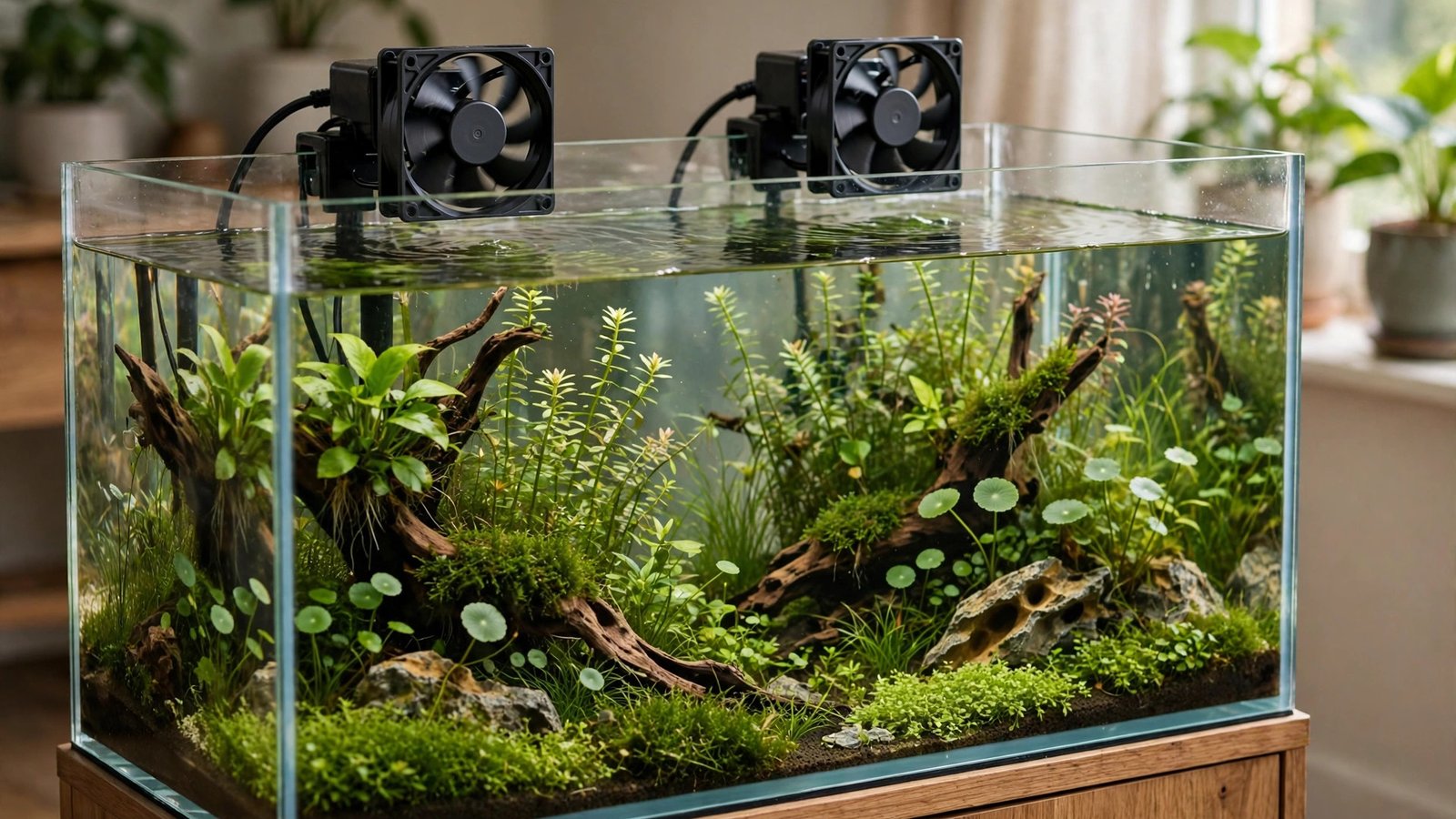
Last summer my carpet of Monte Carlo started melting from the top down — not algae, not a nutrient gap, just water that had crept to 84°F under a long photoperiod. A forty-dollar aquarium cooling fan clipped to the rim brought the tank back under 80°F within a day, and the plants bounced back in a week. That little plastic fan turned out to be the single cheapest rescue tool in my planted-tank cabinet.
Cooling fans are the underdog of planted-tank temperature control: no plumbing, no refrigeration, no $400 chiller bill — just moving air across the water's surface. One thing first: lights tuned hotter than your plants actually need are the number-one heat source in a planted aquarium, and fixing that costs nothing. A fan is what you reach for once the light side is sorted and the tank is still too warm.
How an aquarium cooling fan actually cools your tank
Every gallon of water that evaporates carries a huge amount of heat energy with it — the same reason sweating cools your skin. The U.S. Department of Energy's guide to evaporative cooling explains the physics: dry air moving across water accelerates evaporation, and the energy comes from the water itself, lowering its temperature. A cooling fan does nothing fancier than forcing that airflow. No compressor — just free physics.
Practical consequence: fans work best on open-top tanks. A tight glass lid traps humid air right above the surface and stalls evaporation — pop it off while the fan runs. And the drier your room air, the bigger the drop; humid rooms land at the low end of the range.
Realistic expectations: how much will it actually drop your temp?
Honesty first: an aquarium cooling fan will not turn 90°F water into 74°F water. In a typical planted tank with a room temperature around 76–78°F, a well-placed fan knocks the tank temperature down by 2–4°F (1–2°C). That sounds modest until you remember the stakes — most tropical plants and livestock tolerate the low 80s fine; it's the stretch above 84°F where carpet plants stall, CO₂ demand spikes, and oxygen saturation drops.
The fan's real job is holding the tank within a safe band during the hottest part of the day — usually the last 3–4 hours of the photoperiod, when heat from the lights accumulates. Switch it on an hour before peak intensity and off after lights-out (or hand the cycle to a timer). Run it 24/7 only if the tank drifts warm even at night; otherwise you're just burning through top-off water.
Sizing an aquarium cooling fan by tank gallons
Fan bars come in single, double, triple, and six-fan configurations, and sizing follows surface area more than gallons. Rule of thumb: one clip-on fan handles up to ~30 gallons, a two- or three-fan bar covers 40–75 gallons, and 75+ gallon tanks want a four-to-six fan bar or two units spaced apart.
Coverage beats raw power: two small fans spaced apart cool a long tank better than one big fan blasting the middle, because evaporation happens across the whole surface. Angle air to skim horizontally across the water — downward air just ripples one spot. Adjustable-angle heads earn their price here.
The evaporation tradeoff: why you need an auto top-off
Here's the catch fans don't advertise: evaporative cooling works by removing water. Running a fan typically doubles — sometimes triples — daily evaporation. A 40-gallon tank that lost a quarter-inch of water a day can lose half an inch or more with a fan blowing, and in smaller tanks that shift moves salinity and dissolved solids fast.
For a low-tech planted tank, the fix is simple: top off daily with RO or dechlorinated water, since minerals stay behind when water evaporates. But when the fan runs while you're at work or on vacation, the waterline drops and your heater or filter intake can run dry — exactly the scenario an auto top-off system exists for. Even a lightly planted tank with minimal equipment benefits, because stable waterlines mean stable parameters.
Placement, noise, and temperature controllers
Mount the fan on the rim so it blows across the surface from one end, with the opposite end open so humid air can escape. If the tank sits in an unventilated cabinet, the fan just recirculates its own humid exhaust — crack the doors. Most clip-on units run at 30–40 decibels, about a quiet conversation; pick a bar with speed settings so you can run low at night and high through the hot afternoon.
The upgrade that makes a fan automatic is a temperature controller like an Inkbird unit. Plug the fan into the cooling outlet, set your cutoff (say, 80°F), and it switches itself on only when the water crosses that line. That eliminates the "forgot to turn the fan on" scenario and cuts evaporation to only what's needed — the single best pairing buy in this category.
 ★3.8
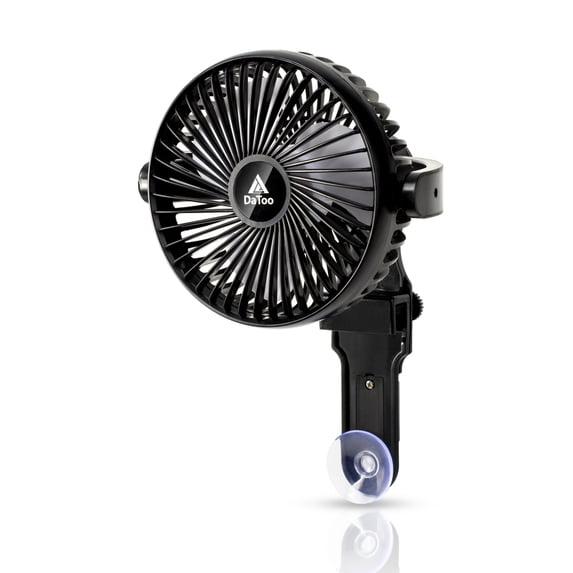
DaToo Aquarium Cooling Fan
Check Price on Amazon ★3.8When a chiller is actually needed
There is a line a fan can't cross. If your room sits above 86°F / 30°C for days, or your tank holds above 84°F even at night, the physics stalls — hot, humid room air can't carry more moisture. At that point you need a refrigerated aquarium chiller (plumbed, several hundred dollars) or you relocate the tank.
For everything short of that, the fan wins: a dirted tank in a warm apartment, a nano on a sunny desk, any summer spike a lighter photoperiod and a fan can absorb. Start with the cheap fix; buy the expensive one only when you've measured it isn't enough.
Frequently Asked Questions
How much will an aquarium cooling fan lower my tank temperature?
Expect a realistic drop of 2–4°F (1–2°C) below what the tank would reach without the fan, measured during the hottest part of the photoperiod. Results depend on room humidity, airflow across the surface, and whether the tank has a lid — open tops in dry rooms land at the high end, sealed humid setups at the low end.
Can I leave an aquarium cooling fan running 24/7?
You can, but it's wasteful: overnight evaporation still removes water without any real cooling benefit since the lights are off. Better to run the fan on a timer or a temperature controller so it only kicks in during the hot hours. That keeps evaporation down and your top-off reservoir lasting days instead of hours.
Will a cooling fan work with a glass lid on the tank?
Barely. Evaporative cooling needs the surface exposed to moving air, and a glass lid traps a blanket of humid air right above the water that kills the effect. Slide the lid back, remove it entirely for the summer, or switch to a mesh lid — you keep jumper protection while the fan still works.
Do cooling fans increase evaporation a lot?
Yes — that's literally how they cool, so plan on roughly double the normal evaporation rate, sometimes more in dry rooms. Pair the fan with an auto top-off unit if you can't top off manually every day, and always replace evaporated water with fresh RO or dechlorinated water, since minerals and salts stay behind.
Is a cooling fan better than a chiller?
They solve different problems. A fan is cheap, silent, and perfect for shaving 2–4°F off a tank in a normal room — plenty for most planted tanks. A chiller is a refrigerator for your aquarium: expensive and plumbed, but the only option when the room itself stays above 86°F or the tank won't drop below 84°F at night.
The bottom line
An aquarium cooling fan is the best-value summer tool a planted-tank keeper can own: thirty to sixty dollars, ten minutes to install, and a steady 2–4°F of relief right when the photoperiod peaks. Size it to your gallons, spread the airflow, top off what it evaporates — and only start shopping for a chiller if the far-end thermometer still reads too high.