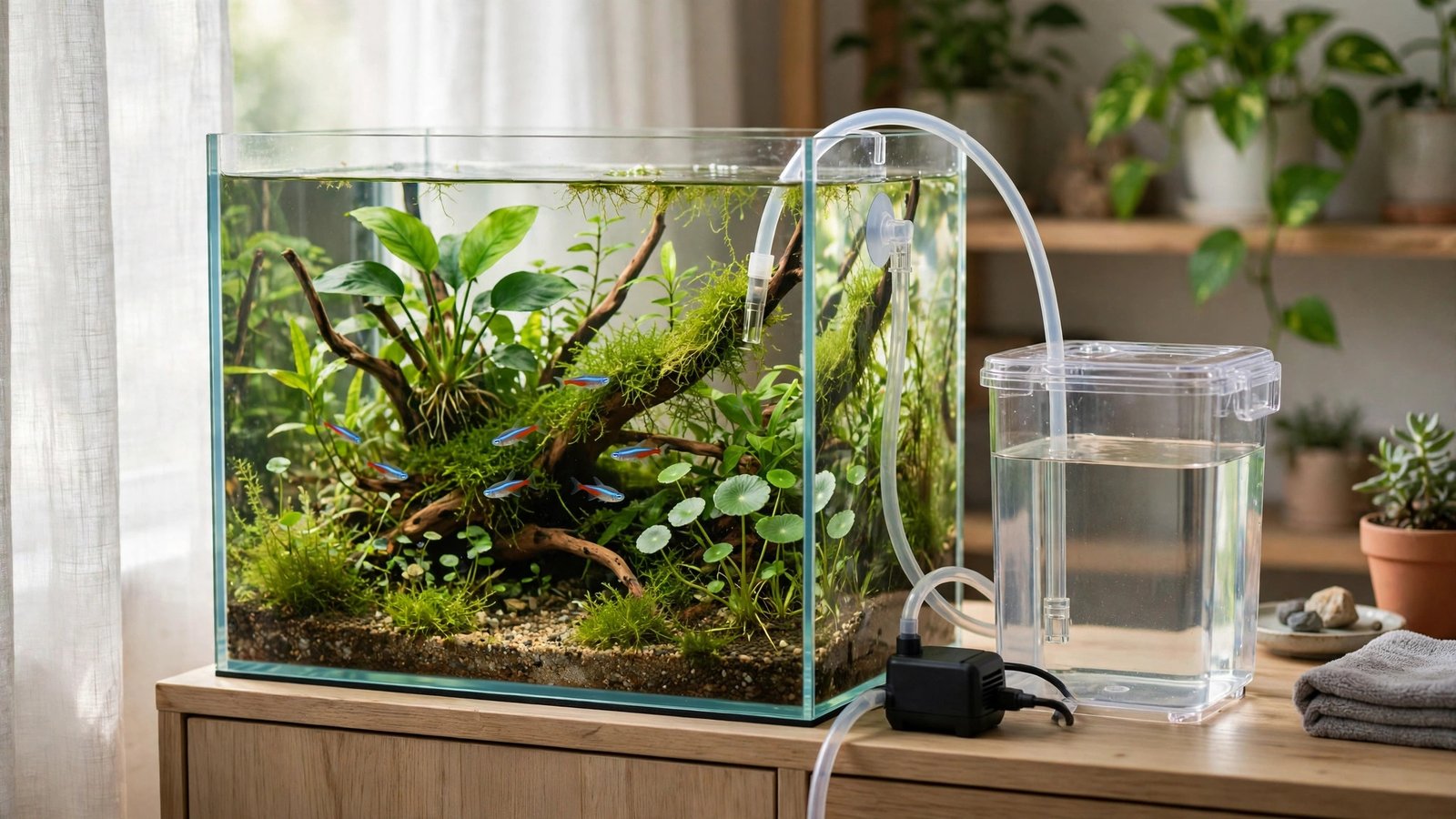
A summer heatwave can evaporate a quarter inch of water from an open planted tank in a single day — and every drop that leaves concentrates your fertilizers, nudges GH upward, and lowers the waterline toward your filter intake. An auto top off aquarium system fixes that quietly: a sensor watches the waterline and a pump adds back exactly what evaporated, so your tank stays stable whether you're home or on a week-long trip.
By the end of this guide you'll know how an ATO works, whether your planted tank needs one, what water belongs in the reservoir, and how to pick and install a unit that won't flood your living room. If you're still sorting out how topping up fits into your routine, our breakdown of topping off vs water changes explains the two very different jobs.
How an auto top off aquarium unit works
Every ATO has three parts: a sensor mounted at your target waterline, a small pump in a freshwater reservoir, and a controller connecting the two. When evaporation drops the level below the sensor, the pump switches on; once the level is restored, it switches off. The cycle runs in seconds and repeats dozens of times a day.
Sensors are either optical (an infrared beam at a probe tip) or float switches (a mechanical float that rises and falls). Optical sensors are precise and never jam but can be fooled by snails or algae film; float switches are simple but can stick. Fail-safes matter more than precision: insist on a max-runtime timer and a low-reservoir warning — a stuck sensor is the one failure mode that floods rooms.
Do You Need an ATO for a Freshwater Planted Tank?
ATO systems were born in reef tanks where salinity swings are deadly, but planted tanks benefit too — evaporation leaves fertilizer behind, so dosing gets stronger and GH creeps up between top-offs.
| Your setup | Evaporation | ATO worth it? |
|---|---|---|
| Small tank (≤15 gal), open top, high light | High | Yes — levels swing fast and shrimp hate that |
| Mid-size tank with a lid | Low–moderate | Optional — twice-weekly manual top-offs work |
| High-tech tank with CO₂ and dosing | Any | Yes — stable waterline keeps parameter math honest |
| Shrimp or breeding setup | Any | Yes — stable GH/TDS protects molting and babies |
Open-top tanks evaporate fastest — see our open top vs lid comparison if you're weighing a cover instead. And if you're automating other maintenance too, our auto water change guide pairs well with this one: the ATO handles daily evaporation while the water changer handles scheduled changes.
What Water Goes in the ATO Reservoir?
Only pure water: RO/DI or distilled. Evaporation removes H₂O and nothing else, so the replacement must contain nothing else either. Adding tap water — or water with fertilizer mixed in — compounds mineral buildup fast. If you test your planted tank's water parameters regularly, you'll see why: GH and TDS only stay flat when top-off water is pure.
Keep the reservoir lidded to keep out dust and light (which grows algae inside), and size it for about a week of evaporation — a 2–3 gallon food-grade jug suits most tanks under 40 gallons. Never use the reservoir to auto-dose fertilizers.
Choosing an ATO: What to Look For
There is no single "best" unit — pick based on tank size, sensor redundancy, and how much you trust the gear while traveling. These are the established names in the hobby:
| ATO unit | Sensor type | Standout fail-safe | Best for |
|---|---|---|---|
| Tunze Osmolator 3155 | Optical eye + backup float | Dry-run protection if the reservoir empties | The industry reference for reliability |
| Tunze Osmolator nano 3152 | Compact single sensor | Same controller DNA, smaller package | Nano tanks tight on space |
| AutoAqua Smart ATO | Optical sensor (QST) | Intelligent overfill / anti-overflow logic | Quiet plug-and-play freshwater setups |
| XP Aqua Duetto ATO | Dual optical sensors | Redundant sensors + audible alarm | Travelers wanting redundancy at a lower cost |
| Hydor Smart Level Control | Water-level sensor + alarm | Overfill alarm and auto shutoff | Budget installs on smaller tanks |
Three rules beat brand shopping: buy redundant sensing, insist on a max-runtime cutoff, and choose a pump that can't siphon — mount reservoir and hose so water can't gravity-drain into the tank. For the engineering detail, Tunze publishes the full Osmolator instruction manual (PDF) — worth reading whichever brand you buy.
Article's product comparison names the Tunze nano 3152 as the reliable pick for tanks under 55 gallons: the Tunze Nano Osmolator 3152.
Installing an ATO on a Rimmed Tank
Yes, an ATO works on a rimmed tank — you just mount the sensor differently. Magnetic holders clamp through the glass below the frame, or small brackets hang over the rim. Set the sensor for a waterline about ½ inch below the top of the frame, and route the refill hose over the back with the outlet above the waterline — never submerged, which can back-siphon.
Keep the sensor away from your filter's outflow: ripples confuse optical sensors, so mount it at the far end of the tank. Our HOB filter guide shows typical layouts, and a prefilter sponge over the intake protects shrimplets near the new waterline.
Test before trusting: mark the waterline with tape, run the system for a day, and confirm the level holds within a few millimeters. Then simulate failure — lift the sensor out of the water and verify the backup timer or secondary sensor stops the pump. That five-minute test is the difference between "set and forget" and "flood the apartment."
Maintenance and Troubleshooting
An ATO is nearly maintenance-free, but "nearly" still counts. Wipe the sensor face monthly — biofilm throws off optical sensors and slows floats. Refill the reservoir on a fixed weekly schedule instead of waiting for the alarm. As our planted shrimp tank setup notes, a rock-steady waterline is ideal for molting.
Pump running but level not rising? Check for an airlocked pump or kinked hose. Pump running constantly? The sensor is dirty, mispositioned, or fighting surface ripples — move it away from the filter outflow. Level dropping despite everything working? You have a leak or unusually high evaporation, not an ATO problem.
Frequently Asked Questions
What is an auto top off system?
An auto top off (ATO) is a small automation device: a sensor monitors the waterline, and when evaporation drops it, a pump adds pure water from a separate reservoir until the level is restored. It replaces only evaporated water — it does not perform water changes or filter the tank.
Do I need an ATO for a freshwater planted tank?
Not strictly, but many planted tanks benefit. Evaporation concentrates fertilizers and raises GH, destabilizing dosing in high-tech tanks and stressing shrimp. Small open-top tanks, shrimp colonies, and anyone who travels will notice the biggest difference. If your tank has a tight lid and twice-weekly manual top-offs keep parameters flat, manual is fine.
What water goes in the ATO reservoir?
Only pure water — RO/DI or distilled. Evaporation removes pure water and leaves dissolved minerals behind, so the refill must add nothing but H₂O. Never use tap water or water with fertilizers added; minerals compound quickly and push GH and TDS upward.
ATO vs manual top off — which is better?
An ATO wins on consistency: it replaces water in tiny increments all day, so the waterline and parameters never swing the way they do between manual top-offs. Manual topping off is free and fine for lidded tanks. If you keep shrimp, dose precisely, or travel often, the ATO is the clear choice.
Will an ATO work on a rimmed tank?
Yes. Magnetic holders mount through the glass below the frame, and over-the-rim brackets come with most kits. Set the sensor for a waterline about half an inch below the frame top, keep the refill hose outlet above the waterline to prevent back-siphoning, and mount the sensor away from filter-outflow ripples that confuse optical sensors.
Stable Waterline, Happier Tank
An ATO won't grow your plants or cycle your filter — but by holding the waterline rock-steady, it makes everything else more predictable: dosing stays accurate, shrimp molt on schedule, and your filter never gulps air. Install it once, test the fail-safes, and let evaporation become a problem you stopped thinking about.