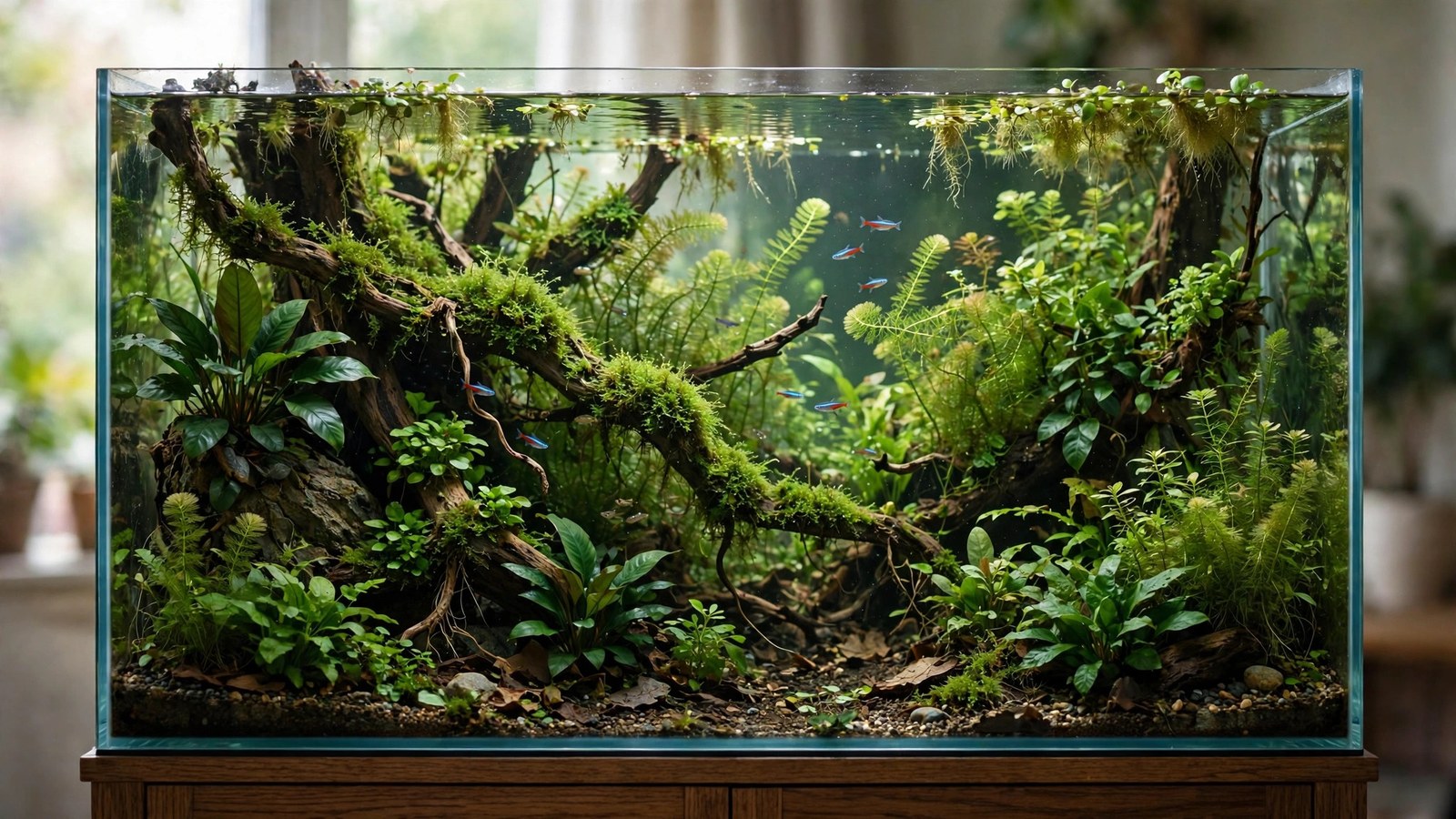
The jungle tank is aquascaping's wild heart — a deliberate embrace of overgrowth where plants compete, intertwine, and create a living thicket that looks like a flooded rainforest floor. Where Dutch style is a formal garden and iwagumi is a haiku, the jungle tank is a novel: layered, chaotic, full of discovery. It's also the most forgiving style for beginners, because "overgrown" is the goal, not the failure mode.
Jungle Philosophy: Controlled Chaos
Jungle style isn't neglect — it's curated wildness. The principles:
- Density over design: 80–90% planted, layers overlapping, sightlines broken everywhere
- Mixed planting: unlike Dutch streets, jungle mixes species freely — the interplay is the point
- Vertical layering: foreground, midground, background, and surface all occupied simultaneously
- Natural processes visible: runners spreading, floaters multiplying, moss creeping — growth is the aesthetic
- Minimal hardscape: wood and rock exist but disappear under vegetation; plants are the architecture
The skill in jungle tanks is knowing what to leave alone. Every other style rewards intervention; jungle rewards restraint. You plant heavily, establish balance, then trim only to prevent collapse — the tank does the designing.
Tank and Equipment: Big and Simple
Jungle tanks want volume — the layered look needs depth:
- Tank: 40 gallons minimum; 55–75 gallons ideal. Tall tanks suit jungle particularly well — vertical layering needs height. Our 75-gallon planted tank build is the dream jungle platform.
- Lighting: moderate LED, 7–8 hours. Jungle plants are mostly undemanding; strong light just accelerates the trimming burden.
- CO2: optional. Jungle style works beautifully low-tech — our low-tech planted tank setup is the natural equipment basis. CO2 speeds growth but also speeds the jungle toward unmanageable.
- Substrate: 2–3 inches of aquasoil or dirted substrate with cap — jungle tanks are hungry. Root tabs for the heavy feeders.
- Filtration: canister rated 2x volume; in dense jungle, circulation matters — dead spots behind plant walls grow algae and detritus.
One workhorse canister handles the bioload of a big, dense jungle tank: EHEIM Classic 150 canister filter.
The Jungle Plant Palette: Fast, Big, Lush
Choose vigorous growers that compete well and layer naturally:
Background giants
- Amazon swords (bleheri, ozelot) — broad leaves, massive presence; the jungle's anchor trees
- Vallisneria (jungle val) — tall ribbons reaching the surface; plant along the back in drifts
- Giant hygrophila — fast, tall, fills the back in weeks
- Water sprite (planted) — feathery giant that softens everything behind it
Midground mass
- Cryptocoryne (wendtii, balansae, usteriana) — the jungle's understory; bronze and green mounds filling the middle layers
- Java fern (large varieties) — attach to wood; broad textured leaves at mid-height
- Anubias (barteri, coffeefolia) — indestructible midground anchors on hardscape
- Red tiger lotus — red lily pads rising through green; the color exclamation point
- Stem plants (ludwigia, rotala, bacopa) — mixed freely for texture variety; let them grow tall and bushy
Foreground and surface
- Dwarf sagittaria — spreads into a meadow; jungle-appropriate low cover
- Chain swords — runner-spread foreground that looks naturally wild
- Floating plants — frogbit, salvinia, water lettuce: the canopy layer. Essential for the dappled-light jungle feel. See our floating plant guide.
- Mosses on wood — java moss, Christmas moss aging the hardscape into the scene
Big swords and heavy root feeders in jungle tanks eat through substrate nutrients — feed them root tabs: Seachem Flourish Tabs.
Planting the Jungle: Layers, Not Streets
- Start with hardscape bones — a few wood pieces angled naturally, some stones. They'll mostly vanish; that's fine.
- Plant background giants first — swords and vals along the back in loose drifts, not rows.
- Fill the midground thickly — crypts, ferns, anubias in overlapping groups. Overlap deliberately; gaps fill with time.
- Scatter stems through the midground — mixed species, irregular spacing. This is anti-Dutch planting: no streets, no rows.
- Foreground meadow — dwarf sag or chain swords across the front.
- Float the canopy — add floaters last; they'll multiply to cover 30–50% of the surface.
Plant at 80%+ density from day one. Jungle tanks establish fast because the plant mass immediately dominates — algae rarely gets a foothold when 80% of the substrate is planted on day one. Our planting quantity guide gives baselines; jungle wants the heavy end.
The First Two Months: Let It Run
Unlike Dutch or iwagumi, jungle establishment needs minimal intervention:
- Weeks 1–4: weekly 30–40% water changes; remove melting leaves; otherwise hands off. Watch the layers establish.
- Weeks 5–8: fast growers hit the surface; trim only what's blocking light to lower layers or escaping the tank. Let everything else run.
The jungle reveals its character around week 6–8, when layers interlock and the tank starts looking like an ecosystem rather than a planting. Resist the urge to "organize" it — the emerging chaos is the design maturing.
Maintenance: Preventing Collapse
Jungle maintenance is about preventing the three collapses: light starvation below, flow death behind walls, and nutrient exhaustion.
- Monthly structural trim: cut back the fastest growers before they shade out everything below. Remove whole stems at the base rather than topping — topping creates ugly stubble in jungle's natural look.
- Thin the canopy: floaters double fast; keep 30–50% surface coverage so light reaches below.
- Clear circulation paths: ensure filter flow reaches behind plant walls; add a small circulation pump if dead spots develop.
- 40% water change every 1–2 weeks: jungle tanks are nutrient-hungry; replenish and reset.
- Root tabs quarterly: heavy root feeders exhaust substrate; replenish on schedule.
- Remove dead lower leaves: shaded lower foliage rots and fouls water; prune it during trims.
Livestock: The Jungle's Inhabitants
Jungle tanks suit fish that evolved in vegetation — they use every layer:
- Angelfish: the classic jungle fish — tall, dramatic, weaving through vertical plants. Our planted angelfish tank setup is essentially a structured jungle.
- Gouramis (pearl, honey): labyrinth fish that haunt the upper layers among floaters
- Schooling tetras: cardinals, rummy-nose — flashes of color through green. See our schooling fish guide.
- Apistogramma / rams: dwarf cichlids that claim territories in the understory
- Corydoras, loaches: bottom patrol in the meadow layer
- Shrimp colonies: cherry shrimp explode in jungle tanks — endless grazing and cover. Our planted shrimp tank setup applies.
Stock moderately — jungle tanks look best with fish visible in the vegetation, not hidden by overcrowding. The fish should accent the jungle, not fill it.
Three Jungle Variations Worth Trying
The basic jungle formula adapts to several distinct flavors. The blackwater jungle adds tannins (catappa leaves, alder cones, driftwood) and dim lighting for an Amazon flooded-forest feel — pair it with cardinal tetras and angelfish for the authentic biotope, following the soft-water principles in our planted neon tetra tank guide. The riverbank jungle uses a riparium-style twist: let pothos and peace lily roots trail into the water from above while the submerged jungle fills below, doubling the layering — see our riparium build guide for the emersed technique. The high-tech jungle adds CO2 and stronger light for explosive growth and red-plant accents (ludwigia super red, alternanthera) woven through the green — spectacular, but budget double the trimming time.
Whichever variation you choose, the core discipline stays the same: plant in layers, let the tank grow wild within its structure, and intervene monthly to prevent the fast growers from winning outright. The variation just changes the flavor of the wilderness.
Frequently Asked Questions
How is a jungle tank different from just neglecting a tank?
Intent and balance. Neglected tanks have algae, dying plants, and chaos without structure. Jungle tanks have healthy plants in deliberate layers, controlled growth, clean water, and thriving livestock — the wildness is curated. The difference is visible: a jungle tank looks lush, a neglected tank looks sick. Maintenance still happens; it's just structural rather than cosmetic.
Won't the fast growers kill the slow ones?
They will if you never intervene — that's the "preventing collapse" maintenance. Monthly structural trims keep fast stems from shading out crypts and anubias below. Think of yourself as the disturbance regime: in nature, floods and herbivores prune jungles; in your tank, that's you with scissors, monthly.
Can I do a jungle tank low-tech?
Absolutely — jungle is the best low-tech style. The plant palette is undemanding, density compensates for slower growth, and the aesthetic welcomes the slightly wilder look of low-tech growth. Our low-tech guide plus this article is the complete recipe. CO2 is optional speed, not required infrastructure.
How do I stop it looking messy instead of lush?
Three things separate lush from messy: healthy plants (no algae-covered, rotting foliage — prune it), visible layering (maintain the foreground/midground/background structure even as it grows wild), and clean water (crystal water makes chaos look intentional; murky water makes it look neglected). Get those right and wild reads as jungle, not mess.
What do I do when it's completely overgrown?
The hard reset: remove 50–60% of plant mass in one session, keeping the structural plants (swords, wood-attached ferns, crypt mounds) and removing excess stems. It looks brutal for a week, then regrows better than before — jungle plants respond to hard pruning with vigorous fresh growth. Do this every 6–12 months.
Is jungle style good for breeding fish?
Excellent — arguably the best style for natural breeding. The dense cover, varied microhabitats, infusoria-rich environment, and broken sightlines are exactly what spawning fish and fry need. Many jungle keepers find fish breeding spontaneously: our breeding tank plant setup describes the same principles in dedicated form.
The Jungle Payoff
A mature jungle tank is the hobby's living wilderness — layers of green from substrate to surface, fish appearing and vanishing in the thicket, new growth visibly emerging every day. It's the lowest-stress aquascaping style and among the most rewarding: plant heavily, intervene lightly, and let the tank become what it wants to be. The jungle knows what it's doing.
For the plant science behind fast-growing species, see the 2Hr Aquarist aquarium plant care guides.