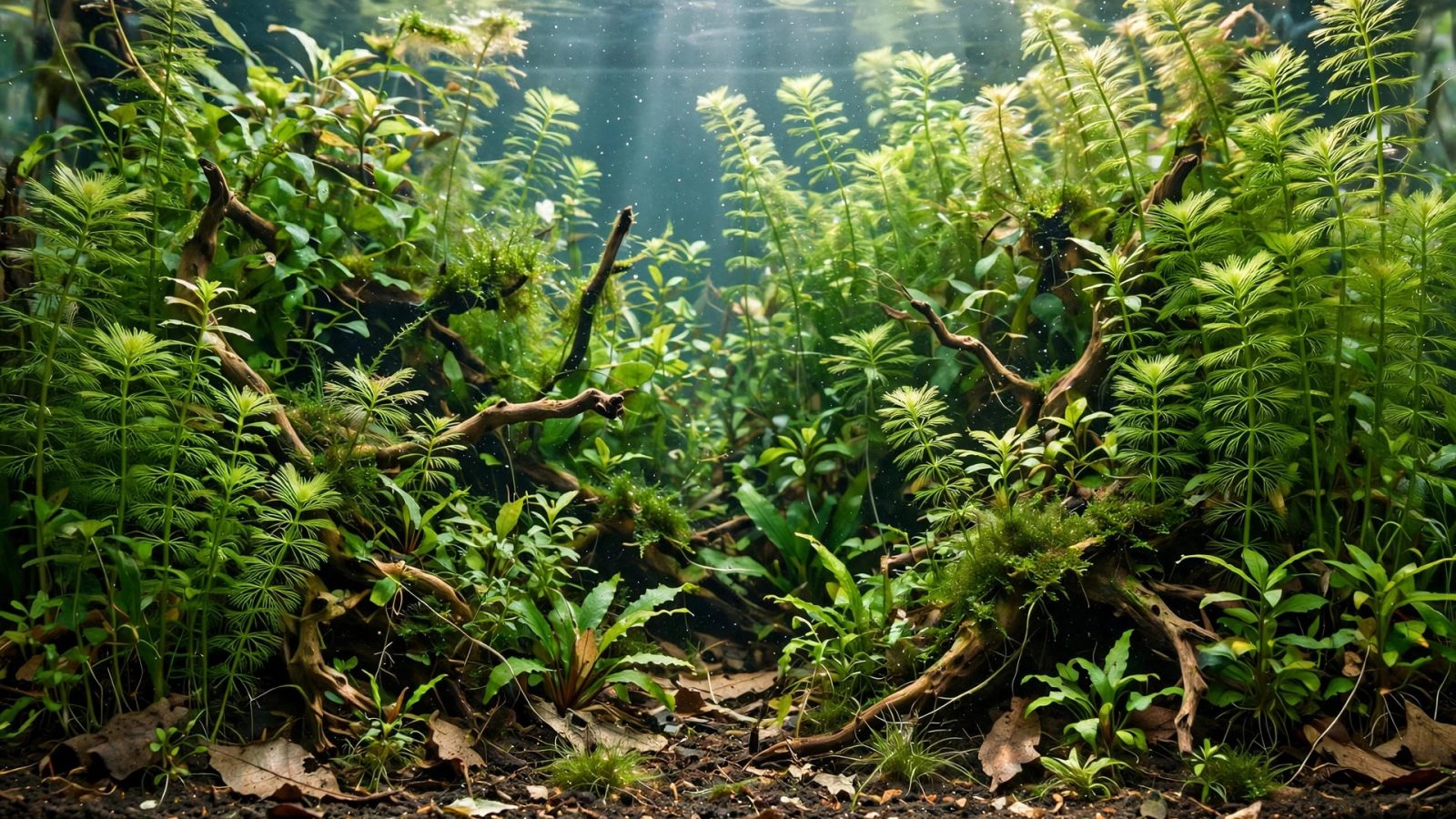
In 1999, ecologist Diana Walstad published Ecology of the Planted Aquarium, and quietly upended the hobby’s assumptions. Her thesis: a planted tank can run as a balanced ecosystem — soil substrate feeding plants, plants purifying water, fish waste fertilizing plants — with minimal filtration, no CO2 injection, and water changes measured in months rather than weeks. The Walstad method has since become the philosophical foundation of the entire low-tech movement.
This guide explains what the method actually is (and isn’t), the science behind it, and how to apply its principles — whether you go full natural or just borrow its ideas for a conventional setup. For the hands-on soil build, see our dirted tank setup guide; for the equipment-based low-tech approach, see low-tech planted tank setup.
The Core Idea: Let Ecology Do the Work
Conventional fishkeeping treats the aquarium as a life-support machine: the filter removes waste, the aquarist replaces water, fertilizers dose nutrients. Walstad inverted this. In her model, plants are the filter. Fast-growing plants consume ammonia directly — preferring it over nitrate, in fact — which means a heavily planted tank processes fish waste through plant uptake before the bacterial nitrogen cycle even gets involved.
The soil substrate plays the complementary role: it supplies CO2 (from organic decomposition), iron, and trace nutrients to roots, creating a rich root zone that water-column dosing can’t match. Together, soil + plants form a loop: fish produce waste, bacteria and soil processes convert it, plants absorb the products, and the water stays clean.
The Science in Plain Terms
Plants Prefer Ammonia
This is the method’s keystone. Aquatic plants uptake ammonium (NH4+) more readily than nitrate (NO3-) because converting nitrate back to usable nitrogen costs the plant energy. In a Walstad tank, fish excrete ammonia continuously at low levels, and a dense stand of fast growers absorbs it almost as fast as it’s produced. The result: measurable ammonia and nitrite stay near zero without a cycled filter doing the heavy lifting.
Soil Generates CO2
Decomposing organic matter in soil releases CO2 directly into the substrate and water — a slow, continuous carbon source. It’s nowhere near pressurized-injection levels, but for undemanding plants it’s enough, especially combined with the method’s moderate lighting (high light without high CO2 just grows algae).
The Substrate Becomes Alive
Over months, the soil layer develops a rich microbial community — bacteria, fungi, microfauna — that processes waste, releases nutrients, and forms symbiotic relationships with plant roots (mycorrhizae associations occur in aquatic plants too). Walstad described the substrate as the tank’s “digestive system.” This is why established Walstad tanks get more stable with age, the opposite of high-tech tanks that demand constant intervention.
Walstad Method Rules
Distilled from the book and two decades of community practice:
- Soil under gravel. About 1 inch of organic potting soil (no added fertilizers, no perlite) capped with 1–1.5 inches of fine gravel. The cap keeps soil from clouding the water while letting roots through.
- Heavy planting from day one. At least 70% of the substrate planted, emphasizing fast-growing stem plants. This is non-negotiable — sparse planting is the #1 reason Walstad attempts fail.
- Moderate light. 6–8 hours of modest LED lighting. The method deliberately avoids high light; the CO2 budget doesn’t support it.
- Minimal filtration. Many practitioners run a small filter for circulation or none at all. The plants handle filtration.
- Infrequent water changes. Once the tank stabilizes (2–3 months), water changes drop to monthly or less — you’re topping off evaporation more than changing water. This preserves the accumulated CO2 and nutrient balance.
- Light fish load. Stocking stays modest. The ecosystem has a waste-processing budget, and overstocking blows past it.
What the Method Gets Right
It’s genuinely low-maintenance once established. A mature Walstad tank asks less weekly work than any other planted setup — no dosing schedules, no CO2 refills, minimal water changes. The “ugly phase” is front-loaded.
It teaches ecological thinking. Practitioners learn to read their tank — plant growth tells you about nutrients, algae tells you about imbalance. That intuition transfers to every other kind of fishkeeping.
It’s cheap. A bag of organic potting soil costs a few dollars. No CO2 rig, no premium aquasoil, no dosing pumps.
Honest Limitations
The first 2–3 months can be rough. New soil leaches ammonia and organics; algae blooms are common; the tank often looks messy before it looks magical. Beginners who expect instant results get discouraged.
Plant choice is constrained. Demanding carpeting plants, most red species, and high-light stems won’t thrive. The palette is hardy, fast-growing, undemanding species — beautiful, but not the full aquascaping spectrum.
Rescaping is destructive. Uprooting plants pulls soil through the cap, clouding the tank and releasing an ammonia pulse. Walstad tanks reward a plant-it-and-leave-it philosophy; frequent rearrangers will fight the method.
“No water changes” is oversold. Evaporation top-offs still needed; many practitioners do small monthly changes anyway. And the method still requires testing during establishment — “natural” doesn’t mean “unmonitored.”
Walstad vs. Dirted vs. Low-Tech: Clearing Up Terms
These get used interchangeably, but they differ:
- Walstad method: The full philosophy — soil substrate, heavy planting, minimal filtration, minimal water changes, ecological balance as the goal. It’s a system.
- Dirted tank: Any tank using a soil-based substrate, regardless of philosophy. A dirted tank with a canister filter, weekly water changes, and CO2 injection is dirted but not Walstad. Our dirted tank setup guide covers the practical build.
- Low-tech: Any planted tank without CO2 injection. A low-tech tank might use inert gravel and liquid ferts — no soil at all. See low-tech setup for that path.
A tank can be all three at once, but each term describes something different: philosophy, substrate, and equipment level respectively.
Getting Started: The Simplified Path
If the full method appeals to you, start here rather than improvising:
- Tank: 10 gallons is the sweet spot — enough soil volume for a real ecosystem, small enough to manage. Smaller tanks work but have less margin for error.
- Soil: Organic potting soil, sifted to remove large wood chunks. About 1 inch. Avoid anything with added chemical fertilizers or moisture-retaining crystals.
- Cap: 1–1.5 inches of fine gravel or coarse sand over the soil.
- Plants: Fast growers first — water sprite, anacharis, hornwort, vallisneria — plus hardy anchors like crypts, anubias, and java fern. Plant heavily on day one.
- Light: Moderate LED, 6–8 hours on a timer.
- Cycle: Even Walstad tanks benefit from patience. Plants process ammonia, but stock lightly at first and test for the first month. Our planted tank cycling guide explains the silent-cycle approach that pairs perfectly with this method.
- Stock: Add fish gradually after 3–4 weeks of plant growth. Small, low-waste species suit the method best — see our schooling fish picks.
Frequently Asked Questions
Does the soil need replacing? No — that’s the beauty of it. The soil ecosystem matures and self-sustains. Practitioners run the same substrate for many years, occasionally pushing root tabs near heavy feeders.
Will my water be yellow? New soil leaches tannins; expect a tea tint for the first weeks. It fades with water changes. Purigen or activated carbon clears it faster if the look bothers you.
Can I do Walstad in a 5-gallon betta tank? Yes — it’s a popular combination. Keep the soil layer thinner (3/4 inch) in small tanks to limit the initial ammonia pulse, plant heavily, and cycle patiently. Our planted betta tank guide covers the species-specific details.
What about the “Father Fish” deep-substrate method I see on YouTube? Related philosophy (natural ecosystem, minimal intervention) with different substrate layering. The core Walstad principles — soil nutrition, plant-driven filtration, patience — apply to both.
The Bottom Line
The Walstad method isn’t magic and isn’t for everyone — but its central insight is now hobby consensus: plants are the best filter ever invented, and working with ecology beats fighting it. Even if you run a conventional filtered tank, borrowing Walstad ideas (heavier planting, moderate light, patience during establishment) will make you a better aquarist. And if you commit to the full method, you’ll own a tank that largely takes care of itself — the closest thing the hobby has to a self-sustaining ecosystem on a shelf.
Soil Chemistry: What’s Actually Happening Down There
Walstad’s book is 200+ pages for a reason — the soil-water-plant system is genuinely complex. Here’s the deeper layer for those who want to understand, not just follow:
Cation exchange capacity (CEC). Soil particles carry negative charges that attract and hold positively charged nutrient ions (calcium, magnesium, potassium, ammonium, iron). This is why soil feeds plants so effectively: it acts as a nutrient bank, holding ions against leaching and releasing them to roots on demand. Inert gravel has near-zero CEC; aquasoils are engineered for high CEC; organic potting soil is naturally high. This single property explains most of soil’s superiority as a substrate.
Redox and the anaerobic question. Deep soil goes anaerobic (oxygen-free), which sounds bad but is nuanced. Mildly anaerobic zones support denitrifying bacteria that convert nitrate to nitrogen gas — a natural nitrate removal pathway. Severely anaerobic zones produce hydrogen sulfide (toxic). The 1-inch soil guideline keeps the substrate in the beneficial zone; deeper risks the toxic one. Malaysian trumpet snails, which burrow through substrate, are the Walstad keeper’s allies — they aerate gently and prevent dead zones.
Iron dynamics. Iron is the nutrient most likely to limit plant growth, and soil handles it elegantly: anaerobic soil chemistry keeps iron in the ferrous (plant-available) form, while oxygenated water columns quickly oxidize it to unavailable ferric form. This is why root-fed plants in soil rarely show iron deficiency while water-column plants in inert substrates often do.
The First 90 Days: A Realistic Timeline
Days 1–14: The ugly phase. Water may tint yellow-brown from tannins. Ammonia from fresh soil feeds a bacterial bloom (mild cloudiness). Some plants melt. Algae — usually diatoms — appears. Do: 30–50% water changes twice weekly, 6-hour photoperiod, remove mushy leaves. Don’t: panic, add chemicals, or “fix” the substrate.
Days 15–45: The turn. Fast growers accelerate visibly. Ammonia readings drop to zero and stay there. Diatoms fade as silicates deplete. You add the first livestock — a few snails, then small fish groups weekly. Water changes drop to weekly 25%.
Days 45–90: Establishment. Plant mass doubles or triples. You start removing excess fast growers. Nitrates stabilize low. Algae, if any, is spot-scale and manageable. The tank starts looking like the photos that inspired you.
Month 4+: Maturity. The substrate ecosystem is fully online. Growth is lush and self-sustaining. Water changes can drop to monthly or less. This is the payoff the method promises — it just takes a season to arrive.
Walstad Plant Shortlist
Species Walstad herself highlights and community experience confirms:
- Water sprite, hornwort, anacharis — the ammonia-uptake workhorses. Non-negotiable in month one.
- Vallisneria — deep roots tap the soil’s full nutrient bank; spreads into meadows.
- Cryptocoryne — root feeders par excellence; wendtii and beckettii are bulletproof.
- Amazon swords — heavy root feeders that become centerpieces in soil.
- Floaters (frogbit, salvinia, water lettuce) — surface nutrient uptake; shade that prevents algae.
- Anubias, java fern — slow but permanent; attach to hardscape.
Adapting Walstad to Your Situation
Small tanks (5 gal): Use 3/4-inch soil max; the ammonia pulse is concentrated in small volumes. Plant even more densely relative to size.
With a filter: Perfectly compatible — Walstad herself notes filtration doesn’t hurt. A small sponge filter adds circulation and a bacterial home; it just isn’t required.
With water changes: Weekly changes don’t break the method; they just slow the march toward the self-sustaining equilibrium slightly. Do what keeps you comfortable.
The method is a spectrum, not a purity test. Borrow its principles — soil nutrition, heavy planting, patience, ecological thinking — in whatever combination suits your tank.
Common Walstad Myths, Corrected
“No water changes ever.” Walstad herself does occasional water changes. The method minimizes them once established; it doesn’t forbid them. Beginners who treat “no water changes” as law end up with accumulated problems they could have diluted.
“No filter needed.” True in the strict method, but filtration doesn’t hurt and adds safety margin. The anti-filter stance is philosophical (prove the ecosystem works), not practical advice for beginners.
“Any soil works.” No — soil with chemical fertilizers, perlite, or fresh manure causes disasters. The method specifies organic soil precisely because additives break the slow-release model.
“It’s the cheapest method.” Startup is cheap, yes. But failed attempts (replacing melted plants, fighting algae from unmineralized soil) cost more than doing it right once. Invest the afternoon in soil prep.
“Walstad tanks can’t grow carpets.” They grow some carpets — Marsilea, dwarf sag, pearlweed — just slowly. What they can’t grow is HC Cuba lawns in eight weeks. Match expectations to the method.
What the Book Actually Says (Key Takeaways)
For those who won’t read all 200 pages, Walstad’s load-bearing claims:
- Plants prefer ammonium over nitrate — the biochemical foundation of the whole method.
- Soil substrates outperform inert ones for plant growth via CEC and CO2 generation.
- Water changes remove CO2 and disrupt the developing ecosystem — hence minimizing them.
- Algae is controlled by healthy plant growth outcompeting it, not by anti-algae measures.
- Fish health improves in planted tanks via water quality, stress reduction, and natural antimicrobial compounds some plants release.
Two decades of community practice have largely validated these — with the practical amendments noted above (mineralize soil, consider a small filter, don’t fear water changes).
Walstad and Shrimp
Walstad tanks are exceptional shrimp tanks. The microbial-rich substrate grows biofilm constantly — shrimplets’ primary food. The stable, low-intervention environment suits neocaridina breeding perfectly. Add shrimp after month two, once the tank is stable and biofilm is established. A Walstad shrimp colony in a 10-gallon is one of the hobby’s great low-effort spectacles.
Walstad in Larger Tanks
The method scales beautifully to 40+ gallons — in fact, larger volumes are more stable, with more soil ecosystem and more buffering against mistakes. The considerations that change at scale:
- Soil quantity: A 55-gallon needs ~3–4 bags of potting soil. Mineralizing that much is a real project — start a week early.
- Planting labor: Achieving 70% coverage in a big tank means dozens of plants. Budget accordingly or propagate in advance.
- Water changes: Even “minimal” changes are 10+ gallons. A Python-style changer stops being optional.
- Lighting: Deeper tanks need stronger fixtures to reach the substrate — but stay moderate. Two medium fixtures beat one strong one for even coverage.
Large Walstad tanks are the closest thing to a self-sustaining ecosystem most hobbyists will ever own — months between water changes, explosive growth, and a substrate that gets richer every year.
Further Reading
Walstad’s Ecology of the Planted Aquarium (3rd edition) remains the definitive text — dense but rewarding. Online, the r/Walstad and r/PlantedTank communities hold two decades of collective troubleshooting. And our own dirted setup guide is the practical build manual for everything described here.
The Walstad Legacy
Diana Walstad didn’t invent soil substrates or heavy planting — aquarists did both for decades. Her contribution was the explanation: the biochemistry of why it works, published with scientific rigor in a hobby running on folklore. That explanation freed thousands of aquarists from equipment dependence and launched the modern low-tech movement. Whether you run a strict Walstad tank or just keep a dirted low-tech setup, you’re practicing her insight: the aquarium is an ecosystem first, a machine second — and ecosystems, given the right foundation, largely run themselves.