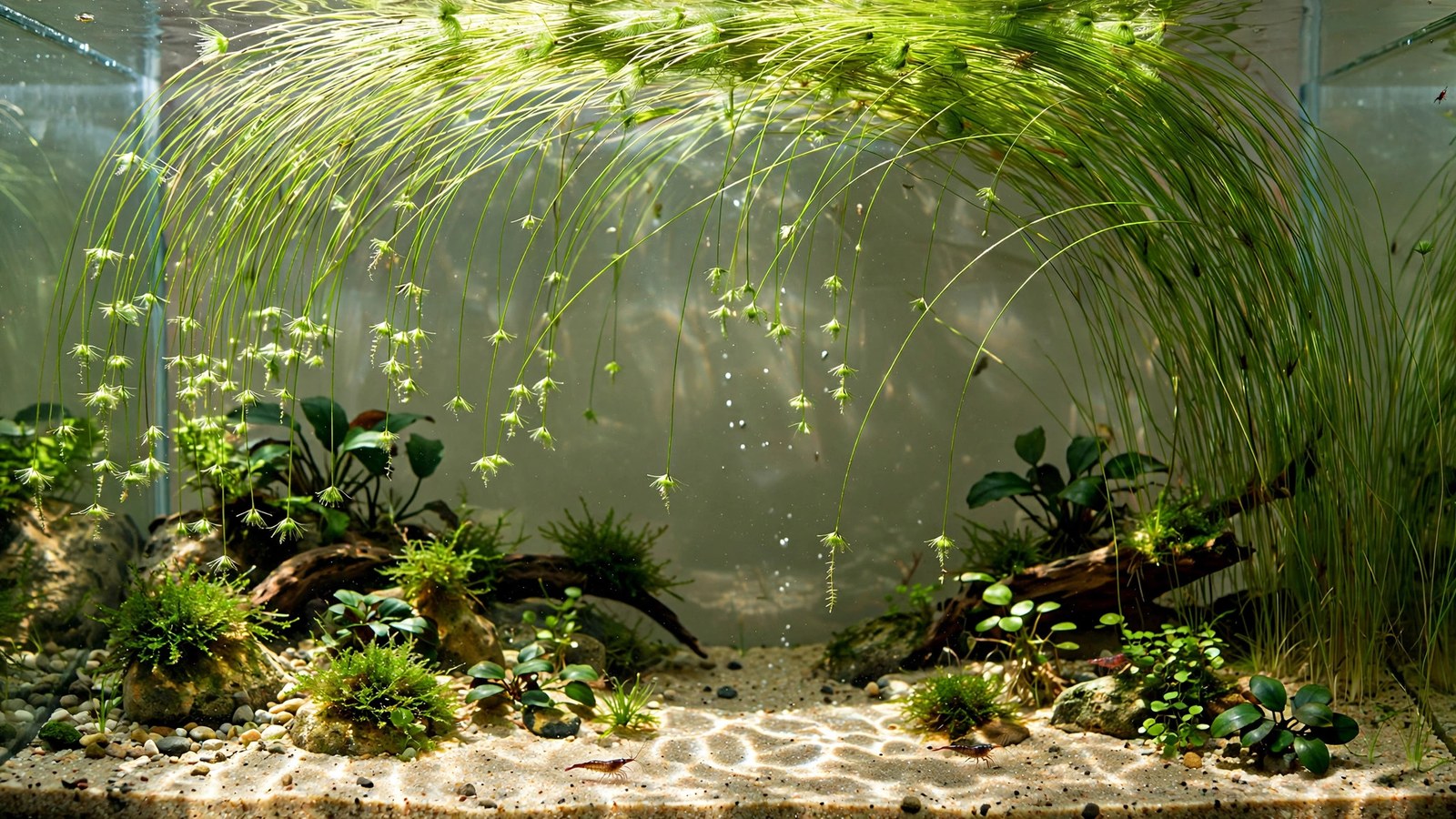
Buy hairgrass online and you will almost certainly order the wrong species. Most listings that say "hairgrass" mean dwarf hairgrass, a three-inch carpet plant — but Eleocharis vivipara is something else entirely: a fountain of fine green blades that climbs 10–16 inches, then bends over at the surface into an arching canopy. Eleocharis vivipara care is straightforward once you stop treating it like a carpet and start treating it like a background grass — plant it in clumps along the back glass, give it medium light and steady nutrients, and it does the rest. Among the best plants for a planted aquarium backdrop, this is the one that moves like water.
The hairgrass mix-up: which Eleocharis are you actually buying?
Three different plants trade under the "hairgrass" name, and they want completely different spots in your tank. This is the section that saves you money:
| Plant | Common name | Height | Placement |
|---|---|---|---|
| Eleocharis parvula | Dwarf hairgrass | 2–3 in | Foreground carpet |
| Eleocharis vivipara | Umbrella hairgrass | 10–16+ in | Background |
| Eleocharis montevidensis | Giant hairgrass | 24–36+ in | Background, tall tanks |
If you bought a pot labeled "hairgrass" hoping for a carpet and it shot for the surface, you have vivipara — the fix is simple: move it to the back and enjoy it. For that low lawn, our guide to foreground carpeting plants for beginners covers dwarf hairgrass done right. Vivipara's closest look-alike is giant hairgrass (E. montevidensis), which grows taller and straighter and belongs in 24-inch-plus tanks; vivipara's signature is the arching, bending canopy at the surface.
Eleocharis vivipara care: the full guide
Once placed correctly, vivipara is forgiving. It is a swamp grass at heart — a native of marshes, pond margins, and wet ditches across the Americas — and it wants what most background grasses want: light, root space, and consistent food.
Light and CO2
Medium to high light is the sweet spot — at low light the blades come up thin and sparse and runners stall; at 50+ PAR the clump thickens and colonizes within weeks. CO2 injection is recommended but not required: without it expect roughly half the growth speed and a leaner stand, which suits low-tech tanks fine. Keep a steady 7–8 hour photoperiod, because erratic lighting grows algae on those long blades faster than on anything else in the tank.
Substrate and fertilizer
As a heavy root feeder, vivipara wants its food where its roots live. Plant into 2–3 inches of fine-grain substrate or aquasoil — coarse gravel lets runners wander and clumps lift. On inert sand or gravel, push a root tab under every clump at planting and refresh every 2–3 months; the plant tells you it is hungry when older blades yellow from the tip downward. For the water-column side, a complete liquid fertilizer at half to full dose weekly covers the rest — our breakdown of whether aquarium plants really need fertilizer will keep you from overcomplicating it.
Water parameters
| Parameter | Ideal range |
|---|---|
| Temperature | 68–80°F (20–27°C); tolerates dips to the low 60s |
| pH | 6.0–7.5, slightly soft to moderately hard |
| Light | Medium–high (30–60 PAR at substrate) |
| CO2 | Recommended; fine without it at slower growth |
| Substrate depth | 2–3 in (5–7.5 cm), fine grain or aquasoil |
| Tank size | 20 gallons minimum; nano tanks only with frequent trimming |
Planting in clumps
Tissue-culture cups and potted portions both arrive as dense mats. Tease them into clumps of 5–10 blades, press each about an inch deep with fine pinsettes, and space clumps roughly 1 inch apart in a band along the back glass. The spacing looks sparse on day one — runners fill the gaps in 3–4 weeks and the band reads as a continuous wall of grass in 6–8. Plant behind stone or wood so blades rise from behind something solid and arc over it; the hardscape anchors the composition while roots establish.
Runners and the famous blade-tip plantlets
Vivipara spreads two ways, and one of them is genuinely unusual. Underground runners colonize the substrate like dwarf hairgrass does — pull unwanted runners with tweezers to contain it. But vivipara means "giving live birth": mature blades form tiny fully-formed daughter plantlets at their tips. Snip a cluster off, press its roots into the substrate, and you have a full new plant — free livestock for a new scape. Plucking the plantlet clusters also tidies the canopy silhouette without a full trim.
Trimming the canopy
The umbrella canopy is the look — but left alone it shades the midground. Once a month, or whenever blades lie flat across the surface, trim the tallest blades back by a third, cutting at a slight angle so no blunt tip shows. Trimming pushes fresh blades from the base and keeps the arching shape instead of a matted lid. In a nano tank under 10 gallons expect to trim every 2–3 weeks, or it will roof the tank and starve everything below.
Aquascaping with umbrella hairgrass
Vivipara shines in nature-style and biotope layouts where movement matters — the blades sway with filter flow in a way stiff plants like Vallisneria nana never do. Give it a corner or the full back, leave the midground open for contrast, and let the canopy fill the dead space at the surface. Avoid planting it right in front of your filter intake, since loose blades from trimming drift straight into it. One retailer sells it as a possible foreground carpet — do not follow that advice. Hobby consensus, from Dennerle's plant profile to every major retailer's care sheet, is unambiguous: this is a background grass, and foreground attempts just produce a shading problem.
Frequently Asked Questions
Can Eleocharis vivipara grow a foreground carpet?
No — that is a retailer listing error. Vivipara blades grow 10–16+ inches and arch at the surface; planted in the foreground it shades everything behind it and looks like an overgrown lawn. For a true hairgrass carpet, grow dwarf hairgrass (E. parvula) instead. Treat vivipara as a background plant and you will never fight it.
Does umbrella hairgrass need CO2 to survive?
Without CO2, vivipara grows at roughly half speed with thinner blades — acceptable in a low-tech tank. With CO2 and medium–high light it thickens into a dense stand, sends runners aggressively, and reaches the arching canopy stage in 6–8 weeks rather than 3–4 months.
Why are there tiny plants growing on the tips of the blades?
That is the plant's signature propagation trick — vivipara means "live-bearing." Mature blades grow miniature daughter plantlets at their tips. Snip a cluster off, press its roots into the substrate, and each one becomes a new plant. It is not damage or deficiency: it is free plants.
How do I stop it from taking over the tank?
Contain the runners, not the blades. Every few weeks, run tweezers through the substrate at the stand's edge and pull runner shoots heading where you don't want them. Trim the canopy monthly so it doesn't shade the midground. As a last resort, slide a plastic plant barrier into the substrate — runners hit it and turn.
Will it grow in plain gravel without aquasoil?
Yes, with feeding. Push root tabs under each clump and refresh every 2–3 months, plus a complete liquid fertilizer in the water column. Fine gravel (2–3 mm grain) beats coarse pebbles, which let clumps loosen. Aquasoil just makes everything easier.
Final word
Umbrella hairgrass rewards one good decision — putting it in the back — and then asks for almost nothing beyond monthly trims and steady food. Buy it when you want motion and a living ceiling over your scape; buy dwarf hairgrass when you want a lawn.