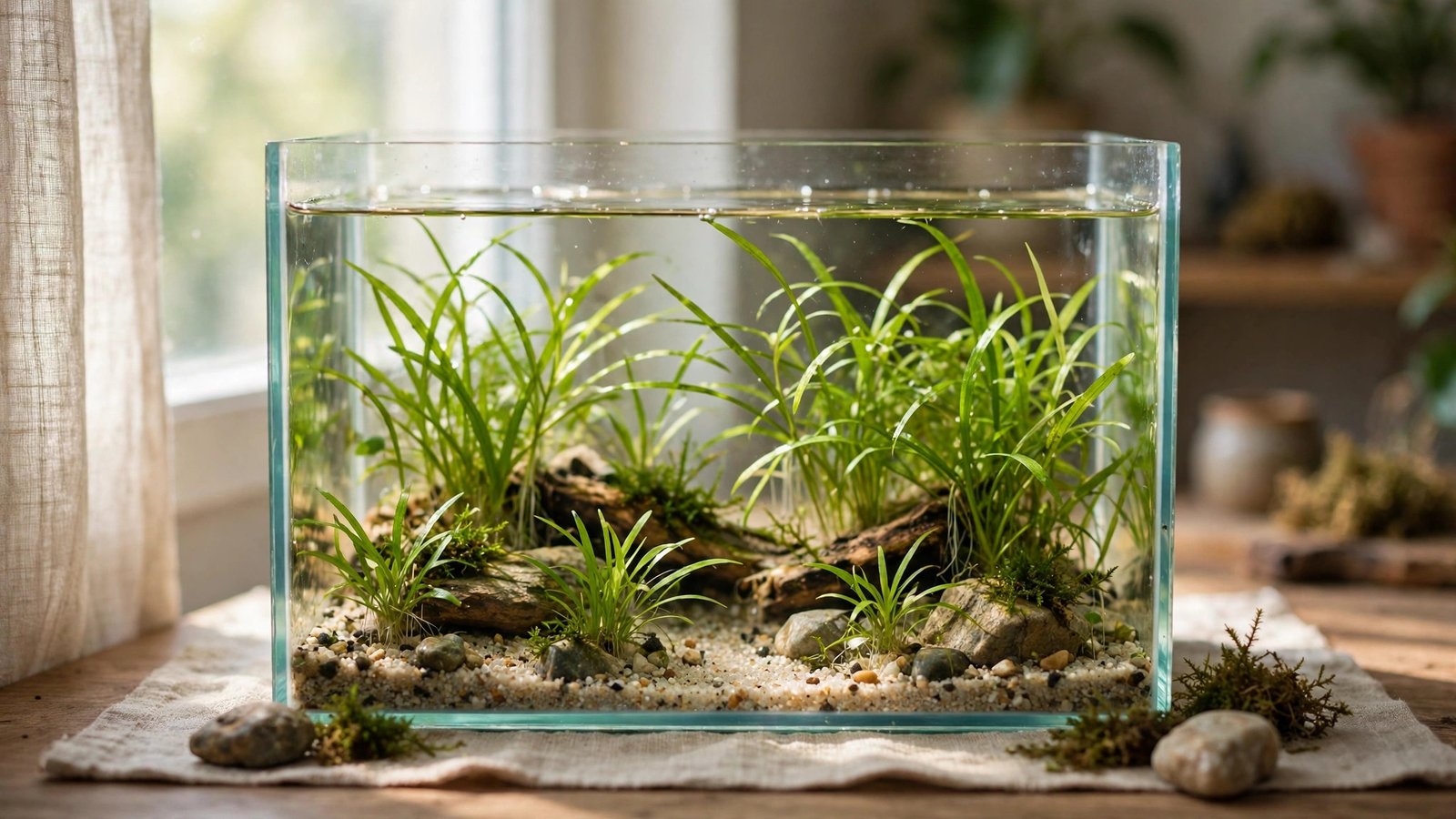
Most vallisneria is too big for the tanks most people own. Standard vals throw meter-long ribbons across the surface and shade everything below — beautiful in a 75-gallon, a menace in a 10-gallon. Vallisneria nana care is the answer for everyone else: the dwarf val, topping out at 5–20 cm, and one of the best plants for a planted aquarium that happens to be small. This guide shows you how to plant it without rotting the crown, keep its runners in check, and grow a dense stand with no CO2.
Vallisneria nana care: the small-tank playbook
The name "nana" does what it promises. Where tall vals send 60–100 cm blades cascading across the surface, Vallisneria nana produces short, bright-green ribbons about 3–5 mm wide that stay vertical — a miniature underwater meadow. It tolerates a wide temperature and pH band, grows in plain gravel once it has root nutrition, and needs no CO2. It ranks comfortably alongside the easy, low-tech aquarium plants for beginner community tanks.
Why dwarf val beats tall val in a nano tank
Tall vals don't just look oversized in small tanks — they misbehave. Their blades reach the surface, fold over, and block light to everything beneath, stalling carpets and inviting algae on lower leaves. V. nana never does this; its blades stay vertical and self-contained, so it works as a true background plant at 15–20 gallons and a striking midground grass at 40+ gallons. A nana stand also gives fish genuine shelter — shy species spend more time out when grass is a dart away. It's a strong pick among aquarium plants for a fish tank where the livestock, not the contest scape, is the point. For the full family picture, see the broader Vallisneria genus guide, or contrast it with Giant Vallisneria, which wants a tank at least 24 inches tall to be happy.
Planting: the crown rule
Get this one detail right and 90% of "my val died" stories disappear. Vallisneria grows from a crown — the pale knot where roots and leaf bases meet. The crown must sit exactly at the substrate surface, never buried. Buried crowns rot within days, and the plant collapses leaf by leaf while the roots still look fine.
- Use 2–3 inches (5–8 cm) of substrate. Fine gravel, sand, or aquasoil all work; push one root tab 1 inch below each plantlet.
- Separate the pot into plantlets of 3–5 leaves each, spaced 1–2 inches (2.5–5 cm) apart.
- Push the roots in, then release the crown right at the surface. Brush away substrate that clouds up over it.
- Expect a sulk: transplanted vals yellow for 1–2 weeks while growing new roots. Don't move them to "check" — watch for fresh green leaves emerging from the center.
Runner control in small footprints
Nana spreads via horizontal runners, each node raising a daughter plantlet. In a big tank that's a feature; in a 10-gallon the plant can own the tank in two months. The fix is monthly: during water changes, find runners heading where you don't want them, snip the runner 1–2 cm from the daughter plantlet, and lift the whole daughter out. Never pull by the leaves — you'll yank the mother's roots too. Keep no more than one plantlet per 4 square inches (~25 cm²) of background in nano tanks, and trade the excess — dwarf val plantlets are easy to give away.
Never trim the blades
This is the second-most-common way beginners kill a val. A vallisneria blade is one long leaf from crown to tip. Cut it and the blade doesn't heal — it dies back from the cut, turning translucent and then mushy. A heavily "trimmed" plant spends weeks recovering instead of growing.
If blades are too long for the spot, you don't have a pruning problem — you have a placement problem. Move the plantlet, thin the stand, or trade it for a shorter grass. When old leaves yellow naturally, trim at the base instead: follow the blade down to the crown and snip it flush.
Parameters: what nana actually wants
| Parameter | Target | Notes |
|---|---|---|
| Temperature | 20–28 °C (68–82 °F) | Thrives at typical tropical room temps |
| pH | 6.5–8.0 | Adapts; grows well in soft or hard water |
| GH | 3–15 dGH | Very tolerant — easier than tall vals in hard water |
| Light | 30–50 PAR (low–medium) | More light = faster spread; high light invites algae on blades |
| Substrate | 2–3 in deep | One root tab per plantlet every 2–3 months |
| Water changes | 25–30% weekly | Keeps nitrate in the 5–20 ppm range nana prefers |
Note what isn't on the table: CO2. Nana pulls carbon from the water column efficiently enough that injection is optional. Add it and runners spread faster — only a benefit when filling a big tank quickly. For a typical nano setup, skip it and spend the money on root tabs.
Propagation and the timeline to a full stand
Propagation needs no technique: let runners run 6–8 weeks, divide the clump into plantlets of 3–5 leaves, and replant them 1–2 inches apart in bare areas. Each division establishes in about two weeks and starts its own runners by week six. A realistic timeline: sulk for 1–2 weeks, active growth from week 3, first runners in weeks 4–6, and a closed stand by week 8–12. If nothing has grown by week 5, check for a buried crown, zero root nutrition in inert gravel, or liquid carbon in your dosing routine.
Frequently Asked Questions
Is Vallisneria nana a beginner plant?
Yes — it's one of the most forgiving plants you can buy. Vallisneria nana care needs no CO2, accepts low light, and tolerates a wide pH and hardness range. The only beginner traps are burying the crown and dosing liquid carbon. Give it medium light and root tabs and it largely looks after itself.
How tall does dwarf vallisneria actually get?
Typically 5–20 cm (2–8 inches) in home aquariums, with 8–12 cm most common in nano tanks. Happy plants in large tanks can stretch toward 30 cm, but it never develops meter-long surface-covering blades like tall Vallisneria species.
Can I trim Vallisneria nana if it gets too tall?
No — trimmed blades don't heal; they die back from the cut and melt. Thin the stand by removing excess plantlets, relocate it where the height works, or cut old leaves only at the crown. Persistent height problems mean it's planted in the wrong position.
Why did my Vallisneria nana melt after planting?
Usually a buried crown (it must sit at the substrate surface), transplant shock (normal yellowing for 1–2 weeks — wait for new center growth), or liquid carbon dosing, which melts vals fast. Fix the cause, trim dead leaves at the base, and the crown usually resprouts.
How fast does it spread — will it take over my tank?
Moderately: first runners in weeks 4–6, a closed stand by weeks 8–12. In a nano tank it can overrun the footprint in 2–3 months, so a monthly runner trim is part of Vallisneria nana care. Control is easy — snip the runner and lift the daughter plant.
Does it need nutrient-rich substrate or root tabs?
It's a heavy root feeder, so one root tab per plantlet every 2–3 months makes a big difference in plain sand or gravel. In active aquasoil it can run 3–6 months before needing supplementation. Root nutrition drives the runner growth that fills your stand.
The bottom line
Vallisneria nana is the val that finally fits the tanks most of us keep: short blades, no CO2, a monthly runner trim, and a meadow by the end of the season. Plant the crown at the surface, never trim the blades, skip the liquid carbon. For a tall tank's background instead, Eleocharis vivipara gives a similar swaying-grass effect at a larger scale — and Tropica's Vallisneria nana profile confirms its published parameters.