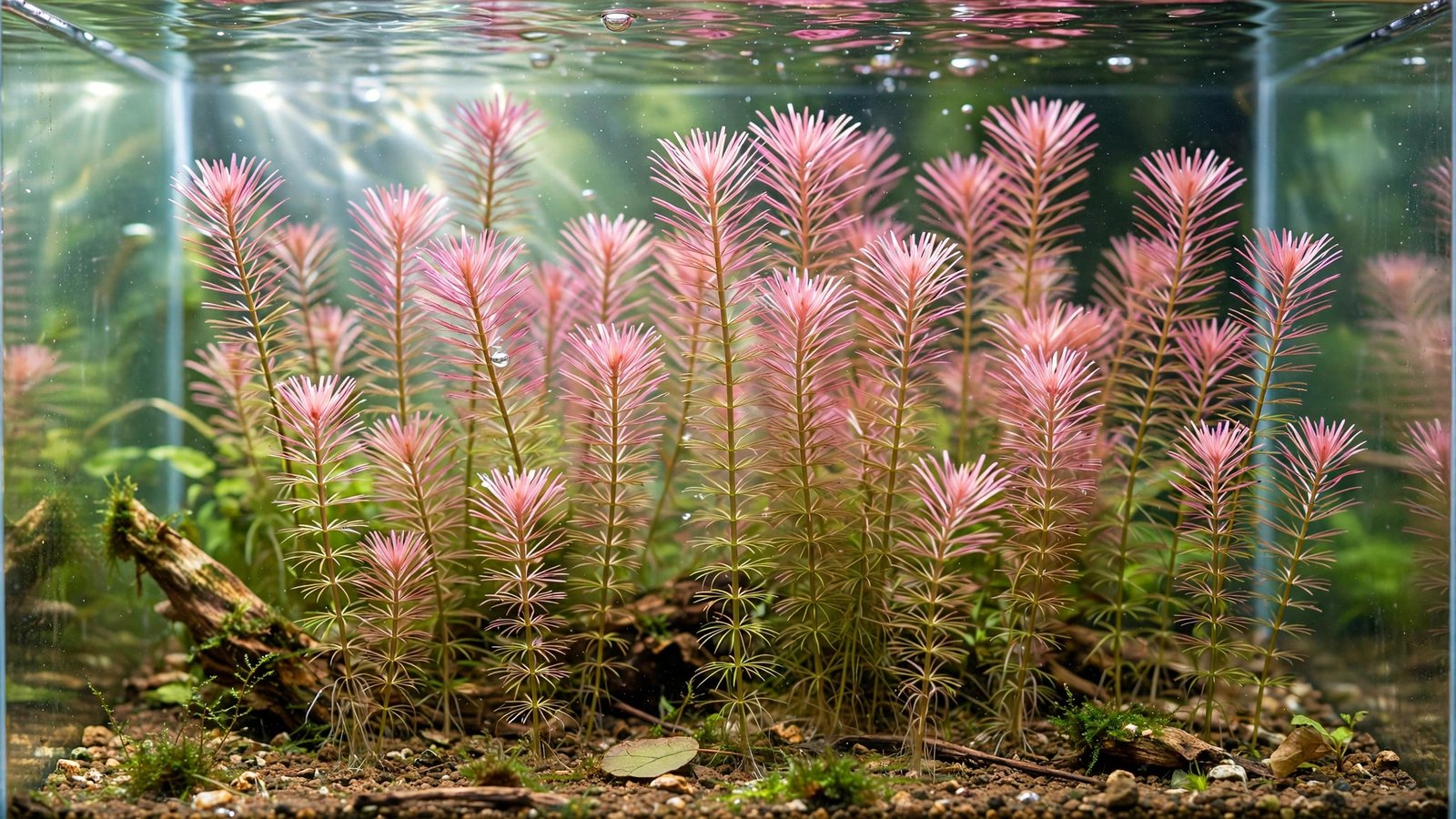
Most pink stem plants make you choose: forgiving growth or real color. One rare exception sits right in the sweet spot. Rotala nanjenshan care is what aquascapers reach for when they want fine, needle-like texture that pinks up under strong light, grows fast enough to reshape a scape in weeks, and doesn't melt if your CO2 slips for a day. By the end of this guide, you'll know exactly how to dial it in.
It ranks among the best plants for a planted aquarium if you favor delicate, textured backgrounds over broad-leaf filler. Below: light, CO2, water chemistry, planting technique, and the trimming rhythm that keeps it looking intentional instead of wild.
Rotala nanjenshan care essentials
This plant sits in the "moderate" tier: harder than its parent Rotala rotundifolia, gentler than the fussy Rotala macrandra. High light, injected CO2, and steady nutrients give you compact salmon-pink bushes; medium light and no CO2 give you a green, leggy stem that never shows off.
| Parameter | Target range | Notes |
|---|---|---|
| Light | 60–100 µmol PAR at substrate | Pink begins around 70+ |
| CO2 | 25–35 ppm (injected) | Required for compact, pink growth |
| pH | 6.0–7.0 | Soft, slightly acidic water |
| GH | 3–8 dGH | Leaves stunt above ~10 |
| KH | 2–5 dKH | Keeps pH stable |
| Temperature | 22–28 °C (72–82 °F) | Growth stalls below 20 °C |
| Nitrate | 10–25 ppm | Leaner sharpens pink; zero invites melt |
| Phosphate | 0.5–2 ppm | Deficiency stunts dark tips |
Light: what turns the tips pink
The pink coloration is the whole reason most people buy this plant, and light is the main switch. Under medium light the leaves stay olive-green; push PAR past roughly 70 µmol at the substrate and new growth comes in pink, deepening to salmon-rose at the tips over the following weeks.
Run a photoperiod of 7–8 hours at high intensity rather than blasting it for 10+ — that balance feeds the pink without feeding algae. Raise the light gradually over two weeks when you introduce the plant; sudden changes make it shed lower foliage. Our breakdown of intensities, photoperiods, and fixture choices: how much light aquarium plants really need.
CO2 and water chemistry
Rotala nanjenshan uses CO2 aggressively to build its dense, compact internodes. Without injected CO2 it stretches — internodes lengthen, leaf density drops, and the fine-leaf texture never appears. Aim for a lime-green drop checker (roughly 25–35 ppm) with flow carrying the mist across the bush. New to injected CO2? See how to set up CO2 on a planted tank for regulators, diffusion, and the first-week tuning schedule.
Soft, slightly acidic water — pH 6.0–7.0, GH 3–8 — keeps leaves narrow and color saturated. In hard, alkaline water it grows stunted and pale. An active aquasoil buffer (ADA Amazonia, Fluval Stratum, or similar) handles this automatically; on inert gravel, dose and test rather than guess.
Nutrient dosing that keeps it bushy
This is a fast stem plant, and fast growth burns nutrients quickly. Dose an all-in-one fertilizer 3–4 times per week — around 2 ml per 40 L of Tropica Specialised Nutrition, or the equivalent EI dosing. Keep nitrates at 10–25 ppm: near zero stalls growth and invites staghorn algae on the fine leaves, while very high nitrates deepen green at the expense of pink.
Keep iron steady around 0.1–0.2 ppm — consistent, not megadosed — and the salmon-pink tips intensify. Pair it with magnesium (roughly a 4:1 Ca:Mg ratio) to avoid interveinal yellowing on older leaves.
Planting in groups for the bush effect
This plant looks sparse as a single stem and spectacular as a stand. Plant 5–8 stems about 2 cm apart in a tight cluster, pushing each stem 3–4 cm into nutrient-rich substrate. They'll lean together, branch from lower nodes, and knit into the dense feathery bush it's known for. Give each group 8–10 cm of clear space so water and CO2 flow through the stand instead of stagnating inside it.
It belongs in the background of standard tanks, where its 30–50 cm height fills vertical space without shading the foreground. In nano tanks (under 40 L) it works midground if you trim every two weeks. It pairs well with other fine-textured stems — fellow fine-leaf species like Limnophila vietnam echo its texture without competing for the same palette.
Trimming, replanting, and propagation
Once a stand hits the waterline, cut the top half of each stem and replant the tops directly in front of the old bases. Tops root within a week and resume pink growth immediately; the cut bases sprout two or three side shoots each. Each cycle roughly doubles stem count: one group becomes a thick stand in 6–8 weeks.
Run this cycle every 2–3 weeks during peak growth. Let it go longer and shaded lower leaves shed, leaving bare stems under a fluffy crown. Never compost healthy trimmings; they propagate so reliably that most hobbyists trade or sell their extras within months.
How it differs from other Rotala species
The Rotala family is full of lookalikes, and mislabeled pots are common. Here's how to tell this hybrid apart:
| Species | Leaf shape | Color | Difficulty vs. nanjenshan |
|---|---|---|---|
| Nanjenshan (hybrid) | Fine, needle-like, delicate | Green to salmon-pink tips | — |
| Rotala rotundifolia | Oval, broader | Green, sometimes bronze-red | Easier — tolerates low tech |
| Rotala wallichii | Feathery needles | Deep pink to magenta-red | Harder — melts without stable CO2 |
| Rotala 'H'ra' | Small, rounder leaves | Orange-red | Similar — slightly more demanding |
The tell is in the leaf: rotundifolia's ovals look chunky next to nanjenshan's needles, wallichii's needles run a touch wider with a deeper magenta cast, and 'H'ra' reads more orange-red with rounder foliage. If your "nanjenshan" stays green in high light, compare it against Dennerle's Rotala rotundifolia database entry — you may have been sold rotundifolia.
Frequently Asked Questions
Is Rotala nanjenshan really a hybrid?
Yes. It originated in Taiwan as a hybrid, generally understood to cross Rotala rotundifolia and Rotala wallichii, named after the region tied to its discovery. That hybrid vigor is part of why it grows faster and adapts more readily than either parent — though it still needs CO2 and good light to color up.
Can Rotala nanjenshan grow without CO2 injection?
It survives, but won't thrive. Without injected CO2 stems grow leggy with long internodes, needle leaves thin out, and the pink never develops — it stays dull olive green. For the plant sold in the photos, CO2 at 25–35 ppm is effectively required, alongside high light and soft water.
How long before it turns pink?
Expect 2–4 weeks after planting for new growth to show pink, assuming PAR above ~70 at the substrate, injected CO2, and steady nutrients. Emersed-grown farm leaves rarely color up — judge progress by the fresh tips emerging underwater, not the foliage it arrived with.
Why is the bottom of my Rotala nanjenshan losing leaves?
Bare lower stems usually mean the stand is shading itself, flow isn't carrying CO2 into the bush's middle, or nitrate has bottomed out. Trim and replant the healthy tops, space stems wider, and keep nitrate above 10 ppm with the drop checker lime-green through the whole photoperiod.
What's the difference between Rotala nanjenshan and Rotala 'Bonsai'?
Different plants. Rotala 'Bonsai' (actually Ammannia bonsai) has small round leaves, stays compact, and suits the midground or foreground. Nanjenshan has true needle leaves, grows 30–50 cm tall, and belongs in the background — and it grows considerably faster than bonsai.
The verdict on Rotala nanjenshan
Rotala nanjenshan rewards strong light, steady CO2, and a trimming routine — and asks for almost nothing else. Plant a group, keep nutrients flowing, cut and replant the tops every few weeks, and within two months you'll have a salmon-pink thicket that photographs like a professional scape. Already running high-tech? This is one of the easiest background upgrades you'll ever make.