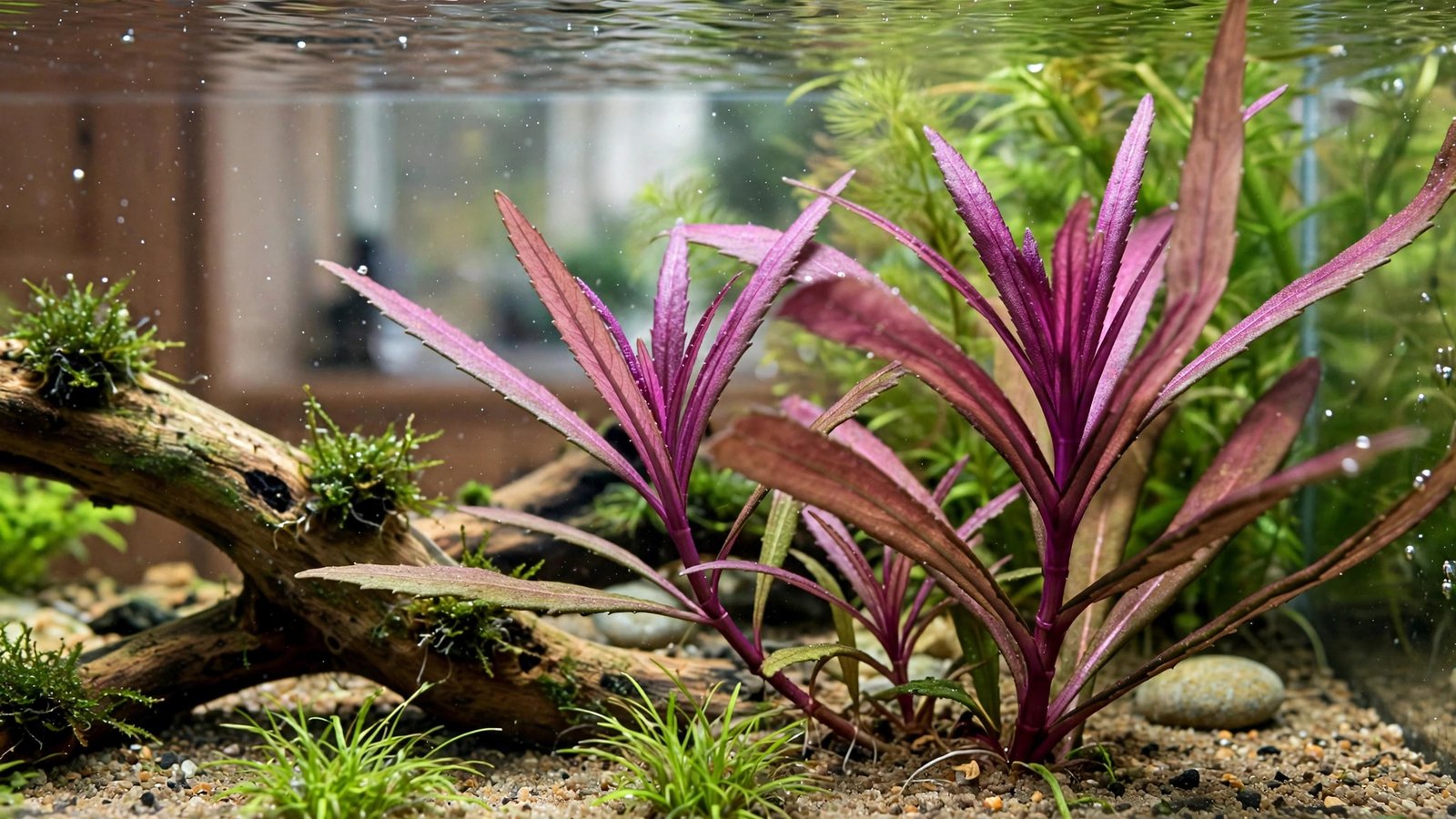
There is a moment most aquascapers remember: the first time they saw a stem plant blush purple from stem to leaf tip. That plant is Pogostemon Kimberley — an ADA-associated cultivar with ruffled, almost crimped leaves and stems that run genuine violet under the right conditions. It sells out within hours whenever retailers restock it, and until now no dedicated care guide existed anywhere online. Pogostemon Kimberley care is demanding, but every demand makes sense once you see how the plant spends its energy. This guide gives you the full recipe to earn it a place among the best plants for a planted aquarium — and keep it pink.
Pogostemon Kimberley care: light, CO2, and nutrients
Kimberley is a CO2-dependent stem, full stop. The retailers that carry it list CO2 injection as a requirement rather than a recommendation, and the plant agrees. In a low-tech tank it survives a few weeks on stored energy, then sheds its lower leaves, develops a glassy stem, and melts. Everything below assumes a properly set up CO2 system for a planted tank running a full hour before lights-on.
Light is what paints the plant. At 40–60 PAR Kimberley grows green and serviceable, which surprises buyers expecting violet. Push it to 80–120 PAR at the substrate and transformation starts at the growing tips within 10–14 days: new leaves emerge pink-edged, and mature stems take on the purple this cultivar is famous for. Raise intensity in 10% weekly steps rather than blasting full power on day one.
Nutrition is the third leg. Kimberley feeds from both roots and water column, so plant it in nutrient-rich aquasoil and dose an all-in-one liquid fertilizer weekly at the label rate. Stem plants with this metabolism punish lean dosing fast — read up on how stem plants respond to fertilizer and which nutrients matter most before dialing in your routine. The color recipe most growers land on: nitrates 10–20 ppm, phosphates 1–2 ppm, and supplemental iron (0.1–0.2 ppm weekly) to keep the pinks vivid.
Water parameters and substrate
Kimberley comes from soft, slightly acidic water and colors best when you recreate it. Stability beats perfection — introduce it only once your tank is mature and CO2 is dialed in.
| Parameter | Target range |
|---|---|
| Temperature | 22–26°C (best color at 23–24°C) |
| pH | 6.0–7.0, lowered by CO2 alone |
| GH / KH | 3–8 dGH / 1–4 dKH |
| Nitrate | 10–20 ppm (zero starves it) |
| Phosphate | 1–2 ppm |
| Iron | 0.1–0.2 ppm weekly |
| Water changes | 30–50% weekly |
Substrate deserves emphasis. Inert gravel grows Kimberley only with root tabs at every cluster plus disciplined liquid dosing — and even then it runs slower and paler. A 5–8 cm bed of active aquasoil buffers pH and feeds roots directly — which is why nearly every successful grower uses it.
Planting and propagation
Rinse off all rockwool or gel, separate the stems, and strip leaves from the bottom 3–4 cm of each. Plant 2–3 cm apart and 3–4 cm deep with tweezers, in a staggered cluster of 5–9 stems. Tight bunching shades the lower stems and invites bare-bottom syndrome — give each stem its own light.
Propagation is the easy part. Kimberley roots readily from cuttings and throws side shoots from leaf nodes within a week or two of trimming. Snip a healthy top 8–10 cm long and plant it beside the mother stems; it roots in 7–10 days under CO2. Leave trimmed stems in place and each cut node typically pushes two new shoots, turning one stem into a bush over a month.
Give it open light — a Pogostemon stellatus 'Octopus' thicket behind it will steal both light and color. At 20–35 cm it suits a midground cluster in 60 cm-plus tanks, or background texture where ruffled leaves catch the light.
Trimming for color and bushiness
Kimberley grows 2–4 cm per week under good conditions, so trim every 2–3 weeks in a high-energy tank. Cut 5 cm above the substrate with sharp scissors; clean cuts heal in days. Never trim more than half the cluster at once.
Note: the base of an untrimmed stem slowly loses purple as the plant feeds the growing tip. That is normal, not a deficiency. Regular topping resets the clock. Compared with the needle-fine Pogostemon erectus, Kimberley's broader ruffled leaves forgive slightly uneven trims — the bush still reads as lush.
Troubleshooting: melting, green stems, and legginess
Most failures fall into four patterns, each with a specific fix:
- Melting in week one. Transition shock from emersed shop growth, or CO2 not truly reaching 25 ppm. Confirm the drop checker is lime green during the photoperiod and wait — submerged growth often appears from the base within 10 days.
- Stays green, never purples. Insufficient light or unstable CO2. Push toward 100+ PAR and verify distribution with a drop checker at the far end from the diffuser.
- Bare lower stems. Under-trimming plus shading. Trim more often, space stems wider, and replant the tops.
- Stunted, twisted new growth. Calcium/boron shortage or CO2 fluctuation. Keep GH at 3 dGH or above, dose consistently, and start CO2 an hour before lights.
Algae on the leaves is a warning light, not a plant disease — the light/CO2/nutrient balance has tipped. Never starve the tank to fix it; confirm CO2 is stable, keep the weekly water change, and shorten the photoperiod to 7 hours while plant mass builds.
How it compares to its cousins
The Pogostemon genus is a useful difficulty ladder. Pogostemon helferi (downoi) is the easy foreground rosette. Pogostemon erectus sits in the middle: a fine-needled stem that wants good light but tolerates leaner setups. Kimberley is the demanding sibling — everything erectus needs, plus richer feeding and stricter CO2, in exchange for color neither can touch. If you have grown erectus, you have most of the skills; Kimberley just removes the margin for error.
Tropica's aquarium plant database documents related species with honest difficulty ratings — a useful reality check before buying any demanding stem.
Frequently Asked Questions
Is Pogostemon Kimberley hard to keep?
It is moderate–difficult, not impossible. The difficulty comes from non-negotiable requirements: pressurized CO2 at 25–30 ppm, 80–120 PAR of light, and consistent feeding. If your tank already runs high-tech, Kimberley is a straightforward addition. In low-tech it will not survive long-term.
Can you grow Pogostemon Kimberley without CO2?
Not successfully. Every retailer that stocks it lists CO2 as required, and growers consistently report melting or stalling within weeks in CO2-free tanks. Liquid carbon is no substitute — treat pressurized CO2 as part of the purchase price.
Why did my Kimberley turn green instead of purple?
Green growth means a healthy but under-lit or under-gassed plant. Purple and pink pigments only develop under strong light (80–120 PAR at the substrate) with stable CO2 all photoperiod. Allow 10–14 days after correcting light and CO2 — color appears in new growth first, never in old leaves.
How fast does Pogostemon Kimberley grow?
Expect 2–4 cm per week under high light and CO2, reaching 20–35 cm tall. That is medium speed — fast enough to need trimming every 2–3 weeks, slow enough to shape deliberately. Growth nearly stops below 22°C or when CO2 dips under 20 ppm.
Where should I plant it in the aquascape?
Midground cluster in tanks 60 cm or longer, background in smaller tanks. Plant 5–9 stems 2–3 cm apart where faster growers will not shade them. Its ruffled texture and purple tones make a natural focal point — leave open space in front so the color reads across the room.
Final thoughts
Kimberley asks a lot and gives a lot: steady CO2, strong light, and consistent feeding repay you with violet stems, ruffled leaves, and pink tips no other stem offers. Keep the trims regular, replant the tops, and you will know exactly why it sells out.