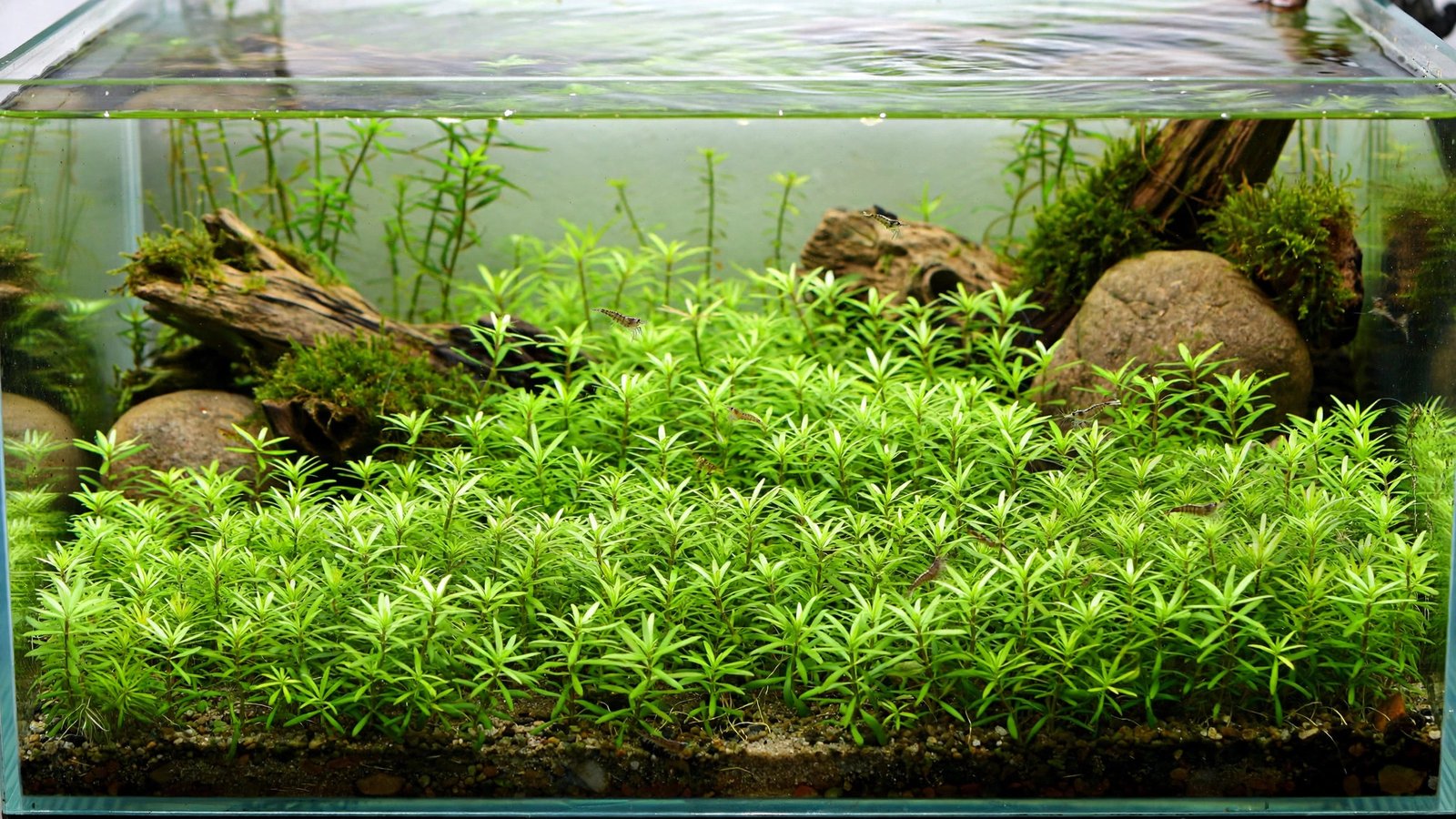
Look down at a well-grown stand of Limnophila sp. "Vietnam" from above, and you will see the trick that makes this plant special: every shoot tip is a perfect little star, a whorl of serrated leaves radiating symmetrically. Then look at how it is planted — as a low creeping cushion in the foreground of one tank, and as a dense midground bush in another. Limnophila Vietnam care is really about learning to steer that choice, because this rare Vietnamese stem plant will happily do either if you trim it the right way. Get the training wrong and you end up with the classic complaint: a leggy, bare-bottomed stem that looks nothing like the trade photos. This guide covers the full method — light, CO2, iron for the purple tips, whorl-trimming, and week-by-week timelines — so yours looks like one of the best plants for a planted aquarium should.
What makes Limnophila "Vietnam" different
Limnophila sp. "Vietnam" (trade code ADA IC419) is a relatively new addition to the hobby, circulated through tissue culture and sold by shops like Buce Plant and Splashy Fin in cup-sized portions. Trade listings call it a rare and new variety, and the regular "sold out" banners tell you the hobby has noticed.
Do not confuse it with its larger cousins. Limnophila aromatica is a tall background stem; Limnophila hippuridoides is a broad-leafed midgrounder. "Vietnam" stays short and compact, creeping along the substrate into pillows or ground cover — and its one superpower is obedience: unlike many stems with a single "right" placement, this one takes direction and keeps it.
Limnophila Vietnam care: the numbers that matter
Keep it inside these parameters and it grows compact, starry, and colorful; drift outside them and it stretches and fades fast.
| Parameter | Target range | Notes |
|---|---|---|
| Light | Medium–high to high | High light drives compact growth and purple tips |
| CO2 | 20–30 mg/L | Recommended; liquid carbon alone is not enough for best form |
| Temperature | 20–28 °C (68–82 °F) | Tolerates 15–30 °C but colors best in the middle |
| pH | 6.0–7.5 | Soft to moderately hard water |
| Substrate | Nutrient-rich | Aquasoil or soil capped with sand; root tabs under lean substrates |
| Nitrate | 10–20 ppm | Steady levels; avoid starvation dips |
| Phosphate | 1–2 ppm | Keeps stems dense rather than wispy |
| Iron / micros | Weekly per bottle dosing | The color lever — see below |
Plant a cup in clusters of 3–5 stems, spaced 3–4 cm apart, anchored firmly with tweezers. Dense initial planting is the biggest factor in speed — the creeping habit fills gaps sideways. Give it 2–3 weeks of steady CO2 and ferts before judging; fresh cups spend week one rooting.
Light and CO2: the non-negotiables
Light is the main control dial. Under medium–high to high light, internodes stay short, whorls stack tightly, and shoot tips blush reddish-purple. Under weak light it stretches upward, drops lower leaves, and never colors up.
CO2 is the second dial. It grows without injected CO2, but wants a real carbon supply for compact, rapid growth and bright foliage. Set up CO2 for your planted tank before planting if you want a carpet — without it, carpets stay thin and the plant reaches for the surface. Aim for a steady 20–30 mg/L; fluctuations hurt more than a slightly lower steady level.
Feeding for color: iron and micronutrients
The star tips turn reddish-purple under high light, but light alone does not finish the job — the plant needs iron and a full range of micronutrients to build those pigments. Dose a complete all-in-one liquid fertilizer on schedule and watch new growth: pale or yellow-green tips mean micros are running low.
If you are wondering whether aquarium plants really need fertilizer, this plant answers it: underfed specimens fade, look bare, and shed lower leaves. A nutrient-rich substrate matters just as much — a carpet's root mat feeds heavily from below. In lean sand or gravel, press root tabs into the planting zone every 6–8 weeks. Steady, moderate dosing wins; excess NPK grows algae faster than purple tips.
The whorl-trimming technique
Limnophila "Vietnam" grows its leaves in star-shaped whorls along each stem. Cut just above a healthy whorl — never mid-internode. Within 7–10 days that whorl pushes 2–4 new shoots, each with its own star tip. One cut becomes a bouquet; two rounds make a tuft; four rounds make a cushion.
For a carpet: trim low and often. At 3–4 cm tall, cut back to 2 cm, always just above a whorl. Replant healthy trimmings into thin spots — they root in days. Repeat every 2–3 weeks. Density compounds: filling at week 5, a continuous pillow by weeks 6–8.
For a bush: in the midground, let stems reach 8–12 cm, then trim the tallest back to 6–8 cm above a whorl. Leave some stems untrimmed — the bush looks best as a dome, not a flat hedge. Presentable in 4–5 weeks from an established planting.
Between trims, comb out melting lower leaves with tweezers — they will not recover, and rotting leaves under the canopy invite algae.
Propagation and keeping it going long-term
Propagation is easy: snip a healthy stem, replant it, and it roots and grows. Division works too — lift a carpet section, split it, replant the pieces — expanding one cup across a large foreground without buying more.
Long-term: a dense carpet restricts flow underneath itself, so once a month lift the canopy edges during a water change and siphon trapped detritus — five minutes that prevents the substrate rot that kills old carpets. Every 3–4 months, give a hard rejuvenation trim (back to 2–3 cm, above whorls) and replant the best tips over the old base.
If you like training unusual stems, Rotala nanjenshan — the pink needle-leaf stem — responds to the same high-light, high-CO2 discipline.
Frequently Asked Questions
Is Limnophila "Vietnam" a beginner plant?
Moderate difficulty. It forgives mistakes — bad trims regrow quickly — but it genuinely wants high light, CO2, and steady fertilization. Without those it grows leggy and disappointing rather than dying outright. For a no-CO2 low-tech tank, pick a true low-light plant instead.
Can it grow as a carpet without CO2?
Technically yes, practically no. Without injected CO2 the creeping habit stalls and stems reach upward, giving you a thin midground plant instead of a carpet. If a carpet is the goal, treat CO2 as required equipment, not an upgrade — liquid carbon alone will not produce the dense cushion.
How do I get the purple and red tips?
Three things in combination: high light, CO2 at 20–30 mg/L, and a complete fertilizer with iron and micronutrients dosed on schedule. Miss any one and new tips stay green. Color develops on new growth, so expect 2–3 weeks after correcting a deficiency.
Why is my plant tall, bare at the bottom, and pale?
That is the classic trifecta of weak light plus low nutrients. Increase light, check CO2, and make sure you are dosing a full fertilizer. Then cut the healthy tops and replant them above their whorls — the bare lower stems will not recover, so restart from the good tips.
How fast will one tissue-culture cup spread?
Planted densely in a 10 × 10 cm block with high light and CO2, one cup fills its square in about 6–8 weeks through creeping growth plus whorl-trimming. Replant trimmings from your first trim into the edges and you can cover roughly double that area in the same timeframe.
Where can I buy Limnophila "Vietnam"?
It is sold as a tissue-culture cup (ADA code IC419) by specialist retailers such as Splashy Fin and AquaArt stockists — stock sells out regularly, so watch for restock alerts. Tissue culture is the safest form: no snails, algae, or pesticides hitchhiking in.
Think like a trainer, not a gardener: strong light, steady CO2, full ferts with iron, and every cut just above a whorl. The star-tipped cushion or purple dome is yours in under two months.