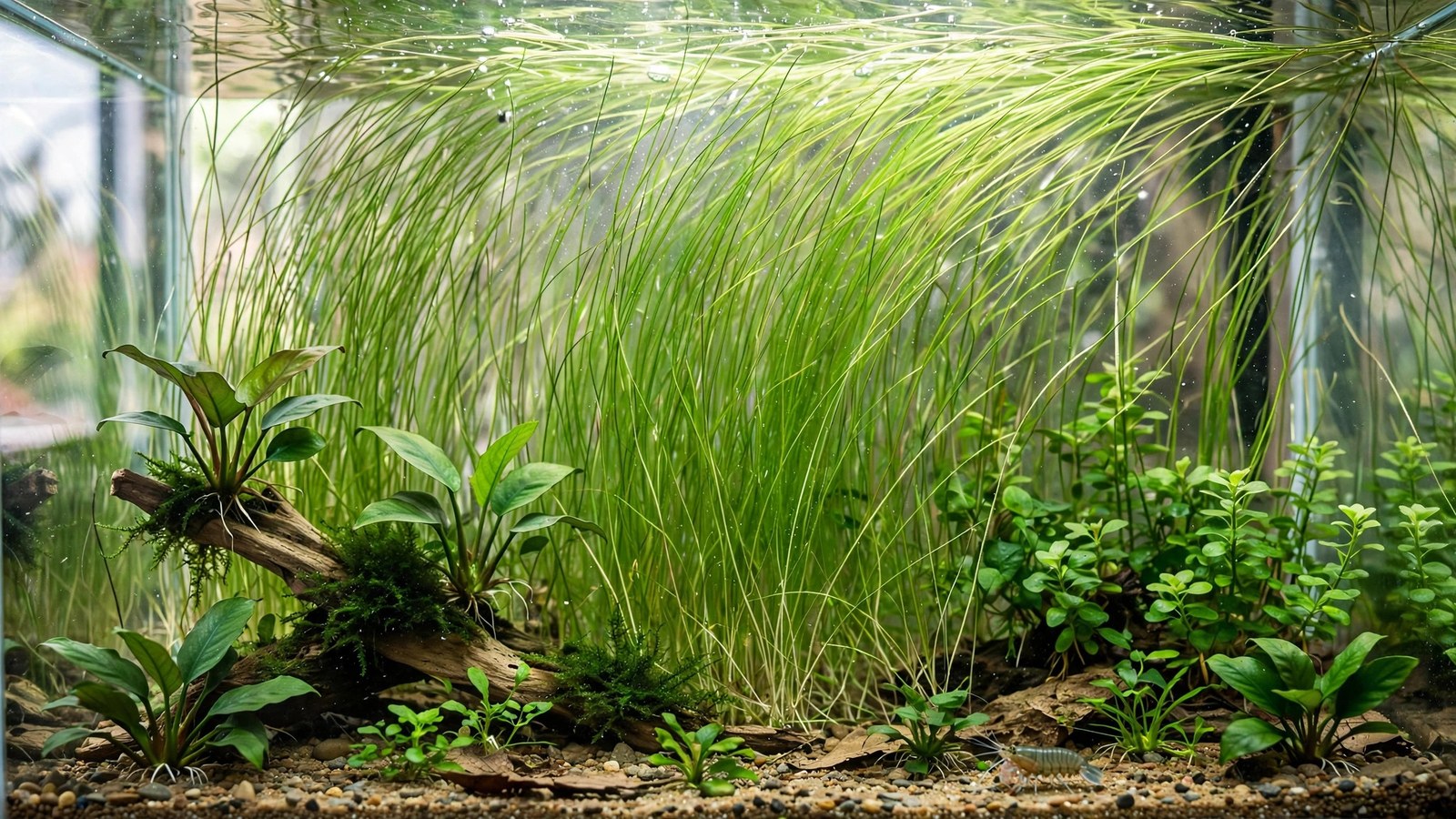
Most aquascapers buy the wrong hairgrass. They want a flowing meadow across the back glass, plant dwarf hairgrass, and end up with a flat green carpet that never rises above an inch. Giant hairgrass (Eleocharis montevidensis) is the plant they were actually after — a 20–50 cm background grass whose blades bend and sway with the filter current, and giant hairgrass care is refreshingly simple once you treat it as a backdrop, not a carpet. Set it up right and it becomes a reliable background grass in almost any tank.
This Is Not Dwarf Hairgrass: Know Your Species
The most expensive mistake in giant hairgrass care happens at the shop. Retailers sell any fine-leaved grass as "hairgrass," and most hobbyists walk home with dwarf hairgrass (Eleocharis parvula), a 3–5 cm foreground carpet. E. montevidensis is a different animal: blades barely a millimeter wide but 20–50 cm long, forming an open, see-through meadow instead of a lawn. Plant the dwarf species along the back glass and you'll stare at low green fuzz for a year; plant the giant species up front and you'll own an impassable wall.
Check the pot label before you pay. If the tag says only "hairgrass," look at the blades — montevidensis flops over the rim in loose arcs, parvula sits in a tight short tuft. Tropica's database lists it as a low-light, low-CO2 background plant at 20–40 cm (Eleocharis montevidensis), and botanically it's a North American sedge that tolerates emersed growth (Flora of North America). One potted portion — typically 8–15 blades — starts a 20-gallon background; expect some blade melt in the first two weeks as emersed-grown stock converts to its submerged form.
| Trait | E. montevidensis (giant) | E. parvula (dwarf) |
|---|---|---|
| Height | 20–50 cm (8–20 in) | 3–5 cm (1–2 in) |
| Placement | Background | Foreground carpet |
| Light needs | Low–moderate | Moderate–high (to carpet densely) |
| CO2 | Not required | Recommended for a thick carpet |
| Growth | Medium; runner-driven spread | Medium–fast under strong light |
Planting: Plugs, Spacing, and Substrate
Good giant hairgrass care starts underground. Rinse off all rock wool and divide the clump into plugs of 5–10 blades each. Push each plug in with long planting tweezers so the lower third of the blades sits buried — roots anchor from the crown, and shallow planting means plugs float free at the first water change. Space plugs 1–1.5 inches (3–4 cm) apart in a loose grid or gentle arc along the back glass; runners fill the gaps within 6–10 weeks, and wider early spacing beats a crowded row.
Substrate matters more than light for this species. Two to three inches of aquasoil gives the roots a charged bed to run through and usually carries the plant for the first 2–3 months alone. In inert gravel or sand, press one root tab per 4–6 inch radius around each plug at planting time, renewing them every 2–3 months. Don't "fix" the planting for the first two weeks — transplant melt is normal with emersed-grown stock, and every time you pull a plug up to inspect roots, you restart the clock.
Giant Hairgrass Care for Low-Tech Tanks: Light, CO2, and Feeding
This is where montevidensis earns its reputation as the low-tech scape workhorse. No injected CO2 — ambient levels plus fish respiration are enough — and 20–30 PAR of full-spectrum light for 6–8 hours a day keeps it growing steadily. That makes it a natural fit for a no-CO2 low-tech tank setup, where most background plants either stall or demand upgrades. Keep water at 68–82°F (20–28°C), pH 6.0–7.5, and it thrives.
Feeding is root-first: the blades draw most nutrition from below, so root tabs under the clump outperform heavy water-column dosing. Push one tab per clump into the substrate every 2–3 months, directly under the crown, plus a light all-in-one liquid dose once or twice a week. Pale, thin blades usually mean exhausted substrate, not low CO2 — a fresh tab revives them within two weeks. Companions with similar appetites, like Cyperus helferi for texture contrast or Limnophila sessiliflora for a feathery backdrop, share the same routine without complicating your schedule.
Trimming and Mulm: Keeping the Base Open
A dense clump is a mulm magnet. Detritus settles between the blades, rots, and the lowest 2–3 inches turn brown — the most common complaint about this plant, and entirely preventable. Every 3–4 weeks, run your fingers through the clump to lift trapped debris, then siphon it out during your water change.
Trim with long, straight aquascaping scissors, never tearing. Cut the clump to roughly two-thirds of its height in an uneven line — a perfectly flat top looks artificial — and never remove more than a third at once, since blades feed the roots. Trimming right before a water change lets you siphon the cut debris immediately. Once a month, trace the 4–6 inch runners back and either snip them or redirect daughter blades into the back row before they colonize the foreground. For a taller, broader backdrop with a similar no-CO2 appetite, Vallisneria is the classic alternative.
| Symptom | Likely cause | Fix |
|---|---|---|
| Brown tips and base | Mulm trapped between blades | Comb the clump and siphon the base |
| Melting after planting | Emersed-to-submerged transition | Wait 2–3 weeks; new blades emerge from the crown |
| Algae coating blades | Too much light, excess debris | Cut photoperiod to 6 hours; clean the base |
| Thin, pale growth | Exhausted substrate | Press fresh root tabs under each clump |
Frequently Asked Questions
Is giant hairgrass the same as dwarf hairgrass?
No. Giant hairgrass (Eleocharis montevidensis) grows 20–50 cm tall for the background, while dwarf hairgrass (E. parvula) stays 3–5 cm as a foreground carpet. They look identical as seedlings, which is why mislabeled pots frustrate buyers. Always check the species on the label before you pay.
Does giant hairgrass need CO2?
No, injected CO2 is not required — it grows steadily on ambient CO2 with low to moderate light, which is why it is a low-tech staple. Added CO2 speeds growth and thickens blades, but it is a bonus, not a requirement. Root tabs every 2–3 months do most of the feeding.
How fast does giant hairgrass grow?
Expect new blades within 1–2 weeks once transplant melt passes, and visible runner spread by week 6–10. In a no-CO2 tank, a back row of plugs fills into a continuous meadow in about 3–4 months. Warmer water (75–80°F), moderate light, and fresh root tabs push it toward the faster end.
Why is my giant hairgrass turning brown?
Brown bases and tips are usually trapped mulm, not disease. Detritus settles between the dense blades and rots, suffocating the lower leaf tissue. Comb through the clump, siphon the debris out, and repeat every 3–4 weeks to keep new growth clean.
Will giant hairgrass carpet my tank?
Not in the way you want. Untrimmed it reaches 20–50 cm and blocks the view; trimmed short it looks stubby and never forms a dense lawn. Use it as a background meadow where its height and sway are assets, and plant a true carpeting species up front instead.
Giant hairgrass rewards the aquarist who plants it once and mostly leaves it alone — space the plugs, feed the roots, groom the base monthly, and let the current do the showmanship. In a no-CO2 tank it may be the most reliable background choice you can make. For more forgiving background options that share its routine, egeria densa is worth a look alongside it.