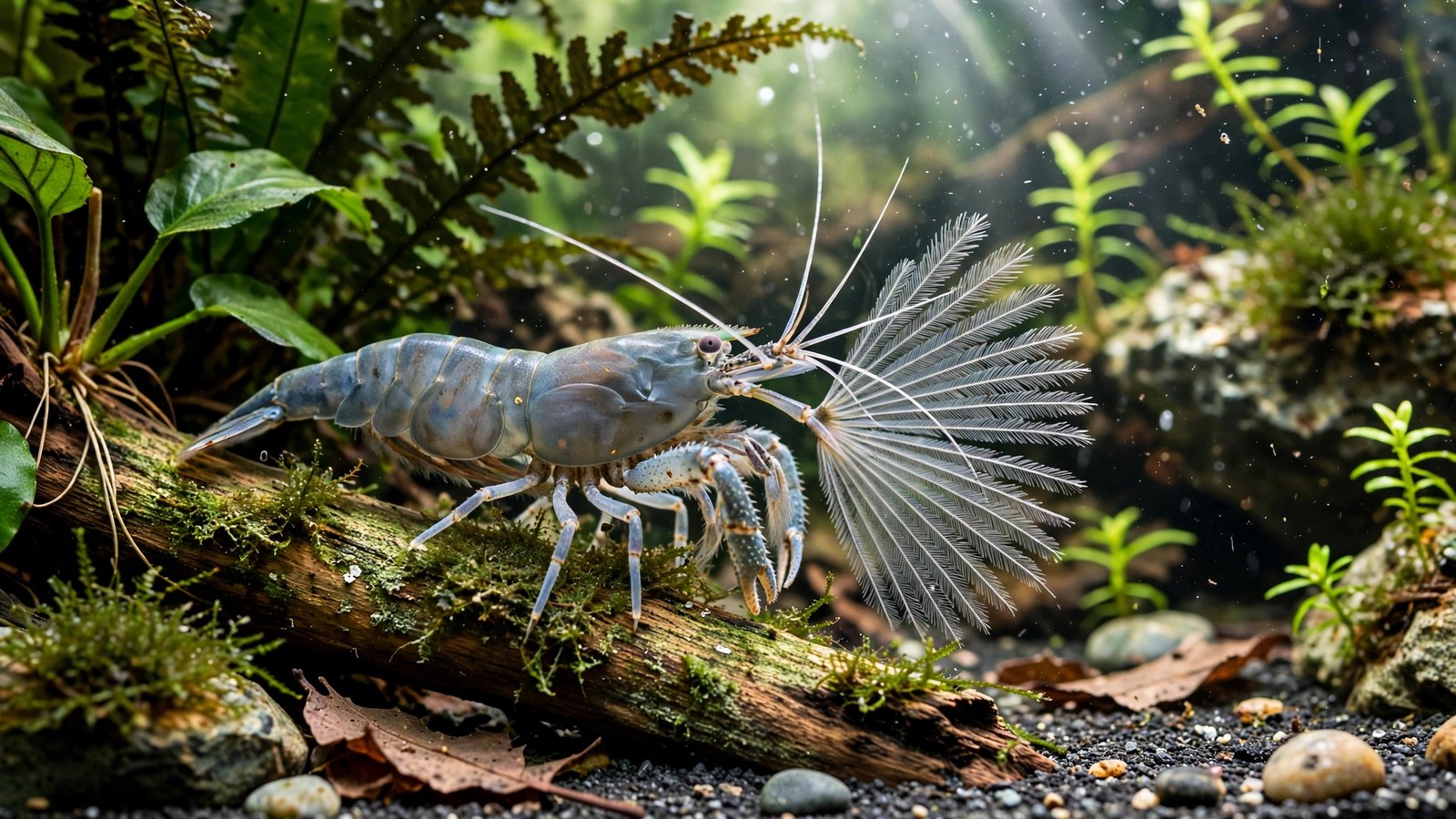
A thumb-sized arrival vanishes under your driftwood for three days, and you wonder if it died. It didn't: Atya gabonensis is the shyest giant in the hobby, a nocturnal filter-feeder that unfolds its feathered fans only after lights-out. Get vampire shrimp care right and you'll have a peaceful 5–6-inch resident for up to a decade — get it wrong and it quietly starves while your water tests perfect. Shrimp dropping without warning? Start with shrimp dying in a planted tank: causes and fixes before changing anything else.
The vampire shrimp care checklist: tank size, flow, and hides
Start with a bigger tank than the care sheets suggest. Juveniles sell at 1–2 inches, but adults reach 5–6 inches, so aim for 30–40 gallons per shrimp plus 10–15 for each additional one. A mature tank — running at least 3–4 months with stable biofilm — matters more than the exact gallon count, because these shrimp feed on what drifts through the water column.
Flow is non-negotiable. In West African rivers they perch on rocks in fast current and fan the water for hours. Reproduce that with a powerhead or by pointing your filter output across a piece of driftwood; your shrimp will claim a perch in the stream and hold its fans open like tiny satellite dishes. Add big caves, PVC pipes, and driftwood overhangs — it spends the entire day wedged into a dark crevice and emerges at night. Use sand or smooth gravel: coarse gravel can damage their delicate fans if they sweep the bottom while scavenging.
Vampire shrimp vs bamboo shrimp: don't confuse them
These two fan-feeders get mixed up constantly at the shop, and their needs differ enough that swapping them into each other's tank is a slow-motion failure. Here's how they split:
| Vampire shrimp | Bamboo shrimp | |
|---|---|---|
| Species | Atya gabonensis | Atyopsis moluccensis |
| Adult size | 5–6 inches (12–15 cm) | 2–3.5 inches (6–9 cm) |
| Activity | Nocturnal, hides all day | Day-active, perches openly |
| Minimum tank | 30–40 gallons | 20 gallons |
| Temperament | Extremely shy, armored claws look scary | Bold, smaller claws |
| Feeding | Needs target-feeding after lights-out | Grazes while you watch |
The rule of thumb: if your "bamboo shrimp" never appears during the day and it's bigger than the others, it's probably a vampire shrimp — and it needs the bigger tank and night-feeding routine below.
Feeding a shrimp that can't eat normal food
This is where vampire shrimp die in home aquariums. Their claw tips are feathered fans, not pincers — they cannot grab pellets or wafers. They catch microscopic particles drifting past. A mature planted tank provides some suspended food, but rarely enough, so plan on target-feeding 3–4 nights a week.
Use a pipette or turkey baster to squirt powdered food just upstream of the shrimp while it's fanning, with the tank lights off. Good options: spirulina powder, crushed flake ground to dust, powdered fry food, or filter-feeder products like Bacter AE. Keep doses small (a pea-sized puff): overfeeding clouds the tank, and cloudy water in a planted tank plus excess detritus will trigger a detritus worms bloom before it feeds your shrimp.
Learn the two signals. Fans spread wide in the current means a feeding shrimp; fans snapped shut with the shrimp scraping the substrate means it's starving — feed every night for a week. Chronic underfeeding is the number-one killer of this species in captivity, per the detailed husbandry records at Aquarium Breeder's vampire shrimp guide.
Molting: the danger zone
Your vampire shrimp sheds its exoskeleton every 4–8 weeks, more often when young. This is its most dangerous night: the new shell takes 24–48 hours to harden, and the soft shrimp is defenseless. Never remove the shed shell — the shrimp eats it to reclaim minerals, and the fragments break down into the mulm in planted tanks.
Molting failures trace back to minerals and stability. Keep GH between 6 and 15 dGH with water test kits built for planted tanks, and re-mineralize with shrimp-safe GH/KH+ if your tap water is soft. A pale, unbroken ring around the carapace — the white ring of death in shrimp — signals a failed molt, usually from low minerals, sudden water-change swings, or copper exposure. Keep changes gradual: even water changes that shock livestock can trigger a bad molt days later.
Tank mates and the planted tank setup
Vampire shrimp are utterly peaceful — the scary claws are a bluff, and they won't harm fry, snails, or other shrimp. Choose tank mates that return the favor: avoid puffers, large cichlids, loaches, and big predatory fish that will pick apart a freshly molted shrimp. Good company includes tetras, rasboras, otos, and corydoras, and even assassin snails in a planted tank won't bother them.
Plant heavily — the best aquarium plants for shrimp tanks give juveniles cover and cultivate the biofilm these shrimp supplement their diet with. Keep ammonia and nitrite at zero; vampire shrimp belong only in mature, fully cycled tanks, and they react badly to swings hardier livestock shrug off.
Frequently Asked Questions
Why does my vampire shrimp hide all day?
That's normal — Atya gabonensis is nocturnal and spends daylight hours wedged into caves or under driftwood. It emerges after lights-out to fan-feed in the current. Only worry if it hides at night with its fans closed; that usually means poor water quality, no flow, or too little food — check parameters and start target-feeding.
What do vampire shrimp eat in an aquarium?
Microscopic suspended particles caught with their fan-like claws. In home tanks you must supplement with powdered foods — spirulina powder, crushed flake ground to dust, fry dust, or filter-feeder products — squirted upstream of the shrimp with a pipette after lights-out, 3–4 nights a week. They cannot eat pellets, wafers, or vegetables, and a shrimp scraping the substrate with its fans is starving.
How big a tank does a vampire shrimp need?
Plan on 30–40 gallons for one adult, which reaches 5–6 inches. Bigger is always better: more water volume means more suspended food and more stable parameters through molting cycles. The tank should also be mature (3–4 months cycled), have a powerhead or strong filter output for current, and offer multiple caves or driftwood hides for daytime cover.
Can vampire shrimp live with bamboo shrimp?
Yes — they're both peaceful filter-feeders and often perch side by side in the current, and Aquariadise's vampire shrimp care sheet notes they do well with other fan shrimp. Just make sure the tank meets the vampire's needs (30+ gallons, strong flow, night target-feeding) since it's the larger, shyer, and more nocturnal of the two. Provide enough perches and hides for both.
How do I tell a molt from a dead vampire shrimp?
A molt is a hollow, translucent shell — often with the fan claws intact — while a dead shrimp looks opaque with tissue inside and gets swarmed by snails. If your parameters are stable and nothing changed, it's almost certainly a molt. Leave the shell in the tank; the shrimp eats it to recover minerals for its new armor, which takes 1–2 days to harden.
The gentle giant that hides all day
Vampire shrimp ask for three things: a roomy, mature tank with real current, powdered food delivered after lights-out, and soft-handed, copper-free maintenance through every molt. Give them that and you're rewarded with one of the longest-lived, most peaceful invertebrates in the hobby — a six-inch filter-feeder quietly fanning the water while the rest of the tank sleeps.