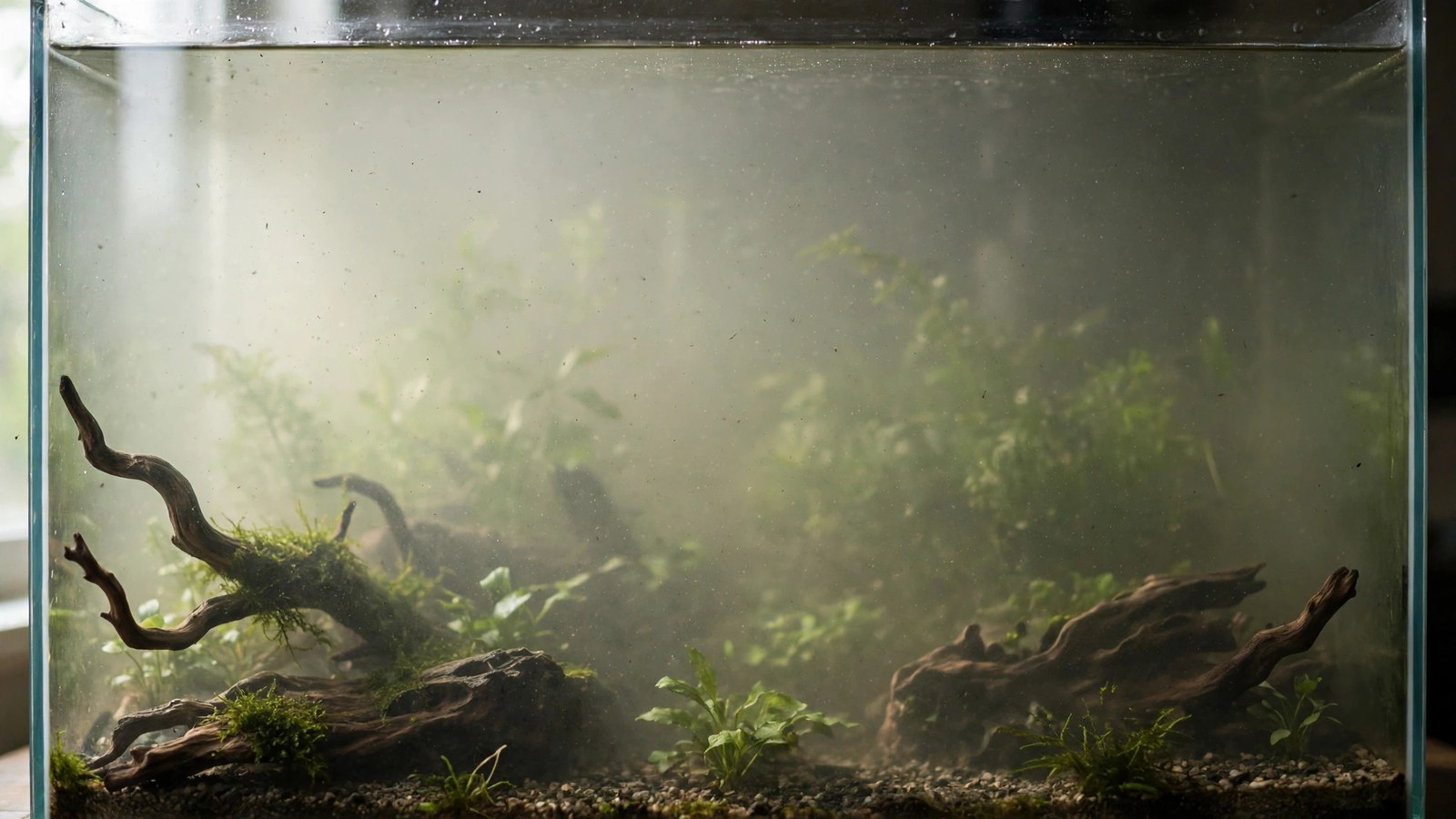
The costliest mistake with cloudy water in a planted tank is reaching for a bottle first. Most hobbyists dose a water clarifier before knowing what they are clarifying, then rip the tank apart when the bottle fails. This guide shows you how to read the water, name the cause, and fix it with a plan instead of guesswork.
Diagnose It First: What Kind of Cloudy Is Yours?
Cloudiness is a symptom, not a diagnosis. Hold white paper behind the tank and read your water like a test kit: color, timing, and smell reveal which of the seven causes you have.
| Cause | What it looks like | When it appears | Clues |
|---|---|---|---|
| Bacterial bloom | Milky white — you cannot see the back glass | New tanks; or 1–3 days after a filter clean or medication | No smell; ammonia often reads above zero |
| Substrate dust / aquasoil leaching | Grey-brown haze, heavier near the bottom | Within 24 hours of adding or disturbing substrate | No smell; settles overnight, stirs back up with movement |
| Overfeeding | White haze plus visible particles drifting | After feeding changes or new foods | Faint sour smell; oily film on the surface |
| Filter flow / media issues | Dull general haze, never quite sparkles | After media changes, reduced flow, or new filter install | Plants barely sway; surface looks glassy-still |
| Crushed coral / calcite dust | Chalky white haze | Within hours of adding coral, aragonite, or GH booster | No smell; GH and KH read higher than usual |
| Micro bubbles | Sparkly, fizzy look when you move | Right after water changes or new equipment startup | A glass of tank water clears fully in 10 minutes |
| Decaying matter | Yellowish-brown tint with floating debris | Gradual buildup; worse in low-flow corners | Swampy smell when you stir the substrate |
One rule: even a faint green tint means suspended algae, not any of these seven causes — see the 8th possibility at the end.
Cause 1: Bacterial Bloom — the Milky White Classic
A bacterial bloom is an explosion of free-floating bacteria feeding on dissolved organics — the most common cause of cloudy water in planted tanks. In a new setup, the filter colony has not matured, so waste and ammonia feed bacteria in the water column instead of on surfaces. The water turns milky white, sometimes so opaque you cannot read a thermometer through it.
Here is the part that trips everyone up: this is your tank cycling, and it is supposed to happen. The bloom collapses on its own in 7–14 days as bacteria colonize your filter media, hardscape, and plant leaves. Your job is simply not to feed it: cut feeding to once a day, only what fish finish in two minutes, change 20–30% of the water twice a week, and do not touch the filter media.
In an established tank, the same bloom can restart after an over-scrubbed filter, a course of antibiotics, or a big rescape. The playbook is identical. With livestock, test ammonia daily; above 0.5 ppm, change water every other day and dose conditioner each time.
Cause 2: Substrate Dust and New Aquasoil Leaching
Fresh substrate arrives coated in fine dust, and aquasoils also release humic substances and ammonia as they first hydrate. Stir the bed while planting and that dust goes airborne, giving the whole tank a grey-brown haze. This differs from a bacterial bloom: it looks dirtier, it is heaviest near the bottom, and it settles a little overnight only to puff back up when fish or flow disturb the bed.
The fix is mechanical. Drop a pad of fine filter floss into your filter and rinse or swap it every 48 hours — most setups clear in 24–72 hours. Do not vacuum the substrate during this window; you will just re-suspend everything. When setting up fresh, fill by pouring water over a plate laid on the substrate so you do not blast the bed apart. Note that fresh aquasoil often causes plants to melt in the first week — clear water and a little melt at the same time usually mean the aquasoil is just settling in.
Cause 3: Overfeeding
Uneaten food decays into dissolved organics that feed both bacteria and suspended particles, producing a white haze with visible specks. The signature clues: an oily film on the surface, a faint sour smell, and food settling into the substrate between cleanings. Overfeeding is the number-one cause of persistent cloudiness in otherwise mature planted tanks — the cycle is fine, but the waste load outruns it.
Fix the input before treating the symptom. Feed once daily, only what fish eat in 90 seconds, and skip one day per week. Siphon uneaten food off the substrate within an hour of feeding. Add a fast-growing stem plant or two (water sprite, hornwort) to soak up excess nutrients; cloudiness typically fades within a week once the surplus stops. Chronic overfeeding also feeds unwanted critters — if you are seeing tiny white bugs swarming leftover food, your feeding schedule is the root cause of that problem too.
Cause 4: Filter Flow and Media Problems
A planted tank needs 4–6 times its volume in turnover per hour, and clarity is the first thing to go when flow drops. Sponges clog, impellers slow, and new canister media has no bacterial colony yet. The result is a dull haze — water that never quite sparkles. If stems barely sway and the surface has gone glassy-still, your flow has dropped.
Check the output against when the filter was new. If it is weak, rinse mechanical sponges in old tank water (never tap water — chlorine kills the biofilm) and clean the impeller shaft of buildup. If you just changed media, keep some old media alongside the new for two weeks instead of swapping everything at once. For polishing, Seachem's own support team recommends adding fine filter floss, noting that clarifying agents only work when paired with fine mechanical filtration.
 ★4.8
Pawfly Filter Media Bags
Check Price on Amazon ★4.8Cause 5: Crushed Coral and Calcite Dust
Crushed coral, aragonite, and powdered GH boosters cloud water with chalky mineral dust when added dry. This appears within hours, looks chalky rather than milky, and your GH/KH tests read higher than before. It is harmless — just dissolved and suspended calcium carbonate.
Give it 12–24 hours; most mineral dust dissolves or gets filtered on its own. If it lingers, the filter-floss pad from Cause 4 handles it. Prevent repeats by dissolving GH boosters in a cup of tank water first, and rinse crushed coral in a bucket until the runoff runs clear — most bags carry far more dust than you expect.
Cause 6: Micro Bubbles
Sometimes the "cloudiness" is not in the water at all — it is air. Micro bubbles from a fresh water change, a new filter purging trapped air, or a pressurized CO2 line with a loose fitting give the water a sparkling, effervescent look. The giveaway test takes ten minutes: fill a clear glass from the tank and set it down. If the glass clears from the bottom up as bubbles rise out, you have an aeration quirk, not a water-quality problem.
After water changes, bubbles from supersaturated tap water dissipate within a few hours — do nothing. If a filter still spits bubbles after days, check for an air leak on the intake side: a loose hose barb, a cracked intake tube, or a failing seal. CO2 users should check diffuser connections instead of cranking the bubble rate — excess undissolved CO2 fogs the water and wastes gas.
Cause 7: Decaying Plant Matter and Detritus
Dead leaves, shed roots, and mulm collect in low-flow dead zones — behind rocks, under driftwood, inside carpet thickets — and decay into a yellowish-brown haze with floating debris. The smell test is decisive: stir the substrate in a back corner and sniff. A healthy tank smells like clean pond water; a detritus-loaded one smells swampy and sulfurous. This builds gradually over weeks, which is why it is easy to miss until the water looks permanently tired.
Do a deep-clean pass, not a full teardown. Siphon the substrate surface during a 30% water change, focusing on visible mulm pockets and behind hardscape. Prune all dead and melting leaves — decaying tissue is the cloudiness source and a nutrient leak that invites algae, so learn why aquarium plants melt in the first place and remove the worst offenders. The same sludge feeds detritus worms thriving in organic waste; if your glass also shows wriggling white threads, one cleanup pass fixes both. Repeat weekly for three weeks.
The 8th Possibility: Green Water Is a Different Problem
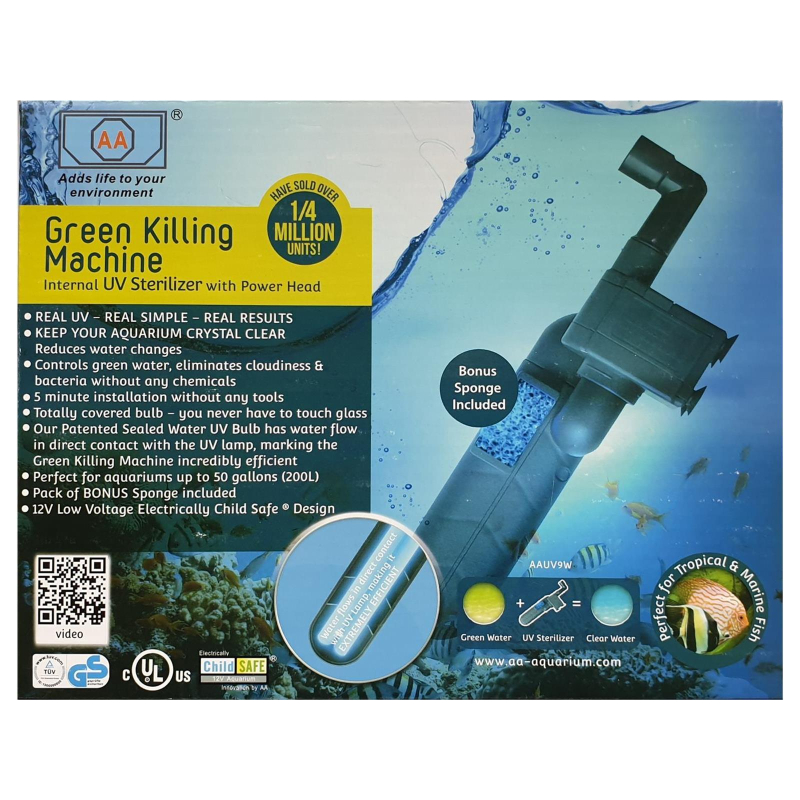
If your cloudiness has even a faint green tint — hold that white paper behind the tank — you are not dealing with any of the seven causes above. Green water is a bloom of single-celled suspended algae, and it responds to a completely different playbook: light reduction, blackout periods, and UV sterilization. Flocculants and filter floss barely dent it, and waiting it out like a bacterial bloom just gives the algae more time to entrench.
The fixes are opposites in places: a bacterial bloom wants you to leave the tank alone, while green water wants aggressive light intervention. Early green water can even masquerade as plain cloudiness — so if your "bacterial bloom" has not budged after two weeks, re-check the tint. Our guide on how to clear green water algae blooms walks through the blackout method step by step.
 ★4.4
AA Aquarium Green Killing Machine 9W UV Sterilizer
Check Price on Amazon ★4.4A 7-Day Action Plan for Cloudy Water in Planted Tanks
Once you have matched your symptoms to a cause, run this sequence rather than trying everything at once. Day 1: test ammonia, nitrite, nitrate, and pH, and write the numbers down. Day 2: cut feeding to the 90-second rule, install a fresh filter-floss pad, and do a 30% water change with dechlorinated water at matching temperature. Days 3–4: leave the tank alone — no rescaping, no media changes, no new chemicals. Day 5: swap the floss pad, siphon visible debris, and re-test. Days 6–7: if clarity is improving, keep the routine; if nothing has moved, re-check your diagnosis, because the most common "stubborn" case is misidentified green water or an unrinsed mineral addition.
Resist the urge to fertilize your way out of trouble — extra liquid fertilizer during a cloudiness episode feeds suspended bacteria and algae alike. If plants show pale new growth or pinholes, that is a separate issue: check our guide to spotting nutrient deficiency signs early rather than changing two variables at once. The UK Aquatic Plant Society's cloudy-water diagnostic discussion has real-tank examples of each cause.
Frequently Asked Questions
How long does cloudy water last in a new planted tank?
A bacterial bloom in a new tank typically clears in 7–14 days once the filter colony establishes, though heavily stocked tanks can take three weeks. Substrate dust clears within 24–72 hours of installing a filter-floss pad. If milkiness persists past three weeks with zero ammonia and nitrite, re-check the diagnosis — it may be mineral dust or early green water.
Will a UV sterilizer clear cloudy water?
Yes for bacterial blooms and green water — UV sterilizers kill free-floating organisms and often clear the tank within 48–72 hours. But they do nothing for substrate dust, mineral precipitation, or micro bubbles, and they treat the symptom rather than the cause. Use UV only after identifying the cause; otherwise the cloudiness returns as soon as you switch it off.
Should I do a water change during a bacterial bloom?
Yes, but keep them modest: 20–30% twice a week. Small changes dilute the organics feeding the bloom without starving the developing filter colony. Massive water changes remove too little of the free-floating bacteria to matter while stressing livestock and plants. The exception is elevated ammonia: above 0.5 ppm with fish in the tank, change water every other day.
Why does my water get cloudy a day after every water change?
This pattern usually means one of three things: micro bubbles from supersaturated tap water (clears on its own in hours), mineral dust from a GH booster added dry (dissolve it first), or a bacterial bloom triggered by chlorine killing filter bacteria. That last one is serious — if you skip dechlorinator, every water change restarts a mini-cycle.
Are water clarifiers safe for planted tanks?
Polymeric flocculants like Seachem Clarity are generally plant- and livestock-safe when dosed per the label — they clump fine particles so the filter can catch them. But they are useless against bacterial blooms and green water, and they fail entirely without fine filter floss to trap the clumps. Fix the underlying cause first — a clarifier is a finishing tool, not a diagnosis.
My tank is cloudy and my plants are melting at the same time. Related?
Often, yes. New aquasoil releases ammonia and fine dust that cloud the water while emersed-grown plants shed old leaves — both are normal first-week events that resolve together. But simultaneous cloudiness and melt in an established tank signals a real problem, like a crashed filter cycle. New tanks also commonly get brown diatom blooms that follow the cloudy phase — expect brown dusting on leaves in week two or three.
Clear Water Is a System, Not a Product
Every cause in this guide traces back to the same triangle: waste input, bacterial processing, and mechanical removal. Feed less than you think, give your filter bacteria a stable home, and keep fine mechanical filtration in place — and cloudy water stops being a recurring emergency and becomes a rare, brief event you can name and fix in minutes. Clear water also means more light reaching the leaves, which is the cheapest plant-growth boost you can buy.