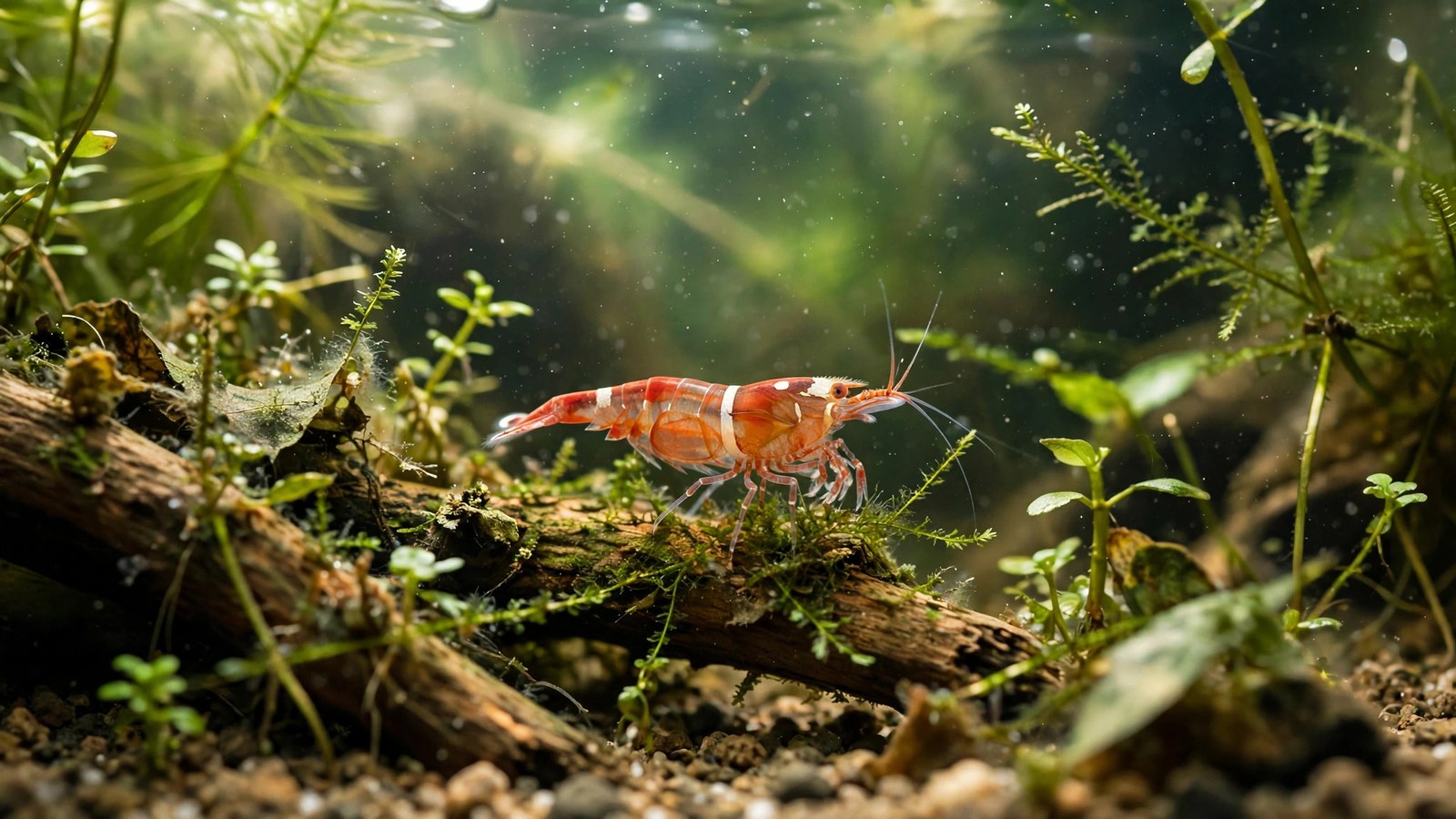
You find a shrimp on its side with a pale band circling its body like a cracked ring — and by morning it's dead. That band is not a disease or a parasite, and no medication fixes it. It's a failed molt: your shrimp died trapped in its own old shell. If you're seeing the white ring of death shrimp problem in your tank, here's how to read the signs, find the cause, and stop it hitting the rest of your colony.
white ring of death shrimp: What the Sign Really Means
To grow, a shrimp must shed its exoskeleton: the shell splits at a fault line behind the head, the shrimp swells the soft new shell underneath, and wriggles free. When it fails, the shell cracks but the body stays stuck — that split line is the white band. The white ring of death is a molt that started and never finished.
This is different from shrimp dying in a planted tank for other reasons — old age, starvation, or predation all leave different evidence. The white ring is molting-specific: the victim lies curled on the substrate, band just behind the head. Berried females and juveniles molt most, so they show it first. One dead shrimp with the ring is a warning; two within a month is a tank-wide problem.
Why Shrimp Get Stuck in Their Shell
Shedding a shell is mineral chemistry, and nearly every cause traces back to it:
- GH too low. The new shell forms thin and weak from mineral starvation. Classic in tanks running straight RO or soft tap water with no remineralization.
- Sudden parameter swings. A big water change with different GH, KH, or temperature shocks the shrimp mid-molt-cycle. The ring often appears 24–48 hours after a "routine" change.
- GH too high. Hard tap water or overdosed remineralizer makes the old shell too rigid to crack cleanly.
- Calcium-poor diet. Tanks fed only algae and detritus slowly run a colony into molting trouble — shrimp need dietary calcium to harden the new shell.
- Very acidic, zero-KH water. Shells weaken from the outside while molts fail from the inside. Mostly a neglected-Caridina-tank problem.
Bacteria and parasites are absent from this list — medicated foods fix nothing here, and panicked dosing usually makes the water chemistry worse. If the ring keeps appearing, reach for a liquid GH/KH test kit, not the medicine shelf.
GH and KH Targets for Neocaridina vs Caridina
Neocaridina and Caridina evolved in very different waters. Hit your species' real target, not a compromise:
| Parameter | Neocaridina (cherry shrimp) | Caridina (crystal red / bee shrimp) |
|---|---|---|
| GH | 6–10 dGH | 4–6 dGH |
| KH | 2–6 dKH | 0–1 dKH |
| TDS | 150–250 ppm | 120–180 ppm |
| Remineralizer | GH/KH+ mineral salt | GH+ only (raises GH, leaves KH near zero) |
For Caridina, remineralize RO water with a dedicated bee-shrimp mineral: about one level spoon (~3 g) per 20 litres gives roughly 6 dGH, per the manufacturer's Bee Shrimp Mineral GH+ dosing guide — mixed in a separate bucket first. For Neocaridina, a GH/KH+ salt adds the carbonate hardness they like. Test with your kit before it touches the tank.
What to Do When You Spot the White Ring
Be honest: once the band is visible, that shrimp is almost certainly already dying — the molt stalled hours ago. Your goal is stopping the next molt from failing:
- Leave the shrimp alone. Don't net it or try to peel the shell off. Handling a mid-molt shrimp kills it faster than the failure would.
- Test GH, KH, and temperature now. Anything outside your species' band is your prime suspect.
- Stop water changes for 7 days. Another change now is another swing on top of the one that just killed a shrimp. Exception: if ammonia or nitrite is detectable, do a 10% change with matched water — poison beats stress.
- Darken the tank. Dim the light for 24 hours, skip a feeding, stop fiddling. Molt-stressed shrimp do better in still, dark water.
- Remove the body within 12 hours. Tankmates eating it is normal calcium recycling — but pull the remains before they rot.
- Fix the root cause slowly. Shift GH by 1–2 degrees per weekly change, over two to three weeks — fast corrections kill more shrimp than the original problem.
A stalled shrimp sometimes finishes the molt within 24–72 hours in dim, undisturbed water. Give it that quiet chance — but the real fix is for the colony, not the individual.
Preventing the White Ring for Good
Shrimp die of white ring when their world changes faster than their shells can adapt — your whole job is sameness:
- One water recipe, forever. Remineralized RO water built to the same target every week beats any tap-water guess. Measure every batch until it's muscle memory.
- Small, slow changes. 15–20% weekly, dripped back over 30–60 minutes for sensitive colonies, within 1°C. Post-change problems usually share a root with plants melting after a water change: the change water didn't match the tank.
- Feed for shells. Blanched spinach, kale, or nettle twice a week plus a proper shrimp food supplies dietary calcium. A small piece of cuttlebone behind the filter works as slow-release background — added once, never as a crisis dose.
- Keep magnesium in the mix. GH is calcium and magnesium; good remineralizers include both. The plant-side mirror: magnesium deficiency and calcium deficiency in aquarium plants.
- Watch berried females and new stock. A female molts right after her eggs hatch — the riskiest molt — so go extra gentle in hatch weeks. New shrimp molt within days of arrival; drip-acclimate 1–2 hours.
Frequently Asked Questions
Can a shrimp survive the white ring of death?
Rarely, but it happens. Dim the lights, stop water changes for a week, and don't touch it — some shrimp complete the molt within 24–72 hours. But most stalled molts are beyond recovery. Treat any survivor as a bonus and focus on fixing tank parameters for the rest of the colony.
Is the white ring of death contagious?
No — it's an individual molting failure caused by water chemistry, diet, or stress, not a disease. Tankmates can't catch it. But several rings within weeks means all your shrimp are reacting to the same bad parameters: treat it as tank-wide.
Does the white ring affect amano and ghost shrimp too?
Yes — any molting shrimp can fail a molt, including amano, ghost, and bamboo shrimp. Amanos are hardier and fail less often, but the mechanism is identical. They tolerate a wider GH band (6–12) than dwarf shrimp but still suffer badly from sudden parameter swings.
How long after a water change does the white ring appear?
Usually 24–72 hours. The swing disrupts the molt cycle, and the band shows up at the next attempted molt. This delay is why people miss the connection. If deaths cluster a day or two after your weekly change, your change water isn't matching the tank.
Can I use distilled water to lower GH if it's too high?
Yes, but blend it — never swap to pure distilled water. Mix RO or distilled with your tap water in a bucket, test the blend, and use it for gradual 15% changes over several weeks.
Your Colony Can Recover
The white ring is a gauge, not a curse — your tank telling you exactly what's wrong with its minerals. Test, stabilize, feed well, keep changes small: colonies bounce back within one or two molt cycles, about 4–8 weeks. If losses continue after parameters stabilize, work through the broader shrimp dying in a planted tank checklist — and rule out planaria, which stress shrimp in ways that mimic molting problems.