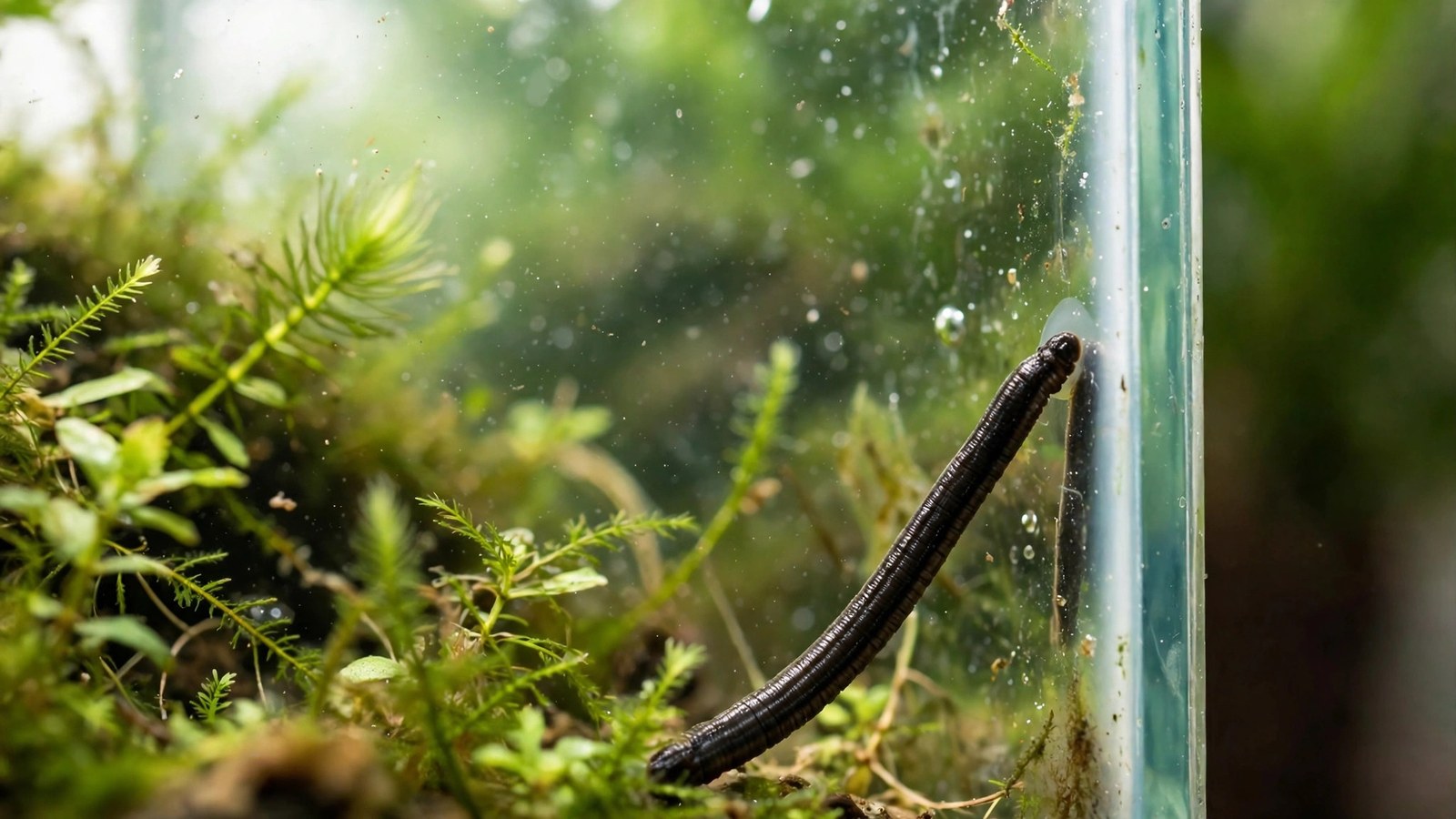
Late one evening you spot a dark inchworm crawling across the glass, moving in a looping stretch nothing else in the tank does. You haven't added livestock in weeks — just plants. It hitched a ride on new plants that skipped a dip and quarantine, and if it's a leech, it needs a plan, not panic. Here's what leeches in aquarium setups really mean, how to separate them from look-alikes, and how to clear them without wiping out your shrimp.
Spotting leeches in aquarium tanks: the 10-second ID
A leech anchors its rear suction disc, stretches its flattened body forward, then pulls the back half up to meet the front. Stretch, pull, stretch, pull: the classic inchworm loop. Tap the glass and many species contract into a tight oval and drop into the substrate — that's why you spot them at lights-out and think they've vanished by morning.
Size confirms it: 5–30 mm, visibly segmented and ribbon-like, usually dark brown, olive, or grey. A recently fed leech may look engorged and reddish. Check the glass just after dark — catching one mid-crawl is the fastest confirmation you'll get.
Leech vs planaria vs detritus worm: the table that settles it
Watch the creature for 60 seconds and match it to this table — treating the wrong one wastes money or kills livestock:
| Feature | Leech | Planaria | Detritus worm |
|---|---|---|---|
| Movement | Loops like an inchworm | Glides smoothly | Wiggles freely |
| Body | Flattened, segmented, rear sucker | Flat, arrow-shaped head, eye spots | Thin white thread, no head |
| Location | Glass, substrate at night | Glass in morning, near food | Water column after water changes |
| Risk | Eggs, shrimplets | Eggs, shrimplets, small snails | None — sign of overfeeding |
If the arrowhead column matches, the planaria removal guide has the right playbook — it's a different animal. Detritus worms mean less food and a substrate vacuum.
Predatory vs blood-feeding: which leech is in your tank?
Predatory leeches — the common plant hitchhikers — eat small invertebrates, fish and snail eggs, and dead matter. They'll harass shrimplets and can clear a spawn overnight, but rarely attach to healthy adult fish.
Blood-feeding leeches are the nastier minority: they attach to fish, feed, and drop off, leaving wounds that invite infection. These arrive on wild-caught or pond-kept fish, not plants. A worm stuck to a fish's flank needs a hospital tank and careful detachment — a different problem from the glass-crawlers this guide covers.
Honest risk: what leeches actually do to your stock
To healthy adult fish, plant-hitchhiker leeches are a low threat — they can't reliably catch active adults. To fish eggs and fry, a real one: a single leech can destroy a spawn in a breeding tank overnight. To shrimp colonies, a moderate threat — adults are usually safe, but shrimplets and molting shrimp get caught. Beyond that, leeches are stress amplifiers: constant harassment weakens stock so other diseases gain a foothold.
If you're still learning the hitchhiker game, the easiest beginner aquarium plants are where most newcomers meet their first stowaways — start with species that quarantine cleanly.
Manual removal: tweezers, slate traps, and baiting
Start here. Manual removal costs nothing, carries zero livestock risk, and for a light infestation it's often the whole solution. After lights-out, scan the glass with a torch and lift each leech with long planting tweezers — pin it against the glass first, since they contract when touched. Work substrate edges and filter intakes too, but never pull a leech off a fish with tweezers; move the fish to a wet net and detach it gently.
Slate traps do the overnight work: sandwich raw prawn between two slate pieces with a 5–8 mm gap and lay it in the tank 1–2 hours after lights-out. Check at dawn, rinse into a bucket, repeat nightly — most light infestations collapse within 5–7 nights. Remove uneaten bait by morning so it doesn't rot and feed the next generation. Still seeing tiny glass-crawlers? Check for freshwater limpets — harmless algae grazers with tiny cone shells.
Chemical treatment: honest invertebrate warnings first
When leeches are deep in the substrate or well established, chemicals come in — but everything that kills leeches kills invertebrates too. Fenbendazole (dog-dewormer powder) is the go-to at roughly 0.1 g per 10 gallons — but treat that as a ceiling, not a floor: start low, observe your livestock for 24 hours, and only work toward the full dose if the tank handles it. It stays active in substrate for weeks, so use it only in tanks you can keep invertebrate-free afterward — never in a breeding shrimp colony.
Copper-based medications also kill leeches, and are equally lethal to shrimp and snails, toxic to scaleless fish at high doses, and persistent in silicone and substrate. Same rule: fish-only tank, start low, observe.
Prevention: plant dips and quarantine that actually work
Every leech arrived the same way: on something you put in. Two layers, twenty minutes, and the problem never reaches your tank. Layer 1 — the alum dip: dissolve 1 tablespoon of alum per gallon of tank-temperature water and soak new plants 2–3 hours (60–90 minutes for delicate species). Alum kills leeches, eggs, and most hitchhikers without bleach's plant damage. Rinse well, then inspect leaf undersides and root crowns — leech egg cocoons look like tiny brownish ovals.
Layer 2 — quarantine: hold new plants in a bare container for 2–4 weeks. Anything that was an egg during the dip hatches by week two and shows up on the walls, where removal is trivial. You'll also spot hitchhikers like pest snails — and if you find a larger ambush predator instead, check the dragonfly nymph guide, because that one eats fish. For the science, skim the University of Florida's pictorial guide to freshwater fish parasites (leeches section).
Frequently Asked Questions
Can leeches kill my fish?
Rarely. Common plant-hitchhiker leeches can't reliably catch healthy adult fish — the real victims are eggs, fry, and shrimplets. A worm attached to a fish's flank is a blood-feeding species, a different and more urgent problem.
How did leeches get into my tank?
Almost always on new plants — adults or egg cocoons glued to leaves and roots. Wild-caught fish and pond equipment are the other routes. Anything wet from another system is a suspect, which is why every new plant gets dipped and quarantined.
Will assassin snails eat leeches?
No — they hunt other snails, not leeches. Loaches may pick off exposed leeches but also eat shrimplets, so they're a blunt instrument. Traps and dips work better.
Is fenbendazole safe for my shrimp?
No. It's lethal to shrimp, snails, and most invertebrates, and persists in substrate for weeks. Use it only in invertebrate-free tanks, start low, and observe livestock for 24 hours before working toward the full dose.
Can I just leave one or two leeches alone?
Don't. What you see is the visible fraction — leeches hide in substrate by day, and a pair can seed a population. In breeding or shrimp tanks, one overlooked leech costs more shrimplets than a week of trapping.
How do I tell a leech from a planaria?
Watch how it moves: a leech loops like an inchworm, a planaria glides smoothly. Planaria also have a triangular arrow-shaped head with eye spots; a leech has a rear suction disc and a clearly segmented body.
The takeaway: trap tonight, dip everything tomorrow
The playbook is short: confirm the ID with the inchworm test, trap manually for a week, and reserve chemicals for fish-only tanks where you accept the invertebrate cost. The habit that pays for itself is the alum dip plus quarantine for every new plant — twenty minutes at the door, and you never fight hitchhikers inside the tank.