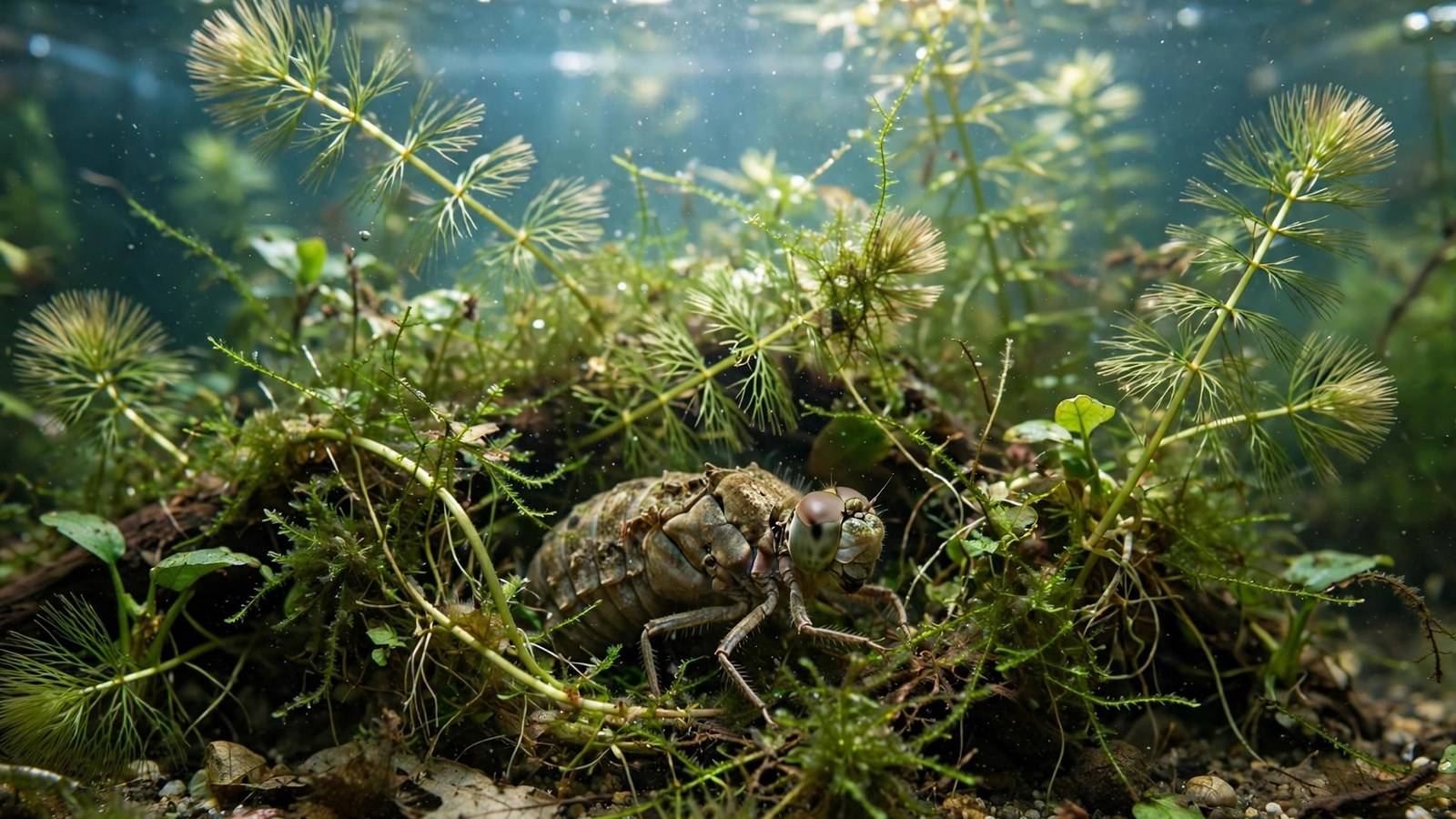
You check the tank before the lights come on and something scuttles behind a leaf — six spindly legs, a flattened olive body, eyes that track you back. Twenty cherry shrimp lived here last week; yesterday you counted fourteen. That twig-thin predator on your anubias is very likely the reason: a dragonfly nymph in aquarium setups is one of the most dangerous hitchhikers you can import on new plants, and it eats shrimp and fry the way a hawk eats sparrows.
That moving twig: how to identify the hunter
Dragonfly and damselfly nymphs both hunt in aquariums and arrive the same way, so learn to tell them apart. A dragonfly nymph is bulkier — a mottled olive-to-brown body 2–4 cm long, a wide triangular head with two enormous compound eyes, and six long legs that make it look like a dead twig come alive. A damselfly nymph is slimmer, usually 1–2 cm, with a narrow head and three feathery tail gills trailing behind it like a tiny plume.
The giveaway for both is the labial mask — a hinged, extendable lower jaw folded under the head that fires forward in a fraction of a second and grabs prey with claw-like palps. Dragonfly nymphs park on a leaf for hours and strike anything within jaw range — roughly their own body length — so a 3 cm nymph can take adult cherry shrimp, endler fry, and newly hatched rasbora fry.
| Feature | Dragonfly nymph | Damselfly nymph |
|---|---|---|
| Body shape | Stocky, flattened, 2–4 cm | Slim, cylindrical, 1–2 cm |
| Tail | No fins | Three feathery external tail gills |
| Threat level | High — shrimplets, fry, small fish | Medium — shrimplets and tiny fry |
Do not confuse them with detritus worms or copepods — those are millimetre-scale and drift passively. If it has six obvious legs and stalks prey, treat it as a predator. Like hydra and planaria, a nymph is an uninvited hitchhiker that arrived on something you added.
How a dragonfly nymph in aquarium water gets in
Dragonfly nymphs do not lay eggs in your tank — the females do, on the plants, before you buy them. Adult dragonflies lay eggs into emersed stems and leaf undersides in ponds and nurseries. Nurseries that grow aquarium plants outdoors harvest those stems with microscopic eggs glued on, and the eggs survive shipping and a brief rinse. One to three weeks after planting, they hatch inside your tank, and the nymphs hunt from day one.
Highest-risk stock is pond-grown or emersed-grown plants sold loose or in bunches. Tissue-culture cups are the only genuinely egg-free source — the plants grow sterile in sealed containers.
If you want a full routine for bringing new plants home safely, this freshwater aquarium plant guide covers the dip-and-quarantine workflow that stops nymphs, snails, and algae spores alike.
What it actually kills (be honest)
A nymph is not a nuisance pest like pest snails — it is a pure carnivore. In a shrimp tank, it takes shrimplets first, then juveniles, then adults up to its own body length. A colony that "mysteriously" stops producing babies while the adults look fine is the classic signature: the adults are breeding, and the nymph is eating the evidence.
In a breeding tank the damage is worse. A single nymph can clear dozens of fry per night — it eats until full, then hunts again an hour later. Guppy, endler, betta, and killifish fry are all vulnerable, and a 3–4 cm nymph will grab nano fish that sleep near its perch. Do not wait to see how bad it gets: the 1 cm nymph you spotted this week is the 3 cm colony-killer next month.
Removing it safely (the shrimp-safe way)
Manual removal is the only method that kills the nymph and nothing else. Copper-based algaecides, fenbendazole at pest doses, and "no-planaria" treatments will kill the nymph — and your shrimp, snails, and biofilter's invertebrate crew along with it. There is no selective poison.
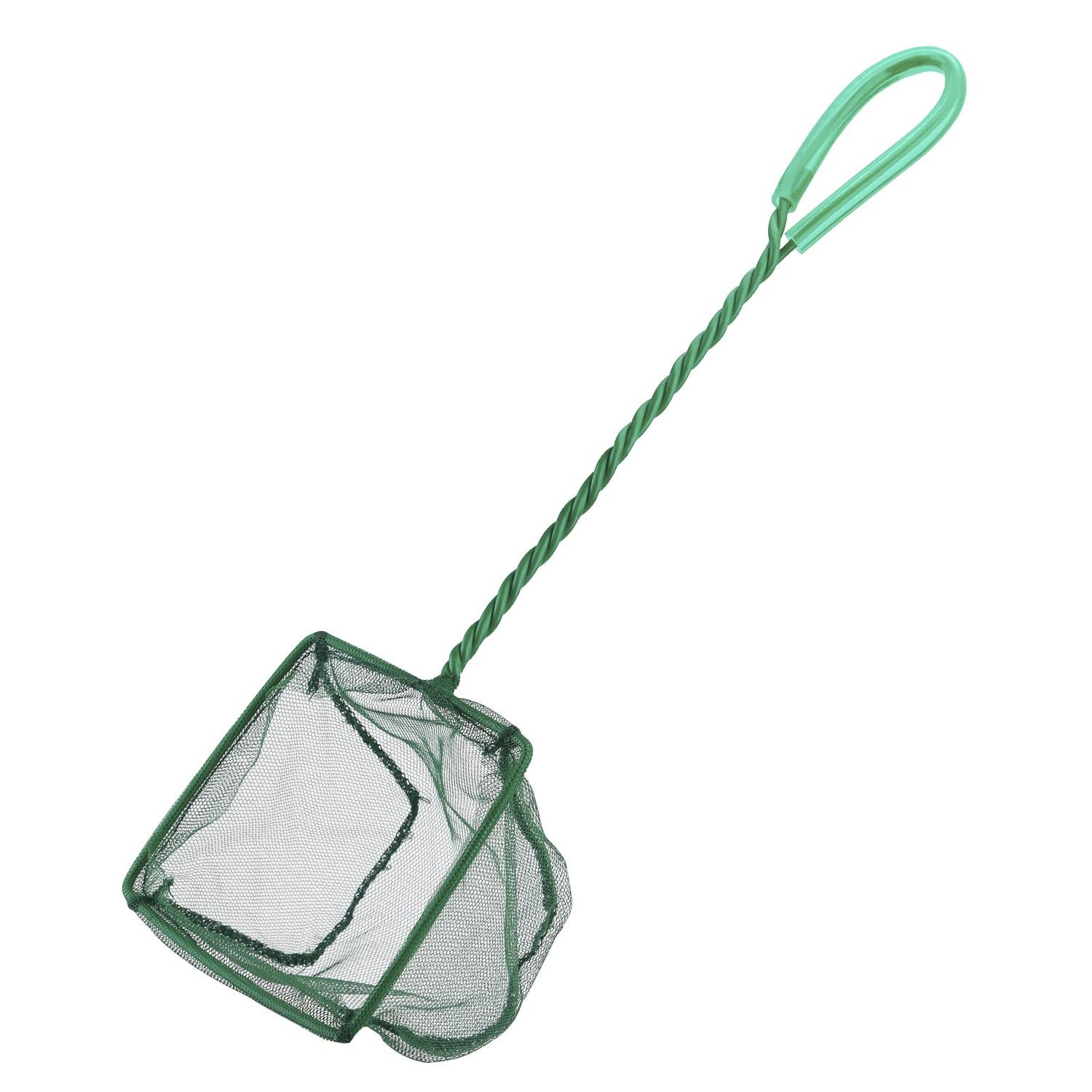
Night netting. Nymphs hunt after lights-out. An hour after lights-off, sweep a fine shrimp net slowly through plant clusters — they freeze in a flashlight beam, so a dim light helps you spot the silhouette. A turkey baster works for nymphs under 1.5 cm.
Plant agitation. By day, nymphs cling to leaf undersides and stem joints. Shake each plant gently while a net waits downstream, and siphon the substrate beneath — dislodged nymphs drop and get caught.
Bottle trap. Cut the top off a plastic bottle, invert it into the body as a funnel, bait it with crushed shrimp pellet, and sink it near the nymph's perch overnight. Check at dawn — nymphs wander in and cannot climb back out. Confirm the ID first: smaller lookalikes like tiny white bugs need different treatment.
Repeat for 5–7 consecutive nights. One visible nymph almost always means more — a single egg clutch hatches several. Stop only after three clean nights in a row.
 ★4.6
Pawfly 4" Aquarium Shrimp Net
Check Price on Amazon ★4.6Keeping them out for good
Prevention is a three-step habit. First, dip every new plant — a 3-minute alum soak (1 tablespoon per gallon) or a potassium permanganate dip per the label, then a thorough rinse. Second, quarantine — hold new plants in a bare bucket under light for 7–10 days; surviving eggs hatch within that window. Third, buy smart — tissue-culture cups first, reputable submersed-grown nurseries second, pond or garden-centre stock only with full dip-and-quarantine discipline.
The same discipline protects every animal in the tank. If you keep sensitive livestock, this aquarium plants for fish tank guide covers the safety angle — plant choice and preparation matter as much to shrimp and fry as water parameters do.
Frequently Asked Questions
Can a dragonfly nymph kill adult shrimp?
Yes. A nymph eats prey up to roughly its own body length, so a 3 cm nymph can take adult cherry shrimp. Shrimplets and juveniles go first, but a large nymph will steadily work through a whole colony.
Will the nymph turn into a dragonfly inside my house?
Eventually it tries. The nymph stage lasts months, and the final instar climbs out of the water to emerge as a winged adult — usually at night. The adult cannot survive indoors, but the nymph's hunting does the real damage long before emergence.
Are damselfly nymphs as dangerous as dragonfly nymphs?
Less, but not harmless. Damselfly nymphs are smaller (1–2 cm) and mostly take shrimplets, newborn fry, and microfauna. But they arrive and hide the same way, and a tank full of them will still strip a shrimp colony of its babies.
Can I dip plants to kill nymph eggs?
Dips help but are not guaranteed. An alum soak (1 tablespoon per gallon, 3 minutes) kills exposed eggs, but eggs tucked into stem joints can survive. Pair every dip with a 7–10 day quarantine so any survivors hatch where you can see them.
Will my fish eat the nymph for me?
Only larger fish. Gouramis, angelfish, and adult barbs eat small nymphs on sight — which is why nymphs are rare in community tanks and common in shrimp-only and breeding tanks, where nothing hunts them back.
Your tank can stay predator-free
Finding a dragonfly nymph in your aquarium feels like a betrayal — you bought plants, not a predator. Now you know the playbook: spot the hunter by its hinged jaw, pull it out with a net and baster over a week of night sweeps, and make dips plus quarantine the price of admission for every new plant. For macro photos of wild nymphs, see the BugGuide dragonfly nymph guide and iNaturalist's Odonata observations.